
Artists: Theory and Thinking is a mandatory section of focus within Content Area 3 (Today's World) of Leaving Certificate Art, assessed in the 30% written examination. While traditional art history concentrated primarily on what was made and how it was made, this section investigates why artists create work, how they develop their ideas, and what happens to an artwork once it enters the wider world. Grounded in the senior-cycle Visual Studies Framework, it traces how the artist's role developed from an apprentice fulfilling contractual commissions into an autonomous thinker, social commentator, and conceptual researcher. Today's World is interconnected with Europe and the Wider World (Content Area 1) and Ireland and its Place in the Wider World (Content Area 2), meaning comparisons with historical workshop practices or patrons will enrich your contemporary answers.
The Core Enquiry: Why, How, and What Happens Next
Visual Studies investigates visual culture across past and contemporary societies through three framing questions: What was created? How was it created? Why was it created? In this section of focus, most of your attention goes on the third question: why was it created? That is the artist's rationale.
An artist's rationale is the intellectual, emotional, or social justification behind their creative decisions. In everyday practice, an artist rarely works in complete isolation. Their rationale is shaped by four practical considerations:
- Audience: Who is the work intended for? Is it aimed at gallery visitors, passers-by on a public street, or an online community?
- Patron: Who commissioned or funded the piece? A patron can be a private collector, a commercial brand, or a public body like the Arts Council or a local county council.
- Space: Where is the work physically encountered? A white-walled gallery creates quiet, focused contemplation, whereas a busy railway concourse requires bold scale and immediate visual impact.
- Location: Does the geographic, historical, or environmental site complete the meaning of the work? Moving a site-specific installation elsewhere changes or destroys its context.
Understanding professional rationale directly informs your practical coursework workbook. When you write your own artist's statement, you explain what you made, how you made it, and the conceptual motivation behind your choices.
The Evolution of the Artist's Role
The social status and creative autonomy of artists have transformed across Western history in four key stages:
Guild Apprenticeships
During the Middle Ages and early Renaissance, artists trained through a formal apprenticeship system. Operating within strict trade guilds, they worked to order, fulfilling contracts for religious institutions, monarchies, and wealthy merchants according to fixed iconographic rules. The painter or sculptor was valued primarily as an expert craftsman rather than an independent visionary.
The Academic Professional
From the sixteenth and seventeenth centuries onward, state-backed Academies gradually took over the training and regulation of artists from the guilds. The French Académie royale was founded in 1648 and the Royal Academy in London in 1768. Academies elevated art into an intellectual profession, establishing rigid hierarchies of genre (placing history painting at the top) and controlling public taste through juried annual exhibitions.
The Modern Avant-Garde
In the late nineteenth and early twentieth centuries, artists broke away from academic salons. Modernists asserted that subjective feeling, personal colour, and expressive mark-making mattered far more than academic finish. Vincent van Gogh, for instance, used colour symbolically rather than naturalistically to communicate psychological tension.
The Conceptual Turn
In contemporary art, the maker is no longer bound by traditional craft skills or narrow media disciplines. While many contemporary Irish sculptors like Rowan Gillespie (cast bronze) and Michael Quane (carved stone) continue to master demanding physical materials, manual virtuosity is no longer mandatory for an artwork to hold merit. The artist acts as an independent researcher, philosopher, and social critic.
Identity, Self-Expression, and Giving Voice
Art allows practitioners to explore personal identity and give visibility to shared cultural experience. In Visual Studies, identity is analysed across distinct lenses:
Personal and Psychological Identity
Artists use visual language to externalise internal emotional states. Vincent van Gogh used thick impasto mark-making and swirling rhythms to convey mental turmoil and spiritual longing, turning his personal crises into direct visual testimony.
Cultural and Gender Identity
Mexican painter Frida Kahlo explored the physical trauma of illness and her mixed cultural heritage. In The Two Fridas (1939), she wears Victorian white lace beside traditional Tehuana dress, reflecting the tension between her European and Mexican roots.
Giving Voice to Communities: Contemporary Irish Examples
Contemporary Irish art frequently confronts shared memory, social issues, and contested history:
- Joe Caslin: Caslin creates monumental, temporary drawings in pencil and charcoal, which are printed onto paper and pasted onto building exteriors using biodegradable wheat paste. His series Our Nation's Sons (2014 onwards) addressed young male mental health and suicide by placing enormous portraits of local young men on civic walls. In 2015, his multi-storey mural of an embracing same-sex couple on South Great George's Street in Dublin gave urgent visibility to the marriage equality campaign. Because the work gradually weathers and disappears, the impermanence mirrors the vulnerability of his subjects.
- Rowan Gillespie: His public bronze monument Famine (1997) features six slightly over life-size, emaciated figures and a dog walking along Custom House Quay in Dublin. Commissioned by Norma Smurfit to mark the 150th anniversary of the Great Famine, Gillespie cast the bronzes himself at his own foundry. The thin, dragging forms give tangible presence to human grief.
- Willie Doherty: In Northern Ireland, Doherty uses lens-based media such as video installations and photography (The Only Good One is a Dead One, 1993) to explore the atmosphere of surveillance, border checkpoints, and the psychological trauma of the Troubles.
- Alice Maher: Maher investigates female identity, folklore, and myth through unorthodox materials such as hair, thorns, and bee bodies, challenging established sculptural traditions.
How Artists Work: Series, Collaboration, Delegated Making, and Residencies
A finished artwork is only the final stage of a sustained enquiry. Looking at an artist's working habits reveals their problem-solving and conceptual focus:
Working in a Series
Artists rarely produce isolated images. Instead, they produce a series based on a single motif, landscape, or personal portrait. By keeping certain elements constant, the artist can test variables such as lighting, scale, or colour harmony across dozens of studies. This sustained investigation is what examiners look for in your own coursework workbook.
Collaboration and Delegated Making
Much contemporary practice is collaborative, involving fabricators, foundry technicians, architects, or local community groups. In Conceptual Art, the artist often delegates the manual execution entirely. For example, Sol LeWitt provided written diagrams and mathematical instructions for his wall drawings, which gallery assistants executed on site. LeWitt argued that the concept was the artwork, meaning his own physical touch was unnecessary. By contrast, Rowan Gillespie models, casts, and patinates his own bronzes in his foundry, making physical labour integral to the sculpture's meaning.
Sketchbooks and Digital Archives
Sketchbooks contain primary source studies, material tests, and written reflections. Major galleries now digitise artists' sketchpads:
- Advantage of digital viewing: Anyone, anywhere, can study rare and fragile pages without the original being handled, so the sketchbook is both more accessible and better preserved.
- Disadvantage of digital viewing: Digital viewing flattens the page, losing the physical scale, paper texture, paper weight, and the varying pressure of charcoal, graphite, or watercolour washes.
Artist Residencies
An artist residency grants dedicated studio space, time, and financial support, often in a fresh geographical setting. It allows an artist to step away from commercial obligations, experiment with new subject matter, build professional networks with curators, and strengthen their CV for future competitive awards.
Conceptual Art: The Primacy of the Idea
In the 1960s, Conceptual Art established the principle that the idea or proposition behind an artwork is far more important than the physical craft object. The movement grew out of Marcel Duchamp's early twentieth-century Dada readymade sculptures, such as Fountain (1917), which demonstrated that an artist's intellectual choice and context could transform an ordinary manufactured object into art.
In his 1967 essay Paragraphs on Conceptual Art, American artist Sol LeWitt wrote that 'the idea becomes a machine that makes the art.' All planning and decisions are made beforehand; execution is merely a mechanical carry-out.
Joseph Kosuth examined this principle in One and Three Chairs (1965). The installation presents three representations of a chair together: a manufactured wooden folding chair, a full-size black-and-white photograph of that same chair taken where it stands in the gallery, and an enlarged photostat of a dictionary definition of the word 'chair'.
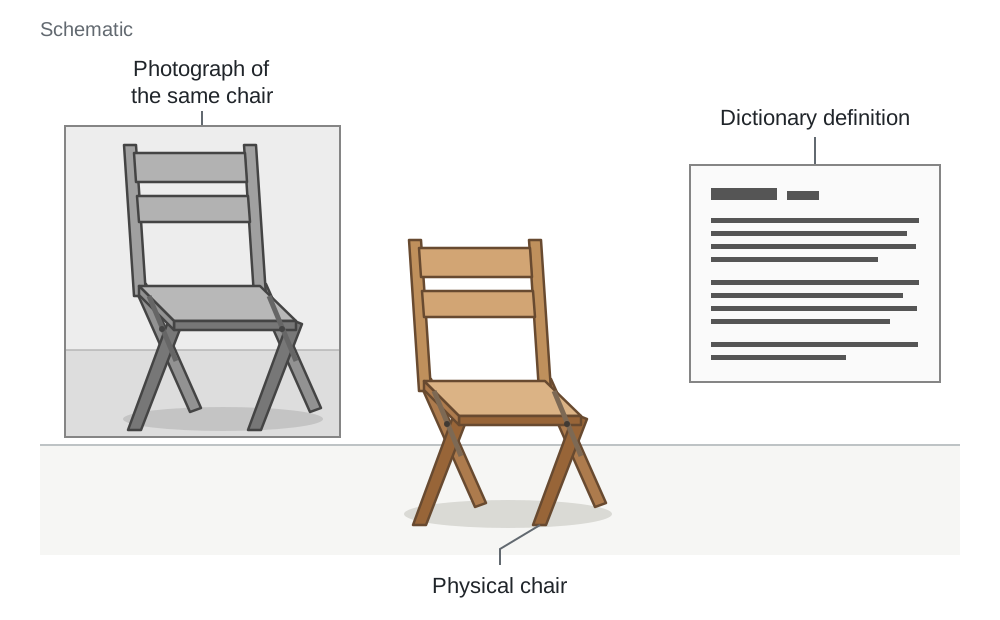
Kosuth asks where the actual concept of 'chair' resides. Is it in the functional timber object, the optical photograph, or the written linguistic definition? Kosuth argues that none of the three is the chair itself, and that the artwork is therefore the proposition rather than any of the physical items on display.
Funding, Display, and Writing About an In-Person Visit
Understanding an artwork requires knowing how it is funded, how it is displayed, and how it is experienced in real life.
Modern Patrons and Funding Bodies in Ireland
Today's artists are supported by public and institutional structures rather than medieval guilds:
- The Arts Council / An Chomhairle Ealaíon: The primary state agency providing competitive project awards, travel bursaries, and core operational funding to arts centres.
- The Per Cent for Art Scheme: A government initiative where up to 1% of the capital cost of a publicly funded building or infrastructural project is ring-fenced to commission an original artwork. It is a major funding route for publicly commissioned art in Ireland, which is one reason so much public art is site-specific. Other works are privately commissioned or donated — Gillespie's Famine, for example.
- Local Authority Arts Offices: City and county councils fund residencies, community arts initiatives, and local galleries.
- Aosdána: An association of Irish artists, writers, and musicians; eligible members receive an annual state stipend called a cnuas to support full-time creative work.
- Open-Submission Exhibitions: Events like the Royal Hibernian Academy (RHA) Annual Exhibition allow unrepresented artists to submit work for jury selection alongside established Academicians.
Experiencing Art in Person
The syllabus requires you to experience visual studies in person. When writing about an exhibition, gallery, or studio visit in your exam, cover these five details:
- Venue and Exhibition: State the gallery and exhibition title clearly (such as IMMA, Kilmainham; the Hugh Lane Gallery, Dublin; the Crawford Art Gallery, Cork; the Glucksman, Cork; or The Model, Sligo).
- Named Artwork: Identify one specific work, noting its medium and scale (for example, 'a monumental charcoal and wheat-paste drawing roughly four metres high').
- Display and Space: Describe the lighting (diffuse natural daylight versus focused spotlights), wall colour, ceiling height, and how the surrounding floor space dictated movement.
- Insight into Rationale: Note what the physical encounter revealed that a digital reproduction could not—such as heavy paint texture, the smell of materials, surface reflection, or architectural scale.
- Spatial Comparison: Explain how the work's meaning would alter if moved into a different setting, such as from an isolated white cube gallery to an open street corner.
Key terms
- Rationale
- The reasoned justification an artist provides for their choices of concept, subject matter, materials, scale, site, and intended audience.
- Artist's Statement
- A concise written statement by an artist explaining what they created, how it was made, and the conceptual rationale underpinning their practical decisions.
- Site-Specific Art
- Artwork conceived and fabricated exclusively for a designated location, where the surrounding architectural, physical, or historical context completes the work's meaning.
- Commission
- A formal contract under which an artist is hired and funded by a client, institution, or patron to create a specific artwork according to agreed criteria.
- Per Cent for Art Scheme
- An Irish government scheme allocating a percentage of capital funding from public building and infrastructure developments toward commissioning new, site-specific art.
- Recognised Artist
- An artist meeting at least three syllabus criteria: canon prominence, solo/group exhibitions, public collection holdings, institutional commissions, peer acclaim, or accredited body membership.
- Conceptual Art
- An art movement emerging in the 1960s where the underlying idea, plan, or proposition is the primary artwork, making manual physical execution secondary.
- Readymade
- A manufactured, mass-produced object selected, modified slightly or unmodified, and displayed as an artwork, shifting focus from craft to conceptual context.
- Apprenticeship
- The historical guild training system where a student bound themselves to a master craftsman for years to master techniques before achieving independent trade status.
- Academy
- A state-sanctioned institution established from the 16th and 17th centuries to regulate artistic training, formalise aesthetic rules, and control public exhibitions.
- Artist Residency
- A structured programme granting an artist dedicated studio space, living quarters, and financial bursaries to develop new work away from daily commercial pressures.
- Curation
- The purposeful selection, physical arrangement, lighting, and thematic contextualisation of artworks within an exhibition space to communicate meaning to visitors.
Check yourself
What three core questions structure the enquiry in Leaving Certificate Visual Studies?
What was created? How was it created? Why was it created?
Name an exhibition, gallery, or artist's studio you have visited. Describe one work you saw and explain how the space in which it was displayed affected your reading of it.
At the Hugh Lane Gallery in Dublin, seeing Francis Bacon's reconstructed studio through glass walls revealed thousands of torn photographs, paint tins, and slashed canvases piled across the floor. The chaotic, enclosed space demonstrated that the room itself was his primary source, showing that his distorted figurative paintings developed directly out of accumulated visual fragments.
Why might an artist accept a public commission rather than sell through a commercial gallery? Give two reasons.
First, a public commission allows the work to engage a broad, everyday community without admission charges or commercial gatekeeping. Second, public commissions through schemes like the Per Cent for Art Scheme provide substantial, guaranteed funding to produce ambitious, large-scale, site-specific work.
Name a recognised Irish artist working today, name one of their works, and state their rationale in one sentence.
Joe Caslin created 'Our Nation's Sons' (2014 onwards) to challenge the stigma around young men's mental health by pasting monumental, temporary charcoal portraits directly onto prominent civic buildings.
What core principle did Sol LeWitt introduce in his 1967 essay 'Paragraphs on Conceptual Art'?
He asserted that the idea or concept is the most important part of the artwork, functioning as a machine that makes the art, meaning physical manual execution is secondary to planning.
State one advantage and one disadvantage of viewing an artist's sketchbook on a digital platform.
An advantage is universal access to fragile manuscripts without causing physical wear; a disadvantage is the loss of physical scale, paper texture, paper weight, and pencil mark pressure.
How does Rowan Gillespie's 'Famine' demonstrate site-specificity?
It stands on Dublin's Custom House Quay, the exact dockside where starving emigrants boarded ships during the 1840s, meaning the historical location completes the emotional meaning of the bronze figures.
What are three sentences that should be included in an effective artist's statement?
A sentence explaining what was created (the subject and medium), a sentence explaining how it was created (the process and technique), and a sentence explaining why it was created (the personal or conceptual rationale).