
Reading texts about places of interest tests your ability to extract practical facts from tourist leaflets, websites, tickets, and public notices. In the Junior Cycle exam, you will scan short Spanish texts for locations, opening hours, admission prices, and visitor rules.
Reading Strategy and Landmark Vocabulary
Read the title and text once to get the main message, then scan for specific details. Tourist notices usually provide practical information about visiting a sight.
Comprehension questions ask for specific details using standard question words:
- ¿Dónde…?: Where (location or building)
- ¿Cuándo…?: When (day, month, or date)
- ¿A qué hora…?: At what time (opening time or event schedule)
- ¿Cuánto cuesta…?: How much does it cost (price or admission fee)
- ¿Qué se puede hacer…?: What you can do there / what activities are available
Useful words for places and landmarks:
- el museo: museum
- el ayuntamiento: town hall
- la plaza mayor: main square
- el castillo / el palacio: castle / palace
- la catedral / la iglesia: cathedral / church
- el puerto / la playa: port / beach
- situado/a en / se encuentra en: is located in (e.g. el castillo está situado en el centro)
- es famoso/a por...: is famous for...
Dates, Times, and Opening Hours
Exam texts frequently state when an attraction opens or when an event takes place.
- Los días de la semana: lunes (Monday), martes (Tuesday), miércoles (Wednesday), jueves (Thursday), viernes (Friday), sábado (Saturday), domingo (Sunday).
- Dates: usually written as day + date, e.g. el jueves, 23 de junio (Thursday 23rd June).
- Times of day: notices often write times with words rather than digits, e.g. a las diez de la mañana (at 10:00 am), de la tarde (in the afternoon), de la noche (at night).
Key schedule vocabulary:
- el horario: timetable / opening hours
- abierto / cerrado: open / closed (e.g. cerrado los lunes = closed on Mondays)
- los días festivos: public holidays / bank holidays
Admission Prices, Discounts, and Rules
Ticket offices and public boards use set phrases to show fees and visitor conditions.
- la taquilla: ticket desk / box office
- la entrada: entrance ticket or physical doorway
- gratis / gratuito: free of charge
- menores de doce años: children under twelve (excludes twelve-year-olds)
Spanish prices place the euro symbol after the figure and use a comma for decimals: 6,50 € means €6.50.
Notices also list visitor restrictions:
- Está prohibido + infinitive (the basic verb form): Está prohibido comer = Eating is forbidden.
- no se permite: it is not permitted
- la salida: exit (éxito is a false friend meaning success)
- Solo means only; hasta means until or up to. Check which detail each word limits.
Locating Places and Directional Phrases
When the text gives a position relative to another place, include that relationship: 'beside the cathedral'.
- enfrente de: opposite / facing
- al lado de: beside / next to
- cerca de / lejos de: near to / far from
- a la derecha / a la izquierda: on the right / on the left
- todo recto: straight ahead
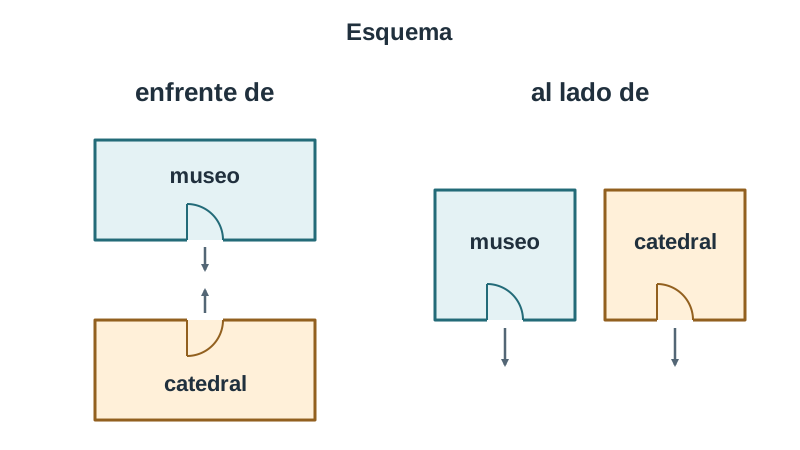
Remember: a + el becomes al (al norte del museo), and de + el becomes del (cerca del castillo).
Use en el norte de for an unambiguous 'in the north of'. Al norte de can also mean 'north of'; read the whole location phrase.
Key terms
- el horario
- The opening hours or operating timetable of an attraction or service.
- el museo
- A museum displaying historical, artistic, or cultural objects.
- el ayuntamiento
- The town hall or municipal council building.
- la taquilla
- The ticket office or counter where admission tickets are bought.
- la entrada
- An admission ticket or the physical entrance of a building.
- gratis / gratuito
- Free of charge, requiring no admission payment.
- enfrente de
- A prepositional phrase meaning opposite or facing across from a place.
- está prohibido
- It is forbidden or not allowed, followed by an infinitive verb.
Check yourself
What does 'el ayuntamiento' mean in English?
The town hall.
Translate the location phrase 'enfrente del museo'.
Opposite the museum.
If a sign says 'Cerrado los martes', on which day is the attraction closed?
Tuesdays.
Translate the time phrase 'a las diez de la noche'.
At ten at night (10:00 pm).