
Reading comprehension in Junior Cycle Spanish requires finding factual information in texts about countries, regions, and towns. In the examination, you will read short travel guides, brochures, notices, or profiles and answer questions in either English or Spanish as instructed.
Compass Points, Borders, and Directions
Texts show location using compass points and estar or está situado/a (is situated).
| Spanish | English | Spanish | English |
|---|---|---|---|
| el norte | the north | el sur | the south |
| el este | the east | el oeste | the west |
| el noroeste | the northwest | el sureste | the southeast |
| el centro | the centre | en la costa | on the coast |
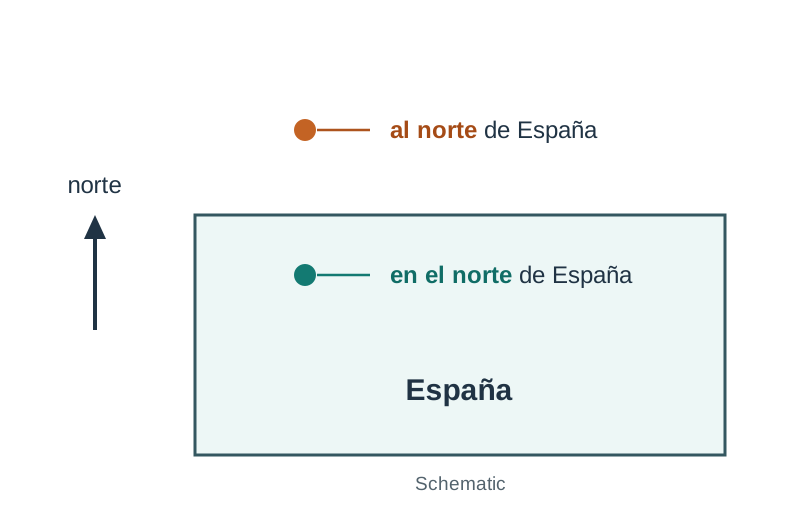
Prepositions matter. En el norte de España means in northern Spain, while al norte de España means to the north of Spain. Use context to confirm whether a place is inside or outside a border. The phrase limitar con means to border.
For directions, look for: gira a la derecha (turn right), gira a la izquierda (turn left), and sigue todo recto (continue straight ahead).
Types of Places, Landmarks, and Public Signs
Texts distinguish un país (country), una región (region), una ciudad (city), and el pueblo (town or village). Capital pattern: La capital de España es Madrid.
Key landmarks include el ayuntamiento (town hall), la plaza mayor (main square), la catedral (cathedral), and el castillo (castle). Common position phrases include delante de (in front of) and enfrente de (opposite/facing).
Common public notices include:
- entrada (entrance) and salida (exit)
- abierto (open) and cerrado (closed)
- está prohibido (it is forbidden)
Compare descriptions with your own locality, noticing features like an old quarter (el casco antiguo) or central square.
Demographics, Weather, and Festivals
Place descriptions may give population figures, weather, and local events.
- Los habitantes means inhabitants (25.000 means 25,000).
- Hace sol means sunny; llueve means it rains.
- Es famoso/a por means famous for; se puede visitar means you can visit.
- Dates usually follow el (el 5 de mayo); clock times usually follow a las (a las tres).
Exam Question Cues and Reading Strategy
With a tourist leaflet or web page, identify its main message, then find the details requested.
| Question Cue | Meaning | What to Look For |
|---|---|---|
| ¿Dónde…? | Where? | Location, compass point, or landmark |
| ¿Cómo es…? | What is it like? | Describing word (tranquilo, moderno, histórico) |
| ¿Cuántos/as…? | How many? | Number, quantity, or population |
| ¿Cuándo…? | When? | Day, month, or date |
| ¿A qué hora…? | At what time? | Time phrase (a las...) |
| ¿Por qué…? | Why? | Reason, often introduced by porque or por |
Scan for question keywords before writing your answer.
Key terms
- los habitantes
- Inhabitants or residents.
- la capital
- The capital city.
- el ayuntamiento
- The town hall.
- la plaza mayor
- The main town square.
- el pueblo
- A town or village.
- limitar con
- To border on.
- enfrente de
- Opposite or facing.
Check yourself
What is the English meaning of 'Gira a la izquierda y sigue todo recto'?
Turn left and continue straight ahead.
Translate into English: 'El ayuntamiento está enfrente de la catedral.'
The town hall is opposite the cathedral.
What does a text mean if it reports a town has '50.000 habitantes'?
It has 50,000 inhabitants (residents).
What information should you find when an exam asks '¿A qué hora empieza el festival?'
The time the festival starts (look for 'a las' plus a time).