
The circulatory system consists of your heart, blood vessels, and blood, working continuously to deliver oxygen and nutrients while carrying away metabolic wastes. Junior Cycle questions test vessel structures and pressure, the path of blood through the heart, exchanges with the digestive and respiratory systems, and how exercise or lifestyle affects pulse rate.
Composition and Functions of Blood
Blood is a liquid tissue made up of cells suspended in a watery fluid called plasma.
- Plasma: Straw-coloured liquid that carries blood cells, dissolved nutrients (glucose), carbon dioxide, urea, and heat.
- Red blood cells: Disc-shaped cells containing haemoglobin, an iron-rich protein that binds oxygen in the lungs and delivers it to body cells.
- White blood cells: Defend the body against infection by destroying pathogens.
- Platelets: Tiny cell fragments that clot blood at cuts to stop bleeding and block out microbes.
Blood Vessels: Structure and Function
Blood travels through three distinct types of blood vessels, each built for a particular pressure.
| Vessel | Direction | Wall Structure | Internal Pressure | Valves Present? |
|---|---|---|---|---|
| Artery | Away from heart | Thick, muscular, and elastic | High | No |
| Vein | Towards heart | Thinner wall, wide lumen | Low | Yes |
| Capillary | Links arteries to veins | Microscopic, one cell thick | Low | No |
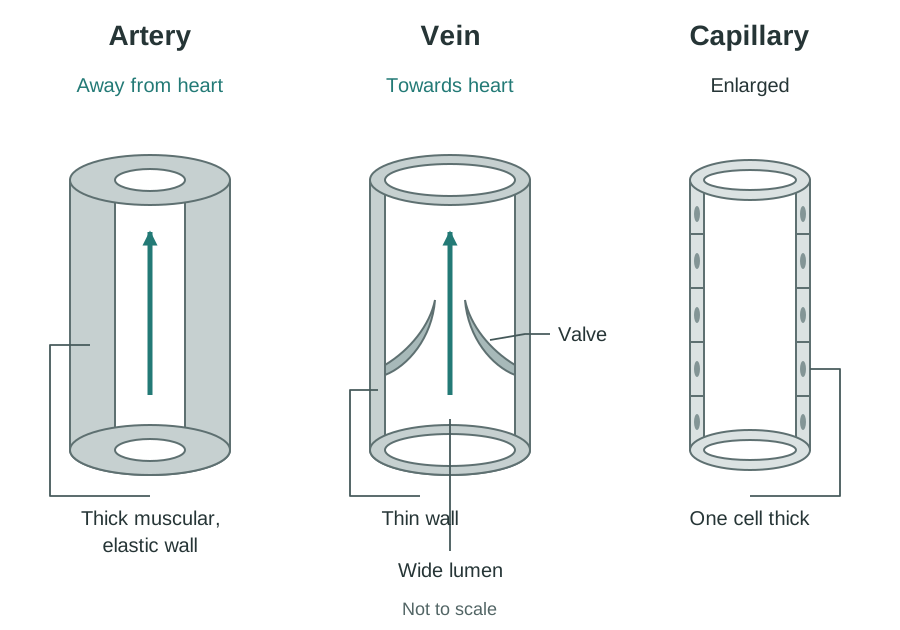
Capillary walls are only one cell thick, which allows rapid diffusion of oxygen, glucose, and wastes between the bloodstream and nearby tissues.
The Heart and Double Circulation
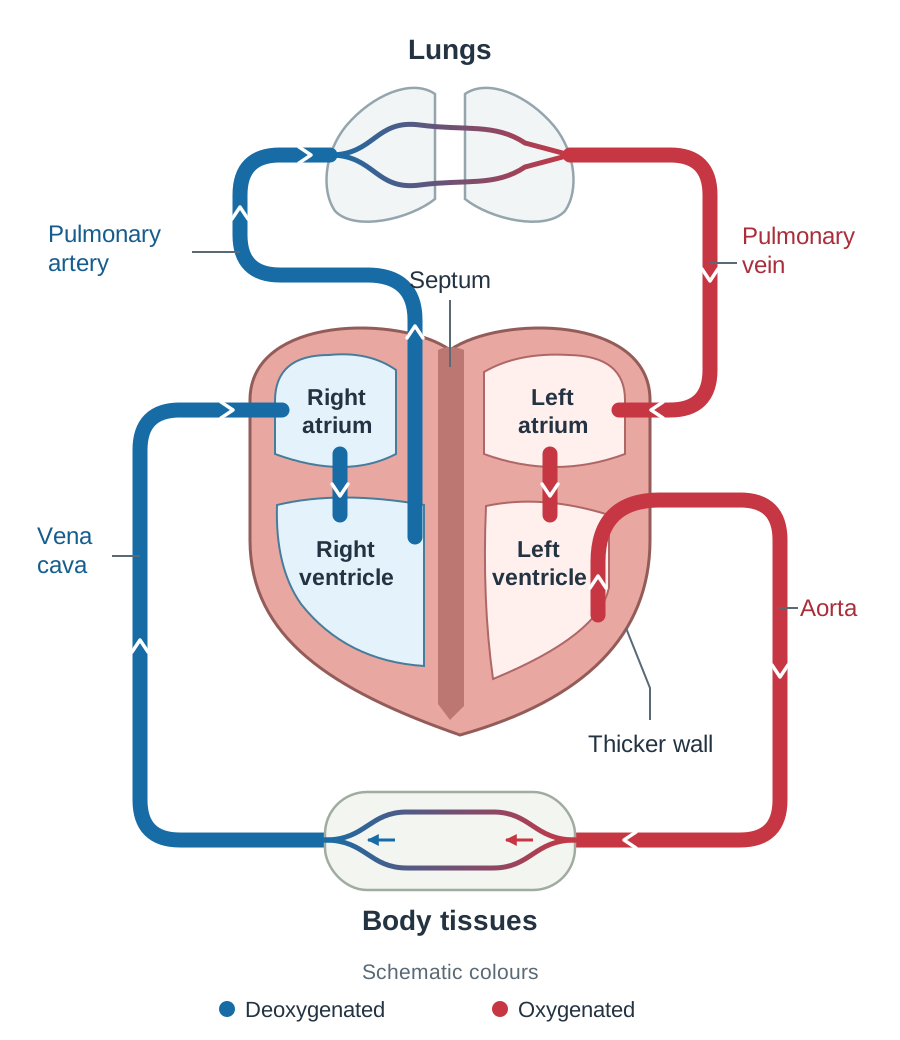
The heart is an organ made of cardiac muscle, which contracts non-stop without tiring. Humans have a double circulation system: blood passes through the heart twice on one complete circuit of the body.
- The septum is a thick muscle wall dividing the right side from the left side.
- The right side collects deoxygenated blood from the body and pumps it to the lungs.
- The left side receives oxygenated blood from the lungs and pumps it to the rest of the body.
- Complete route: Vena cava → right atrium → right ventricle → pulmonary artery → lungs → pulmonary vein → left atrium → left ventricle → aorta → body cells.
- The left ventricle has a far thicker muscular wall than the right ventricle because it must force blood under high pressure around the entire body.
System Interactions, Exercise, and Health
The circulatory system works alongside other organ systems to supply cells with raw materials for respiration:
- Lungs: Blood takes in oxygen and releases carbon dioxide to be breathed out.
- Small intestine: Blood absorbs glucose and other digested food from food breakdown.
- Kidneys: Blood unloads waste urea and extra water for excretion in urine.
- Exercise: Working muscles demand more energy, so pulse rate speeds up to circulate glucose and oxygen faster.
- Lifestyle factors: Regular aerobic exercise strengthens cardiac muscle and lowers resting heart rate. Smoking raises resting pulse and damages artery walls. A diet high in saturated fat can cause fatty deposits to build up in arteries, increasing the risk of a heart attack.
Key terms
- Circulatory system
- The organ system made up of the heart, blood vessels, and blood that moves materials through the body.
- Cardiac muscle
- Specialised heart muscle that contracts rhythmically throughout life without fatiguing.
- Artery
- A thick, elastic blood vessel that carries blood away from the heart under high pressure.
- Vein
- A thin-walled blood vessel with valves that carries blood back toward the heart under low pressure.
- Capillary
- A tiny blood vessel with walls just one cell thick, where gases and nutrients swap between blood and cells.
- Haemoglobin
- The iron-containing protein inside red blood cells that transports oxygen.
- Double circulation
- A circulatory layout where blood travels through the heart twice during each complete body circuit.
- Pulse
- The wave of pressure felt along an artery each time the left ventricle pumps blood.
Check yourself
Why are capillary walls only one cell thick?
To provide a short distance so gases and nutrients can diffuse quickly between blood and body cells.
Which chamber of the heart pumps oxygenated blood directly into the aorta?
The left ventricle.
Which component of blood stops wounds from bleeding?
Platelets.
Name one lifestyle choice that tends to increase a person's resting pulse rate over time.
Cigarette smoking or an inactive lifestyle.