
Ecology is the study of how living organisms interact with one another and their environment. The Junior Cycle exam focuses on habitat sampling methods, food chains and webs, energy flow versus matter cycling, adaptations, and practical ways humans conserve biodiversity.
Habitats, Communities, and Environmental Factors
A habitat is the specific place where an organism lives and finds food, shelter, and breeding conditions. All individuals of one species in a habitat form a population, while all the different populations interacting there make up a community.
An ecosystem consists of this living community together with its non-living environment.
Environmental conditions determine which organisms survive in an ecosystem:
- Abiotic factors are non-living physical and chemical influences, such as light intensity, air temperature, soil temperature, and soil pH.
- Biotic factors are living influences, such as food supply, predators, competitors, and disease.
Feeding Relationships, Energy Flow, and Matter
Energy enters ecosystems from the Sun. Green plants are producers that make chemical food through photosynthesis. Animals are consumers that obtain energy by feeding on other living things. A food web links several food chains together, showing how feeding relationships connect in a habitat.
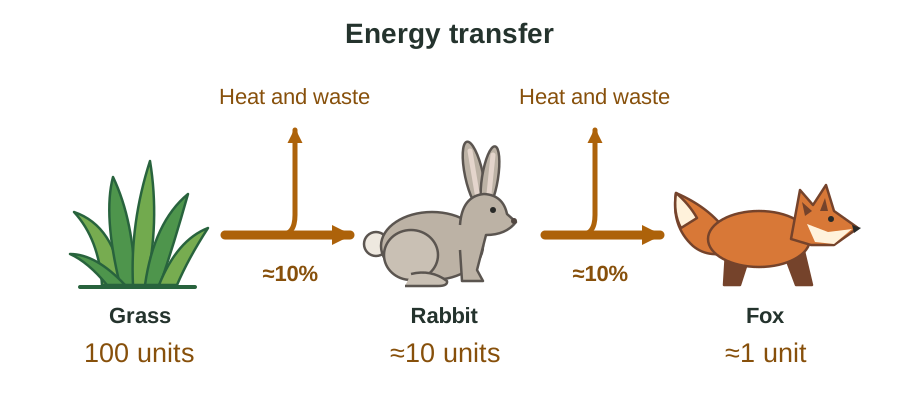
Food chain arrows point from the organism being eaten into the organism eating it, showing the direction of energy flow.
- About 10% of the energy passes on to the next feeding level. The rest is lost as heat, in waste, and in movement. For example, 100 units of energy in grass gives about 10 units in a rabbit and 1 unit in a fox.
- If a predator is removed from a food web, the number of its prey increases because fewer are eaten. If a producer dies out, populations above it decrease due to food loss.
- While energy flows one way, matter cycles continuously. Decomposers (such as bacteria, fungi, woodlice, and earthworms) break down dead plants and animals, returning minerals to the soil.
Adaptation, Competition, and Interdependence
An adaptation is an inherited feature that helps an organism survive and reproduce in its habitat.
- Buttercups have bright yellow petals to attract insect pollinators.
- Limpets have a muscular foot to anchor firmly to wave-swept rocks.
- Rose bushes have sharp thorns to deter herbivores from eating their stems.
Natural selection drives adaptation over generations. Members of a species are slightly different from each other; individuals with the most useful features survive, breed, and pass those traits on.
Competition occurs when organisms struggle for scarce resources. Plants compete for light, water, space, and soil minerals. Animals compete for food, shelter, territory, and mates. Different species also compete with each other: grey squirrels, introduced to Ireland, outcompete native red squirrels for food.
Interdependence means two or more species rely on each other for survival, such as bees gathering food while pollinating flowers.
Fieldwork and Habitat Sampling Methods
Habitat studies use specific sampling tools to measure populations and observe species:
- Using a quadrat (a square frame of known area): Place or throw the quadrat randomly in the habitat so the sample is unbiased. Count the target organisms inside, or record their presence. Repeat at least ten times in different random spots to calculate an average.
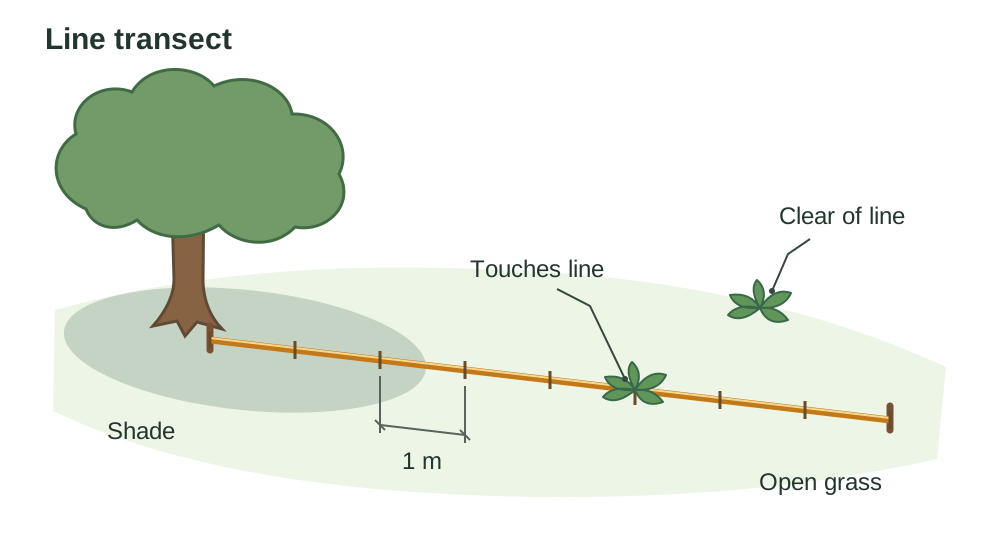
- A line transect is a tape or string laid across a habitat to record species touching it at regular intervals (such as every 1 m). Transects show changes in species distribution along a gradient, such as moving from a tree canopy out into open grass.
- An identification key names an unknown organism through paired questions about visible features (for example: has legs → go to 2; no legs → go to 3).
| Apparatus | Use in Habitat Study |
|---|---|
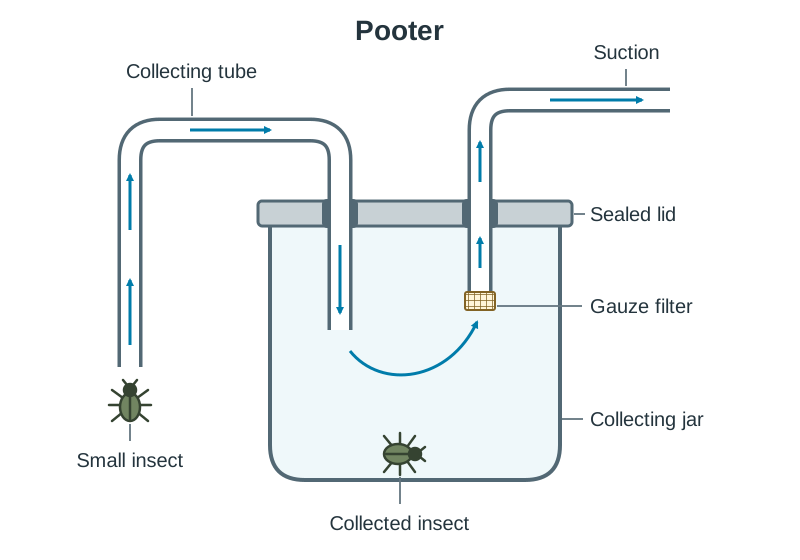
| Pooter | Collects small insects using gentle suction through a tube; a gauze filter prevents swallowing them. |
| Pitfall trap | Catches crawling ground invertebrates in a sunken jar; rest a stone on small stones above it to keep rain out. |
| Beating tray | Catches insects dislodged when shrub branches are gently tapped over a white sheet. |
| Sensors / Probes | Record light intensity, soil temperature, and soil pH; wash the probe between readings. |
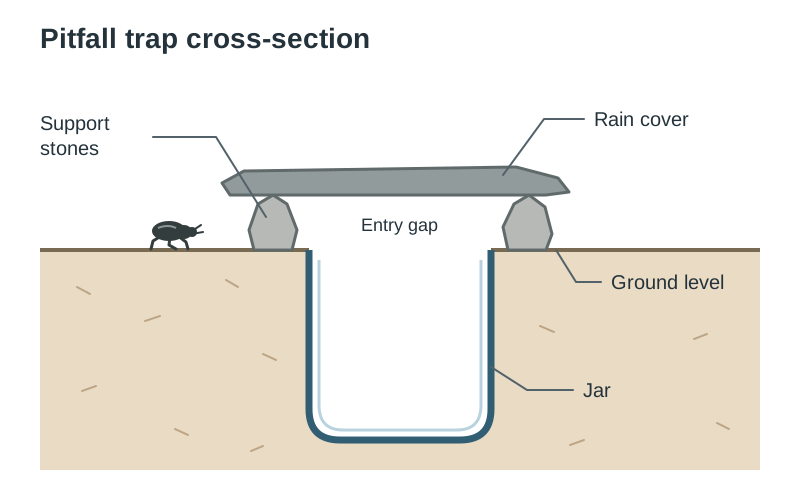
Always handle live animals with care and return them safely to their habitat.
Biodiversity and Conservation
Biodiversity is the variety of different living organisms within a habitat or on Earth. High biodiversity keeps ecosystems stable and provides human benefits, such as pollination of crops and clean water.
Human activities such as habitat destruction, pollution, and pesticide overuse reduce biodiversity.
Ways humans conserve biodiversity include:
- Setting up nature reserves and national parks to protect critical habitats.
- Planting native trees and hedgerows to restore lost habitats and provide wildlife corridors.
- Reducing pesticide and chemical fertiliser use so fewer non-target species and waterways are harmed.
- Passing laws to protect endangered species from hunting or commercial collection.
Key terms
- Habitat
- The specific place where an organism lives and finds food, shelter, and breeding conditions.
- Population
- All the individual organisms of one species living in a particular area at the same time.
- Community
- All the different plant and animal populations living and interacting together in a habitat.
- Ecosystem
- A community of living organisms interacting with each other and their non-living environment.
- Abiotic factors
- Non-living physical and chemical conditions in a habitat, such as temperature, light, and soil pH.
- Biotic factors
- Living elements that affect organisms in a habitat, such as predators, food availability, and disease.
- Decomposer
- An organism that breaks down dead plant and animal matter, returning minerals to the soil (e.g. bacteria, fungi, woodlice).
- Biodiversity
- The variety of all the different species of living organisms in an area.
Check yourself
If all the foxes in a woodland die, what will happen to the rabbit population in the short term?
It will increase because fewer rabbits are being eaten by predators.
What is the difference between a population and a community?
A population contains only one species, whereas a community contains all the different species living in that habitat.
Why is there a fine gauze filter inside a pooter?
It prevents the user from accidentally inhaling or swallowing the insects being collected.
Why do food chains rarely have more than four or five feeding levels?
Around 90% of energy is lost at each level, leaving too little energy to support higher consumers.