
Green plants make their own food by photosynthesis, respire constantly to release energy, and reproduce sexually or asexually. The Junior Cycle exam tests word equations, mineral roles, germination investigations, and the difference between pollination and fertilisation.
Plant Cells and Photosynthesis
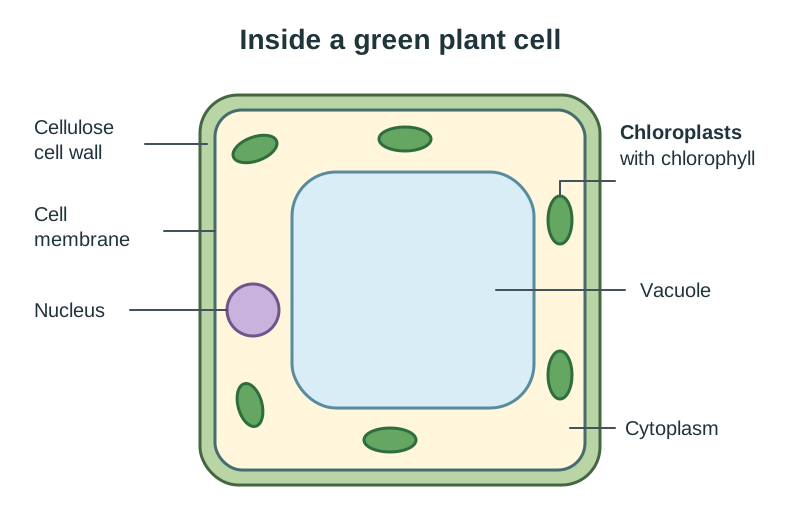
Plant cells have a nucleus, cell membrane, and cytoplasm, but they also have chloroplasts, a vacuole, and a cellulose cell wall. Chlorophyll inside chloroplasts traps light energy to drive photosynthesis.
- Extra light intensity, higher carbon dioxide levels, and warmer temperatures increase the rate of photosynthesis.
- De-starching a potted plant in a dark cupboard for 48 hours ensures starting leaves contain no starch.
- Boil the leaf in water first to soften cell walls and kill leaf tissue.
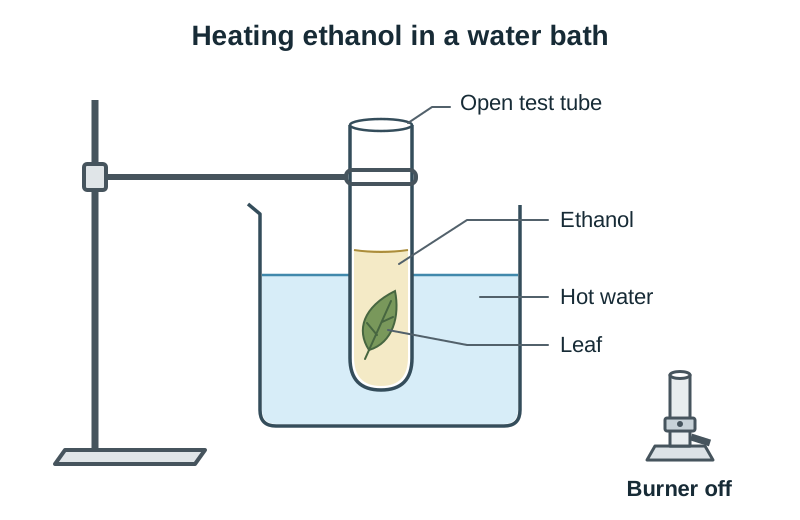
- Boil the leaf in ethanol inside a hot water bath to dissolve green chlorophyll safely.
- Turn off the Bunsen burner before using ethanol because ethanol vapour catches fire easily.
- Iodine solution turns from yellow-brown to blue-black when starch is present in the leaf.
Respiration and Germination
Respiration is the release of energy from food, and living plant cells carry it out day and night. Seeds need specific conditions before this stored food can power new growth.
- Germinating seeds release heat energy, causing a measurable temperature rise in an insulated vacuum flask.
- Living seeds produce carbon dioxide gas, which turns clear limewater milky.
- Dead boiled seeds serve as an experimental control, producing neither heat nor carbon dioxide.
- Germination requires three environmental conditions: water, oxygen, and warmth.
- Light and soil are not needed for germination because the embryo lives on stored seed food.
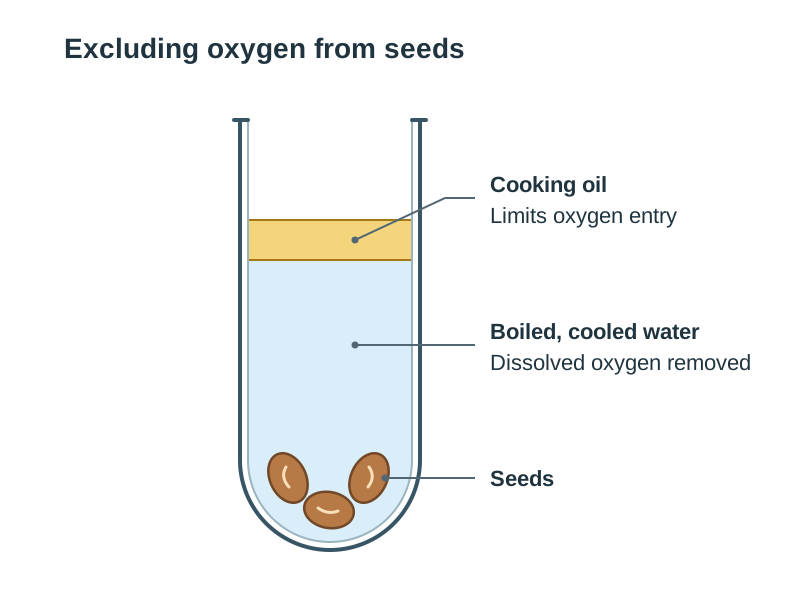
- Boiled cooled water topped with a layer of cooking oil removes dissolved oxygen from seeds.
Water Transport and Plant Minerals
Roots absorb water and dissolved soil minerals through microscopic root hair cells. Water moves up the stem to the leaves, where much of it evaporates.
- Transpiration is the loss of water vapour from plant leaves, mainly through microscopic stomata.
- Fastening a clear plastic bag around a leafy shoot collects condensed droplets of transpired water.
- Pouring oil over water in a tube stops surface evaporation during water uptake experiments.
- Magnesium helps the plant make green chlorophyll; lacking it causes leaves to turn yellow.
- Nitrogen is essential for making proteins that build new leaves and stems.
- Phosphorus supports strong root growth and cellular energy transfers.
- Potassium promotes healthy flower and fruit formation.
- Potted plants run out of minerals quickly because their roots cannot spread into fresh soil.
Reproduction and Propagation
Flowering plants can reproduce sexually through seeds or asexually by vegetative propagation. Sexual reproduction creates varied seedlings, while asexual propagation produces identical clones.
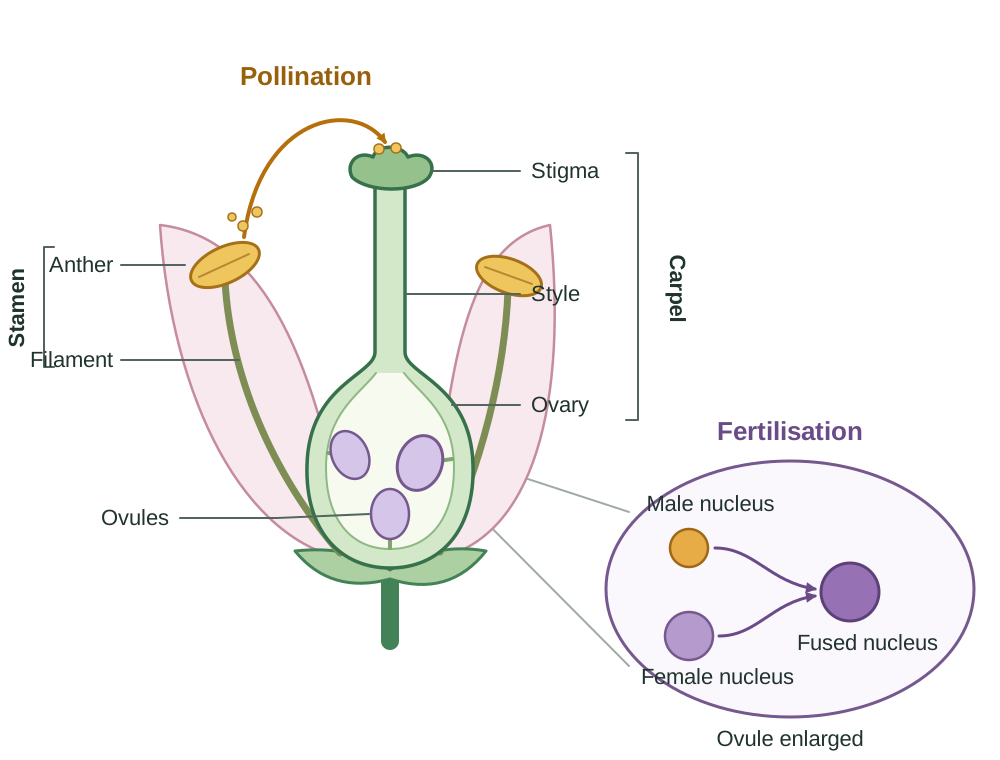
- The male stamen consists of a pollen-producing anther held up by a thin filament.
- The female carpel consists of a sticky stigma, a neck-like style, and an ovary with ovules.
- Pollination is the transfer of pollen from an anther to a stigma by insects or wind.
- Fertilisation happens when the male nucleus fuses with the female nucleus inside an ovule.
- After fertilisation, each ovule develops into a seed and the surrounding ovary becomes a fruit.
- Vegetative propagation forms new plants from runners, tubers, bulbs, or stem cuttings.
- Asexual reproduction requires only one parent, producing offspring with identical genes and traits.
Key terms
- Photosynthesis
- The chemical process where green plants use light and chlorophyll to convert carbon dioxide and water into glucose and oxygen.
- Respiration
- The cellular process that releases energy by breaking down glucose using oxygen.
- Transpiration
- The evaporation of water vapour from plant leaves into the atmosphere.
- Germination
- The restart of growth in a plant embryo inside a seed when water, oxygen, and warmth are supplied.
- Pollination
- The transfer of pollen grains from an anther to a receptive stigma.
- Fertilisation
- The fusion of the male gamete nucleus with the female gamete nucleus inside an ovule.
- Vegetative Propagation
- Asexual reproduction in plants where new individuals grow directly from stems, roots, or leaves.
Check yourself
Why is an ethanol tube placed into a water bath rather than directly over a flame?
Ethanol is flammable and can easily catch fire if heated directly over a flame.
What observation proves germinating seeds produce carbon dioxide?
Limewater in the test container changes from clear to milky or cloudy.
Which mineral does a plant need to manufacture proteins for new growth?
Nitrogen.
Why are plants grown by vegetative propagation genetically identical to their parent?
They come from a single parent without gamete fusion, making them exact genetic clones.