
Photosynthesis is the process green plants use to make glucose and oxygen from carbon dioxide and water, using light energy trapped by chlorophyll. In the Junior Cycle exam, you need to know its equations, explain why it is both a chemical and a biological process, and interpret experiments on factors affecting its rate.
A Chemical and Biological Process
Photosynthesis produces food for the plant and releases oxygen into the atmosphere.
The word equation is what most questions ask for:
You should also recognise the balanced chemical equation:
The course describes photosynthesis in two complementary ways:
- A chemical process: bonds in the reactants break and atoms rearrange to form new chemical substances, transforming light energy into stored chemical energy.
- A biological process: it takes place inside living cells that contain chloroplasts and is controlled by protein catalysts called enzymes.
Respiration is the opposite process: $$
Plant Structures, Minerals, and Ecosystems
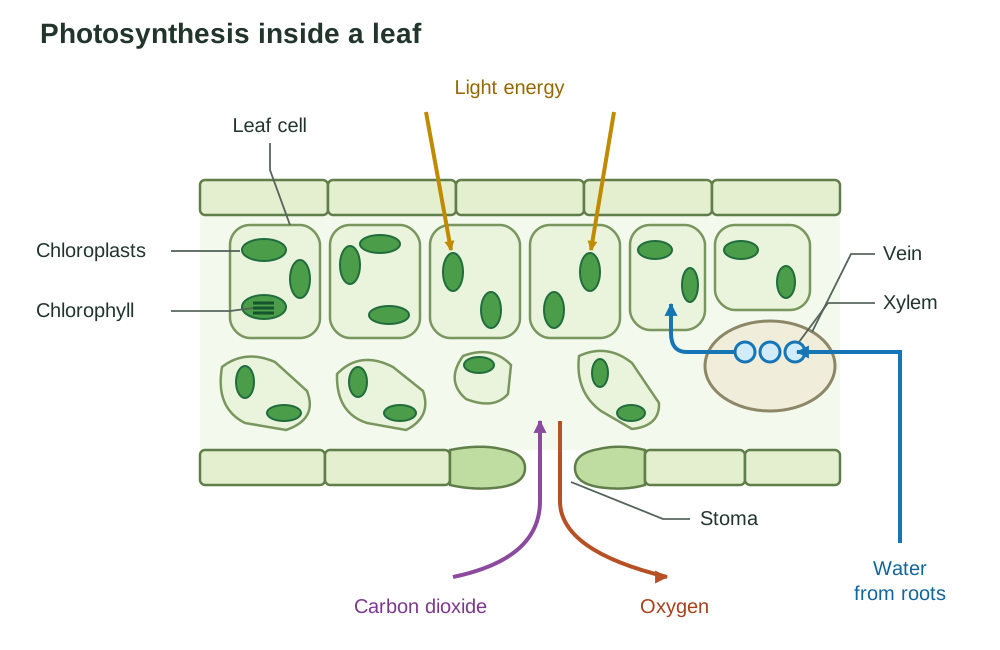
Leaves contain specialised structures that allow photosynthesis to take place:
- Chloroplasts: the small structures (organelles) inside plant cells that contain chlorophyll and carry out photosynthesis.
- Chlorophyll: the green pigment inside chloroplasts that traps light energy.
- Stomata: tiny pores, mostly on the underside of a leaf, that let carbon dioxide in and oxygen out. One pore is a stoma.
- Roots and veins: roots absorb water from the soil, and xylem vessels deliver it to leaf cells.
Plants also absorb dissolved minerals. For example, plants need magnesium to make chlorophyll. Without enough magnesium, leaves turn yellow and cannot trap light properly. Potted plants run short of minerals much faster than garden plants because their soil volume is strictly limited.
In ecosystems, green plants are producers: photosynthesis is how light energy first enters a food chain. Animals get energy by eating plants or by eating other animals. Photosynthesis also adds oxygen to the air for respiration and removes carbon dioxide.
Factors Affecting the Rate
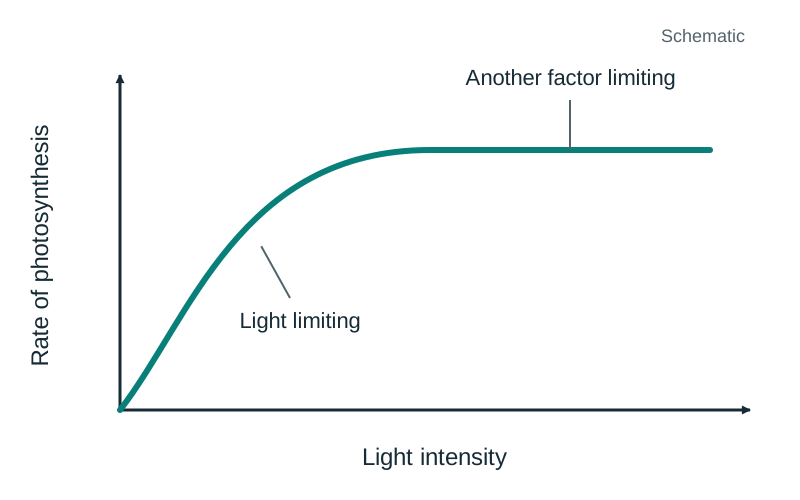
The rate of photosynthesis is how fast a plant photosynthesises, such as the number of oxygen bubbles produced per minute. A limiting factor is an environmental condition in shortest supply that caps the rate.
- Light intensity: increasing light provides more energy, speeding up the reaction until another factor runs short.
- Carbon dioxide: supplying more carbon dioxide provides more reactant molecules, raising the rate until another factor limits it.
- Temperature: warming speeds up enzyme-controlled reactions up to an optimum temperature. Above roughly , enzymes denature (permanently lose their shape) and photosynthesis stops completely.
Testing a Leaf for Starch
You should be able to describe and explain this investigation:
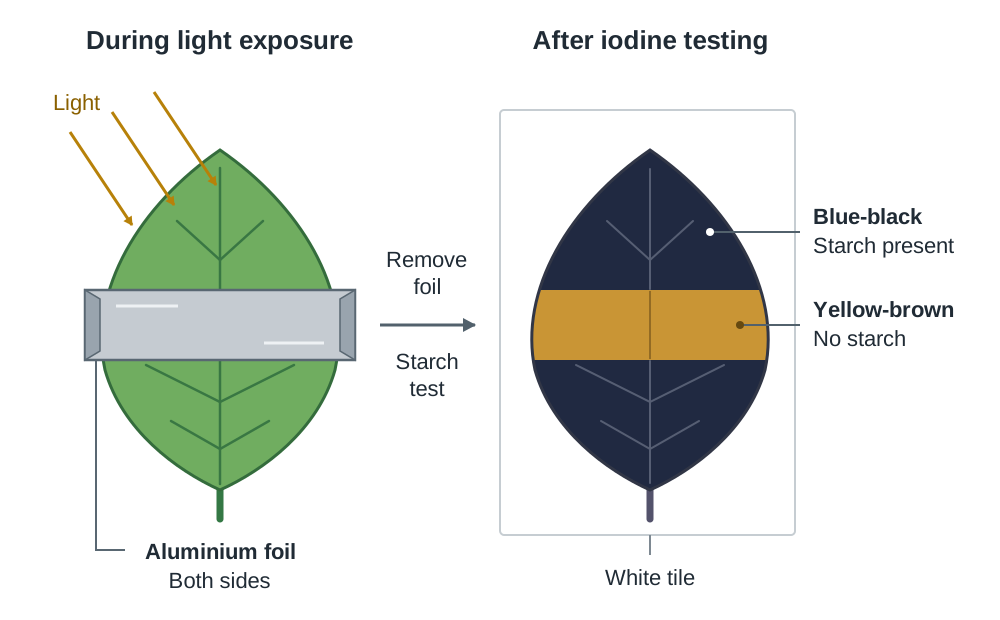
- Leave a potted plant in complete darkness for 24 to 48 hours to destarch it, ensuring leaves use up all stored starch reserves.
- Cover part of a leaf with aluminium foil as a control (it receives no light but is identical in every other way), then place the plant in bright light for several hours.
- Boil the leaf in water for one minute to kill the leaf and soften it, so iodine can get in.
- Place the leaf into a tube of ethanol and stand it in a hot water bath. Hot ethanol dissolves out the green chlorophyll so colour changes are visible. Never heat ethanol over an open flame because it is flammable.
- Dip the brittle leaf into warm water to soften it.
- Spread the leaf on a white tile and add iodine solution.
The uncovered area turns blue-black (starch present), while the foil-covered control stays yellow-brown (no starch).
Measuring Rate with Pondweed
You should also be able to describe how to measure the rate of photosynthesis:
- Submerge pondweed in water containing dissolved sodium hydrogen carbonate, which provides a steady supply of carbon dioxide.
- Place a lamp at different measured distances to vary light intensity (the independent variable).
- Count the number of oxygen bubbles released per minute (the dependent variable).
- Keep water temperature constant using a water bath, and keep the plant size and carbon dioxide concentration unchanged (controlled variables).
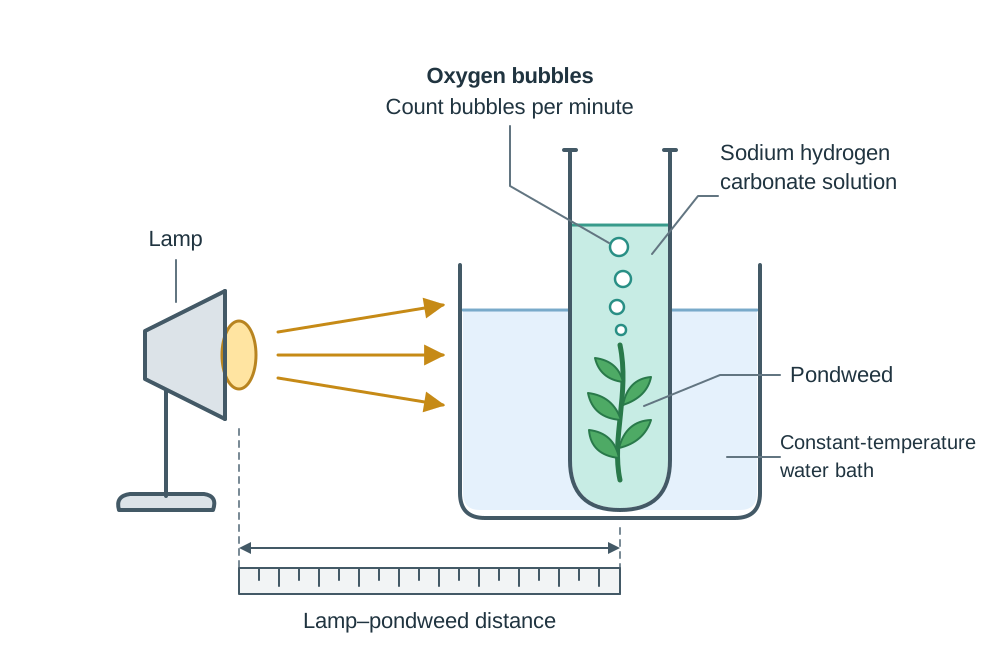
To prove the bubbles are oxygen, collect the gas in a test tube and insert a glowing splint. The splint relights, confirming the gas is oxygen.
Key terms
- Photosynthesis
- The biological and chemical process by which green plants make glucose and oxygen from carbon dioxide and water using light energy trapped by chlorophyll.
- Chloroplast
- The small structure (organelle) inside a plant cell where photosynthesis takes place.
- Chlorophyll
- The green pigment found inside chloroplasts that traps light energy.
- Stomata
- Tiny pores, mostly on the underside of a leaf, that allow gas exchange between the leaf and the air.
- Limiting factor
- An environmental condition in shortest supply that restricts the rate of photosynthesis.
- Destarching
- Placing a plant in darkness for 24 to 48 hours so it uses up its stored starch reserves.
- Producers
- Organisms such as green plants that make their own food and introduce energy into a food chain.
Check yourself
What test confirms that the gas collected from pondweed is oxygen?
Place a glowing splint into the test tube of collected gas; it relights.
Why is a plant kept in darkness for 24 to 48 hours before testing if light is needed for photosynthesis?
To destarch the plant so any starch detected at the end was made during the experiment.
Which mineral do plants take up from soil to produce chlorophyll, and what symptom appears if it is missing?
Magnesium; a deficiency causes leaves to turn yellow.
What happens to photosynthesis when leaf temperature rises well above 40°C?
Enzymes denature (permanently lose their shape) and photosynthesis stops completely.