
Evolution describes how populations of living things gradually change over generations through natural selection. In the exam, you must outline how inherited variation leads to the survival of better-adapted organisms and explains biodiversity.
Variation and Mutation
Differences between living things of the same species are called variation. Natural selection relies on these differences to work.
- Inherited variation comes from DNA passed from parents to offspring, like eye colour.
- Environmental variation comes from surroundings or lifestyle, like scars, and is not passed on.
- A mutation is a random change in an organism's DNA code.
- Mutations happen by pure chance, never because an animal or plant wants to change.
- Most mutations have no effect, some cause harm, and occasional mutations give a survival advantage.
The Mechanism of Natural Selection
Charles Darwin developed the theory of natural selection to explain how living things adapt to their habitats.
| Stage | What happens |
|---|---|
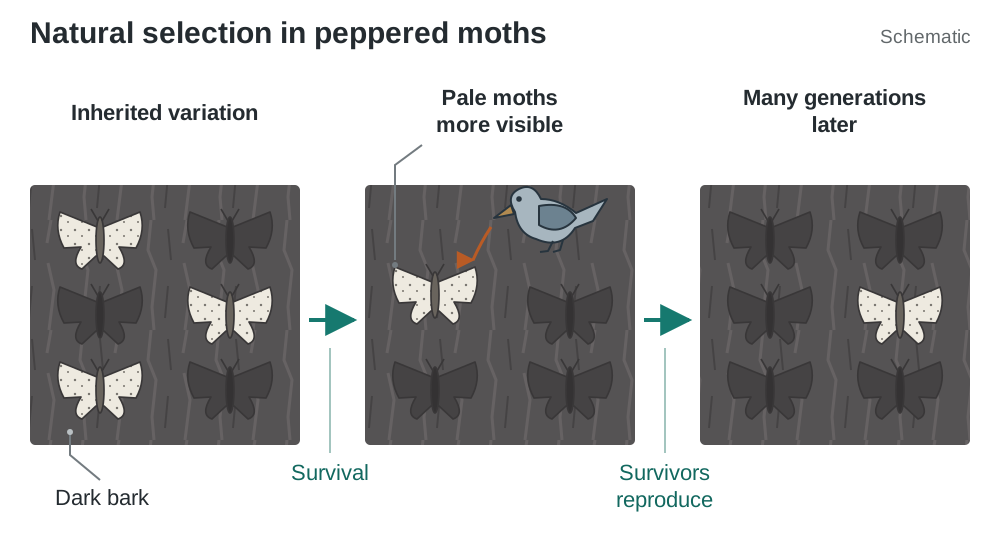
| 1. Variation | Organisms inherit different physical traits from their parents. |
| 2. Competition | More offspring are born than can survive, causing competition for food and shelter. |
| 3. Survival | Individuals with traits that suit the habitat survive better. |
| 4. Inheritance | Survivors reproduce and pass their helpful genes to the next generation. |
Over many generations, these helpful traits become far more common across the population.
Adaptations in Plants and Animals
An adaptation is an inherited feature that helps an organism survive and reproduce in its environment.
| Organism | Adaptation | How it helps survival |
|---|---|---|
| Galápagos finch | Strong, thick beak | Cracks open tough seeds for food. |
| Red fox | Thick fur coat | Traps body heat to stay warm in freezing weather. |
| Rose bush | Sharp thorns on stems | Stops hungry animals from eating the stems. |
Always link the named physical feature directly to its specific survival advantage in your answer.
Biodiversity, Fossils, and Changing Ideas
Biodiversity means the variety of all living species on Earth. Evolution explains how this variety arose from shared ancestors.
- A species is a group of organisms that can breed together to produce fertile offspring.
- Extinction happens when every individual member of a species dies out completely.
- Fossils show that species changed gradually over millions of years, such as early horses developing single hooves.
- Antibiotic resistance in bacteria shows natural selection happening today over very short periods.
- Later genetic discoveries supported Darwin's original theory by explaining how DNA mutations create new traits.
Key terms
- Evolution
- The gradual change in the inherited traits of a population over many generations.
- Natural Selection
- The process where organisms with helpful traits survive, reproduce, and pass those traits to offspring.
- Variation
- The differences in characteristics between individual members of the same species.
- Mutation
- A random change in an organism's DNA that may produce a new trait.
- Adaptation
- An inherited feature that helps an organism survive and reproduce in its habitat.
- Species
- A group of living organisms that can interbreed to produce fertile offspring.
- Biodiversity
- The variety of all different species of living organisms on Earth.
- Extinction
- The permanent disappearance of all living members of a species.
Check yourself
What is the main source of new genetic variation in any population?
Random mutations in DNA.
What must two organisms be able to produce to prove they are the same species?
Fertile offspring.
Name one adaptation of a fox and explain how it helps it survive.
Thick fur, which traps heat to keep the fox warm in cold weather.
How did the discovery of DNA support Darwin's theory of evolution?
It showed the physical mechanism of inheritance and how mutations create variation.