

House choice and design covers how families select housing, maintain a safe living environment, and plan practical, attractive interior rooms. In the Junior Cycle written exam, questions focus on housing choices, safe home requirements, design principles, floor plan scale calculations, and room decorating steps.
Choosing a Home and Safety Requirements
Choosing a home depends on household needs, location, and financial resources.
Households obtain housing in three main ways:
- Renting: paying rent monthly to a landlord; flexible, but the property is not owned.
- Buying: securing a mortgage, a long-term loan repaid to a bank with interest.
- Local authority housing: rented from the city or county council by qualifying families.
A safe and nurturing home environment provides:
- Heating and ventilation: reliable warmth and fresh air circulation to prevent dampness.
- Safety equipment: working smoke alarms, carbon monoxide detectors, and a fire blanket.
- Child safety: fitted stair gates, covered electrical sockets, and no trailing cords.
- Space and hygiene: sufficient space to sleep, eat, and study, with clean running water.
Insulating the attic, walls, and hot-water cylinder reduces heat loss, lowers heating bills, keeps rooms comfortable, and conserves fuel. Energy performance is shown on a Building Energy Rating (BER) certificate from A (most efficient) to G (least efficient).
Characteristics and Elements of Design
Good design balances appearance with everyday practicality. Remember AFDES: Attractive, Functional, Durable, Environmentally friendly, and Safe.
Five design elements are used to style interior spaces:
- Colour: warm colours (red, orange) feel cosy but make rooms seem smaller; cool colours (blue, green) feel calm and make rooms look larger. A tint is lightened with white; a shade is darkened with black. North-facing rooms get cool light, so warm colours suit them; sunny south-facing rooms suit cool blues.
- Texture: smooth surfaces like wall tiles are hygienic and wipe-clean; rough surfaces like wool rugs add physical warmth and absorb sound.
- Line: vertical lines make low ceilings look taller; horizontal lines make narrow rooms seem wider.
- Shape and pattern: shapes define furniture forms, while patterns add visual interest without cluttering the room.
Applying Design Principles
Design principles are the guidelines used to arrange elements into an attractive and practical space.
| Principle | Meaning | Room Example |
|---|---|---|
| Balance | Visual weight is evenly spread so a room feels stable | Matching bedside lockers and identical lamps on either side of a bed |
| Emphasis | Drawing the eye to a main focal point | A brightly painted chimney breast or bold feature wall behind a bed |
| Proportion | Furniture sizes suit each other and the room scale | A compact single bed and slim wardrobe in a small box room |
| Rhythm | Repeating a colour, texture, or pattern for visual flow | Repeating navy blue across curtains, cushions, and a rug |
| Harmony | All parts of the room look as if they belong together | Choosing walls, curtains, and bedding from the same coordinated colour scheme |
Room Planning and Decorating
Room planning ensures an interior layout suits family needs before decorating starts.
Key planning factors include:
- Function: who uses the room and what activities take place there.
- Aspect: south-facing rooms get warm, direct sunlight for most of the day; north-facing rooms get cooler, indirect light.
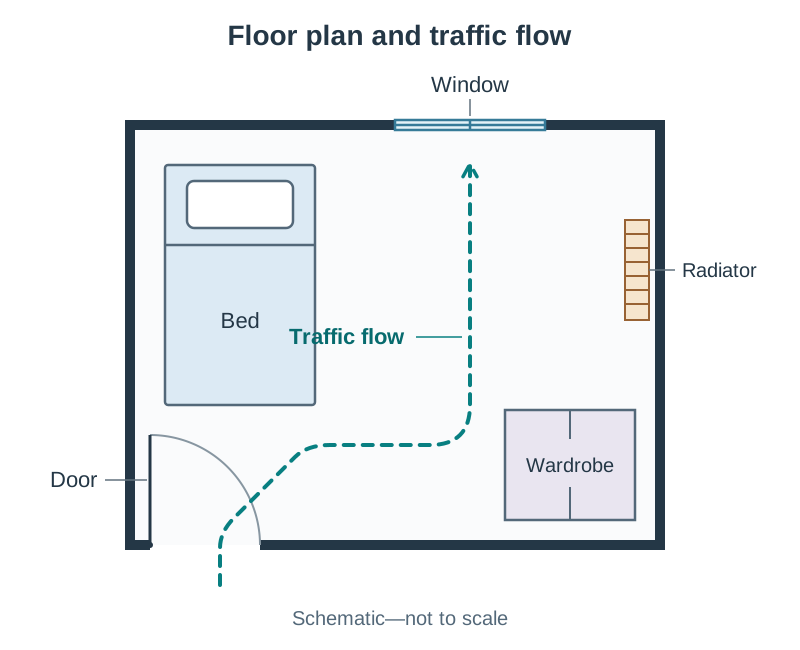
- Traffic flow: clear walking paths between doors, windows, and furniture.
- Fixtures: fixed items like radiators and sockets that cannot move easily.
A floor plan is a bird's-eye scale drawing showing walls, doors, and furniture layout.
When decorating, work from the top down so drips do not spoil finished surfaces: paint the ceiling first, then the walls and woodwork (door frames and skirting boards), and lay the floor covering last so it stays clean.
Key terms
- Building Energy Rating (BER)
- A scale from A to G measuring the energy efficiency and environmental performance of a home.
- Mortgage
- A long-term bank loan used to purchase a property, repaid in monthly instalments with interest.
- Aspect
- The compass direction a room's windows face, determining the daylight and warmth it receives.
- Traffic flow
- The clear walking pathway people use to move safely between doors, windows, and furniture in a room.
- Floor plan
- A bird's-eye scale drawing of a room showing fixtures, doors, windows, and furniture placement.
- Proportion
- The size relationship between individual furniture items and the overall scale of the room.
- Harmony
- The design principle where all elements in a room work together to create a unified appearance.
Check yourself
Explain the design principle of emphasis and give one room example.
Emphasis draws the eye to a focal point, such as a brightly painted chimney breast or feature wall behind a bed.
Which compass direction provides warm, direct sunlight for most of the day in Ireland?
South.
List two advantages of a well-insulated home.
It reduces heat loss, lowers heating bills, and keeps the home warmer and more comfortable.
At a scale of 1:50, what is the length on paper of a 3.5 m wall?
7 cm (3.5 m = 350 cm; 350 ÷ 50 = 7 cm).
What is the difference between a tint and a shade?
A tint is a colour lightened by adding white, while a shade is a colour darkened by adding black.