

The physical force tradition is the belief that Irish independence could only be won through armed rebellion rather than peaceful debate. In Junior Cycle History, the main pre-twentieth-century example is the 1798 Rebellion, where exam questions focus on its causes, course, and lasting political impact.
The Physical Force vs Parliamentary Tradition
Irish nationalists took two very different paths to seek change from Britain.
- Parliamentary tradition: Sought change peacefully through elections, debates, and passing laws in parliament, as shown by politicians like Henry Grattan and later Daniel O'Connell.
- Physical force tradition: Believed British rule would never be removed peacefully, arguing that independence required an armed rebellion.
- Republicanism: Aimed to establish an independent Irish republic where citizens governed themselves without a king or queen.
- Tone's vision: Theobald Wolfe Tone wanted to unite all Irish people regardless of religion, famously stating his goal was to unite Protestant, Catholic, and Dissenter.
Causes of the 1798 Rebellion
Severe inequalities and revolutionary ideas from abroad pushed reformers towards armed rebellion.
- Protestant Ascendancy: A small, wealthy Anglican minority owned most of the land and held total control over the Irish parliament in Dublin.
- Penal Laws: Laws that discriminated against Catholics and Presbyterians. Although the 1793 Catholic Relief Act allowed Catholics with property to vote, they were still barred from sitting in parliament or holding senior government jobs.
- Land inequality: Catholics made up about three-quarters of the population but owned only a small fraction of the land.
- American and French Revolutions: Successful revolutions in America and France proved that ordinary people could overturn monarchies and fight for liberty.
- Society of United Irishmen: Founded in Belfast in 1791 by Wolfe Tone and others to demand parliamentary reform peacefully. Banned by the government in 1794, it became a secret oath-bound society aiming for armed revolt.
- Bantry Bay (1796): Wolfe Tone secured French help, but winter storms prevented 43 French ships from landing at Bantry Bay.
- Government crackdown: Crown forces (the British army and local militia) arrested key leaders, including Lord Edward FitzGerald, leaving the rebellion disorganized before it even started.
Course of the 1798 Rebellion
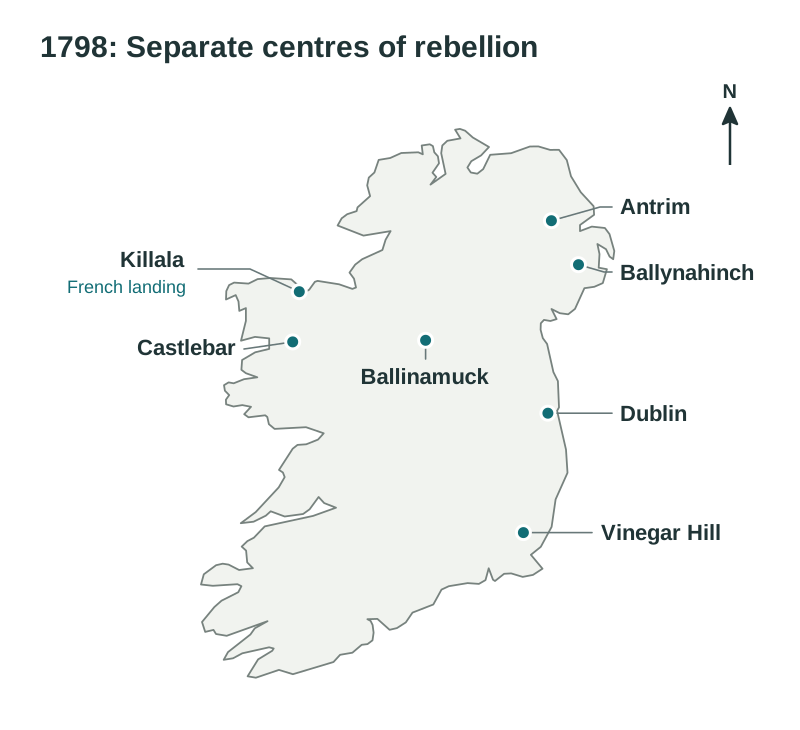
The rebellion began in May 1798 and was defeated within four months. Because the leaders were arrested, the fighting broke out in separate areas instead of as one national rising.
| Region | Leaders and Main Events |
|---|---|
| Dublin and Leinster | Planned Dublin rising collapsed due to arrests; clashes in Kildare, Meath, and Carlow were quickly put down by Crown forces. |
| Wexford | Rebels led by Fr John Murphy won early victories at Oulart Hill and Enniscorthy before their decisive defeat at Vinegar Hill. Sectarian violence broke out, including the burning of over 100 loyalists in a barn at Scullabogue. |
| Ulster | Mainly Presbyterian rebels rose in Antrim and Down. Henry Joy McCracken was defeated at Antrim and executed; Henry Munro was defeated at Ballynahinch. |
| Connacht | General Humbert landed 1,000 French soldiers at Killala, winning the Battle of Castlebar. Humbert surrendered at Ballinamuck in September 1798, ending the rebellion. |
Consequences and Legacy in Irish Politics
The rebellion was defeated, but its results changed Irish politics for more than a century.
- Act of Union: Passed in 1800 and coming into effect in 1801, this law abolished the parliament in Dublin and ruled Ireland directly from Westminster in London.
- Heavy loss of life: About 30,000 people died in the fighting and the reprisals that followed.
- Deepened sectarianism: Atrocities committed by both sides hardened religious divisions between Catholics and Protestants, especially in Ulster.
- Father of Irish Republicanism: Tone was captured with a French fleet off Donegal in October 1798 and died in prison in November, but his idea of uniting all religions in one republic lived on.
- Commemoration: Tone's grave at Bodenstown, Co. Kildare is still visited each year by republican groups, showing that later movements claimed him as their founder.
- Inspiration for future risings: The physical force tradition begun in 1798 directly inspired armed rebellions in 1803 (Robert Emmet), 1848 (Young Irelanders), 1867 (Fenians), and the 1916 Easter Rising.
Key terms
- Physical force tradition
- The belief that Irish national independence could only be won through armed rebellion rather than peaceful politics.
- Parliamentary tradition
- The method of achieving political change through peaceful elections, debates, and passing laws in parliament.
- Protestant Ascendancy
- The wealthy Anglican minority who owned most land and held political power in eighteenth-century Ireland.
- Penal Laws
- Unfair laws that limited the civil, religious, and political rights of Catholics and Presbyterians in Ireland.
- Society of United Irishmen
- A political organisation founded in Belfast in 1791 aiming to unite Irish people across all religions to end British control.
- Theobald Wolfe Tone
- A Protestant barrister who co-founded the United Irishmen and is remembered as the father of Irish republicanism.
- Vinegar Hill
- The rebel camp near Enniscorthy, County Wexford, where the United Irishmen were decisively defeated in June 1798.
- Act of Union
- The 1800 law that abolished the Irish parliament in Dublin and placed Ireland under direct rule from Westminster in 1801.
Check yourself
What is the physical force tradition in Irish history?
The belief that Irish national independence must be won through armed rebellion.
Where and in what year was the Society of United Irishmen founded?
Belfast in October 1791.
In what month and year did the 1798 Rebellion begin?
May 1798.
Where were the Wexford rebels decisively defeated in June 1798?
The Battle of Vinegar Hill.
What major constitutional change took effect on 1 January 1801 following the rebellion?
The Act of Union abolished the Irish parliament and united Britain and Ireland.