

Between about 1550 and 1660, English rulers confiscated Irish land and granted it to English and Scottish settlers. The Junior Cycle exam tests one plantation, the growth of towns, and how these changes shaped identity in Ireland.
The Policy of Plantation
A plantation was an English government policy of granting confiscated Irish land to English and Scottish settlers to establish English authority.
English rulers had three main aims:
- Establish English royal authority and English Common Law.
- Spread the Protestant religion following the Reformation.
- Settlers would defend the land themselves, so England would not have to pay for as many soldiers.
Henry VIII first tried surrender and regrant, which granted English titles to Gaelic lords who surrendered land and swore loyalty. When this policy failed to secure full control, rulers turned to plantation.
| Ruler | Plantation area |
|---|---|
| Mary I | Laois–Offaly (1550s) |
| Elizabeth I | Munster (1580s) |
| James I | Ulster (from 1609) |
| Oliver Cromwell | Cromwellian settlement (1650s): land given to soldiers and adventurers; Catholic landowners transplanted west to Connacht |
The Ulster Plantation
Ulster was the most Gaelic part of Ireland and the hardest for England to control. English victory in the Nine Years' War ended with the Treaty of Mellifont in 1603. Following the Flight of the Earls in 1607, Hugh O'Neill and other chiefs fled into European exile, leaving their lands open to confiscation by King James I across six counties: Armagh, Cavan, Coleraine (renamed County Londonderry in 1613), Donegal, Fermanagh, and Tyrone.
| Planter type | Land grant and conditions |
|---|---|
| Undertakers | British Protestant settlers granted up to 2,000 acres; forbidden to rent to Irish tenants |
| Servitors | Crown soldiers and officials granted land; permitted to take native Irish tenants |
| Loyal Irish | Gaelic Irish who stayed loyal to the Crown; given smaller estates at higher rents |
Life of a Settler
Settlers had to build a stone house and a bawn (a fortified stone yard) to defend themselves and shelter livestock. Settlers grew crops such as oats and wheat, planted orchards, drained bogs, and introduced flax for linen. Defence was critical because dispossessed Irish outlaws, called woodkerne, raided farms from surrounding woods and hills.
Pattern of Settlement: Growth of Towns
Gaelic Ireland had no real towns; people lived in scattered farms and ringforts. The Vikings founded Ireland's first towns as trading ports, including Dublin, Waterford, and Limerick. The Normans later established walled market towns, such as Kilkenny and Drogheda.
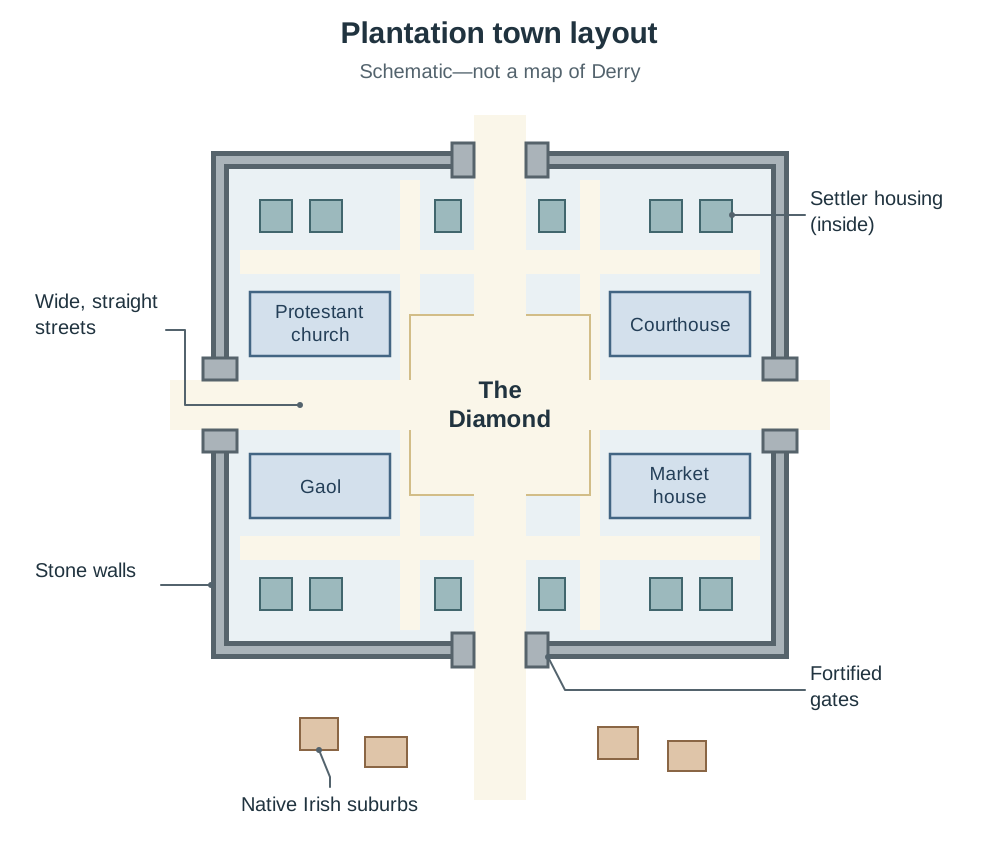
Plantation rulers built planned market towns to secure conquered areas and administer English law. For example, Derry was granted to the London craft guilds, renamed Londonderry, and laid out inside stone walls with four straight streets meeting at the centre.
Key features of a plantation town included:
- Wide, straight streets laid out in a grid pattern.
- The Diamond: a central open square used for markets and for gathering soldiers.
- Defensive stone walls, ramparts, and fortified gates.
- Civic buildings, including a Protestant church, courthouse, gaol, and market house.
- Separate housing, with settlers living inside the walls while native Irish settled in suburbs outside the gates.
Influence on Irish Identity
Identity means how a group of people are bound together by nationality, ethnicity, religion, or other social or cultural connections. The plantations brought two distinct groups into the same physical space.
| Feature | Planters | Native Irish |
|---|---|---|
| Religion | Protestant (Anglican and Presbyterian) | Roman Catholic |
| Language | English and Scots | Irish (Gaelic) |
| Law | English Common Law | Brehon Law (suppressed and replaced) |
| Land | Owned most of the good farmland | Became tenants or labourers; some lost their land completely |
Religion and power became linked: Protestants owned the land and Catholics worked it. Protestant planters developed a British identity loyal to the Crown, forming the roots of modern unionism. Dispossessed Catholics maintained a shared grievance over lost land and political power, forming the roots of modern nationalism.
Key terms
- Plantation
- Sixteenth- and seventeenth-century English government policy of granting land in Ireland to English and Scottish settlers as part of a plan to establish English authority.
- Colonisation
- Process where a country takes over another country, establishes its authority, and settles its people there.
- Identity
- How a group of people are bound together by nationality, ethnicity, religion, or other social or cultural connections.
- Surrender and regrant
- A Tudor policy where Gaelic chiefs surrendered ancestral land to the King and received it back with an English title and legal system.
- Undertaker
- A British planter granted confiscated land in Ulster who undertook to bring over English or Scottish Protestant tenants.
- Bawn
- A fortified stone courtyard built around a plantation castle or house to protect settlers and their animals from attack.
Check yourself
What 1607 event left Ulster land open to royal confiscation by King James I?
The Flight of the Earls.
What was a bawn, and why did planters build one?
A fortified stone courtyard built to protect the planter's house, family, and livestock from attack.
Why were Undertakers forbidden from taking native Irish tenants?
To ensure their estates were settled entirely by loyal British Protestants.
Name one British ruler who carried out a plantation and the area involved.
King James I in Ulster (or Queen Mary I in Laois–Offaly; Queen Elizabeth I in Munster; Oliver Cromwell, the Cromwellian settlement of the 1650s).
What was The Diamond in a plantation town?
A central open square used for holding markets and assembling armed settlers.