

This topic examines how the clash between Irish nationalism and Ulster unionism transformed Ireland between 1911 and 1923. The exam asks you to explain why each side acted as it did, name key leaders, and describe how Ireland changed by 1923.
The Home Rule Crisis and Arming (1912–1914)
Ireland was divided over Home Rule, a plan for a Dublin parliament to manage domestic affairs within the United Kingdom.
| Feature | Nationalists | Unionists |
|---|---|---|
| Main aim | Self-government for Ireland | Maintain the union with Great Britain |
| Tradition | Mostly Catholic; split between constitutional nationalists (parliamentary) and republicans (force) | Mostly Protestant; concentrated in north-east Ulster |
| Motive | Wanted to govern their own affairs | Feared Catholic domination and lost industry |
- The British government introduced the Third Home Rule Bill in 1912.
- Unionists signed the Ulster Covenant in 1912 and founded the Ulster Volunteer Force (UVF) in 1913.
- Nationalists set up the Irish Volunteers in November 1913 to defend Home Rule.
- In April 1914, the UVF smuggled 25,000 rifles into Larne without police interference.
- In July 1914, the Irish Volunteers landed 900 rifles at Howth from the Asgard; British troops shot three civilians at Bachelor's Walk.
- Home Rule passed in September 1914 but was immediately suspended for the duration of World War One.
Key Leaders of Nationalism and Unionism
Exam questions regularly ask you to identify a leader and give one significant fact:
- Edward Carson: Leader of the Ulster unionists; organised the Ulster Covenant and the UVF to oppose Home Rule.
- James Craig: Carson's deputy; became the first Prime Minister of Northern Ireland in 1921.
- John Redmond: Leader of the Irish Parliamentary Party; supported the 1912 Home Rule Bill and encouraged Irishmen to fight in World War One.
- Eoin MacNeill: Head of the Irish Volunteers; attempted to cancel the 1916 Rising after uncovering the forged Castle Document.
- James Connolly: Leader of the Irish Citizen Army; commanded the rebel forces in the GPO and was executed in May 1916.
- Constance Markievicz: Citizen Army fighter in 1916; first woman elected to the Westminster parliament in 1918.
The 1916 Rising and Political Shift (1914–1919)
- In September 1914, Redmond encouraged Volunteers to join the British army; most followed him, while 11,000 stayed with MacNeill.
- A secret group, the IRB Military Council, planned a rising, believing Britain's difficulty was Ireland's opportunity.
- On Easter Monday, 24 April 1916, rebels occupied the GPO and key Dublin buildings, where Patrick Pearse read the Proclamation.
- British artillery and the gunboat Helga shelled Dublin, forcing an unconditional surrender on 29 April.
- Firing squads executed 15 leaders in May 1916 (Roger Casement was hanged in London in August), swinging public sympathy behind the rebels.
- In 1918, British plans to introduce conscription caused outrage, boosting support for Sinn Féin.
- Sinn Féin won 73 seats in the 1918 election, adopted an abstention policy from Westminster, and established the First Dáil on 21 January 1919.
The War of Independence and Partition (1919–1921)
- On 21 January 1919, the same day the First Dáil met, an ambush at Soloheadbeg, County Tipperary, began the war.
- The Irish Volunteers became the IRA, using guerrilla warfare and flying columns to ambush Crown forces.
- Michael Collins directed an intelligence network and set up 'the Squad' to assassinate British spies.
- Britain deployed the Black and Tans and Auxiliaries, who carried out violent reprisals, including the 1920 Bloody Sunday shootings at Croke Park.
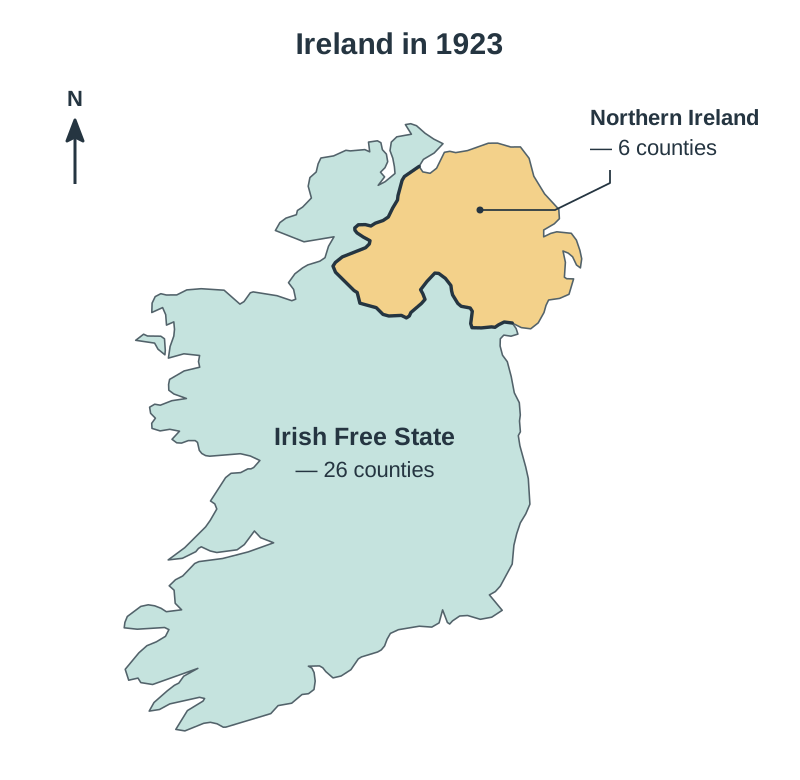
- The Government of Ireland Act 1920 enacted partition, establishing a parliament in Belfast for six Ulster counties and one in Dublin for the remaining twenty-six.
- A truce ended the fighting on 11 July 1921.
The Treaty, Civil War, and Impact (1921–1923)
Michael Collins and Arthur Griffith signed the Anglo-Irish Treaty on 6 December 1921.
| Treaty Term | Content |
|---|---|
| Irish Free State | Self-governing dominion status within the British Empire. |
| Oath of Allegiance | TDs had to swear loyalty to the British monarch. |
| Partition | Northern Ireland could opt out of the Free State, which it did immediately. |
| Treaty Ports | Britain retained naval bases at Berehaven, Cobh, and Lough Swilly. |
The Dáil ratified the Treaty (64–57) in January 1922. The Free State army shelled anti-Treaty republicans in the Four Courts in June 1922, igniting the Civil War. Collins was killed in an August ambush; the anti-Treaty IRA dumped arms in May 1923.
Impact by 1923
- Ireland was partitioned into Northern Ireland and the 26-county Irish Free State.
- Civil War bitterness split Irish politics into two main rival parties.
- Unionists governed Northern Ireland, where nationalists became an excluded minority.
Key terms
- Nationalism
- The political belief that Ireland is a distinct nation and should govern itself independently.
- Unionism
- The political belief that Ireland should maintain its union with Great Britain under the Westminster parliament.
- Home Rule
- A system where a Dublin parliament would manage domestic Irish affairs while Ireland remained within the United Kingdom.
- Abstention
- The political policy of refusing to sit in an elected parliament, practised by Sinn Féin after the 1918 election.
- Guerrilla warfare
- A style of fighting using small, mobile groups to carry out surprise ambushes and quick retreats.
- Partition
- The political division of Ireland into two separate territories, first enacted under the Government of Ireland Act 1920.
- Dominion status
- Self-government within the British Empire that recognises the British monarch as head of state.
- Oath of Allegiance
- A formal pledge of loyalty to the British monarch, required of Irish Free State parliamentarians under the 1921 Treaty.
Check yourself
Why did Ulster unionists oppose the Third Home Rule Bill in 1912?
They feared Catholic domination, loss of British identity, and damage to Ulster's economy.
Why did the British executions after the 1916 Rising help republicans?
They caused public sympathy to swing behind the rebels and led to Sinn Féin sweeping the 1918 election.
How many counties were included in Northern Ireland under the Government of Ireland Act 1920?
Six counties.
What event on 21 January 1919 marked the military start of the War of Independence?
The Soloheadbeg ambush in County Tipperary.
What military action began the Irish Civil War in June 1922?
Free State forces shelled anti-Treaty troops occupying the Four Courts in Dublin.