

This topic explores how Christianity arrived in Ireland in the fifth century, which changed how people in Ireland lived and made Irish monasteries famous across Europe for learning and art. For the Junior Cycle exam, you need to describe monastic settlements, the monk's daily routine, surviving artworks, and the broader significance of the Christian church.
The Arrival of Christianity and St Patrick
Before Christianity arrived, Celtic Ireland was pagan and druids led religious rituals. The new religion spread gradually through trade and missionaries from Roman Britain.
- In AD 431, Pope Celestine sent Bishop Palladius to minister to Christians already living in Ireland.
- In AD 432 (traditional date), St Patrick arrived as a missionary bishop. Patrick was taken from Roman Britain by Irish raiders at sixteen and spent six years in Ireland as a slave minding sheep. He escaped, trained as a priest, and returned to convert the Irish, establishing his main church at Armagh.
- Patrick's own Latin writings, including his Confessio, provide primary written evidence of fifth-century Ireland.
Monastic Settlements and Daily Life
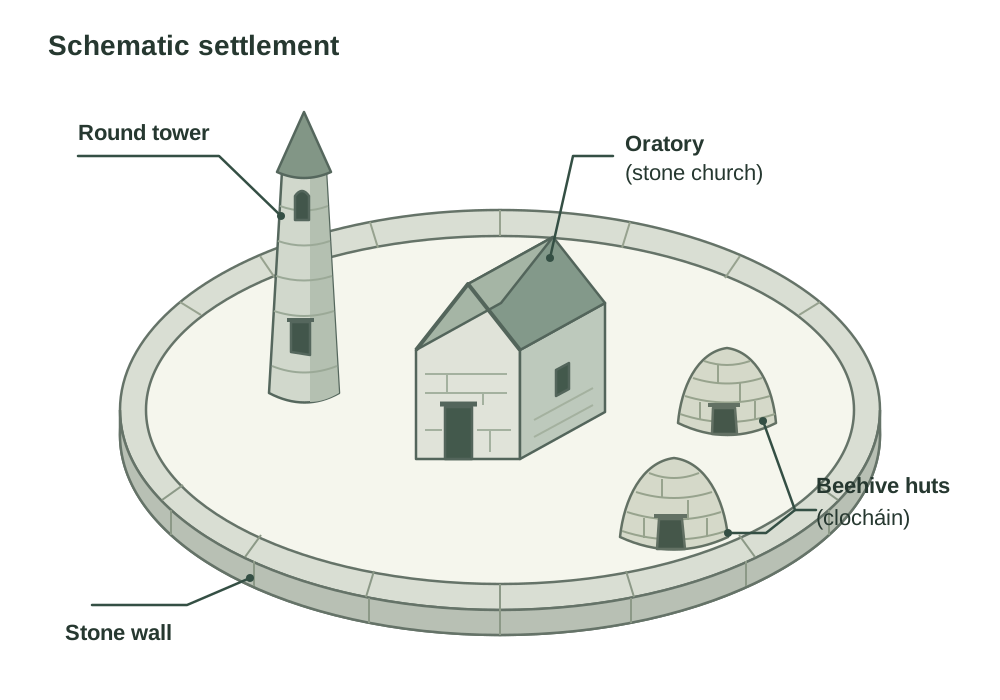
A monk was a man who gave up ordinary life to pray, work and study for God. A monastery was an enclosed settlement of monks, surrounded by a protective stone wall or earthen bank, with a church at its centre. Monks took solemn vows of poverty, chastity, and obedience to the abbot.
Monks wore a tonsure, a shaved hairstyle showing they belonged to the monastery. Well-known monasteries and their founders include Clonmacnoise (St Ciarán), Glendalough (St Kevin), and Durrow and Iona (St Colmcille).
| Monastic Feature | Practical and Spiritual Function |
|---|---|
| Oratory | Small stone church where monks attended daily Mass and prayed. |
| Scriptorium | Workshop where scribes copied and illustrated manuscripts. |
| Refectory | Dining hall where monks ate simple meals in silence. |
| Round tower (cloigtheach) | Bell tower for prayer calls, a lookout, and emergency refuge during raids. |
| Beehive hut (clochán) | Small round hut built of stone without mortar, where a monk slept. |
| Guest house | Quarters providing shelter and food for travellers and the poor. |
Art, Craftwork, and Learning
Monasteries combined Celtic spiral patterns with Christian symbols across three major crafts:
- An illuminated manuscript was a handwritten religious book decorated with colourful letters, patterns and small pictures. Scribes prepared vellum (scraped calfskin) and wrote with quill pens and inks made from plants and minerals. A famous surviving example is the Book of Kells.
- Metalworking monks crafted sacred vessels using silver, gold, and coloured glass studs. The best-known example is the Ardagh Chalice.
- A high cross is a tall, free-standing stone monument carved with biblical scenes. Most people could not read, so priests used the carved scenes to teach Bible stories outdoors. An example is the Cross of the Scriptures at Clonmacnoise.
Historical Significance and European Influence
Christianity changed Irish society and linked Ireland closely with the rest of Europe.
- Monks preserved heritage by writing down oral sagas, laws, and genealogies in the Latin alphabet alongside scripture, earning Ireland fame as the 'Island of Saints and Scholars'.
- Irish monks travelled abroad to convert pagans and set up monasteries in Britain and continental Europe, such as St Colmcille on the Scottish island of Iona.
- Monasteries grew rich in cattle, crops and gold vessels, which made them targets for Viking raids from AD 795.
- Christianity kept shaping Irish life long afterwards: religious difference divided communities after the Reformation and the plantations, and churches ran most Irish schools and hospitals into the twentieth century.
Key terms
- Monastery
- An enclosed settlement where monks live, work, and pray under religious vows.
- Abbot
- The head monk in charge of governing a monastery and directing its community.
- Scriptorium
- The monastic room where scribes copied and decorated manuscripts by hand.
- Vellum
- Specially prepared calfskin scraped and dried to serve as writing pages for manuscripts.
- Clochán
- A beehive-shaped hut built from dry stone without mortar where an individual monk slept.
- Round tower
- A tall stone bell tower (cloigtheach) used to call monks to prayer and provide refuge during raids.
- High cross
- A tall stone cross carved with biblical scenes to teach religious stories to people who could not read.
- Tonsure
- The distinctive shaved hairstyle worn by monks to show humility and membership of the monastery.
Check yourself
Which bishop was sent to Irish Christians in AD 431 before St Patrick?
Bishop Palladius.
Name an Irish monastery and the saint who founded it.
Clonmacnoise, founded by St Ciarán (or Glendalough, founded by St Kevin).
What primary written text by St Patrick gives an authentic account of his life?
His Confessio.
What three vows did an Early Christian monk take?
Poverty, chastity, and obedience.
Name two surviving examples of Early Christian Irish art from different crafts.
The Book of Kells (manuscript) and the Ardagh Chalice (metalwork).