

The Northern Ireland Troubles was a violent thirty-year conflict from the late 1960s to 1998 over civil rights and the constitutional status of Northern Ireland. In the Junior Cycle exam, you need to identify the causes, course, and consequences of the conflict, as well as its impact on North–South and Anglo-Irish relations.
Causes: a divided state
The roots of the Troubles trace back to partition under the Government of Ireland Act 1920.
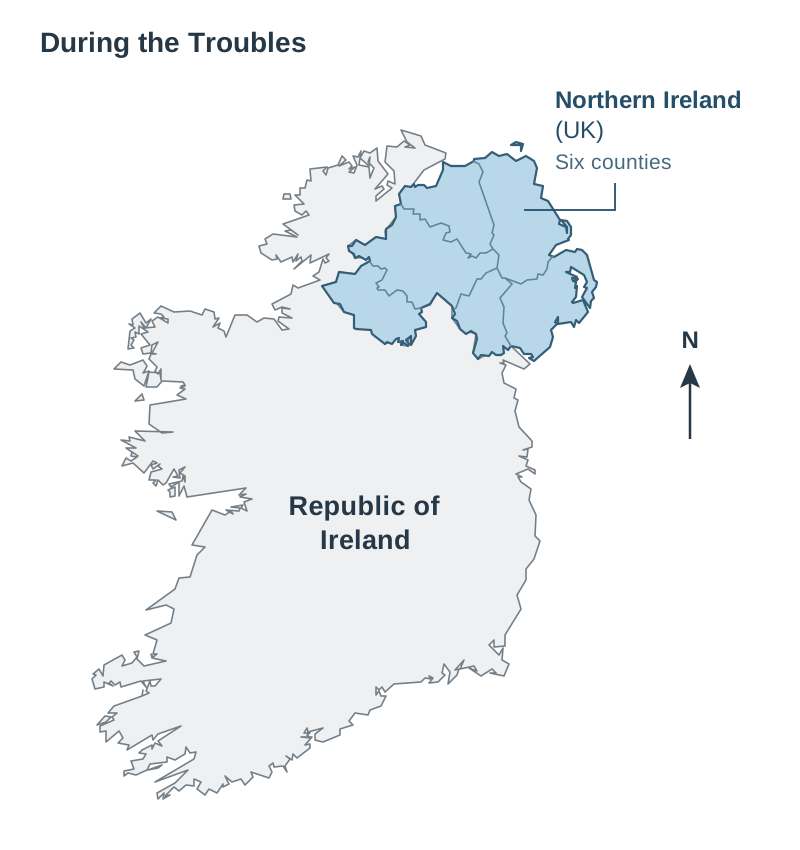
- Northern Ireland comprised six counties with its own parliament at Stormont, governed by a permanent unionist majority.
- About two-thirds of the population were Protestant unionists and about one-third Catholic nationalists.
Discrimination against the Catholic minority
| Area | Manifestation |
|---|---|
| Elections | Gerrymandering (rigging constituency boundaries) secured unionist council majorities even in Catholic areas. |
| Voting rights | Local elections required being a ratepayer, excluding many poorer Catholics, while businesses held plural votes. |
| Jobs and housing | Protestants were favoured in council housing and public jobs; Catholic men were about twice as likely to be unemployed. |
| Policing | The Royal Ulster Constabulary (RUC) and armed B-Specials were almost entirely Protestant and widely distrusted. |
Causes: 1960s reform and civil rights
- Terence O'Neill, Prime Minister of Northern Ireland, attempted economic reforms and met Taoiseach Seán Lemass in 1965 to improve North–South relations.
- O'Neill faced furious resistance from hardline unionists like Ian Paisley, while delivering little practical change for Catholics.
- Founded in 1967, the Northern Ireland Civil Rights Association (NICRA) was modelled on the US civil rights movement.
- NICRA demanded "one man, one vote", an end to gerrymandering, fair housing allocation, and the disbandment of the B-Specials.
- On 5 October 1968, the RUC baton-charged peaceful civil rights marchers in Derry. Television images of the violence won sympathy for the marchers worldwide.
- In August 1969, the Battle of the Bogside in Derry erupted into rioting, prompting the British government to deploy troops to restore order.
- The Provisional IRA formed to fight British rule, while loyalist paramilitaries — armed groups outside the state's forces, such as the UVF (Ulster Volunteer Force) and UDA (Ulster Defence Association) — attacked Catholics.
Course: key events (1971–1994)
| Date | Event and significance |
|---|---|
| Aug 1971 | Internment (imprisonment without charge or trial) was introduced. 342 men, almost all Catholics, were arrested on the first day, and many more later. It greatly boosted IRA recruitment. |
| 30 Jan 1972 | Bloody Sunday: British soldiers shot dead 13 unarmed marchers in Derry (a fourteenth died later), sparking worldwide outrage. |
| Mar 1972 | Stormont was suspended and direct rule from London began. |
| 1973–74 | The Sunningdale Agreement attempted power-sharing, but collapsed after the loyalist Ulster Workers' Council strike. In May 1974, UVF car bombs in Dublin and Monaghan killed 33 people. |
| 1981 | Ten republican hunger strikers died in the Maze Prison demanding political status, including Bobby Sands MP, boosting Sinn Féin politically. |
| 1985–94 | The Anglo-Irish Agreement (1985) gave Dublin a consultative role in Northern affairs. The Downing Street Declaration (1993) affirmed majority consent, leading to paramilitary ceasefires in 1994. |
The peace process and the Good Friday Agreement
In the 1990s John Hume (SDLP) and Gerry Adams (Sinn Féin) pursued talks, and multi-party negotiations chaired by US Senator George Mitchell produced the Good Friday Agreement, signed on 10 April 1998 and approved by referendums North and South.
- Power-sharing: A devolved Northern Ireland Assembly and Executive governed jointly by unionists and nationalists.
- Principle of consent: Northern Ireland remains part of the UK unless a majority of its people vote otherwise.
- Cross-border bodies: Formal institutions established for co-operation between Dublin and Belfast.
- Security and justice: Paramilitary decommissioning of weapons, early prisoner releases, and reforming the RUC into the Police Service of Northern Ireland (PSNI).
Consequences and impact on relations
Consequences of the Troubles
- About 3,500 people were killed and thousands injured; most victims were civilians.
- Communities became more divided, with segregated housing, schools and "peace walls" in Belfast.
- Stormont was shut down in 1972, and Northern Ireland was ruled from London for most of the next 25 years.
- The Northern economy suffered as bombings damaged town centres and reduced investment.
- In August 1998 a Real IRA bomb in Omagh killed 29 people, but the peace process survived.
- John Hume (SDLP) and David Trimble (UUP) shared the 1998 Nobel Peace Prize.
Impact on relations
- North–South relations: Relations between Dublin and Belfast were long strained by violence, but the 1998 agreement created permanent cross-border bodies.
- Anglo-Irish relations: After Bloody Sunday (1972), protesters burned the British Embassy in Dublin. After the Anglo-Irish Agreement (1985), London and Dublin worked together closely to build peace.
Key terms
- Unionist
- A person, usually Protestant, who wants Northern Ireland to stay part of the United Kingdom. Militant unionists are called loyalists.
- Nationalist
- A person, usually Catholic, who wants Northern Ireland to join a united Ireland. Nationalists who support the use of force are called republicans.
- Partition
- The division of Ireland under the Government of Ireland Act 1920, which took effect in 1921, creating Northern Ireland (six counties) and the rest of Ireland.
- Gerrymandering
- The rigging of constituency boundaries in an election to give an unfair advantage to one political party.
- Internment
- The arrest and imprisonment of suspects without charge or trial, introduced in Northern Ireland in August 1971.
- Bloody Sunday
- The shooting dead of 13 unarmed civil rights demonstrators (a fourteenth died later) by British soldiers in Derry on 30 January 1972.
- Direct rule
- The governing of Northern Ireland directly by the British government in London after Stormont was suspended in 1972.
- Principle of consent
- The rule that Northern Ireland remains part of the UK unless a majority of its population votes otherwise.
Check yourself
What did civil rights marchers demand under the slogan "one man, one vote"?
A vote in local elections for every adult, not just ratepayers and businesses.
Which Taoiseach and Northern Ireland Prime Minister met in 1965 to improve North–South relations?
Seán Lemass and Terence O'Neill.
What happened in Dublin following the Bloody Sunday shootings in Derry in 1972?
Outraged demonstrators burned down the British Embassy.
Who was the leader of the 1981 republican hunger strikes who was elected an MP before he died?
Bobby Sands.
What new police service replaced the Royal Ulster Constabulary (RUC) as part of the peace process?
The Police Service of Northern Ireland (PSNI).