

The Great Famine (1845–1850) was a disaster that changed Irish society, population and language for ever. Exam questions focus on its underlying causes, government and charitable relief, long-term consequences for Ireland, and the global impact of the Irish diaspora.
Why Blight Caused a Catastrophe
Before 1845, over eight million people lived in Ireland, with rural families living in deep poverty.
Several social factors turned a plant disease into mass starvation:
- Potato blight: A plant disease arrived in autumn 1845 and spread rapidly in damp weather, turning healthy potatoes into black rot.
- Potato dependency: About three million people, mostly cottiers and labourers, ate little except potatoes because potatoes grew well in poor soil and fed a family from a small plot.
- Land subdivision: Farms were divided among all sons over generations, leaving families on plots too tiny to grow grain.
- Lack of money: Cottiers paid rent through farm labour rather than wages, leaving them without cash to buy imported grain when crops failed.
The Course of the Famine and Relief Responses
The potato crop failed repeatedly between 1845 and 1849, and the worst suffering arrived during the freezing winter of Black '47.
Relief efforts were hindered by strict economic ideas:
- Crop failures: Part of the crop failed in 1845 and almost all of it in 1846. The 1847 harvest was tiny because seed potatoes had been eaten, and blight returned in 1848.
- Laissez-faire: The British government believed it should not interfere in the free market, so commercial food exports of livestock and grain from Ireland continued while people starved.
- Relief schemes: Prime Minister Robert Peel imported Indian maize meal, and public works schemes paid poor labourers to build roads.
- Workhouses and soup kitchens: Workhouses were overcrowded and plagued by typhus and cholera. From 1847, government soup kitchens fed around three million people a day, assisted by Quaker charities.
- Evictions: Under the Gregory clause, anyone holding over a quarter-acre of land was refused relief, forcing families to surrender farms or face eviction.
- Profiting from hunger: Gombeen men lent money and sold meal at extreme prices, while souperism offered food only to those who converted to Protestantism.
How the Famine Transformed Ireland
The disaster transformed Irish demographics, farming, and culture for over a century.
Key long-term consequences included:
- Population collapse: Roughly one million people died of hunger and disease, and over one million emigrated by 1851.
- End of subdivision: Farms were now passed down intact to the eldest son alone, forcing younger siblings to emigrate.
- Pasture farming: Landlords cleared bankrupt tenants and converted small tillage plots into cattle pastures.
- Language decline: Irish-speaking areas in the west lost the most people to death and emigration, speeding up the nationwide shift to English.
- Political bitterness: Anger over British relief policy hardened Irish nationalist feeling and demand for self-government.
Coffin Ships and the Irish Diaspora
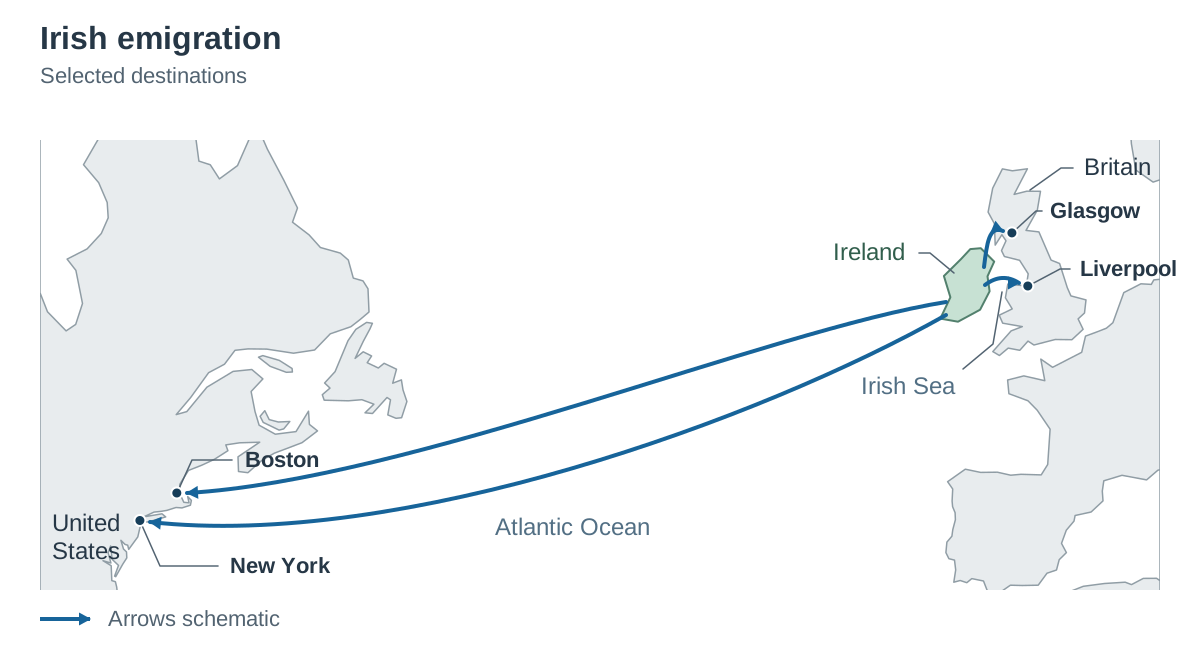
Fleeing starvation, hundreds of thousands boarded ships across the Irish Sea and the Atlantic Ocean, creating a worldwide Irish Diaspora.
- Coffin ships: Overcrowded, unseaworthy vessels carried emigrants across the Atlantic, with thousands dying at sea from fever (typhus) and hunger.
- Settlement in Britain: Emigrants crowded into slums in Liverpool and Glasgow, taking low-paid labouring jobs building canals and railways.
- Life in America: Irish emigrants landed in Boston and New York, facing anti-Catholic prejudice, but gradually secured steady employment and political influence.
- Remittances: Emigrants sent wages back home to clear family debts and buy passage tickets for relatives.
- Political support: Irish-Americans founded the Fenian Brotherhood in New York in 1858 and later funded the Land League and Irish independence movements.
Key terms
- Diaspora
- Where people of an ethnic group are dispersed around the world through emigration.
- Migration
- Movement of people from one place to another, especially in a different country.
- Potato Blight
- A plant disease that rots potato plants in damp weather, triggering the Great Famine.
- Cottier
- A poor rural labourer who rented a tiny plot of land in return for working on a farm.
- Subdivision
- The practice of dividing family land between all sons, resulting in unsustainable, tiny farm plots.
- Laissez-faire
- The economic belief that governments should not interfere in the working of the free market.
- Workhouse
- A large institution where completely destitute people received basic food and shelter in return for hard labour.
- Coffin Ship
- An overcrowded, unseaworthy emigrant vessel with very high death rates from disease and malnutrition.
Check yourself
Apart from blight, give one reason why the potato failure caused mass starvation.
Heavy dependence on the potato, subdivision of land into tiny plots, or cottiers having no cash savings.
Name two ways people were helped during the Great Famine.
Government soup kitchens and public works road-building schemes (also workhouses and Quaker charity).
What economic policy prevented the British government from banning food exports from Ireland?
Laissez-faire.
How did farm inheritance change after the Famine?
Subdivision ended, and the family farm was inherited by the eldest son alone.
What term describes money sent back to Ireland by emigrants living overseas?
Remittances.