

Matching pictures and words tests your ability to connect written German vocabulary, public signs, and short sentences to visual images. You may match words or sentences to pictures, or choose German words for forbidden items.
Recognising Public Signs and Places
Public notices appear frequently across Junior Cycle reading questions. Look for capital letters on signs — every German noun starts with a capital letter, which helps you spot the key word to match.
| German Sign | English Meaning | Visual Clues |
|---|---|---|
| Eingang | Entrance | Read the word rather than guessing from colour |
| Ausgang | Exit | Read Ausgang: it means exit. |
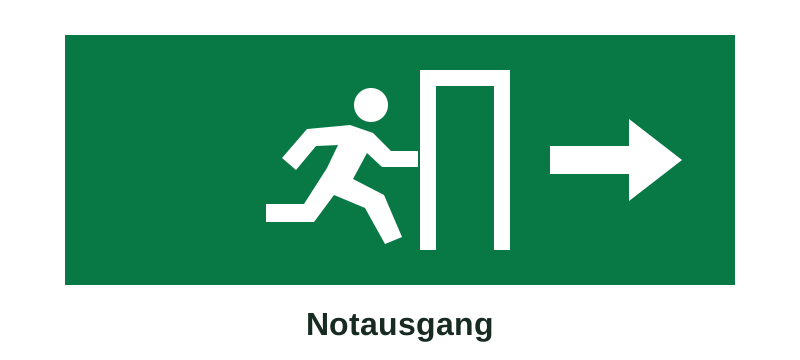
| Notausgang | Emergency exit | White running figure and arrow on a green background |
| Öffnungszeiten | Opening hours | Clocks, days of the week, times |
| Apotheke | Pharmacy / chemist | Red stylized 'A', green cross, medicines |
| Buchhandlung | Bookshop | Displays of books, shelves |
Rules, Prohibitions, and Offers
Signs often show what is forbidden or highlight a special deal. Missing a negative word can reverse the meaning of a sentence or notice.
- Verboten means forbidden or prohibited (for example, Rauchen verboten means no smoking).
- Nicht means not; kein means no or not a.
- Nicht erlaubt means not permitted; kein Zutritt means no entry.
- A crossed-out symbol shows a prohibition, such as swimming (Schwimmen), climbing (Klettern), or parking (Parken).
- Commercial notices highlight customer offers: Eintritt frei means free admission, while Sonderangebot signals a special offer or discounted price.
Decoding German Compound Nouns
German frequently joins two or more smaller words into a single compound noun. The last part tells you what the compound names; the earlier parts describe its kind.
| Compound Word | Breakdown | Meaning |
|---|---|---|
| Fahrradweg | Fahrrad (bicycle) + Weg (path) | Cycle path |
| Fahrkartenautomat | Fahrkarte (ticket) + Automat (machine) | Ticket machine |
| Bushaltestelle | Bus (bus) + Haltestelle (stop) | Bus stop |
| Obstsaft | Obst (fruit) + Saft (juice) | Fruit juice |
| Tierarzt | Tier (animal) + Arzt (doctor) | Vet |
Break long words down from the right to quickly find the matching picture.
Matching Sentences to Picture Stories
Some exam questions provide comic panels illustrating a daily routine or helpful action. You must match each frame to a German sentence by checking action verbs and time words.
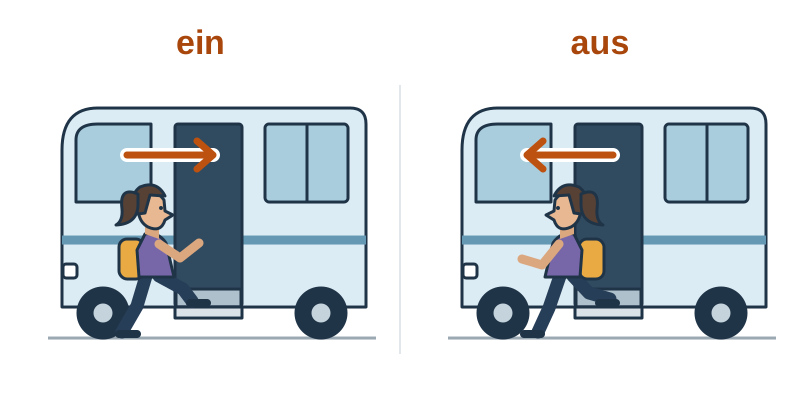
- Sie steigt in den Bus ein means she gets on the bus.
- Sie steigt aus dem Bus aus means she gets off the bus.
- Look for key objects in the illustration, such as die Schultasche (schoolbag) or der Zebrastreifen (zebra crossing).
- Check sequence words to follow the narrative: zuerst (first), dann or danach (then/afterwards), and am Ende (at the end).
Key terms
- Eingang / Ausgang
- Entrance and exit signs indicating the way into or out of a building or station.
- Verboten
- Forbidden or prohibited, used on warning signs to show an action is banned.
- Notausgang
- Emergency exit, indicated by a white running figure and arrow on a green background.
- Öffnungszeiten
- Opening times displayed on shop windows, museums, and offices.
- Eintritt frei
- Free admission: you do not pay an entrance fee.
- Sonderangebot
- A special offer or discounted price shown in shops or sales.
Check yourself
Which public sign should you follow to leave a train station: Eingang or Ausgang?
Ausgang (exit).
What does a sign reading 'Handys verboten!' mean?
Mobile phones are forbidden / not allowed.
Which part of the compound noun 'Bushaltestelle' tells you what it fundamentally is?
The final part, 'Haltestelle' (stop).
Picture 1 shows a boy boarding a bus. Picture 2 shows him stepping off. Which sentence matches which picture? A: Er steigt aus dem Bus aus. B: Er steigt in den Bus ein.
A matches Picture 2; B matches Picture 1.