

Longer listening pieces test your ability to follow spoken German conversations, phone calls, and announcements about everyday situations. In this section of the examination, you listen to recordings and answer questions.
Clip Types and Question Formats
Longer tracks test your understanding of everyday spoken German across three main contexts:
- Public announcements in train stations, airports, or shops about delays, cancellations, and opening hours.
- Phone calls regarding appointments, personal news, travel arrangements, or describing problems and symptoms.
- Conversations between friends or family about school, weekend plans, holidays, and hobbies.
Questions do not always require full sentences in English. Depending on the question, you may need to tick a box, circle True or False, or complete a grid or table. Always read the instructions carefully before each clip plays.
Decoding Times, Numbers, and Spelled Details
Exam questions frequently ask for precise numbers, times, or personal details:
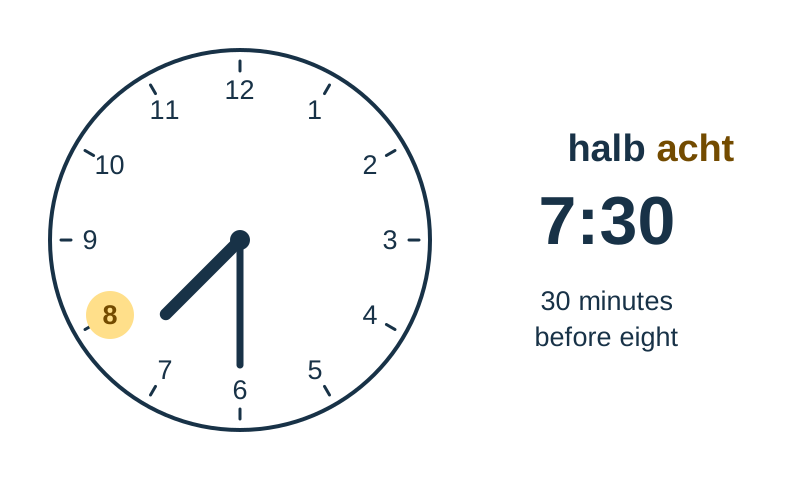
- Clock time with halb: halb plus an hour means half an hour before that hour, so halb acht is 7:30.
- Duration versus clock time: zwei Stunden means two hours, whereas um zwei Uhr means at two o'clock.
- Two-digit numbers: in numbers like fünfundzwanzig (25), the unit is spoken before the ten.
- Spelled names: Das schreibt man … introduces letter-by-letter spelling; note down letters immediately as you hear them.
- Phone numbers: record the digits in order, including any initial zero.
Signal Words and Negatives
German speakers use connecting words to indicate reasons, contrasts, or changes:
- Weil or denn introduces a reason or motive.
- Aber signals a contrast, turn, or change of plan.
- Leider indicates bad news, such as an illness or cancellation.
- Deshalb means therefore or so and introduces a result.
Listen carefully for negatives that change meaning entirely. Words like nicht (not), kein / keine (no / not any), and nicht mehr (no longer) completely reverse a statement, such as Es frisst nicht mehr (It no longer eats).
Exam Strategies and Marking Rules
Approaching the audio with a clear method protects your marks:
- Use pre-listening time: predict whether each question requires a time, place, or reason.
- First listen for the overall situation; use subsequent playings to confirm exact details and fill gaps.
- Write clearly and check names and numbers when the recording is repeated.
Key terms
- halb
- Indicates half an hour before the named hour.
- die Durchsage
- A spoken announcement made over a public loudspeaker at a station, airport, or school.
- die Verspätung
- A delay, usually accompanied by a number of minutes or hours.
- abgesagt
- Cancelled; indicates that a planned journey, class, or event will not take place.
- der Termin
- An appointment or fixed meeting, such as a visit to the doctor or vet.
- der Grund
- The reason or explanation given for a problem, action, or change of plan.
Check yourself
What English clock time is meant by 'halb zehn'?
9:30.
What English number is 'sechsundvierzig'?
46.
A speaker says: 'Es frisst nicht mehr.' Does the animal still eat?
No, it no longer eats.
Which German word signals bad news like a breakdown or cancellation?
Leider (unfortunately).