

Reading comprehension at Junior Cycle tests your ability to extract factual details, times, prices, and personal details from everyday German texts. Questions may ask for short answers, table entries, or True/False choices, so always follow the answer-language instruction.
Skimming, Scanning, and Question Words
You do not need to translate every word to find the right information. Read the questions first so you know what details to look for.
- Scan for related words, names, or numbers, then read the surrounding sentence.
- Wer? asks who, pointing to a person or family member.
- Wo? asks where, pointing to a location.
- Wohin? asks where to, pointing to a destination or direction.
- Wann? asks when, pointing to a time, day, or date.
- Warum? asks why, pointing to an explanation.
- For reasons, weil and denn mean because, but a reason can appear without either word.
Notices, Signs, and Everyday Formats
Exam texts often use short public notices, brochures, and messages. Spotting layout clues lets you locate answers quickly.
- Public notices state rules: Rauchen verboten means smoking is forbidden.
- Instructions direct visitors: Bitte hier warten means please wait here.
- Directions guide movement: geradeaus means straight ahead, while links and rechts mean left and right.
- Menus list meals and courses: Frühstück means breakfast, Mittagessen means lunch, and Hauptgerichte means main courses.
- Menus mark dietary information clearly: ohne Fleisch means without meat.
- Letters and emails show the recipient at the top greeting and the sender at the bottom signature.
- Forms ask for personal details like Vorname (first name), Nachname (surname), and Geburtsdatum (date of birth).
Numbers, Dates, Times, and Prices
Many exam questions test exact figures. Read the words beside numbers carefully to see what they apply to.
- German prices use a comma for decimals, such as 4,50 €.
- Check what an amount covers, as general admission (Eintritt) may be free while renting equipment costs extra.
- Dates place the day before the month:
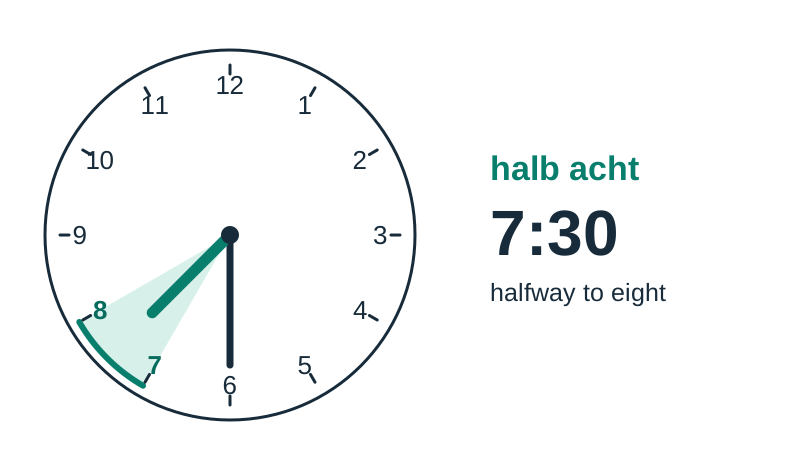
05.09.means 5th September, not 9th May. - Time expressions look forward: halb acht means 7:30 (halfway to eight), not 8:30.
- Age limits use ab: ab 12 Jahren means suitable for ages 12 and older.
- Transport schedules show frequency: alle 20 Minuten means every 20 minutes.
Sentence Decoding and True/False Strategy
Long German sentences and compound nouns become simple once you break them into pieces.
Break compound nouns from the back: in Kochunterricht, der Unterricht means lesson and kochen means to cook, giving 'cooking class'.
- Read the whole sentence to the end because key verbs or negatives often appear there.
- Watch for negatives: nicht means not, and kein means no or not a.
- Ich kann heute nicht kommen means I cannot come today.
- For richtig / falsch questions, locate the exact sentence in the German text that proves or disproves each statement.
- Do not guess from the general topic alone.
- Watch for classic exam traps: a changed number, a swapped town, or an added negative that flips the meaning.
Key terms
- die Öffnungszeiten
- Opening hours or times when a venue or business is open.
- der Eintritt
- Admission or entry fee required to enter a venue.
- der Absender
- The sender of a letter, email, or parcel.
- der Empfänger
- The recipient who receives a letter or message.
- das Geburtsdatum
- Date of birth, written in German in day.month.year format.
- verboten
- Forbidden or banned by a rule or notice.
- richtig
- True or correct in comprehension statements.
- falsch
- False or incorrect in comprehension statements.
Check yourself
What does a menu mean when it labels a meal 'ohne Fleisch'?
It means the dish is prepared without meat.
If an advert states that an event is 'ab 14 Jahren', who can attend?
People aged 14 and older.
In the Kletterhalle notice, true or false: school students pay €3 admission?
False; admission costs €7.00, while €3.00 is the shoe hire fee.
How often does a bus depart if the timetable states 'alle 15 Minuten'?
Every 15 minutes.