

German listening tasks test your understanding of everyday conversations. Identify the main topic and specific details, such as times, places, prices, opinions and reasons.
Exam Setup and Question Words
Listening is assessed in Section A of the final examination. Follow paper and recording instructions for playings and pauses. Use the reading time beforehand to look at questions and underline question words to know what to listen for.
| Question Word | Meaning | What to Listen For |
|---|---|---|
| Wer? | Who? | A person, friend, or relative |
| Wo? / Wohin? | Where? / Where to? | A place (am Bahnhof) or destination (nach Berlin) |
| Wann? | When? | A time, day of the week, or date |
| Warum? | Why? | A reason or explanation (often after weil) |
| Wie viel? | How much? | A price, quantity, or number |
| Wie lange? | How long? | A duration of time (zwei Stunden) |
Recognising Speakers, Register, and Instructions
Friends and family speak informally using du or ihr, casual greetings like Hallo, and requests such as Kannst du...?.
Polite Sie is used with adults you do not know well and in formal situations: Können Sie mir helfen?. Children and teenagers are addressed as du.
Conversations often include basic directions and instructions:
- links (left), rechts (right), geradeaus (straight ahead), e.g. Gehen Sie geradeaus, dann links.
- Classroom instructions include Setz dich (Sit down) and Mach bitte die Tür auf (Open the door, please).
Times, Numbers, and Prices
- German says units before tens: fünfundzwanzig is 25 (five-and-twenty), not 52.
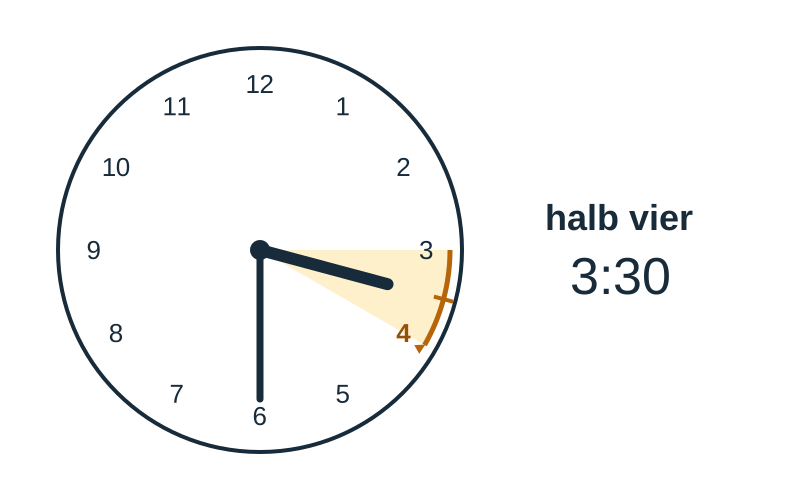
- Halb means halfway towards the named hour: halb vier is 3:30, not 4:30.
- Quarters use nach (past) and vor (to): Viertel nach drei is 3:15; Viertel vor drei is 2:45.
- Spoken prices give euros then cents: vier Euro fünfzig is €4.50.
Plans, Opinions, and Reasons
- Aber (but) and leider (unfortunately) can signal a problem or change of plan.
- Lieber introduces an alternative choice: Lieber um vier (Preferably at four).
- Nicht (not) and kein (no/none) express negation: Ich habe keine Zeit.
- Weil (because) signals a reason and pushes the verb to the end: ...weil ich lernen muss.
- Opinions: listen for gern (Ich spiele gern Fußball) and Ich finde das toll / langweilig.
Key terms
- das Gespräch
- A conversation or dialogue between speakers.
- der Treffpunkt
- The agreed meeting place or location.
- die Uhrzeit
- The clock time.
- halb
- Halfway towards the named hour in time-telling (halb sechs is 5:30).
- weil
- Conjunction meaning 'because', introducing a reason.
- gern
- Adverb used with a verb to express enjoying an activity.
Check yourself
What clock time is 'halb zehn'?
9:30 (half past nine).
What direction does 'geradeaus' mean in an instruction?
Straight ahead.
What does 'Ich spiele nicht gern Tennis' mean?
I do not like playing tennis.
Which word means 'because' and sends the verb to the end of its clause?
Weil (because).
What number is 'zweiundvierzig'?
42.