

Globalisation is the process where the world's economies, societies and cultures become increasingly connected and dependent on each other. The Junior Cycle exam tests how this global interconnectedness drives population movement, reshapes settlements and creates unequal human development.
Drivers of Globalisation and Multinational Corporations
Globalisation depends on goods, money and ideas moving quickly between countries. Three modern systems make this happen: telecommunications (the internet and mobile networks for instant communication), banking and finance (electronic transfers that allow continuous worldwide trade), and modern transport (large container ships, air freight and motorways that make moving goods cheap and reliable).
A multinational corporation (MNC) has its headquarters in one country and operates offices or factories in others. Many manufacturing MNCs are footloose, meaning they are not tied to any raw material and can locate anywhere to cut production costs.
MNCs bring formal factory jobs and tax revenue to developing countries. However, workers often face low pay, long hours and unsafe conditions. For example, the 2013 Rana Plaza collapse in Bangladesh killed over 1,000 garment workers making clothes for Western retailers.
Global Patterns of Development and Life Chances
Countries are grouped by income: low, lower middle, upper middle and high income. The global pattern of wealth is deeply uneven. Most high-income countries lie in the north, including Europe, North America and Japan, alongside Australia and New Zealand. Most low-income countries lie in sub-Saharan Africa and parts of southern Asia. This divide is called the development gap.
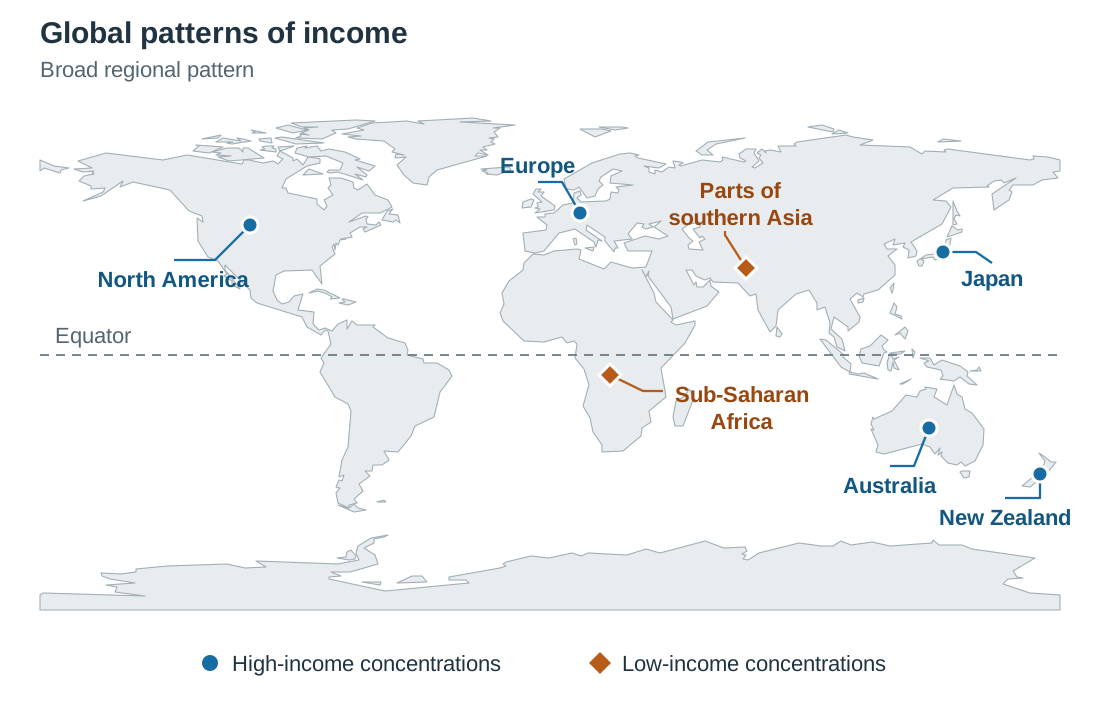
Where you are born directly affects your life chances across four main areas:
- Education: Free and compulsory up to age 16 in Ireland, while school fees and distance keep many children out after primary school in Malawi.
- Health care: Accessible hospitals and free childhood vaccinations in Ireland, compared to distant clinics and a severe shortage of doctors in Malawi.
- Employment: Mostly tertiary services with legal rights and steady wages in Ireland, compared to low-income subsistence farming in Malawi.
- Gender equality: Girls and boys stay in school at equal rates in Ireland, whereas girls in poorer countries often leave earlier to work or marry.
Development Assistance and Fairtrade
Wealthy donor countries provide assistance to poorer recipient countries to help reduce poverty:
- Bilateral aid: Given directly from one government to another, such as Irish Aid supporting health and farming in Malawi.
- Multilateral aid: Channeled through international organisations such as the United Nations.
- Emergency aid: Food, shelter and medicine provided during a crisis like a flood, earthquake or famine.
- Development aid: Long-term funding to improve infrastructure, such as training teachers, building clinics and drilling clean water wells.
- Tied aid: Aid given with conditions attached, such as forcing the recipient country to buy equipment from the donor.
Alongside aid, Fairtrade tackles unfair global trade rules. It guarantees small-scale farmers in developing countries a stable minimum price for crops like coffee, plus an extra social premium to invest in local schools and clinics.
Synthesis: Linking Population, Settlement and Development
To synthesise means to draw together different ideas and information to create a deeper geographical understanding. Globalisation accelerates urbanisation, which is the increase in the proportion of a country's population living in towns and cities. In rapidly expanding cities like Kolkata, India, about one in three people live in informal shanty settlements called bustees, which lack piped water, electricity and sewerage.
Use these four steps to build a longer answer worth more marks:
- Economic investment: An MNC opens a manufacturing plant in a developing country to reduce operating costs.
- Population movement: Low farming returns push people from rural areas, while factory wages pull them into cities.
- Settlement change: Rapid population growth outpaces housing and pipe networks, causing informal bustees to multiply.
- Human development outcomes: Factory wages provide steady household income, but overcrowded conditions and contaminated water limit healthcare gains and life expectancy.
Key terms
- Globalisation
- The process by which the world's economies, societies and cultures become increasingly connected and interdependent.
- Multinational Corporation (MNC)
- A company with its headquarters in one country and operational branches or factories in other countries.
- Footloose Industry
- An industry that is not tied to a specific raw material or location and can relocate easily to reduce costs.
- Development Gap
- The difference in wealth, income and quality of life between the world's richest and poorest countries.
- Bilateral Aid
- Development assistance given directly from the government of one country to the government of another.
- Tied Aid
- Foreign aid provided with strict conditions, such as requiring the recipient nation to purchase goods from the donor country.
- Fairtrade
- A trading system that guarantees small producers a fair minimum price and an extra premium for community development.
- Urbanisation
- The increase in the proportion of a country's total population living in towns and cities compared to rural areas.
Check yourself
Name three modern systems that drive the process of globalisation.
Telecommunications, international banking and finance, and modern transport.
Name one high-income country and one low-income country.
Ireland is a high-income country; Malawi is a low-income country.
Why is an industry described as footloose?
It is not tied to a specific raw material and can locate anywhere to find cheaper labour or lower costs.
What is tied aid?
Aid given to a country with specific conditions attached, such as spending the money on goods from the donor nation.