

Economic inequality describes how wealth, income, and opportunities are distributed unevenly between countries and communities. In the exam, you will interpret global income data, compare young people's life chances, evaluate development assistance, and explain how globalisation affects settlement and population.
Measuring Economic Development
Geographers measure economic growth and living standards using both wealth and social indicators.
- Gross National Income (GNI) is the total income earned by a country's residents and businesses in a year.
- GNI per capita calculates the average income per person by dividing GNI by total population, though it can hide wide gaps between rich and poor.
- The Human Development Index (HDI) measures quality of life by combining income, life expectancy, and average years of schooling into a score from 0 to 1.
- The World Bank divides countries into four official income brackets using GNI per capita:
| Income Bracket | Example Countries |
|---|---|
| Low income | Ethiopia, Chad |
| Lower middle income | India, Kenya |
| Upper middle income | Brazil, China |
| High income | Ireland, Germany |
Global Wealth Patterns and Obstacles to Development
Wealth is distributed unevenly across the globe, creating clear regional patterns.
- The North–South divide describes an economic gap between richer and poorer nations rather than a line along the Equator.
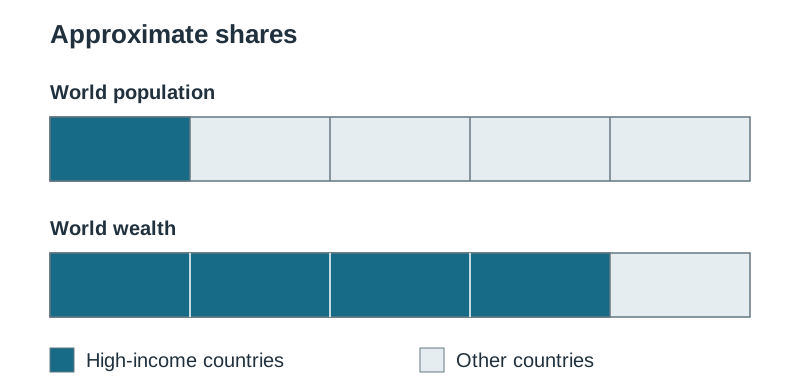
- About one fifth of the world's people live in high-income countries, but they hold roughly four fifths of the world's wealth. Poorer countries in the South have only a small share of the world's wealth.
- Developing economies rely heavily on primary economic activities (farming, mining), whereas developed nations depend on tertiary activities (services, technology).
Factors slowing development: Ethiopia
- Unfair trade: Ethiopia exports cheap raw materials like coffee but imports costly manufactured goods, leaving it earning less than it spends.
- Conflict: War destroys farmland and roads while diverting government funding away from schools and clinics.
- Climate: Repeated droughts cause severe crop failures and famine.
- Rapid population growth: Scarce resources are consumed by basic food needs rather than infrastructure.
Comparing Life Chances: Ireland and Tanzania
A person's birthplace directly affects their life chances and access to basic services.
| Feature | Developed Country (Ireland) | Developing Country (Tanzania) |
|---|---|---|
| Gender equality | High female literacy (99%) and equal legal rights to education and work. | Early marriage and pregnancy often force girls to leave secondary school permanently. |
| Healthcare | Piped clean water, routine vaccinations, and hospitals support a life expectancy over 80 years. | High child mortality from treatable diseases like malaria; rural clinics face supply shortages. |
| Employment | Regulated jobs in services and technology with statutory minimum wages and protections. | Most workers rely on low-income subsistence farming or unregulated day labour. |
| Education | Free State-funded schooling, compulsory to age 16; most students go on to further or third-level education. | Overcrowded rural classrooms of up to 100 students; private secondary fees are unaffordable for most. |
Evaluating Development Assistance
Development assistance (aid) provides financial help, goods, or technical expertise to developing nations.
- Emergency aid delivers immediate food, clean water, and medical care to save lives during crises.
- Long-term (development) aid pays for lasting projects, such as building schools and water wells.
- Aid improves healthcare by building clinics, supplying vaccines, training local nurses, and drilling clean water wells to prevent cholera.
- Bilateral aid is given directly from one government to another, such as Irish Aid in Tanzania.
- Multilateral aid is pooled through international bodies like the United Nations.
- Non-Governmental Organisations (NGOs), such as Trócaire and Concern, provide community-level support independently.
Evaluating aid requires looking at both sides:
- Benefits: Emergency aid prevents starvation, and funding has paid for vaccination programmes that have sharply cut deaths from measles in Tanzania.
- Problems: Corrupt officials can misdirect funds, recipient nations can develop dependency, and tied aid forces recipients to spend funding on donor-country goods.
Globalisation, Settlement, and Population
Globalisation connects economies through faster transport, telecommunications, and multinational corporations (MNCs).
- Better transport and communications mean many factories are footloose — they can be built almost anywhere, so companies choose countries where wages are low.
- Urban jobs trigger rapid rural-to-urban migration.
- Cities grow faster than housing, water, and sewerage can be provided, so shanty towns (informal settlements like Kolkata's bustees) spread.
- Inequality also exists inside cities: the centre has modern offices, while nearby shanty towns have no clean water, sewerage, or electricity.
- In developing countries, high birth rates produce very young populations, requiring heavy spending on schools and basic care.
- In developed countries, low birth rates create ageing populations, shifting government spending toward pensions and elder care.
Key terms
- Economic inequality
- The unequal distribution of income, wealth, and opportunities between different individuals, regions, or countries.
- GNI per capita
- A country's Gross National Income divided by its total population, indicating the average income per person.
- Human Development Index (HDI)
- A United Nations metric combining income, life expectancy, and education into a score between 0 and 1.
- Life chances
- The practical opportunities an individual has to improve their quality of life, including healthcare, education, and work.
- North–South divide
- The socio-economic gap between the wealthier developed world and the poorer developing world.
- Development assistance
- Financial, technical, or material aid provided by governments or charities to improve living standards in poorer nations.
- Tied aid
- Foreign aid that must be spent on goods and services supplied exclusively by the donor country.
- Globalisation
- The ongoing process by which world economies, cultures, and populations become increasingly connected and interdependent.
Check yourself
What three indicators are combined to calculate a country's Human Development Index (HDI)?
Gross National Income per capita (income), life expectancy (health), and average years of schooling (education).
What is the key difference between bilateral aid and multilateral aid?
Bilateral aid passes directly from one government to another, while multilateral aid is pooled through international bodies like the UN.
Name two factors that have slowed development in a named developing country.
In Ethiopia, repeated droughts have caused crop failure and famine, and conflict has destroyed essential infrastructure and farmland.
How does economic globalisation cause shanty towns to expand in developing cities?
Footloose factories create urban jobs, sparking rapid rural-to-urban migration that outpaces the supply of planned housing and water infrastructure.