

In Leaving Certificate Religious Education, the study of creation explores how religious traditions and modern science understand the origins, nature, and purpose of the universe. The syllabus asks you to outline the understanding of creation in one tradition (Buddhism, Christianity, Hinduism, Islam, or Judaism) and contrast it with another. A monotheistic tradition and a cyclical tradition make an especially clear contrast. These topics appear in Section J (Religion and Science, Part 2.4; Part 3.1 on cosmologies applies if your class studies Part 3 rather than Part 4) and Section F (Issues of Justice and Peace, Part 3.2). Note that in any given examination year, two sections from Unit Three are designated for coursework and will not appear on the terminal written paper; check with your teacher which sections apply to your cohort.
Theology and Science: Different Inquiries and Modern Debates
A central skill in Section J is distinguishing what religious creation accounts set out to do from what empirical science investigates. Theology and science explore different dimensions of human experience and answer different questions.
The 'Who and Why' Versus the 'How'
- Theological inquiry explores questions of ultimate origin, divine intention, purpose, and moral duty. It asks 'who' created reality and 'why' the universe exists, treating scripture as a disclosure of spiritual meaning and value.
- Scientific inquiry investigates physical mechanisms, natural processes, and chronological development. It asks 'how' the physical cosmos functions, relying on empirical observation, mathematical models, and falsifiable hypotheses.
Treating scriptures like Genesis or the Qur'an as literal physics textbooks distorts their religious function. They exist to reveal truths about God, human dignity, and ethical responsibility.
Conflict Versus Dialogue: A Reasoned Evaluation
When examining the relationship between religion and science, two primary stances emerge:
- The conflict view: Thinkers such as evolutionary biologist Richard Dawkins argue that empirical science provides the only valid path to truth. In this view, scientific discoveries render religious accounts obsolete, reducing faith to unprovable superstition.
- The dialogue view: Theologians and scientists, including the Belgian physicist-priest Georges Lemaître, argue that science and theology are complementary rather than contradictory. In 1996, Pope John Paul II affirmed this stance to the Pontifical Academy of Sciences, noting that physical evolution is 'more than a hypothesis' while maintaining that the human soul remains a divine gift.
A balanced evaluation recognises that conflict usually arises from fundamentalism on either side: biblical literalism that rejects empirical findings, or scientific materialism that denies any dimension beyond physical matter. When both disciplines respect their own boundaries, dialogue clarifies both physical facts and moral duties.
The Big Bang Theory and Religious Cosmologies
A cosmology is an account of the origin, structure, and nature of the universe as a whole. When studying Section J Part 3, practise comparing scientific and religious accounts of creation and distinguishing ancient from contemporary cosmologies.
The Big Bang Theory
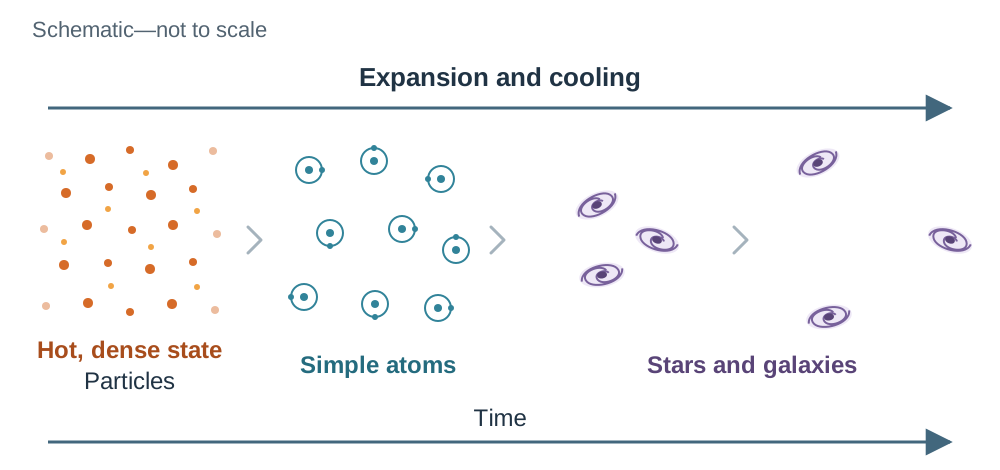
The Big Bang is the prevailing scientific model explaining the expansion and development of the universe. It states that roughly 13.8 billion years ago, the universe was in an extremely hot, dense state and has since expanded and cooled. As the cosmos expanded and cooled, subatomic particles formed simple atoms, which eventually coalesced under gravity to form stars and galaxies.
The theory developed, and is supported by evidence, as follows:
- In 1927 Georges Lemaître showed mathematically that the universe could be expanding; in 1931 he proposed that it began from a 'primeval atom'.
- In 1929, Edwin Hubble reported a relationship between galaxies’ distances and their redshifts, interpreted as recession speeds. This provided evidence for cosmic expansion; it does not make Earth the centre of the universe.
- In 1965, Arno Penzias and Robert Wilson detected cosmic microwave background radiation, the faint leftover thermal glow from the early universe.
Ancient Cosmologies: The Babylonian Enuma Elish Versus Genesis 1
Ancient cosmologies used mythological narratives to reflect the culture and anxieties of their societies:
- In the Babylonian Enuma Elish, the universe is born out of violent cosmic warfare. The warrior god Marduk defeats the chaos goddess Tiamat, cleaves her corpse to make the sky and earth, and forms human beings from the blood of a slain rebel god (Kingu) to serve as slave labour for the gods.
- In Genesis 1, which many scholars date to the time of the Babylonian Exile or soon after, the text counters this worldview. There is one supreme God who speaks creation into an orderly cosmos ('Let there be light') without conflict or rival gods. The sun and moon are not deities to be feared, but created lamps to mark seasons. Human beings are not slaves, but creatures made in the imago Dei (image of God) with inherent dignity and royal responsibility.
Monotheistic Creation: Genesis, Christianity, and Islam
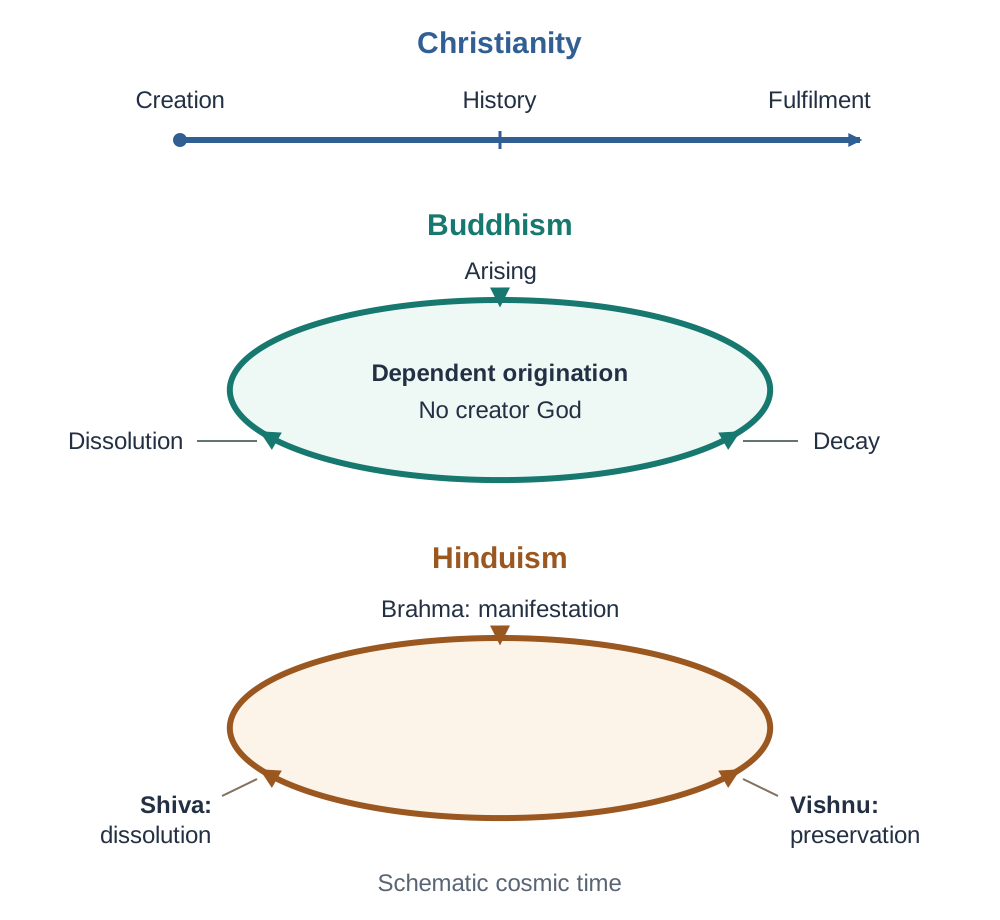
The Abrahamic traditions share a linear understanding of time, running from a decisive historical beginning through human history towards ultimate judgement and redemption.
Judaism and Genesis: Order Out of Chaos to Ex Nihilo
Genesis 1:1–2:3 describes God bringing order out of dark, watery chaos over six days, pronouncing creation 'good' and finally 'very good', and resting on the seventh day (Sabbath). While early texts describe God fashioning this chaotic matter, Jewish and Christian tradition came to understand this creative act as creatio ex nihilo (creation out of nothing), a doctrine explicitly expressed in 2 Maccabees 7:28. God did not depend on pre-existing materials; nothing exists independent of God's will.
Christianity: Creatio Continua and Divine Immanence
Christian theology pairs creatio ex nihilo with creatio continua (continuous creation). God is not an absent watchmaker who wound up the universe and walked away. Instead, God actively sustains the physical laws and life of the universe moment by moment. God is both transcendent (existing beyond the world) and immanent (actively present within the world through the Holy Spirit).
Islam: Tawhid, Khalifah, and the Book of Signs
Islamic creation theology centres on Tawhid—the absolute oneness and sovereignty of Allah. The Qur'an teaches that Allah brought the heavens and the earth into being by divine command ('Kun fa-yakun' / 'Be, and it is') over six periods (ayyam):
- Book of signs (ayat): The physical world is not divine, but every creature, star, and natural cycle acts as an ayah* (sign) pointing reason toward Allah's wisdom.
- Mizan (cosmic balance): Allah established the created order in delicate, perfect equilibrium.
- Khalifah (vicegerent/steward): Humans are appointed as caretakers on Earth. Humanity does not own nature; we hold it in sacred trust (amanah). Greed and wasteful consumption (israf) violate this balance.
Cyclical Worldviews: Buddhism and Hinduism
In contrast to belief in one Creator God, Buddhism and Hinduism understand reality through cyclical time, where universes arise, decay and dissolve across vast aeons.
Buddhism: Dependent Origination Without a Creator God
Buddhism does not teach that a supreme creator God made the universe. The Buddha regarded metaphysical arguments over whether the universe had a beginning as avyakata (undeclared questions):
- In the Parable of the Poisoned Arrow, the Buddha compared someone demanding to know the ultimate origin of the cosmos to a warrior shot with an arrow who refuses treatment until he learns the archer's caste, name, and bowstring material. He dies before the poison can be drawn. Speculating about cosmic beginnings does not remove suffering (dukkha) or bring enlightenment (nirvana).
- Dependent origination (pratītyasamutpāda): All mental and physical phenomena arise only in dependence on interacting conditions. When conditions come together, things appear; when conditions end, they dissolve. There is no uncaused first cause.
- Saṃsāra and Anicca: The universe moves through beginningless cycles of time across cosmic aeons (kalpas). Everything within conditioned reality is marked by anicca (impermanence).
Hinduism: Brahman, the Trimurti, and the Yugas
Hinduism is not non-theistic; it presents a vibrant theistic and philosophical framework centred on Brahman (the ultimate, unchanging reality underlying all phenomena). Matter is never created from absolute nothingness; instead, it is repeatedly manifested and dissolved:
- The Trimurti: The three primary aspects of the divine oversee cosmic cycles. Brahma oversees manifestation (srishti), Vishnu maintains and preserves cosmic order (dharma), and Shiva dissolves the universe (pralaya) so it can begin anew.
- The Yugas: Time moves through repeating cycles. A single mahayuga lasts 4,320,000 years and is made up of four cosmic ages (yugas) of declining moral virtue: Satya Yuga (golden age), Treta Yuga, Dvapara Yuga, and the current dark age of moral decline, the Kali Yuga. At the end of the Kali Yuga, the cycle renews and a new Satya Yuga (golden age) begins.
- Cosmic humility in the Nasadiya Sukta: The Creation Hymn of the Rig Veda openly questions ultimate beginnings, asking who truly knows how the universe arose, noting that even the gods came after creation.
Humanity's Status and Environmental Ethics
How a religious tradition views creation directly shapes how its followers treat the earth.
The Biblical Debate: Domination Versus Stewardship
In Genesis 1:28, humanity is told to subdue the earth and have dominion (radah):
- In 1967, historian Lynn White published an influential essay arguing that this concept of dominion had been interpreted as licence for human exploitation, helping cause the Western ecological crisis by placing humans above nature.
- Christian and Jewish theologians countered that dominion must be read alongside Genesis 2:15, where humanity is placed in Eden to 'till it and keep it'. This establishes stewardship: humans are accountable caretakers serving God's creation, not exploiters.
Jewish Environmental Precepts
Jewish legal tradition (halakhah) derives specific conservation mandates from scripture:
- Bal tashchit ('do not destroy', Deuteronomy 20:19–20): Originally forbidding the cutting down of fruit trees during warfare, rabbinic law expanded this into a general prohibition against waste, pollution, and the wanton destruction of natural resources.
- Sabbath: A weekly day of rest for humans and domestic animals (Exodus 20:8–11; 23:12), restraining constant commercial production and consumption; this challenges today's non-stop consumption that drives resource depletion and emissions.
- Schmittah: The sabbatical year: every seventh year the land lies fallow (Leviticus 25:1–7) and debts are released (Deuteronomy 15:1–2), protecting soil from exhaustion, relevant to soil exhaustion and degradation from intensive farming.
- Jubilee: Every fiftieth year (Leviticus 25:8–17), land returns to its original family owners and indentured servants are freed. Grounded in Leviticus 25:23 ('The land is mine; with me you are but aliens and tenants'), it prevents permanent land accumulation and resource inequality, relevant to land-grabbing and the unequal ownership of resources, where the poor lose access to land and water.
Buddhist Environmental Action: Tree Ordination
Because dependent origination teaches that all life is interconnected, damaging ecosystems harms all sentient beings. In Thailand, monks in the 'ecology monk' movement perform tree ordination ceremonies (buat ton mai). By chanting prayers and wrapping sacred saffron robes around ancient, threatened trees, monks make the trees sacred in the eyes of local communities, deterring loggers and educating the public on conservation.
The Contemporary Ecological Crisis: Scientific and Theological Perspectives
Section J (Part 2.4) requires candidates to outline the contemporary ecological crisis and examine perspectives from both a named scientist and a named theologian.
Main Features and Origins of the Ecological Crisis
The contemporary crisis includes global climate change driven by greenhouse gas emissions, rapid biodiversity loss and species extinction, deforestation, widespread ocean and plastic pollution, and the depletion of fresh water and fertile topsoil.
Key historical and social causes include:
- The Industrial Revolution and global economic dependence on fossil fuels.
- Exponential human population growth driving unsustainable consumption.
- A consumer culture that treats nature merely as an expendable resource for short-term profit.
- Global structural inequality, where wealthy nations have produced most of the historical carbon emissions while developing nations suffer the worst droughts, storms and floods.
A Named Theologian: Seán McDonagh
Seán McDonagh is an Irish Columban missionary priest and eco-theologian, born in 1944. During his work with the indigenous T'boli people in Mindanao, Philippines, he witnessed first-hand how corporate clear-felling of rainforests destroyed local biodiversity and drove vulnerable communities into poverty. He articulated his vision in landmark books, including To Care for the Earth (1986) and The Greening of the Church (1990).
McDonagh's key ideas:
- The environmental crisis is primarily a spiritual and moral failure, not just a technical or economic hitch.
- Western theology focused too narrowly on human salvation, forgetting that creation as a whole is redeemed in Christ.
- Environmental destruction is inseparable from social injustice; the poor suffer first and worst from environmental breakdown.
- McDonagh's work directly influenced Pope Francis's 2015 encyclical Laudato Si', which calls the earth 'our common home' and demands an integral ecology uniting ecological protection with social justice.
A Named Scientist: James Lovelock
James Lovelock (1919–2022) was an English chemist and environmental scientist who developed the Gaia hypothesis from ideas arising during his 1960s work on planetary life detection for NASA and published it in the 1970s.
Lovelock's key ideas:
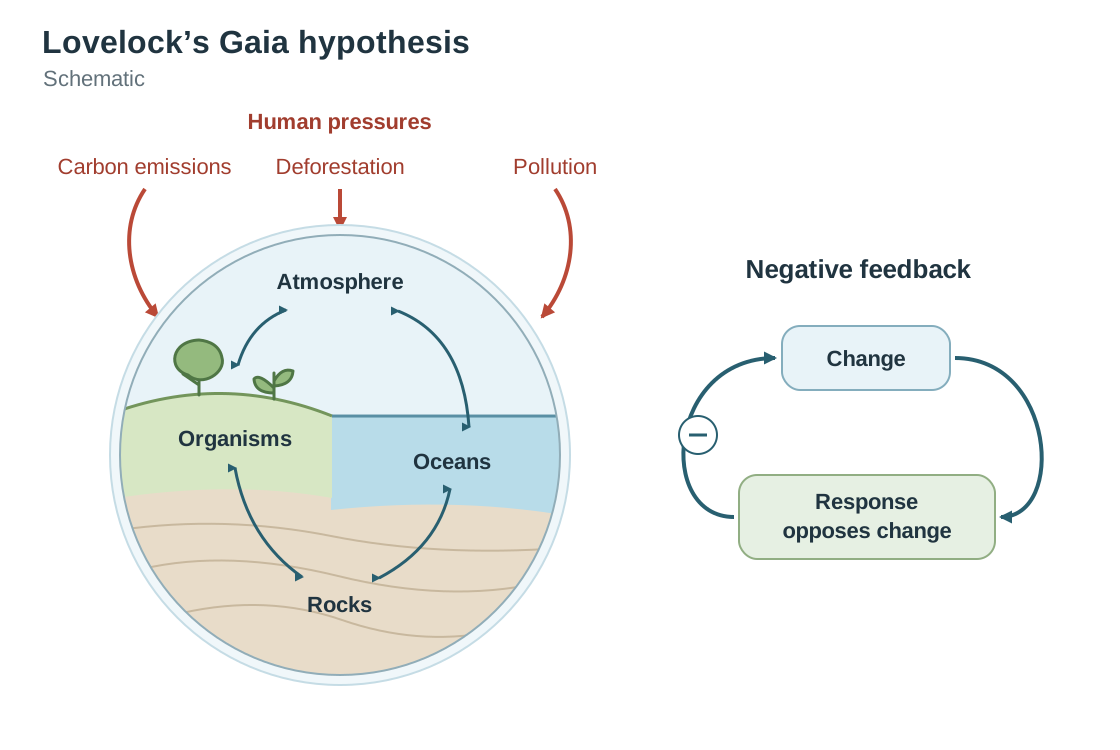
- The Earth functions as a single, complex, self-regulating super-organism. Living organisms interact with inorganic rocks, oceans, and the atmosphere to maintain stable conditions (such as planetary temperature and atmospheric oxygen levels) suitable for life.
- Excessive human carbon emissions, deforestation, and industrial pollution are overwhelming Gaia's negative feedback loops.
- While the planet itself will eventually survive and re-stabilise, Lovelock warned it could shift into a much hotter state that is hostile to human civilisation.
Contrasting the Two Perspectives
Lovelock analyses the crisis empirically using systems biology, physics, and planetary science, warning of catastrophic physical consequences if negative feedback loops break down. McDonagh addresses human hearts and moral duties, arguing that caring for nature is a religious obligation to the Creator and an act of solidarity with the poor. Both converge on the urgent practical necessity of immediate, systemic ecological action.
Comparative Analysis: Monotheism Versus Cyclical Origination
When a Leaving Certificate question asks you to compare or contrast, address each theme point by point across both traditions rather than writing two separate, isolated essays. The table below outlines five key comparative points between monotheistic and cyclical traditions.
| Analytical Point | Monotheistic Traditions (Christianity, Judaism, Islam) | Cyclical Traditions (Buddhism, Hinduism) |
|---|---|---|
| First Cause | A personal, transcendent God creates the universe deliberately by word or will. | Buddhism: No personal creator God; reality arises through dependent origination. Hinduism: The universe is repeatedly manifested, maintained, and dissolved by the divine (Trimurti) or Brahman. |
| Nature of Origin | Creatio ex nihilo: The cosmos has a definitive temporal beginning brought out of nothing. | Beginningless cycles (saṃsāra); universes continually expand, decay, and dissolve. Matter is not created from nothing. |
| Concept of Time | Linear time: Unfolding from creation through salvation history towards a final judgement or fulfilment. | Cyclical time: Endlessly repeating cosmic aeons (kalpas or yugas) without an absolute beginning or end. |
| Status of Humanity | Distinct status created in the imago Dei or appointed as khalifah (stewards/vicegerents). | One sentient life-form among many in the cycle of rebirth; human birth is uniquely valuable for attaining liberation (moksha or nirvana). |
| Root of Environmental Duty | Accountable stewardship to the Creator (Genesis 2:15, bal tashchit, mizan); nature is God's handiwork. | Compassion (karuṇā), non-harming (ahiṃsā), and recognising that all life is interconnected. |
Key terms
- Creatio Ex Nihilo
- The doctrine that God created the entire universe out of absolute nothingness through divine will, rather than shaping pre-existing materials.
- Creatio Continua
- The theological understanding that God's creative work is ongoing, actively sustaining and interacting with the universe from moment to moment.
- Imago Dei
- Latin for 'image of God' (Genesis 1:26–27), expressing the biblical teaching that human beings possess inherent dignity, moral agency, and a role as caretakers.
- Tawhid
- The core Islamic doctrine affirming the absolute oneness, uniqueness, and sovereign creative power of Allah.
- Khalifah
- The Islamic concept of humans acting as vicegerents, trustees, or stewards on Earth, responsible for caring for Allah's creation.
- Mizan
- The Islamic theological principle of cosmic balance, harmony, and proportion built by Allah into the natural order.
- Pratītyasamutpāda
- The Buddhist doctrine of dependent origination: the principle that all phenomena arise and cease solely through interconnected causes and conditions.
- Avyakata
- The 'undeclared questions' regarding cosmic beginnings and eternity that the Buddha set aside because metaphysical speculation does not lead to liberation from suffering.
- Trimurti
- The Hindu triad of three deities personifying cosmic functions: Brahma (manifestation), Vishnu (preservation), and Shiva (dissolution).
- Mahayuga
- A complete cosmic cycle in Hindu cosmology lasting 4,320,000 years, consisting of four yugas: Satya, Treta, Dvapara, and Kali.
- Schmittah
- The Jewish sabbatical seventh year: every seventh year the land lies fallow (Leviticus 25:1–7) and debts are released (Deuteronomy 15:1–2), allowing land to regenerate.
- Gaia Hypothesis
- James Lovelock's scientific theory that the Earth functions as a single, self-regulating system wherein living organisms and their inorganic environment interact to sustain life.
Check yourself
What is the difference between 'creatio ex nihilo' and 'creatio continua' in Christian theology?
'Creatio ex nihilo' refers to God's act of bringing the universe into existence out of nothing, while 'creatio continua' refers to God's continuous, ongoing work sustaining the cosmos from moment to moment.
Name two pieces of empirical evidence that support the Big Bang theory.
Hubble’s 1929 relationship between galaxies’ distances and redshifts, supporting cosmic expansion, and the cosmic microwave background radiation detected by Penzias and Wilson in 1965.
Why did the Buddha refuse to declare whether the universe has an absolute beginning or is eternal?
He considered questions of cosmic origins to be undeclared (avyakata), explaining in the Parable of the Poisoned Arrow that such metaphysical speculation distracts from the practical path of ending suffering (dukkha).
How do the Jewish laws of Schmittah and Jubilee differ in their timing and social function?
Schmittah is the seventh-year sabbatical where agricultural land rests fallow and debts are released; Jubilee is the fiftieth-year festival where ancestral lands are restored and bonded servants are freed.
Name one theologian and one scientist who have written on the ecological crisis, and state one key idea from each.
Theologian Seán McDonagh argued that environmental destruction is a moral crisis closely linked to injustice against the poor; scientist James Lovelock proposed the Gaia hypothesis, viewing the Earth as a self-regulating super-organism disrupted by human activity.