

Section B explores Christianity from its first-century origins in Roman-occupied Palestine to its contemporary global and Irish expressions. At Leaving Certificate Higher Level, the syllabus examines how communities return to their founding vision to renew belief and practice; the political, social, and religious context of first-century Palestine and the wider Greco-Roman world; the religious and secular evidence for Jesus of Nazareth; his core message of the Kingdom of God and response to messianic hopes; the historical and faith dimensions of his trial, crucifixion, and resurrection; the lived reality of early Christian communities like Corinth; and how modern denominations carry forward Christ's mission through social action, worship, ecumenical dialogue, and contemporary Christologies.
The Return to Origins: Patterns and Historical Movements
A recurring pattern across human history is the return to origins. When an institution grows rigid, compromised, or distant from its original purpose, people look back to its founding vision to evaluate the present and imagine an alternative future. In Christianity, this founding vision is the life, preaching, death, and resurrection of Jesus Christ, together with the witness of the first believers.
Scope Note for the Exam: You need to be able to provide two contemporary examples of this trend (one secular and one religious) and explain the purpose and effect of each. For Christian history, the syllabus lists six movements; you only need to study two, explaining what returning to origins looked like, why it happened, and what changed as a result.
Contemporary Trends of Return
- Secular Example (The Co-operative Movement): Facing aggressive commercial pressures, modern co-operatives reaffirmed the 1844 Rochdale Pioneers' founding principles of democratic member control, one-member-one-vote, and local community investment. Its purpose was to stop co-ops being sold off and turned into ordinary private companies owned by external shareholders instead of members; its effect was preserving ethical trading, fair prices, and member-owned credit unions and agricultural co-operatives worldwide.
- Contemporary Religious Example (The Taizé Community): Founded by Brother Roger in Burgundy in 1940, Taizé gathers thousands of young people across divided denominations. Its purpose was to recapture the simple prayer, reconciliation, and common life of the early church described in the Acts of the Apostles amid the devastation of World War II; its effect is an enduring international ecumenical youth movement whose distinctive meditative chants and silence are used in parish liturgies across the world.
The Pattern in Christian History
Structure your study around the founder, the specific drift being tackled (the purpose), and the concrete changes that followed (the effect). Choose two of the following:
- The Céli Dé (8th-Century Ireland): Founded by Máel Ruain of Tallaght, the 'Servants of God' reacted against Irish monasteries that had grown wealthy, lax, and deeply entangled with secular clan politics. Purpose: To recover ascetic Gospel simplicity, rigorous personal prayer, and separation from secular ambition. Effect: They reformed monastic discipline from within, introduced Gospel readings during meals, and revived older Irish monastic practices, including the guidance of an anam chara (soul friend) and the repeated private confession of sins that Irish monks had earlier developed and spread across Europe.
- The Mendicant Orders (13th Century): St Francis of Assisi and St Dominic abandoned wealthy, isolated rural monasteries. Purpose: To imitate the radical evangelical poverty of Jesus and the wandering apostles. Effect: The friars owned no property, begged for daily bread, lived directly among ordinary townspeople, preached in the vernacular language, and ministered to urban outcasts and lepers.
- Martin Luther and the Reformation (16th Century): Disturbed by clerical corruption and the commercial sale of papal indulgences, Luther re-examined Paul's Letter to the Romans. Purpose: To recover the core apostolic teaching that reconciliation is a free gift of God rather than a human transaction. Effect: Luther formulated three defining principles: Sola Scriptura (Scripture alone as ultimate authority), Sola Fide (justification by faith alone), and Sola Gratia (salvation by grace alone). This prompted vernacular Bible translations, congregational singing, and the emergence of Protestant traditions.
- The Evangelical Movement in Early 19th-Century Protestantism: Associated with figures like the Wesleys' successors and the Clapham Group around William Wilberforce. Purpose: To recover personal conversion, the supreme authority of Scripture, and an active preaching ministry in established churches seen as formal, complacent, and detached from social suffering. Effect: Widespread revival meetings, the founding of Bible and foreign missionary societies, the spread of Sunday schools for working-class children, and sustained moral campaigning that secured the abolition of the British slave trade in 1807.
- The Second Vatican Council (1962–1965): Pope John XXIII called the Council to bring about aggiornamento (an Italian word meaning 'bringing up to date'). Its work is also described as ressourcement, a return to biblical and early-Church sources, a phrase taken from theologians whose scholarship shaped the Council. Purpose: To renew a defensive church and equip it for dialogue with the modern world. Effect: The Church was redefined as the 'People of God' (Lumen Gentium); Sunday Mass moved from Latin into local vernacular languages; lay people assumed active liturgical ministries; and the Council formally committed to ecumenism (Unitatis Redintegratio) and social justice (Gaudium et Spes).
- Liberation Theology (Late 20th-Century Latin America): Crystallised at the 1968 Medellín Conference of Latin American bishops, theologians and pastors reacted against grinding poverty and military repression. Purpose: To reclaim Jesus as the liberator of the oppressed who takes the side of the suffering. Effect: The founding of Christian Base Communities (comunidades eclesiales de base), the Church's formal adoption of the preferential option for the poor, and courageous advocacy that produced martyrs of justice like Archbishop Óscar Romero of El Salvador.
Jesus and his Message in Contemporary Culture
Contemporary culture continually interprets and represents Jesus through artistic media. In an exam answer, you need one example from two of the following four media (film, literature, music, art), explaining the inspiration behind the image and evaluating its relevance for contemporary society.
Film
- Cultural Example: The Passion of the Christ (directed by Mel Gibson, 2004).
- Inspiration: Gospel passion narratives, combined with traditional Catholic devotional forms such as the Stations of the Cross and the visions of Anne Catherine Emmerich, focusing almost entirely on the final twelve hours of Jesus' life.
- Relevance: Emphasises the physical reality of Jesus' suffering and sacrificial endurance. It speaks powerfully to audiences searching for tangible evidence of divine love and solidarity in the face of human agony. However, because it isolates Jesus' death from his ethical preaching and kingdom ministry, some critics argue it risks sensationalising violence.
Literature
- Cultural Example: Sophie's World (Jostein Gaarder, 1991).
- Inspiration: The Gospel sayings, parables, and dialogues.
- Relevance: Gaarder's narrator sets Jesus beside Socrates as a teacher who challenged the powerful, paid for it with his life, and taught a radical ethic of love of enemies and forgiveness. It presents Jesus as a moral authority whose defence of conscience and critique of religious hypocrisy appeal strongly to secular readers seeking ethical guidance outside formal religious dogma.
Music
- Cultural Example: Jesus Christ Superstar (rock opera by Andrew Lloyd Webber and Tim Rice, 1970).
- Inspiration: Holy Week accounts, viewed through the sceptical perspective of Judas Iscariot.
- Relevance: Portrays a deeply human, vulnerable Jesus who struggles with exhaustion, fear, and the burden of celebrity. It resonates with modern audiences confronting doubt and personal limitation, though believers often criticise its omission of the bodily resurrection.
Art
- Cultural Example: Christ of Saint John of the Cross (Salvador Dalí, 1951).
- Inspiration: A drawing produced by the 16th-century Spanish mystic St John of the Cross following a mystical vision.
- Relevance: Depicts Christ on the cross viewed from above, suspended over a serene bay without nails, wounds, blood, or a crown of thorns. Dalí reinterprets the cross not as a scene of physical horror, but as an act of cosmic beauty and transcendent peace, offering spiritual solace to an anxious post-war world.
The First-Century World: Roman Occupation and Jewish Responses
To understand Jesus' ministry, you must understand the world he inhabited. Palestine was a small, volatile province on the eastern edge of the Roman Empire, shaped by both Roman imperial power and deep internal religious divisions.
Four Features of the Greco-Roman World
- Urban Life: The empire was organised around interconnected cities linked by paved military roads and protected sea lanes (the Pax Romana, the period of relative peace under Roman military hegemony). People moved freely for trade, military postings, and administration, which later enabled Christian missionaries like Paul to travel across the Mediterranean.
- Disappearance of Traditional Kinship Patterns: In traditional agrarian villages, an individual's security, identity, and livelihood rested on the extended family and clan. In growing Greco-Roman cities, migrants, freed slaves, soldiers, and day labourers lived among strangers without clan protection. In place of kinship arose the patron–client relationship, where a wealthy patron offered financial aid and legal protection in return for public deference and political loyalty. The insecurity of urban life helped early Christian house-churches spread rapidly, because they offered a surrogate family where members called one another 'brother' and 'sister'.
- A Common Language and Culture: Koine (everyday) Greek served as the shared lingua franca across trade routes and administrative centres, allowing the New Testament texts to be written in Greek and preached across cultural frontiers.
- Religious Pluralism and the Imperial Cult: Roman cities housed traditional civic gods, Eastern mystery cults promising personal immortality, and the imperial cult, which required public honours and sacrifices to the emperor as divi filius ('son of a god') and lord. For monotheistic Jews and early Christians, participating in emperor worship was idolatry. Refusal was viewed by Roman authorities as civic subversion and disloyalty.
Roman Rule as a Threat to Palestine
Roman occupation placed severe pressure on Palestinian institutions across three areas:
- Political System: Rome governed either through direct military prefects (such as Pontius Pilate in Judea, 26–36 CE) or compliant client rulers (such as Herod Antipas in Galilee). The Sanhedrin kept authority over local religious and civil matters, but capital punishment was reserved to the Roman governor, which is why Jesus had to be formally handed over to Pilate to be executed.
- Social System: Dual taxation—Roman imperial tribute alongside Temple tithes—crushed peasant farming families under debt. Smallholders lost their ancestral lands to wealthy creditors, creating a growing class of dispossessed tenant farmers, day labourers, and beggars.
- Religious System: The presence of Roman standards displaying pagan images in the holy city, Roman control over the appointment of the High Priest, and the garrisoning of soldiers in the Antonia Fortress overlooking the Temple during pilgrim feasts were perceived as persistent desecrations of God's covenant land.
Four Jewish Responses to Roman Rule
| Group | Social Profile | Stance on Rome | Strategy and Religious Rationale |
|---|---|---|---|
| Sadducees | Wealthy, aristocratic priestly families; dominated the Sanhedrin and controlled the Temple | Political collaboration and accommodation | Cooperated pragmatically with Roman administrators to safeguard Temple rituals, preserve political stability, and protect their elite privileges. Theologically conservative, they accepted only the written Torah literally and rejected beliefs in bodily resurrection, angels, and the Oral Law. |
| Pharisees | Respected lay scholars, scribes, and synagogue teachers popular among ordinary people | Religious and cultural resistance | Refused armed rebellion, choosing instead strict observance of the written Torah—traditionally counted as 613 mitzvot (commandments)—interpreted and applied to daily life through the Oral Law. They believed meticulous ritual purity, Sabbath observance, and table fellowship would preserve Jewish covenant identity under occupation without military provocation. |
| Essenes | Ascetic, monastic separatists (associated with the Dead Sea Scrolls at Qumran) | Total withdrawal and rejection | Regarded Roman occupation, mainstream Jewish society, and the Jerusalem Temple priesthood as irredeemably defiled. They withdrew to the Judean desert, held all property in common, practised ritual washings, studied Scripture, and waited for a cosmic battle in which God and the 'Sons of Light' would destroy the 'Sons of Darkness'. |
| Zealots | Militant, radical religious nationalists | Armed, violent rebellion | Held that paying taxes to Caesar or acknowledging any earthly pagan ruler was treason against Yahweh, Israel's only legitimate King. They waged guerrilla warfare against Roman forces and assassinated Jewish collaborators, believing armed force was a religious duty that would compel God to intervene and liberate his people. |
Evidence for Jesus of Nazareth: Sources and Historical Evaluation
The syllabus requires you to evaluate the sources for Jesus of Nazareth by distinguishing between two vital concepts:
- Evidence of history: Verifiable data established through historical methodology, critical evaluation of written documents, and archaeological corroboration (e.g. Jesus was a first-century Jew executed by crucifixion in Jerusalem under Pontius Pilate).
- Witness of faith: The personal or communal testimony of believers interpreting the spiritual, theological, and transcendent meaning of those historical events (e.g. Jesus' death was a redemptive sacrifice that saved humanity from sin).
Summary Table of Historical Sources
| Source | Date | Type | Primary or Secondary | Historical Value and Authority |
|---|---|---|---|---|
| Mark's Gospel | c. 65–70 CE | Religious (Christian) | Secondary for the earthly ministry; primary for early Christian belief | Earliest Gospel, written for a Gentile church facing persecution. Provides authentic early traditions of Jesus' actions, parables, and passion, but interpreted from a faith perspective. |
| Luke's Gospel | c. 80–85 CE | Religious (Christian) | Secondary for the earthly ministry; primary for early Christian belief | Addressed to Theophilus; explicitly claims to investigate eyewitness traditions (Luke 1:1–4). Emphasises outcasts, women, prayer, and the universal scope of salvation. |
| Paul of Tarsus | c. 50–62 CE | Religious (Christian) | Secondary for the earthly ministry; primary for early Christian belief and practice | Earliest surviving Christian writings. Did not know the pre-Easter Jesus, but preserves early liturgical traditions (Last Supper in 1 Cor 11) and the earliest resurrection creed (1 Cor 15). |
| Flavius Josephus | c. 93 CE | Religious / Cultural (Jewish) | Secondary source | Jewish historian writing Antiquities of the Jews. The Testimonium Flavianum (18.3.3) provides independent external confirmation of Jesus as a wise teacher condemned to the cross by Pilate. |
| Tacitus | c. 116 CE | Secular (Roman) | Secondary source | Roman senator and historian writing Annals. Hostile to Christianity ('a deadly superstition'), confirming that Christus was executed by the procurator Pontius Pilate under Emperor Tiberius. |
| Pliny the Younger | c. 112 CE | Secular (Roman) | Primary for early church worship; secondary for Jesus' life | Roman governor of Bithynia-Pontus writing to Emperor Trajan. Confirms Christians gathered before dawn to sing hymns to Christ 'as to a god' and bound themselves to moral conduct. |
Religious Sources: Two Evangelists
- Mark (c. 65–70 CE): Likely written in Rome for a community enduring Nero's persecution. Key evidence: Jesus is a Galilean prophet baptised by John, who calls disciples, performs exorcisms and healings, preaches the Kingdom of God in parables, clashes with religious leaders over Sabbath and purity rules, cleanses the Temple, and is executed under Pilate. Mark portrays Jesus as the suffering Son of God whose identity remains hidden (the 'messianic secret') until the Roman centurion at the cross confesses: 'Truly this man was God's Son' (Mark 15:39). Mark's narrative is unvarnished: the disciples frequently fail, Jesus experiences acute anguish in Gethsemane, and the earliest manuscript ending finishes abruptly at the empty tomb (Mark 16:8).
- Luke (c. 80–85 CE): Written for a Greek-speaking Gentile audience. Luke frames his text as an 'orderly account' compiled from investigative research (Luke 1:1–4). Key evidence: the infancy narrative, the inaugural sermon at Nazareth where Jesus applies Isaiah's prophecy of 'good news to the poor' to his mission (Luke 4:16–21), extensive parables on mercy and money (the Good Samaritan, the Prodigal Son, Zacchaeus), the active prominence of women and the Holy Spirit, and the post-resurrection walk to Emmaus (Luke 24). Luke presents Jesus as the compassionate, universal saviour whose mission extends beyond ethnic Israel.
Evaluation of the Evangelists: The Gospels are secondary sources for the events of Jesus' ministry, compiled decades later from oral traditions and early written collections. They are not detached modern biographies, but faith documents (witness of faith) composed to evoke and sustain commitment to Christ.
The Teachings of Jesus: The Kingdom of God and Messianic Expectations
The heart of Jesus' preaching was the Kingdom of God (Basileia tou Theou), rendered in Matthew's Gospel as the 'Kingdom of Heaven' out of traditional Jewish reverence that avoided pronouncing the divine name. To Jewish rabbis, the Kingdom represented personal obedience to the Torah (Malchut Shamayim); to ordinary people, it was popularly envisioned as a Davidic theocracy that would cast out the Romans.
Jesus proclaimed that the Kingdom of God is not an exclusive military state, but God's saving rule breaking into human hearts and history, demanding metanoia (a radical, inward turning of one's whole life toward God). Jesus articulated four key characteristics:
- Peace as the Alternative to Violence: Rejecting the armed rebellion of the Zealots, Jesus taught non-retaliation and reconciliation. In the Sermon on the Mount, he instructed: 'Love your enemies and pray for those who persecute you' (Matthew 5:44) and 'If anyone strikes you on the right cheek, turn the other also' (Matthew 5:39).
- Inclusion as the Alternative to Elites: Jesus broke through the social and ritual barriers maintained by religious elites. He practised open table fellowship with tax collectors and sinners (Mark 2:15–17), touched lepers, conversed with a Samaritan woman at the well (John 4), and placed despised outsiders at the centre of his teaching, as in the Parable of the Good Samaritan (Luke 10:25–37).
- Sharing of Goods as the Alternative to Amassing Wealth: Jesus warned that wealth captures the human heart: 'You cannot serve God and wealth' (Matthew 6:24). When a wealthy man asked how to inherit eternal life, Jesus told him: 'Go, sell what you own, and give the money to the poor, and you will have treasure in heaven; then come, follow me' (Mark 10:21).
- A God of the Powerless as the Alternative to a God Sanctioning Inequalities: Revealing God intimately as Abba (an affectionate Aramaic term expressing paternal closeness), Jesus modelled servant leadership by washing his disciples' feet at the Last Supper (John 13:1–15). When authorities brought a woman caught in adultery to be stoned, Jesus defended her: 'Let anyone among you who is without sin be the first to throw a stone at her' (John 8:7).
First-Century Messianic Expectations
Expectations of the Messiah ('Anointed One') took three main forms, and Jesus showed clear awareness of each:
- Davidic Messiah: A royal, military conqueror descended from King David who would defeat pagan armies, liberate Jerusalem, and restore national sovereignty.
- Evidence from Jesus' Words: At Caesarea Philippi, when Peter confessed, 'You are the Messiah', Jesus accepted the title but immediately redefined it, warning that the Son of Man must undergo great suffering, be rejected, and be killed (Mark 8:29–31).
- Evidence from Jesus' Actions: Jesus entered Jerusalem mounted on a humble donkey's colt, fulfilling Zechariah 9:9, rather than riding a military warhorse, presenting himself as a peaceful, non-violent king.
- Priestly Messiah: A pure descendant of Aaron (prominent in Essene writings) who would cleanse the Temple priesthood and restore spotless sacrificial worship.
- Evidence from Jesus' Words: Jesus claimed authority over the Temple itself, stating: 'Something greater than the temple is here' (Matthew 12:6), and bypassed Temple sacrifices by directly forgiving sins (Mark 2:5–10).
- Evidence from Jesus' Actions: He drove the money changers and animal traders out of the Court of the Gentiles, quoting Isaiah: 'My house shall be called a house of prayer for all the nations' (Mark 11:17), demonstrating prophetic authority to cleanse sacred worship.
- Prophetic Messiah: A prophet like Moses or Elijah who would proclaim God's final word, work signs of deliverance, and restore the covenant.
- Evidence from Jesus' Words: In the synagogue at Nazareth, Jesus read from Isaiah 61 and announced: 'Today this scripture has been fulfilled in your hearing' (Luke 4:16–21), later noting that 'no prophet is accepted in the prophet's home town' (Luke 4:24).
- Evidence from Jesus' Actions: He performed symbolic prophetic signs, including miraculously feeding crowds in the wilderness (recalling Moses and the manna) and appointing Twelve disciples to symbolise the renewal of the twelve tribes of Israel.
The Message in Conflict: Trial, Crucifixion, and Resurrection
Jesus' words and public actions brought him into direct collision with both the Jewish religious establishment and the Roman imperial authorities.
Conflict with Authorities
- Threat to the Jewish Religious Establishment: Jesus claimed direct divine authority to forgive sins outside Temple rituals (Mark 2:5), performed healings on the Sabbath, and openly criticised religious leaders who prioritised external legalism over compassion ('The Sabbath was made for humankind, and not humankind for the Sabbath', Mark 2:27). His public disruption of the Temple animal trade during Passover struck directly at the economic revenue and legitimacy of the Sadducean high priests.
- Threat to Roman Imperial Values: Roman rule rested on military force, social hierarchy, and the accumulation of wealth. Jesus proclaimed that 'the first will be last, and the last will be first' (Mark 10:31) and defined greatness as service: 'whoever wishes to be first among you must be slave of all' (Mark 10:43–44). Furthermore, crowds hailing Jesus as 'Son of David' and 'King' during the combustible Passover festival represented a direct threat of insurrection (maiestas, treason against Caesar).
Sequenced Historical Account of the Sentencing and Death
- Arrest at Gethsemane: Following the Last Supper during Passover week (c. 30–33 CE), Jesus was arrested at night in the Garden of Gethsemane on the Mount of Olives after being identified by Judas Iscariot; his disciples scattered.
- Interrogation before the Sanhedrin: Jesus was taken to the residence of the High Priest Caiaphas, where he was questioned by members of the Sanhedrin on religious charges of blasphemy; outside in the courtyard, Peter denied knowing him three times.
- Transfer to Pontius Pilate: Because the Sanhedrin lacked legal power to carry out an execution, they delivered Jesus at dawn to the Roman prefect, Pontius Pilate, reframing the accusation into political treason: inciting unrest, opposing imperial taxes, and claiming to be a rival king (Luke 23:2).
- Roman Trial and Sentencing: Pilate questioned Jesus, offered the crowd a customary holiday release, and released the insurgent Barabbas instead; Pilate condemned Jesus to death and ordered him scourged and mocked by soldiers with a purple cloak and crown of thorns.
- The Crucifixion at Golgotha: Jesus was led out carrying the crossbeam (patibulum), assisted by Simon of Cyrene, to Golgotha outside the city walls. He was nailed to the cross between two criminals, and the official Roman charge was posted above his head: 'The King of the Jews'.
- Death and Burial: After several hours on the cross, Jesus died. Before the Sabbath commenced at sunset, Joseph of Arimathea obtained permission from Pilate to take down the body, wrapping it in linen and placing it in a rock-hewn tomb.
Calvary: Event of History and Event of Faith
- Historical Event: Around 30–33 CE, Jesus of Nazareth was publicly put to death by Roman crucifixion outside Jerusalem by order of Pontius Pilate on charges of sedition against the Roman Empire.
- Event of Faith: For Christian believers, Calvary was an act of divine self-giving love that achieved atonement (reconciliation) between God and sinful humanity, fulfilling Isaiah's prophecy of the Suffering Servant (Isaiah 53).
The Faith Response of Jesus' Contemporaries to his Suffering and Death
When Jesus was arrested and crucified, his contemporaries responded not with neutral detachment, but with deep crises of faith, shattered expectations, or steadfast devotion. Most of the male disciples fled in fear, and Peter denied knowing him three times. A faithful few remained near the cross: Mary his mother, Mary Magdalene, and the disciple whom Jesus loved (John 19:25–27). Watching him die, the Roman centurion made an unexpected confession of faith: 'Truly this man was God's Son' (Mark 15:39). Joseph of Arimathea showed courageous commitment by risking his position to ask Pilate for Jesus' body and give it an honourable burial. On the road to Emmaus, two followers captured the disciples' general despair: 'we had hoped that he was the one to redeem Israel' (Luke 24:21). These varied reactions demonstrate that his death was experienced as an event of faith and shattered faith, not as a neutral historical report.
Impact of the Resurrection on the Disciples
The Resurrection is the central event of Christian faith. Historians cannot evaluate a miraculous act of God, but they confirm that Jesus' shattered followers underwent a sudden, radical transformation based on their conviction that they had encountered the risen Christ:
- The Gospel Accounts of the Resurrection: The empty tomb discovered by the women on the first day of the week and the subsequent appearances of the risen Jesus—to Mary Magdalene, to the disciples gathered behind locked doors, to the two travellers on the road to Emmaus, and to Thomas—along with the earliest resurrection creed handed on by Paul (1 Corinthians 15:3–8), provided the foundational evidence that overturned the disciples' despair and convinced them that Jesus was alive.
- New Understanding of Jesus and Search for Suitable Images: The disciples came to understand that the cross was not a humiliating defeat, but God's vindication of Jesus. They proclaimed him Lord (Kyrios), Messiah, and the Son of God. To make sense of his death, they turned to the Hebrew Scriptures, interpreting him as the Suffering Servant, the Passover Lamb of God, and the glorified Son of Man.
- New Sense of Mission: Fearful disciples hiding behind locked doors were transformed into bold public witnesses. Empowered by the Holy Spirit at Pentecost (Acts 2), Peter preached openly to crowds in Jerusalem. The disciples understood themselves as commissioned by the risen Lord (the Great Commission, Matthew 28:19) to proclaim the Gospel to all nations, even in the face of imprisonment and martyrdom.
- New Awareness of Community: The early Christians formed close-knit communities characterised by egalitarian solidarity (Acts 2:42–47). They met regularly for the apostles' teaching, shared fellowship, communal prayer, and the 'breaking of bread' (the Eucharist), selling property so that no one was left in need.
- Jesus as the Mediator of Salvation: The disciples recognised that Jesus was the unique bridge reconciling humanity with God: 'For there is one God; there is also one mediator between God and humankind, Christ Jesus, himself human, who gave himself a ransom for all' (1 Timothy 2:5–6).
The Formation of Christian Community: Paul and the Church at Corinth
To understand how the early Christian movement took root in urban Greco-Roman society, the syllabus focuses on the church at Corinth as revealed through the letters of St Paul.
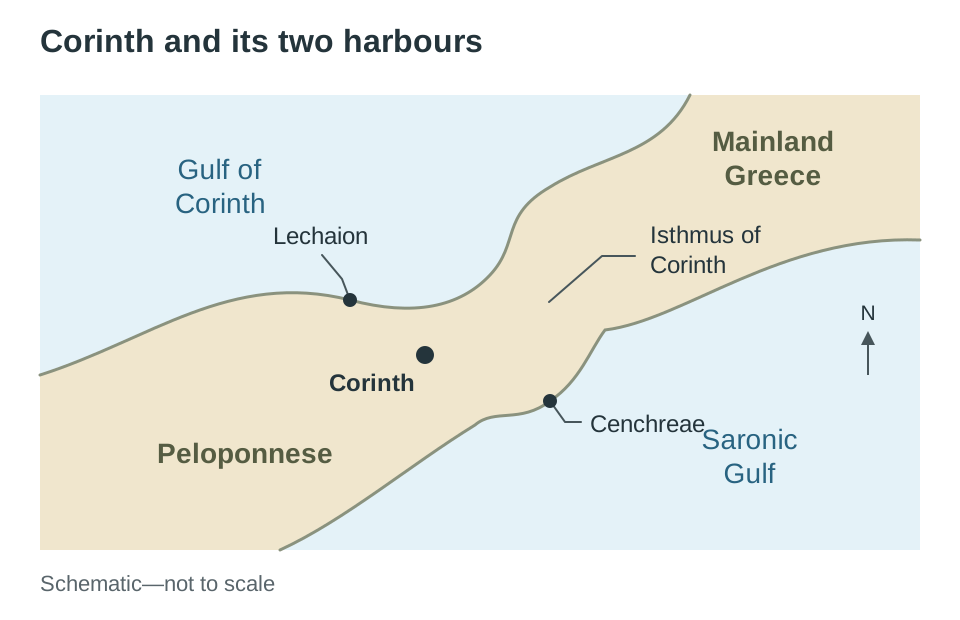
Geographical Location
Corinth was a wealthy, strategic commercial hub situated on the narrow Isthmus of Corinth in southern Greece, connecting mainland Greece to the Peloponnese. It possessed two busy seaports: Lechaion on the Gulf of Corinth, facing west towards Italy and Rome, and Cenchreae on the Saronic Gulf, facing east towards the Aegean Sea and Asia Minor. Destroyed by Rome in 146 BCE and refounded as a Roman colony by Julius Caesar in 44 BCE, it served as the administrative capital of the province of Achaia. The city was dominated by the towering fortress rock of the Acrocorinth. Its population was a volatile, diverse mix of Roman veterans, freed slaves, Greek merchants, Jewish traders, and sailors, giving Corinth a reputation for commercial hustle, religious pluralism, and notorious moral decadence.
Main Features of Christian Belief and Impact on Lifestyle
Paul founded the Corinthian church around 50–52 CE (Acts 18), living and working as a tentmaker alongside Priscilla and Aquila. Becoming a Christian in Corinth meant real, difficult changes in daily life:
- Jesus is Risen: Paul passed on the foundational creed: 'Christ died for our sins... he was buried... he was raised on the third day' (1 Corinthians 15:3–4). Impact on lifestyle: Believers expected their own bodily resurrection, meaning the physical body was sacred and could not be abused; Paul insisted that 'your body is a temple of the Holy Spirit' (1 Cor 6:19), requiring converts to abandon the city's accepted culture of prostitution and promiscuity.
- Jesus is Lord (Kyrios): Believers confessed that Jesus held ultimate authority over their lives (1 Cor 12:3). Impact on lifestyle: Christians could not offer worship to pagan civic gods or burn incense to Caesar, forcing them to withdraw from civic festivals and trade-guild banquets.
- Baptism into One Body: 'In the one Spirit we were all baptised into one body—Jews or Greeks, slaves or free' (1 Cor 12:13). Impact on lifestyle: Social hierarchies were dismantled within the church. Wealthy home-owners, poor labourers, and enslaved people were expected to treat one another as equals and sit at the same table.
- The Lord's Supper as a Memorial: Paul handed on the words of institution: 'Do this in remembrance of me' (1 Cor 11:23–26). Impact on lifestyle: Communities gathered weekly for a shared fellowship meal and the Eucharist, where members were expected to show genuine charity to the poor.
- Spiritual Gifts for the Common Good: The Spirit gives diverse charismata (wisdom, healing, prophecy, tongues) for mutual building up (1 Cor 12). Impact on lifestyle: Worship was participatory and vibrant, but Paul required gifts to be exercised with order and submitted to love (1 Cor 13).
- Christ Will Return: Believing the Lord was returning soon (Marana tha, 'Our Lord, come!', 1 Cor 16:22), Christians lived with moral urgency, viewing worldly status and possessions as temporary (1 Cor 7:29–31).
Internal Tensions within the Community
- Factions and Cliques: The community fractured into competing personality cults centred on different preachers: 'I belong to Paul', 'I belong to Apollos', or 'I belong to Cephas' (1 Cor 1:12). Paul rebuked them, insisting ministers are merely servants and that Christ cannot be divided.
- Inequality at the Lord's Supper: At the communal Agape meal, wealthy believers arrived early and consumed their own fine food and wine, while arriving labourers and slaves went hungry. Paul condemned this behaviour, warning that humiliating the poor disgraced the Church and invited judgment (1 Cor 11:17–22).
- Abuse of Spiritual Gifts: Members competed for social prestige through dramatic gifts, especially speaking in tongues (glossolalia). Paul declared that love (agape) surpasses all ecstatic gifts: 'If I speak in the tongues of mortals and of angels, but do not have love, I am a noisy gong or a clanging cymbal' (1 Cor 13:1).
- Denial of Bodily Resurrection: Influenced by Greek philosophical dualism—which taught that the physical body was a corrupt prison for the immortal soul—some members denied a future bodily resurrection. Paul replied that if the dead are not raised, Christ has not been raised, and Christian faith is worthless (1 Cor 15).
- Moral Scandals and Lawsuits: The community tolerated an incestuous relationship and dragged fellow believers into pagan public courts to resolve financial quarrels (1 Cor 5–6).
External Tensions
- Meat Sacrificed to Idols (eidolothyta): Most public meat in Corinth had been dedicated in pagan temples. Paul explained that while idols have no real spiritual existence, Christians should voluntarily abstain from eating temple meat if doing so would wound the conscience of a weaker believer (1 Cor 8).
- Hostility from Civic Society: By refusing to worship civic deities, take imperial oaths, or attend temple feasts, Christians were viewed by neighbours as anti-social, unpatriotic 'atheists'.
The Christian Message Today: Denominational Mission, Ecumenism, and Christologies
Christian denominations understand their contemporary teaching and work as carrying forward the mission of Jesus in the modern world.
Carrying on the Mission of Jesus (Topic 5.1)
The syllabus lists five areas; you must be able to explore how the teaching and work of one Christian denomination carries forward the mission of Jesus in your chosen area:
- Faced with Violence, Intolerance, and Sectarianism: The Presbyterian Church in Ireland, from which the late Reverend Ray Davey founded the Corrymeela Community in Ballycastle in 1965. Corrymeela creates safe spaces where Catholics and Protestants heal sectarian wounds and practise reconciliation, carrying forward Jesus' Beatitude: 'Blessed are the peacemakers' (Matthew 5:9). In Belfast, Catholic Redemptorist Fr Alec Reid facilitated secret talks between political leaders to advance the peace process.
- Creating a Just and Inclusive Society: The Roman Catholic Church in Ireland carries forward Jesus' solidarity with the excluded through charities such as the Peter McVerry Trust, founded by Jesuit priest Fr Peter McVerry to provide shelter and addiction support for homeless youth in Dublin, and the Society of Saint Vincent de Paul (SVP).
- Use and Sharing of the Earth's Resources: Pope Francis's 2015 encyclical Laudato Si' frames the ecological crisis as a profound moral challenge, linking 'the cry of the earth and the cry of the poor'. In Ireland, Catholic agency Trócaire campaigns for climate justice and aids smallholders in developing countries suffering drought, fulfilling Jesus' command to share the earth's goods.
- Christian Faith and Victory over Death (Response to Dying and Death): Grounded in Jesus' promise, 'I am the resurrection and the life' (John 11:25), the Roman Catholic Church provides the Order of Christian Funerals, where the coffin is sprinkled with holy water and covered with a white pall recalling Baptism, and the Paschal candle is lit as a sign of Easter victory. In healthcare, Catholic religious congregations founded hospices dedicated to palliative care and human dignity, such as Our Lady's Hospice in Harold's Cross, Dublin (founded by the Religious Sisters of Charity in 1879), and Milford Care Centre in Limerick.
- Structures and Authority in Christian Community Today:
- Roman Catholic Church: Governed by an episcopal and hierarchical structure. The Pope (Bishop of Rome) and the college of bishops exercise the magisterium (authoritative teaching office). Parishes are led by ordained priests assisted by parish pastoral councils. This structure traces its authority back to Christ's commission to Peter (Matthew 16:18).
- Church of Ireland: Episcopal yet synodical. While led by bishops, doctrine, liturgy, and financial decisions are governed by the General Synod, composed of bishops, clergy, and elected lay representatives.
- Presbyterian Church in Ireland: Governed presbyterially without bishops. Local congregations are led by a minister and elected lay elders (the kirk session), grouped into regional presbyteries, with the General Assembly and an annually elected Moderator serving as the highest court.
Trends in Christianity (Topic 5.2)
Option A: The Search for Christian Unity (Ecumenism)
Ecumenism (from the Greek oikoumene, 'the whole inhabited world') is the movement working for visible reconciliation and structural unity among divided churches.
- Key Achievements: Founding of the World Council of Churches (1948); the Second Vatican Council's decree Unitatis Redintegratio (1964); the 1965 mutual lifting of the 1054 excommunications between Rome and Constantinople; and the 1999 Joint Declaration on the Doctrine of Justification between Catholics and Lutherans.
- The Irish Experience: In 1970, Jesuit theologian Fr Michael Hurley co-founded the Irish School of Ecumenics (ISE). His work met initial resistance from conservative Dublin Archbishop John Charles McQuaid, who temporarily barred Fr Hurley from speaking publicly in the archdiocese. Relationships warmed over decades; Cardinal Desmond Connell later extended diocesan patronage, and in 2008 Archbishop Diarmuid Martin issued a formal personal apology to Fr Hurley for past institutional hostility.
- Key Difficulties Remaining: Disagreements over the mutual recognition of ordained ministry and the ordination of women; Eucharistic theology preventing shared communion (intercommunion); the universal jurisdiction and infallibility of the Papacy; and divergent moral teachings on human sexuality and reproductive ethics.
Option B: Christian Worship as Remembering Jesus
- Rite 1: The Eucharist / The Lord's Supper: The community gathers to obey Jesus' command at the Last Supper: 'Do this in remembrance of me' (1 Cor 11:24). The liturgical term for this remembering is anamnesis—not merely recalling past history, but making the saving power of Christ's death and resurrection present here and now. Sharing bread and wine recalls his table fellowship, the cross, and the New Covenant.
- Rite 2: Baptism: Water is poured or the candidate is immersed in the name of the Father, Son, and Holy Spirit (Matthew 28:19). As Paul explains in Romans 6:3–4, going under the water symbolises being buried with Christ, while rising out of the water represents rising with him to new life.
Contemporary Issues in Christology
Christology investigates the person, nature, and role of Jesus Christ. Modern theology has shifted from speculative 'Christology from above' to 'Christology from below', beginning with Jesus' historical life and social context:
- Jesus the Liberator — Jon Sobrino: A Basque-Salvadoran Jesuit theologian (Jesus the Liberator, 1991). Writing amid the Salvadoran civil war, Sobrino's Christology from below starts with the historical Jesus who took the side of the poor and was executed by imperial powers. Sobrino identifies today's oppressed poor as the 'crucified people' of history, arguing that Christ is encountered when believers act in solidarity to 'take the crucified down from the cross'.
- Jesus-Sophia — Elizabeth Johnson: An American feminist theologian (She Who Is, 1992). Johnson critiques exclusively patriarchal language that equates God with male domination. Drawing on Hebrew Wisdom literature, where divine Wisdom (Sophia) is personified as female, Johnson presents Jesus as the embodiment of Holy Wisdom (Jesus-Sophia). For Johnson, Jesus' liberating table fellowship with women and outcasts reveals God's tender, inclusive love, confirming that women and men reflect the divine image with equal dignity.
Key terms
- Founding Vision
- The original spiritual inspiration, values, and purpose established by the founder of a movement; in Christianity, the life, preaching, death, and resurrection of Jesus Christ.
- Anam Chara
- An Irish term meaning 'soul friend'; an experienced spiritual director and confessor whose guidance was central to Celtic monasticism and the 8th-century Céli Dé reform.
- Sola Scriptura, Sola Fide, Sola Gratia
- The three foundational principles of the Protestant Reformation formulated by Martin Luther: Scripture alone, Faith alone, and Grace alone.
- Aggiornamento and Ressourcement
- The two guiding concepts of the Second Vatican Council: aggiornamento ('bringing up to date', coined by Pope John XXIII) and ressourcement ('returning to biblical and patristic sources').
- Preferential Option for the Poor
- A central theological principle of Liberation Theology asserting that Christian discipleship requires prioritising the needs, rights, and liberation of impoverished and marginalised people.
- Evidence of History and Witness of Faith
- Evidence of history refers to verifiable historical facts established through methodology and external sources (e.g. Jesus was crucified under Pilate). Witness of faith refers to believers' theological testimony regarding the spiritual meaning of those events (e.g. his death reconciled humanity to God).
- Testimonium Flavianum
- The passage in Antiquities of the Jews (18.3.3) by the first-century Jewish historian Flavius Josephus that provides independent external confirmation of Jesus' life, deeds, and execution under Pilate.
- Basileia tou Theou
- The Greek phrase for the Kingdom of God: the active, sovereign rule of God inaugurated through Jesus, characterised by peace, inclusion, justice, and service.
- Metanoia
- A Greek term meaning repentance: an inward spiritual transformation involving a complete turning around of one's values, life direction, and outlook toward God.
- Abba
- An intimate, affectionate Aramaic word for father used by Jesus in prayer to reveal God as loving, caring, and personally accessible.
- Kyrios
- The Greek title meaning 'Lord', applied to the risen Jesus by early Christians to confess his divine authority and supremacy over all earthly powers, including Caesar.
- Suffering Servant
- The prophetic figure in Isaiah 53 whose innocent suffering and death atone for the sins of others, used by early disciples to understand the theological meaning of Calvary.
- Maiestas
- The Roman crime of treason or rebellion against the emperor's sovereign majesty; the political charge on which Jesus was executed as a claimant to kingship.
- Anamnesis
- The Greek liturgical term for active memorial: recalling a past saving event (such as the Last Supper) in worship so that its power becomes living reality in the present.
- Charismata and Glossolalia
- Charismata are spiritual gifts granted by the Holy Spirit for building up the community (1 Cor 12). Glossolalia is the specific gift of speaking in ecstatic tongues.
- Body of Christ
- Paul's metaphor in 1 Corinthians 12 portraying the Christian community as an interconnected organism where every diverse member has equal, indispensable value.
- Ecumenism
- The movement within Christianity dedicated to fostering mutual understanding, cooperative social action, and visible structural unity among divided denominations.
- Christology
- The branch of Christian theology that investigates the identity, nature, and theological significance of the person and work of Jesus Christ.
Check yourself
What two theological concepts describe the aims and method of the Second Vatican Council?
Aggiornamento ('bringing up to date', the Council's aim announced by Pope John XXIII) and ressourcement ('returning to biblical and patristic sources', drawn from theologians who shaped its decrees).
Which first-century Jewish group rejected beliefs in bodily resurrection and angels, accepting only the written Torah?
The Sadducees, the wealthy priestly aristocracy who controlled the Temple and cooperated with Roman authorities.
What independent historical evidence does the Roman historian Tacitus provide about Jesus?
Writing in his Annals (c. 116 CE), Tacitus confirms that 'Christus' was executed by the procurator Pontius Pilate during the reign of Emperor Tiberius.
Name the four key characteristics of the Kingdom of God as preached by Jesus.
Peace as the alternative to violence; inclusion as the alternative to elites; sharing of goods as the alternative to amassing wealth; and a God of the powerless as the alternative to a God who sanctions inequalities.
Give one word and one action of Jesus showing his awareness of the Davidic messianic expectation.
In words, he accepted Peter's confession at Caesarea Philippi but redefined it by predicting the Son of Man must suffer (Mark 8:29–31); in actions, he rode into Jerusalem on a humble colt rather than a warhorse (fulfilling Zechariah 9:9).
Name two beliefs held by the Corinthian Christians and say how each changed the way they lived.
Belief in bodily resurrection led to strict sexual ethics because the body is a temple of the Holy Spirit (1 Cor 6:19); confessing 'Jesus is Lord' (Kyrios) meant refusing to worship pagan gods or Caesar, cutting them off from civic temple banquets.
What serious social abuse occurred during celebrations of the Lord's Supper in Corinth?
Wealthy Christians arrived early and feasted on their own food and wine, while arriving poor labourers and slaves went hungry (1 Corinthians 11:20–22).
Give one example of the structures and authority of a named Christian denomination.
The Roman Catholic Church has an episcopal and hierarchical structure, where the Pope and bishops form the magisterium (teaching office) with authority over dioceses and parishes.
Name one major achievement and one remaining difficulty in the search for Christian unity (ecumenism).
A key achievement is the 1999 Joint Declaration on the Doctrine of Justification between Catholics and Lutherans; a major remaining difficulty is disagreement over the mutual recognition of ordained ministry and the ordination of women.
What is the central focus of Jon Sobrino's 'Christology from below'?
Sobrino begins with the historical Jesus who stood with the poor and was executed by imperial power, identifying today's oppressed as the 'crucified people' whom Christians are called to liberate.