
Section G explores how human beings express their search for meaning and the spiritual dimension of life through symbol, ritual, sacrament, prayer, meditation, and contemplation. The section begins with the core foundations: how symbols communicate deeper realities, how the capacity to create symbols defines human nature, how rituals structure human transitions and healing, and how sacraments function within Christian denominations. It then investigates the human person as pray-er, examining the human need for reflection, the experience of awe, worship, the difference between private and communal prayer, and formal prayers like the Lord's Prayer and the Shema. Finally, it explores meditative approaches in Buddhism and Christianity, the development and contemporary appeal of contemplative traditions like hermitage, poustinia, pilgrimage, and retreat, and the transformative impact of mysticism through Teresa of Ávila, Thomas Merton, and Rabi'a al-Adawiyya.
Symbol and Symbolic Language
A symbol is an object, gesture, or word that points beyond its literal surface to communicate deeper layers of meaning. While a sign conveys straightforward, functional information (such as a red traffic light signalling a driver to stop), a symbol carries multiple meanings, stirs emotion, and actively participates in the reality it represents.
Why Symbol-Making Makes Us Human
The human person is not just homo sapiens (the one who knows) but homo symbolicus (the one who makes meaning). The ability to create symbols is a defining characteristic of being human for three core reasons:
- Only humans create symbols. Animals communicate through direct signals: a bird's alarm call signifies immediate danger and nothing else. Only human beings make one physical thing stand for another that is absent, invisible, or abstract. A piece of fabric becomes a national flag, a band of metal represents lifelong fidelity, and a wooden cross represents self-giving divine love.
- It is how we handle what cannot be measured. Realities like love, grief, guilt, hope, and God cannot be weighed, counted, or photographed. Symbols are the only way to give these realities a concrete shape that can be shared with others. Every human culture, from prehistoric burial sites to modern public commemorations, invents symbols for this purpose.
- It is how culture is transmitted across generations. Because symbols carry collective memory and meaning, society's language, art, law, and religion depend on them. Without symbols, shared culture cannot survive.
Types of Symbols
Symbols fall into three main types:
- Symbolic objects: Material items that represent deeper collective realities, such as a crucifix or a national flag.
- Symbolic actions or gestures: Bodily movements that express inner attitudes, such as kneeling in reverence, tracing the Sign of the Cross, or observing a minute's silence.
- Symbolic words or language: Metaphorical expressions that describe transcendent realities, such as addressing God as a 'rock' or a 'shepherd'.
Symbolic language holds immense power in both secular and religious life. In secular society, symbols unite diverse groups; raising a national flag and singing an anthem at Croke Park creates instant civic solidarity among thousands of strangers. In religion, symbolic language is essential because God is transcendent and beyond direct sensory perception. Physical symbols such as water in baptism or holy oils allow believers to participate directly in divine realities that cannot be captured in literal speech.
Ritual, Ritualism, and Contemporary Culture
A ritual is a patterned, repeatable sequence of actions, gestures, and words through which individuals and communities enact deep meaning and mark significant transitions. Unlike everyday routine, which is repeated purely for practical efficiency (such as brushing teeth), ritual carries symbolic intention, engages community memory, and forms identity.
Types of Religious Ritual
Religious rituals generally divide into two major categories:
- Transitional rituals (rites of passage): Ceremonies that guide individuals across boundaries between life stages, moving through separation from the old status, a liminal threshold phase, and incorporation into a new role. A clear example is the Jewish Bar Mitzvah, where a thirteen-year-old boy reads from the Torah at the bimah and takes on religious responsibility as an adult member of the community.
- Restorative rituals (healing rites): Ceremonies designed to repair relationships, comfort the sick, or restore spiritual balance. Examples include the Christian Sacrament of the Anointing of the Sick and the Sacrament of Reconciliation.
Rituals operate on personal and collective levels at the same time. In a funeral ritual, the personal meaning provides a grieving family member with a structured space to process sorrow and say farewell. The collective meaning allows the gathered community to affirm shared beliefs about eternal life and publicly support the bereaved.
Ritualism: Positive and Negative Features
Ritualism means the repeated, regular practice of ritual. The term is often used critically to describe going through the outward motions of a ritual without inner meaning, but repetition itself carries both value and risk:
- Positive feature: Regular repetition provides emotional security, aids memory, and allows people in deep distress to participate in worship through familiar patterns without needing to invent their own prayers (such as reciting the Rosary at a wake).
- Negative feature: Repetition can degenerate into empty, mechanical formalism, where participants recite words or perform gestures purely out of habit, social pressure, or superstition, without personal engagement or understanding.
Contemporary Rituals
In contemporary culture, both religious and secular rituals remain vital. Religious rituals like the Catholic Mass gather believers around the Eucharistic table to nourish spiritual life and commission them for service. In secular life, a secondary school graduation ceremony marks the completion of years of study through academic gowns, processions, speeches, and certificates, publicly validating hard work and marking an important status transition into adulthood.
Sacrament in Christian Denominations
Think of symbol, ritual, and sacrament as a progression: a symbol communicates deeper meaning, a ritual arranges symbols into an established sequence of actions, and a sacrament is a Christian ritual believed to make God's grace active and effective. Christian theology historically defines a sacrament as an outward, visible sign of an inward, spiritual grace instituted by Jesus Christ.
Christian denominations hold distinct theological understandings of the number and operation of sacraments:
The Roman Catholic Church
The Catholic Church recognises seven sacraments, grouped into three categories: sacraments of initiation (Baptism, Confirmation, Eucharist), sacraments of healing (Reconciliation, Anointing of the Sick), and sacraments at the service of communion (Holy Orders, Matrimony). Catholic theology teaches that sacraments operate *ex opere operato ('from the work worked'). This means they are objective channels of grace through Christ and the Holy Spirit, independent of the personal holiness of the minister, provided the recipient places no obstacle in the way. In the Eucharist, Catholics teach the doctrine of transubstantiation*, holding that the underlying substance of bread and wine becomes the actual Body and Blood of Christ while the physical appearances remain.
The Church of Ireland (Anglican Tradition)
The Church of Ireland catechism defines a sacrament as 'an outward and visible sign of an inward and spiritual grace given unto us, ordained by Christ himself.' Arising from the Reformation principle of scriptural authority, the Church of Ireland recognises only two sacraments of the Gospel: Baptism and Holy Communion (the Eucharist). Only these two rites were explicitly commanded and instituted by Christ in the New Testament. Other rites—such as confirmation, ordination, and marriage—are valued sacramental ministries of the church but do not hold the same dominical status. In Holy Communion, the Church of Ireland affirms that Christ is really present and truly received, but spiritually and by faith, rather than by any change in the substance of the elements. It therefore rejects transubstantiation while insisting that Holy Communion is more than a bare memorial. By contrast, some other Protestant traditions, such as Baptists, understand the Lord's Supper mainly as an ordinance or memorial rather than a sacramental means of grace.
Sacramental Symbols and Their Functions
Sacramental symbols perform a dual function: they reveal spiritual truths and bring about real spiritual transformation in the believer:
- Water in Baptism: Poured or immersed, the physical washing reveals cleansing from sin and brings about new spiritual birth into the Christian community.
- Oil of Chrism: Traced in the Sign of the Cross during Confirmation, the fragrant oil signifies strengthening, protection, and consecration by the Holy Spirit.
- Bread and Wine in the Eucharist: Represent everyday nourishment and community fellowship, through which believers receive spiritual sustenance and communion with Christ's sacrifice.
Prayer, Worship, and Religious Experience
Prayer is the raising of the mind and heart to God, engaging the intellect, emotions, body, and community.
The Need for Reflection and Religious Experience
Prayer begins in reflection: stepping back from immediate events to evaluate their meaning. Reflection is vital for a young person for three reasons: it aids identity formation away from peer pressure and digital noise, fosters moral responsibility by evaluating the consequences of personal choices, and assists meaning-making during times of grief, stress, or major transitions.
When reflection encounters deep wonder or crisis, it can lead to a religious experience—an awareness of a transcendent presence that evokes awe and reverence. Rudolf Otto described this as encountering the numinous, experienced as mysterium tremendum et fascinans: a mystery that is simultaneously awe-inspiring, humbling, and irresistibly attractive.
Worship and Awe
Worship means giving God or the transcendent the honour, reverence, and adoration that believers hold God alone deserves. The word comes from the Old English weorthscipe, meaning 'to declare worth'. Worship is wider than prayer: it includes praise, thanksgiving, sacrifice, ritual actions, music, and silence, and it is usually communal and public.
Awe is the feeling of wonder mixed with a sense of personal smallness that comes over a person in the presence of something overwhelmingly great. Awe matters for worship in three ways:
- It is the starting point: without sensing that God is greater than oneself, worship becomes an empty social routine rather than adoration.
- It shapes bodily actions: kneeling, bowing, prostration, removing shoes at the entrance of a mosque, and silence before the Blessed Sacrament are what awe looks like in practice.
- It draws worshippers back: awe is attractive as well as humbling, which is why architecture, incense, chant, and stained glass are used to open people to the sacred.
The Importance of Prayer in Relationship with the Divine: Evidence from Two Traditions
- Christianity: Christians understand prayer as conversation with a personal God who is addressed as Father. The evidence lies in the tradition's foundational texts and daily practices. Jesus instructs his disciples to pray 'Our Father' (Matthew 6:9) and withdraws to deserted places to pray alone before major decisions (Mark 1:35, Luke 6:12). The Divine Office structures daily life with psalms at set hours, families say grace before meals, and Catholics recite the Rosary. Prayer sustains a personal relationship, giving voice to trust, sorrow, gratitude, and petition.
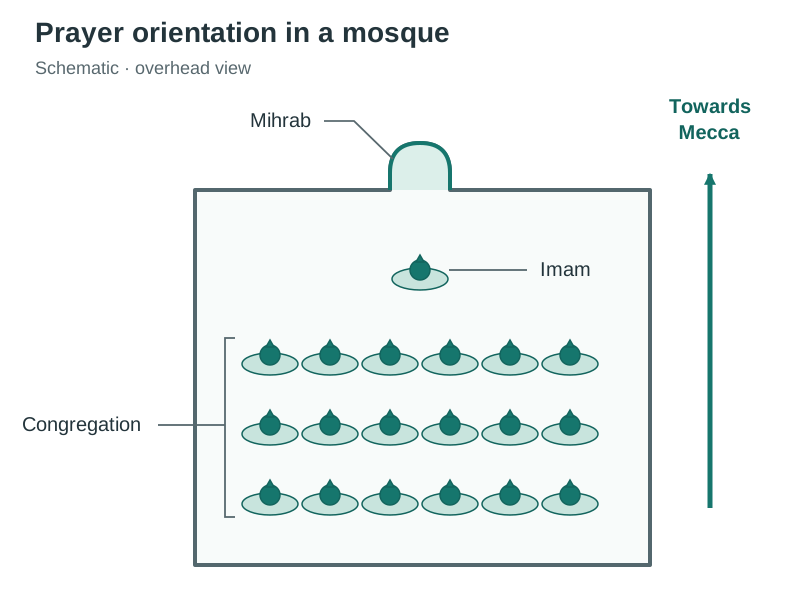
- Islam: Muslims understand prayer as submission to Allah, the one God. The evidence is Salat, the second Pillar of Islam: five obligatory daily prayers preceded by ritual washing (wudu), performed facing Mecca in set physical cycles (rak'ahs) of standing, bowing, and prostrating. The Fatihah, the opening surah of the Qur'an, is recited in every rak'ah. Prayer maintains constant consciousness of God (taqwa) and orders the entire day around that relationship.
- Common thread: In both traditions, prayer is not an occasional emergency measure but a patterned, regular practice that sustains the living relationship with God.
Private and Communal Forms of Prayer
- Private prayer is offered by a person alone, in their own words or in silence, at a time and place of their choosing (such as a Muslim making personal supplication, du'a, after Salat, or a Christian praying in their room).
- Communal prayer is offered by a gathered congregation using shared, traditional words and actions, led by someone with a recognised role (such as Sunday Mass, Friday Jumu'ah in a mosque, or a Jewish service requiring a minyan of ten adults).
Key differences:
- Participants: The individual alone versus the gathered community.
- Words: Personal and spontaneous versus fixed, traditional liturgical texts.
- Timing: Chosen freely by the pray-er versus set by the community's calendar or clock.
- Strengths: Intimacy and freedom versus shared identity, belonging, and communal support during grief or joy.
- Risks: Private prayer can fade without discipline; communal prayer can slip into empty ritualism if attention drifts.
Contexts: Friday Jumu'ah, Sacred Space, and Sacred Time
Picture the Friday midday prayer at the Islamic Cultural Centre in Clonskeagh, Dublin. It illustrates the three elements of people at prayer:
- Religious tradition: Rooted in the Sunnah of Muhammad. Believers perform wudu and pray in unison behind the Imam, moving through rak'ahs facing Mecca.
- Cultural environment: Gathers a multicultural community of Irish, Arab, South Asian, and African Muslims who stand shoulder to shoulder on a shared carpeted floor.
- Prayer and life: The prayer interrupts the working week, realigning hearts with God, while the sermon (khutbah) applies ethical values to living responsibly in Irish society.
A sacred space is a physical environment consecrated and set apart from ordinary use for divine encounter. A Catholic church is identified by its altar, tabernacle, sanctuary lamp, and baptismal font. A mosque (masjid) is identified by the mihrab (niche showing the direction of Mecca) and an open prayer hall free of statues or images to honour divine transcendence.
A sacred time is a period dedicated to divine encounter that interrupts ordinary clock time. In Judaism, Shabbat runs from Friday sunset to Saturday nightfall as a sanctuary in time dedicated to rest, prayer, and family meals. In Christianity, Lent and Easter form a seasonal liturgical cycle of forty days of prayer, fasting, and almsgiving culminating in the celebration of Christ's resurrection.
The Praying Tradition: The Lord's Prayer and the Shema
Formal, traditional prayers unite believers across generations, providing reliable language for faith, communal worship, and private devotion.
The Lord's Prayer (Christianity)
- Origin: Taught directly by Jesus to his disciples when they asked him to teach them to pray, recorded in the Gospels (Matthew 6:9–13 and Luke 11:2–4). It addresses God with intimate trust as 'Our Father' (Abba).
- Historical development: The Didache, a Christian manual from around 100 CE, instructs believers to pray the Lord's Prayer three times a day and ends it with a short doxology of praise ('for thine is the power and the glory for ever'). The fuller form familiar today—'for thine is the kingdom, the power and the glory'—developed in later manuscripts and liturgy. Protestant churches generally recite this doxology as part of the prayer itself; in the Catholic Mass the congregation recites it after a short prayer by the priest, so it is not counted as part of the Our Father text.
- Usage and content: Prayed in private devotion, the Divine Office, and in every Catholic Mass and Church of Ireland service. It combines praise of God's holy name and petition for the coming of God's Kingdom with requests for daily bread, forgiveness of sins, and deliverance from evil.
The Shema (Judaism)
- Origin: Drawn directly from the Torah, primarily Deuteronomy 6:4–9 ('Hear, O Israel: The Lord our God, the Lord is one'), alongside Deuteronomy 11:13–21 and Numbers 15:37–41.
- Historical development: Established as the foundational Jewish declaration of faith by 200 CE. Its words are handwritten on parchment scrolls placed inside the mezuzah on doorposts and within tefillin (leather prayer boxes bound to the forehead and arm during weekday morning prayer).
- Usage and content: Recited twice daily, during morning and evening prayers, and traditionally spoken as the final words before death. Worshippers cover their eyes with their right hand during the opening line to eliminate distractions and focus entirely on God's oneness.
Comparing the Two Prayers
Both prayers originate in foundational sacred scriptures, are recited multiple times daily, and express core theological identity. However, while the Shema is a creedal proclamation of God's absolute oneness and a command to love God with heart, soul, and strength, the Lord's Prayer is a conversational, relational dialogue asking God for spiritual and physical needs, mutual forgiveness, and divine protection.
Meditation: Buddhist Emptiness and Christian Encounter
Meditation is a disciplined practice using focused concentration to quieten mental chatter, refine awareness, and open the practitioner to spiritual insight. It typically uses an upright posture, regulated breathing, and a chosen anchor.
Forms: Sacred Mantra and Sacred Text
- Meditation with mantra: Repeating a sacred word stills discursive thought. In Eastern Orthodoxy, believers repeat the Jesus Prayer ('Lord Jesus Christ, Son of God, have mercy on me, a sinner'). In the modern Western church, Benedictine monk Fr John Main revived Christian meditation using the Aramaic word Maranatha ('Come, Lord Jesus') recited silently in four equal syllables. In Buddhism, mantras such as Om Mani Padme Hum cultivate mindfulness and compassion.
- Meditation with sacred text (Lectio Divina): Developed in monastic traditions, this method moves through four deliberate steps: Lectio (slow reading of scripture), Meditatio (ruminating on a word or phrase that resonates), Oratio (speaking to God from the heart in response), and Contemplatio* (resting wordlessly in God's presence).
Comparing Buddhist and Christian Meditation
In Buddhism, the ultimate goal is an experience of emptying, whereas in Christianity, it is an experience of encounter.
- Theological framework: Buddhism is non-theistic and does not direct prayer to a creator God, whereas Christianity is theistic, centring on relational communication with a personal God revealed in Jesus Christ.
- Core purpose: Buddhist meditation aims at the experience of emptying—letting go of craving, attachment, and the illusion of a permanent ego (*anatta) to achieve liberation from suffering (dukkha) in nirvana. Christian meditation aims at the experience of encounter*—quietening internal clutter to be filled with the Holy Spirit and enter communion with Christ.
- Methods used: Buddhists practice concentration (Samatha) and insight into impermanence (Vipassana), whereas Christians practice Lectio Divina, mantra repetition (Maranatha), and imaginative reflection on Gospel scenes.
- Practical fruits: Buddhist practice produces universal loving-kindness (*metta*) and equanimity, whereas Christian practice produces charity, humility, peace, and service to neighbours.
Contemplative Traditions: Origins, Modern Expressions, and Popular Appeal
Contemplation goes beyond thinking, imagining, and using techniques. It is simply resting in God's presence without words—'being with' God rather than 'talking to' God. Over the centuries, four major practices developed to foster this contemplative awareness:
1. Hermitage
A hermitage is a place and way of life rooted in solitude, silence, and prayer. The term derives from the Greek erēmos, meaning 'desert'. St Antony of Egypt (c. 270 CE) withdrew into the desert, inspiring the Desert Fathers and Mothers. In Ireland, early Christian monks sought a 'green martyrdom' of radical solitude on remote sea cliffs like Skellig Michael and at Glendalough.
Modern expression: Very few live as full-time hermits today, but the tradition survives in hermitage cabins attached to monasteries (such as Glenstal Abbey or Mount Melleray) which lay people book for days of silence, as well as in the digital detox retreat movement that borrows the practice of stripping away noise to recover clarity.
2. Poustinia
Poustinia is a Russian Christian tradition popularised in the modern West by Catherine Doherty. Meaning 'desert' in Russian, a poustinia is a sparsely furnished cabin or room containing only a bed, a table, a chair, a Bible, and an icon. A person enters the poustinia for a 24-hour desert day of silence, fasting on bread and water, and listening to God in Scripture. Doherty taught the concept of a 'desert in the city'—setting aside a quiet space in an ordinary home to regain spiritual clarity before returning to family and work life.
3. Pilgrimage: Croagh Patrick
A pilgrimage is a journey to a holy place made for a religious reason—to do penance, to give thanks, to pray for someone, or to work out an important decision. Croagh Patrick was an ancient site of assembly associated with the harvest festival of Lughnasa. Christian tradition holds that St Patrick fasted for forty days on its summit (traditionally dated to 441 CE), and the mountain became one of Ireland's great pilgrimage sites. The timing of Reek Sunday, the last Sunday in July, still echoes the older Lughnasa date, illustrating how Christian rituals absorbed earlier sacred patterns.
On Reek Sunday, tens of thousands climb the steep quartzite scree, some walking barefoot as an act of penance. On the summit, they complete the 'Stations of the Reek', walking clockwise (deiseal) around designated cairns and the chapel while reciting set prayers, culminating in Confession and Mass.
Modern expression: Pilgrimage numbers are rising worldwide. The Camino de Santiago attracts hundreds of thousands annually, many seeking personal reflection rather than formal dogma. In Ireland, Reek Sunday still draws thousands, while Lough Derg offers one-day reflective retreats alongside its traditional three-day barefoot fast.
4. Retreat
A retreat is a designated period where an individual steps away from normal daily work, noise, and routine to spend time in structured silence, prayer, and reflection. Biblical roots trace to Jesus withdrawing to deserted places to pray (Mark 1:35). In the 16th century, St Ignatius of Loyola systematised retreats through his Spiritual Exercises, creating guided silent retreats.
Why Contemplative Traditions Continue to Have Popular Appeal
These traditions continue to draw modern participants for four reasons:
- Reaction against noise: Constant digital notifications, streaming media, and workplace stress leave people overstimulated. Silence has become scarce, and scarce things become attractive.
- Embodiment: Climbing a mountain, walking an extended route, or fasting engages the physical body. In a screen-based culture, people are drawn to practices that are physically demanding and tangible.
- Space to decide: Retreats and pilgrimages are often undertaken at turning points—bereavement, exam milestones, career changes, or relationship crises. They provide a structured pause to evaluate life direction.
- Community without institutional demand: On a pilgrimage route like Croagh Patrick or the Camino, strangers share a difficult physical task. This offers belonging without the rigid demands of institutional membership, appealing to people who identify as spiritual but wary of organized religion.
The Mystic Tradition: Characteristics, Texts, and Figures
Mysticism is an immediate, direct, and transforming experiential awareness of union or deep communion with God or Ultimate Reality. Rather than merely learning doctrines about God, the mystic experiences divine presence directly.
Characteristics of Mysticism
Philosopher William James identified four classic marks of mystical experience:
- Ineffability*: The encounter defies ordinary human language; it cannot be fully described in literal speech, requiring the mystic to use poetry, metaphor, and paradox.
- Noetic* quality: The encounter provides direct spiritual insight and intuitive knowledge that carries profound personal authority.
- Transiency*: The intense peak experience is brief in duration, rarely lasting more than a short time, though its transforming effects endure.
- Passivity*: The mystic feels grasped, held, and drawn by a superior power, experiencing the encounter as an unearned gift rather than a human achievement.
Mystical theology employs two modes of speech: cataphatic (the via positiva, using positive images like light, water, and marriage to speak of God) and apophatic (the via negativa, using darkness, silence, and unknowing to protect God's absolute transcendence).
Authentic Moral Fruits
Religious traditions test mystical claims not by visions or ecstatic phenomena, but strictly by their moral fruits. Authentic mysticism produces deep humility, selfless charity, patient endurance of suffering, and courageous service to others.
Teresa of Ávila (1515–1582)
A Spanish Carmelite nun, reformer, and Doctor of the Church, Teresa founded the Discalced Carmelites to restore poverty, simplicity, enclosure, and contemplative prayer. In her spiritual classic The Interior Castle, she depicted the human soul as a diamond castle containing seven concentric mansions, with God dwelling at the centre. Spiritual growth moves inward through vocal prayer and meditation into the prayer of quiet (mansion 4), through trials and ecstasies (mansion 6), to the permanent peace of 'spiritual marriage' (mansion 7), where human and divine wills are fully united. She used the image of the silkworm dying in its cocoon to emerge as a flying butterfly to illustrate spiritual transformation, insisting that prayer must always bear fruit in humility and love of neighbour.
Thomas Merton (1915–1968)
A 20th-century American Trappist monk at the Abbey of Gethsemani in Kentucky, Merton authored the spiritual autobiography The Seven Storey Mountain. In New Seeds of Contemplation, he made a famous distinction between the false self (an illusion built on ego, social status, fear, and consumerism) and the true self (our authentic identity hidden in God). During his 1958 Louisville Epiphany on a busy street corner, Merton was overwhelmed by the sudden realisation that every passer-by shone with divine dignity. This contemplative insight proved to him that prayer cannot be detached from society; it directly inspired his prophetic writings against racism, warfare, consumerism, and the nuclear arms race, alongside groundbreaking dialogue with Zen Buddhist masters.
Rabi'a al-Adawiyya (c. 717–801 CE)
A Sufi mystic of Basra in modern Iraq, Rabi'a was born into severe poverty, sold into slavery as a child, and freed when her master witnessed her at prayer surrounded by divine light. She chose a life of solitude, poverty, and celibacy. Her central contribution was the doctrine of pure divine love (mahabba): God must be loved for God's own sake, not out of fear of hell or hope of paradise. Her famous prayer declared that if she worshipped God out of fear of hell, God should burn her in it, and if she worshipped out of desire for paradise, God should exclude her from it—she sought God alone. Her life displayed William James's marks: ineffability expressed through paradoxical poetry, noetic authority, and complete passivity before divine love. Like Teresa of Ávila, she used the imagery of love and devotion to articulate union with God across centuries and traditions.
Key terms
- Symbol
- An object, action, or word that points beyond itself to express deeper, multi-layered invisible realities, stirring emotion and participating in what it represents.
- Ritual
- A patterned, repeatable sequence of symbolic actions, words, and gestures that marks life transitions or expresses shared community memory and values.
- Ritualism
- The regular and repetitive practice of ritual, which can be positive (providing comfort, structure, and memory) or negative (becoming empty, mechanical routine).
- Sacrament
- An outward, visible sign of inward, invisible divine grace instituted by Jesus Christ, celebrated through material elements, set words, and communal ritual.
- Ex Opere Operato
- A Catholic theological term meaning 'from the work worked', signifying that sacraments confer grace through Christ's objective power, independent of the minister's personal holiness.
- Transubstantiation
- The Catholic teaching that during Eucharistic consecration, the underlying substance of bread and wine becomes the actual Body and Blood of Christ while physical appearances remain.
- Worship
- The act of offering supreme honour, reverence, homage, and adoration to God or the Transcendent, deriving from the Old English for declaring worth.
- Awe
- The feeling of wonder mixed with personal smallness experienced before something overwhelmingly transcendent, forming the psychological starting point of genuine worship.
- Numinous
- Rudolf Otto's term for the experience of the sacred as mysterium tremendum et fascinans—a mystery that is simultaneously awe-inspiring, terrifying, and attractive.
- Sacred Space
- A physical environment consecrated and set apart from ordinary use where believers gather to encounter the divine.
- Sacred Time
- Time dedicated to divine encounter through daily prayer rhythms, weekly rest days, or seasonal liturgical feasts, interrupting ordinary linear time.
- Meditation
- A disciplined practice using posture, breath, and a focused anchor (text, mantra, or breath) to quieten the intellect and refine spiritual awareness.
- Contemplation
- A receptive, wordless resting in the presence of God that moves beyond active thoughts, techniques, and mental images.
- Hermitage
- A physical place and way of life dedicated to solitude, silence, and prayer, rooted in the early Christian desert monastic tradition.
- Poustinia
- A Russian contemplative tradition involving withdrawal to a simple cabin or room for 24 hours of silence, fasting on bread and water, and Scripture reading.
- Pilgrimage
- A journey to a holy place made for a religious reason, such as penance, thanksgiving, intercession, or discernment.
- Retreat
- A temporary withdrawal from ordinary daily life and work for prayer, silence, and spiritual reflection.
- Mysticism
- An immediate, direct, and transformative experiential awareness of union or communion with God or Ultimate Reality.
- Ineffability
- One of William James's four marks of mystical experience, stating that the encounter is so profound it cannot be adequately captured in ordinary language.
- Noetic Quality
- One of William James's four marks of mystical experience, referring to the deep, intuitive spiritual insight and knowledge imparted during the encounter.
- Transiency
- One of William James's four marks of mystical experience, noting that intense peak mystical encounters are brief in duration.
- Passivity
- One of William James's four marks of mystical experience, describing the sense that the mystic is grasped and acted upon by a superior divine power.
Check yourself
Name three different types of symbols and give an example of each.
Symbolic objects (e.g. a crucifix or national flag), symbolic actions or gestures (e.g. the Sign of the Cross or kneeling), and symbolic words or language (e.g. calling God a 'shepherd' or 'rock').
What is the difference between a transitional ritual and a restorative ritual?
A transitional ritual (rite of passage) marks an individual's movement across life stages (e.g. Bar Mitzvah or Baptism), whereas a restorative ritual aims to heal, restore spiritual balance, or reconcile relationships (e.g. Anointing of the Sick or Reconciliation).
How many sacraments do the Roman Catholic Church and the Church of Ireland recognise, and why do they differ?
The Roman Catholic Church recognises seven sacraments rooted in scripture and church tradition; the Church of Ireland recognises two sacraments of the Gospel (Baptism and Eucharist) because only these two were explicitly commanded by Christ in scripture.
Explain what is meant by 'worship' and give one reason why awe matters for it.
Worship is the act of giving supreme honour, reverence, and adoration to God. Awe matters because it is the psychological starting point: without sensing that God is overwhelmingly greater than oneself, worship becomes an empty social routine rather than genuine adoration.
Give two differences between private and communal prayer.
Private prayer is offered by the individual alone using spontaneous or personal words at a time of their choosing, whereas communal prayer gathers a congregation using set, traditional liturgical texts led by a recognised leader at a scheduled time.
State one key theological difference between the Christian Lord's Prayer and the Jewish Shema.
The Lord's Prayer is a conversational petition addressed directly to God as 'Our Father', whereas the Shema is a communal creedal declaration addressed to the people ('Hear, O Israel') asserting the absolute oneness of God.
What is the fundamental distinction between Buddhist and Christian meditation?
Buddhist meditation is an experience of emptying the mind of attachment and ego to achieve enlightenment (nirvana); Christian meditation is an experience of encounter, quieting distractions to enter into loving communion with a personal God through Christ.
Why has pilgrimage kept its popular appeal in Ireland today? Give two reasons.
It provides a physical, embodied counter-cultural retreat from constant digital noise, and it offers an inclusive sense of shared purpose and solidarity without requiring formal institutional commitment.
List William James's four classic marks of mystical experience.
Ineffability (defies words), noetic quality (conveys deep spiritual knowledge), transiency (brief in duration), and passivity (the person feels grasped and acted upon by a superior power).