

Basic Properties of Magnets and Field Patterns
Only a few materials are strongly attracted to magnets and can be made into magnets. These are ferromagnetic materials, primarily iron, steel, cobalt, and nickel. Everyday metals like copper, aluminium, and brass are non-magnetic.
Every magnet is a dipole with two distinct ends: a north-seeking pole (north pole) and a south-seeking pole (south pole). A magnet always has both a north and a south pole; an isolated single pole has never been found. If you break a bar magnet in two, each piece becomes a complete magnet with its own N and S pole. The fundamental law of magnetic poles states that like poles repel and unlike poles attract. When freely suspended, a magnet aligns roughly north-south along Earth's magnetic field lines.
A magnetic field is any region of space where a magnetic force can be detected. We represent this field using imaginary lines called magnetic field lines, where the tangent to a line at any point indicates the direction of the magnetic field vector.
How to Draw Magnetic Field Patterns
When drawing field lines in an exam, always draw continuous lines and put directional arrows on them:
- Single bar magnet: Lines emerge from the north pole, curve through the surrounding space, and enter the south pole, forming closed loops. Lines are most concentrated near the poles, where the field is strongest.
- Two unlike poles facing (N facing S): Lines run straight across the gap from N to S. They are closely and evenly spaced in the centre of the gap, showing a uniform and strong field, and bow outwards at the edges.
- Two like poles facing (N facing N or S facing S): Lines emerging from each pole curve away sideways and never cross. Exactly midway between the poles, mark an 'X' to identify a neutral point, where the opposing fields cancel out and the resultant magnetic field is zero.
- Properties of field lines: Field lines run from N to S externally; their spacing indicates field strength (closer lines mean a stronger field); and field lines never cross (if they did, a compass placed at the intersection would have to point in two directions at once).
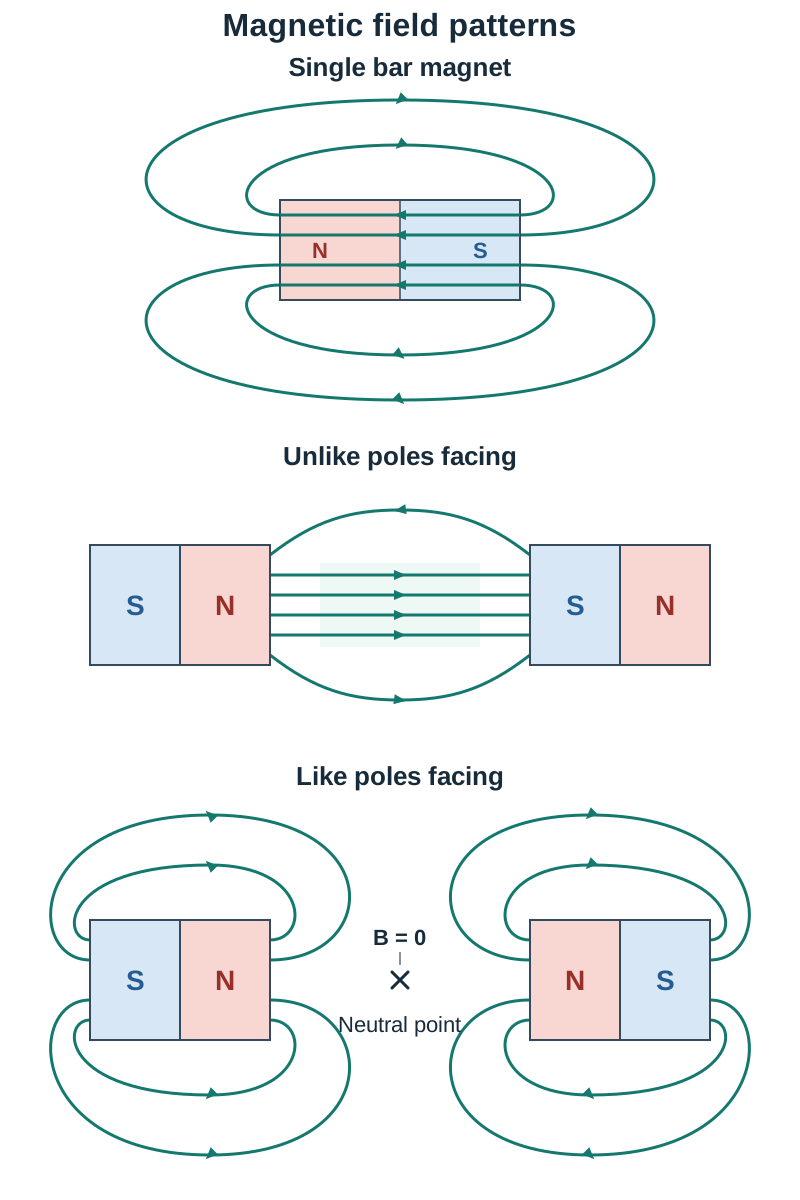
You can plot field lines using a small plotting compass. Place a bar magnet on a sheet of paper, set the compass near the north pole, and mark pencil dots at the needle's tip and tail. Move the tail to the second dot, mark the new tip position, and repeat until you trace a continuous curve into the south pole.
Magnetism can pass through non-magnetic materials, so a magnet can attract a paper clip through paper, wood, or aluminium.
| Magnet Type | Material Example | Retentivity (Holds Magnetism) | Common Practical Use |
|---|---|---|---|
| Permanent Magnet | Hard magnetic material (e.g. steel, alnico) | High (remains magnetised after field is removed) | Compass needles, fridge catches, loudspeakers |
| Temporary Magnet | Soft magnetic material (e.g. soft iron) | Low (demagnetises almost instantly when field is removed) | Electromagnet cores, relays, transformer cores |
Magnetic Effect of an Electric Current and Solenoids
In 1820, Hans Christian Oersted showed that an electric current produces a magnetic field when he noticed that a current-carrying wire deflected a nearby compass needle. When direct current flows through a conductor, it generates a magnetic field around it.
Field Around a Straight Wire
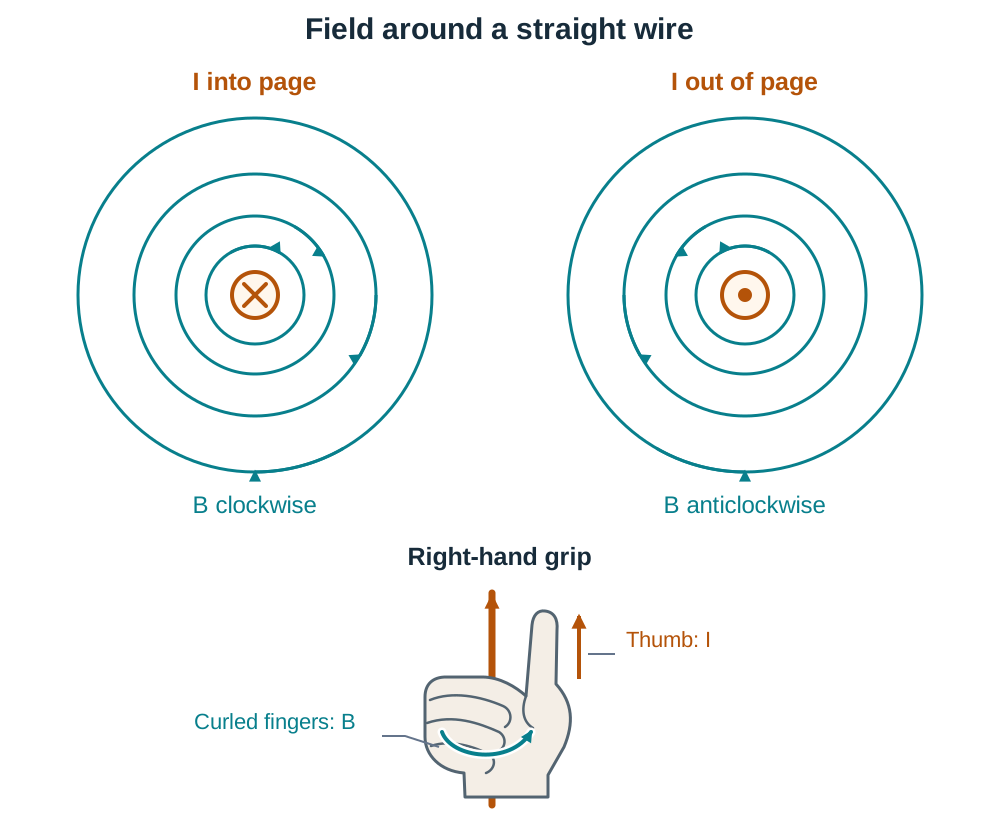
For a straight wire seen end-on, the field lines form concentric circles centred on the wire. Space the circles further apart as you move outward, because the field gets weaker further from the wire. Current into the page is represented by (like the tail feathers of an arrow moving away) and produces clockwise circles. Current out of the page is represented by (the tip of an oncoming arrow) and produces anticlockwise circles.
To find the direction, use the right-hand grip rule for a straight wire: grip the wire with your right hand with your thumb pointing in the direction of conventional current (positive to negative); your curled fingers point in the direction of the concentric magnetic field lines.
Solenoids and Finding Their Polarity
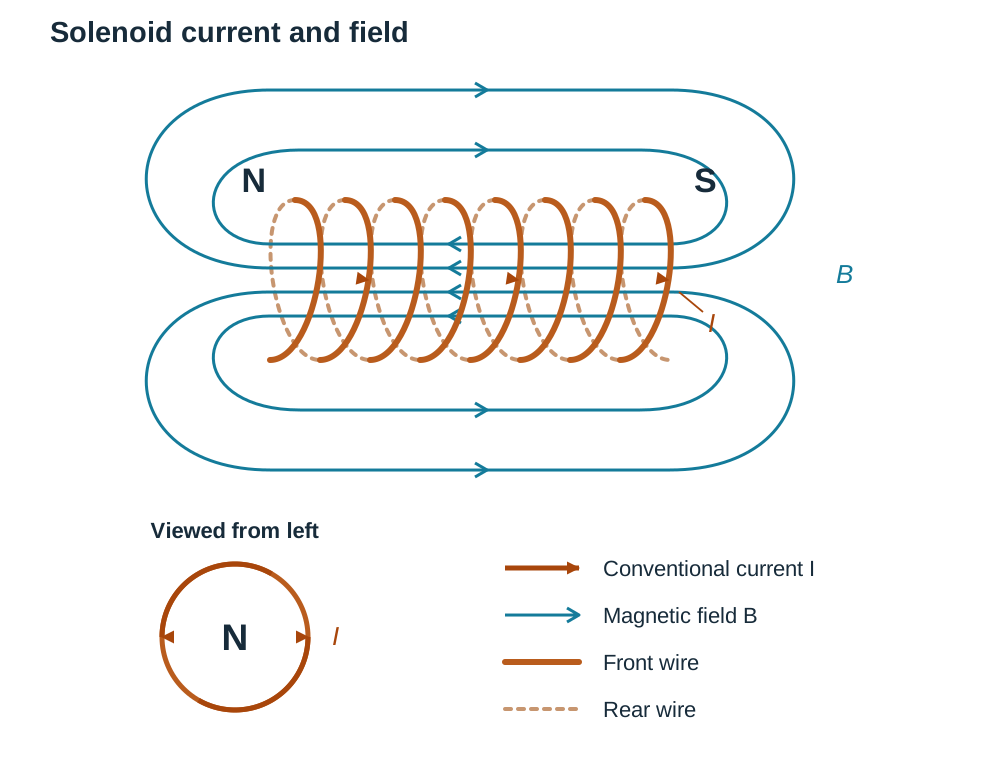
A solenoid is a long helical coil of wire whose length is greater than its diameter. When current passes through the turns, their individual fields combine. Inside the solenoid, draw parallel, evenly spaced lines along its axis, showing a strong, uniform magnetic field. Outside, the pattern is identical to that of a bar magnet, with lines looping from the north end to the south end.
Right-hand grip rule for a solenoid: Grip the solenoid with your right hand so that your fingers curl round the coil in the direction of the conventional current flowing through the turns. Your thumb then points towards the north pole of the solenoid.
End-view check: Look directly at one open end of the coil:
- If the current flows anticlockwise, that end is a north pole (picture an 'N' with arrows on its tips pointing anticlockwise).
- If the current flows clockwise, that end is a south pole (picture an 'S' with arrows on its tips pointing clockwise).
For example, if current enters the left-hand end of a solenoid and flows up the front face of each turn, curl your right fingers up over the front of the coil. Your thumb points to the left, so the left end is a north pole and the right end is a south pole.
Electromagnets and Domains
Iron is made of tiny microscopic regions called domains, each acting like a tiny magnet. Normally, these domains point in random directions, cancelling each other out. In an external magnetic field, the domains line up, turning the iron into a strong magnet. Soft iron's domains return to random orientations as soon as the external field is removed, whereas steel's domains stay locked in alignment.
Inserting a soft-iron core inside a solenoid creates an electromagnet. The core aligns with the field, increasing the magnetic flux density substantially. Because soft iron has low magnetic retentivity, it loses virtually all its magnetism the moment the current is cut off. Because an electromagnet can be switched on and off, and its strength changed by changing the current, it is used in scrapyard cranes, relays, electric bells, and door locks.
Everyday Applications of Permanent and Temporary Magnets
Permanent magnets and electromagnets are used across domestic, medical, and industrial technologies. For each application, be able to identify which type of magnet is used and why:
- Scrapyard Cranes (Temporary Magnet): Heavy lifting cranes use large electromagnets with soft-iron cores. When the operator switches on a large direct current, the electromagnet generates an intense magnetic field that lifts tonnes of scrap iron and steel. Once positioned over a container, the operator switches off the current; the soft iron immediately demagnetises and drops the load.
- Moving-Coil Loudspeakers (Permanent Magnet and Electromagnet): An audio amplifier feeds an alternating current signal into a small cylindrical coil (the voice coil), which is attached to a paper or plastic speaker cone. The voice coil sits inside the radial magnetic field of a strong permanent magnet. As alternating current flows through the coil, it experiences an alternating force () that drives the cone rapidly back and forth, generating sound waves in the air.
- Magnetic Levitation / Maglev (Electromagnets): Maglev trains use powerful electromagnets on the train and guideway to lift the carriage a small distance above the track. Opposing magnetic forces levitate the vehicle, while travelling magnetic fields propel it forward. Because there is no mechanical wheel-rail contact, rolling friction is eliminated, drastically reducing mechanical wear and allowing high operating speeds (though air resistance still opposes motion).
- Magnetic Resonance Imaging / MRI (Superconducting Electromagnet): Diagnostic scanners use a powerful, liquid-helium-cooled superconducting electromagnet to produce an intense, uniform magnetic field (typically 1.5 to 3.0 T). This field aligns protons in body tissues without using ionising radiation. Radio pulses disturb this alignment, and the emitted radio signals are processed into high-resolution soft-tissue scans.