

Static electricity deals with stationary electric charges, the forces they exert on each other, and how charge moves through or settles on different materials. Every electrostatic phenomenon comes down to the behaviour of electrons within atomic structures. By understanding how electrons move or remain bound, we can explain why a rubbed plastic rod attracts neutral paper or metal cans, how a metal sphere can be charged without contact, and why electric charge concentrates at sharp points on conductors. In this section we deal with whether charges attract or repel and why; the quantitative formula for the size of that force (Coulomb's law) and electric field strength are explored in the next topic.
Atomic Structure and the Nature of Electric Charge
All matter is made of atoms. At the centre of every atom sits a nucleus containing positively charged protons and uncharged neutrons. Surrounding this nucleus are negatively charged electrons. Protons and electrons carry equal magnitudes of charge but opposite signs.
The size of the charge on one electron (or one proton) is called the elementary charge, :
This is usually rounded to in calculations. An electrically neutral object contains equal numbers of protons and electrons, so the positive and negative charges cancel out completely.
Protons are bound tightly inside atomic nuclei by the strong nuclear force and never move during ordinary electrostatic interactions. Charging an object happens exclusively by transferring electrons:
- Gaining electrons leaves an object with an excess of negative charge ().
- Losing electrons leaves an object with a deficit of electrons, meaning protons outnumber electrons and the object acquires a positive charge ().
The net charge on any body is quantised as a whole number of elementary charges: .
The Unit of Charge and Common Prefixes
The SI unit of electric charge is the coulomb (C). Charges met in static electricity are tiny fractions of a coulomb, so metric prefixes are always used. Always convert these to coulombs before substituting into any calculation:
- Microcoulombs ():
- Nanocoulombs ():
- Picocoulombs ():
Conductors, Insulators, and Testing Materials
Materials are classified by how easily electric charge moves through them. This distinction depends on atomic structure:
- An electrical conductor is a substance that allows electric charge to flow freely. In metals like copper and aluminium, outer electrons detach from individual atoms to form a sea of delocalised free electrons. Because the free electrons are mobile, any excess charge placed on a conductor redistributes itself over the whole outer surface almost immediately, until no charge is left moving.
- An electrical insulator is a substance that does not allow electric charge to flow freely. In materials like polythene, Perspex, glass, and rubber, all electrons are bound electrons held firmly within chemical bonds. Deposited charge stays trapped locally where it was placed.
| Property | Conductor (e.g. Copper, Aluminium) | Insulator (e.g. Polythene, Glass) |
|---|---|---|
| Charge carriers | Mobile free electrons | Bound electrons |
| Charge mobility | High throughout the material | Immobile; locked to parent atoms |
| Charge distribution | Spreads over the entire outer surface | Remains localised where deposited |
Testing Whether a Material is a Conductor or an Insulator
There are two standard laboratory methods to test whether a material is a conductor or an insulator:
- Circuit (continuity) test: Connect a low-voltage d.c. power supply, a switch, a small indicator bulb, and two open leads in series. Place the test material across the gap between the leads. If the bulb lights, charge flows through the material, classifying it as a conductor. If the bulb remains unlit, the material is an insulator.
- Electroscope discharge test: Charge a gold-leaf electroscope so its leaf diverges. Touch the metal cap of the electroscope with the test sample held in your bare hand. If the leaf collapses immediately, charge has flowed through the material and your body to Earth, identifying it as a conductor. If the leaf remains deflected, the material is an insulator.
The Gold-Leaf Electroscope
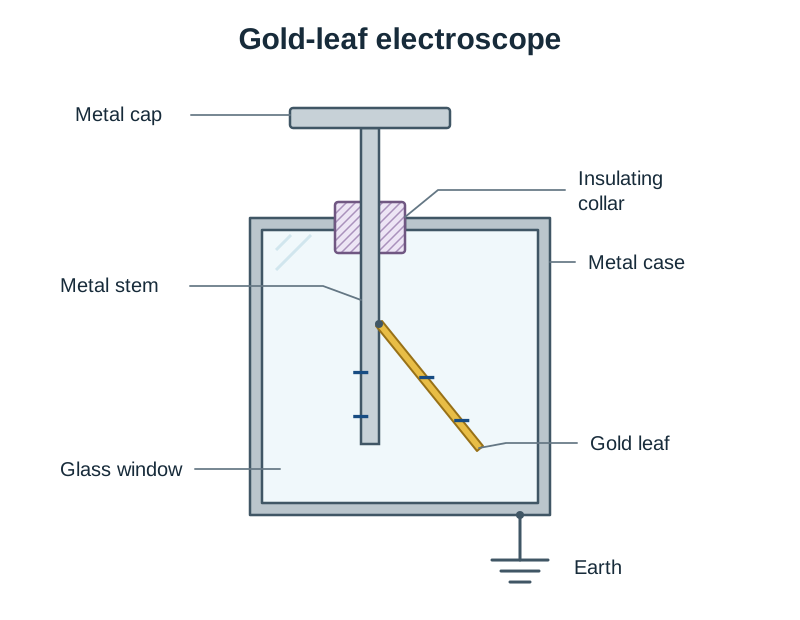
A gold-leaf electroscope is an instrument used to detect electric charge. It consists of a metal cap at the top, a vertical metal stem passing through an insulating plug, and a thin, flexible gold leaf hinged to the lower end of the stem. The stem and leaf are enclosed in a metal case with glass observation windows, and the case is connected to Earth to shield the leaf from stray external electric fields and draughts.
- Detecting charge: Touch the cap with a charged body. Because the cap, stem, and leaf are all conductors in contact, charge spreads across them. The leaf and the stem acquire charge of the same sign. Because like charges repel, the leaf swings away from the stem. A greater deflection indicates a larger quantity of charge.
- Discharging (earthing): Touch the metal cap with your finger. Your body provides a conducting path to Earth, allowing electrons to flow until the electroscope is neutralised, causing the leaf to fall flat against the stem.
Diagram to sketch: Draw a flat horizontal metal cap connected to a vertical metal rod (stem) passing through a shaded insulating collar into a rectangular box with an Earth symbol at the base. At the lower tip of the rod, draw a thin gold leaf angled outward, labelling both the stem and the leaf with identical charge signs ( or ).
Electrostatic Forces and Practical Demonstrations
Electrostatic forces are non-contact forces that act between charged bodies:
- Like charges repel (positive repels positive; negative repels negative).
- Unlike charges attract (positive attracts negative).
Demonstration: Forces Between Charges
- Purpose: To demonstrate attraction and repulsion between electric charges.
- Apparatus: Two polythene rods, a Perspex rod, a woollen cloth, a silk cloth, and a light suspension stirrup with dry nylon thread.
- Method:
- Rub one end of a polythene rod with a woollen cloth to charge it negatively, then balance it horizontally in the suspended stirrup so it can pivot freely.
- Rub a second polythene rod with wool and bring its charged end close to the charged end of the suspended rod.
- Rub a Perspex rod with a silk cloth to charge it positively, and bring its charged end near the suspended polythene rod.
- Observation: The suspended rod turns away when the second polythene rod approaches. It swings towards the charged Perspex rod.
- Conclusion: Like charges repel; unlike charges attract.
- Precautions: Ensure a dry room atmosphere, avoid touching the charged ends with bare hands, and shield the apparatus from air draughts.
Newton's Third Law in Electrostatic Interactions
When two charged bodies interact, they exert forces on each other that are equal in magnitude and opposite in direction, forming a Newton's third law pair. This holds true regardless of differences in the size of the charges or their masses. For example, a rod carrying a charge of attracts a small scrap of paper carrying an induced charge of with the exact same magnitude of force that the scrap of paper exerts on the rod. The paper accelerates visibly while the rod remains stationary purely because the paper has a vastly smaller mass ().
Forces on Neutral Objects and Why Repulsion is the Definitive Test
A charged body attracts neutral objects, but the mechanism depends on whether the neutral object is a conductor or an insulator.
Why a Charged Rod Attracts a Neutral Insulator (e.g. Scraps of Paper)
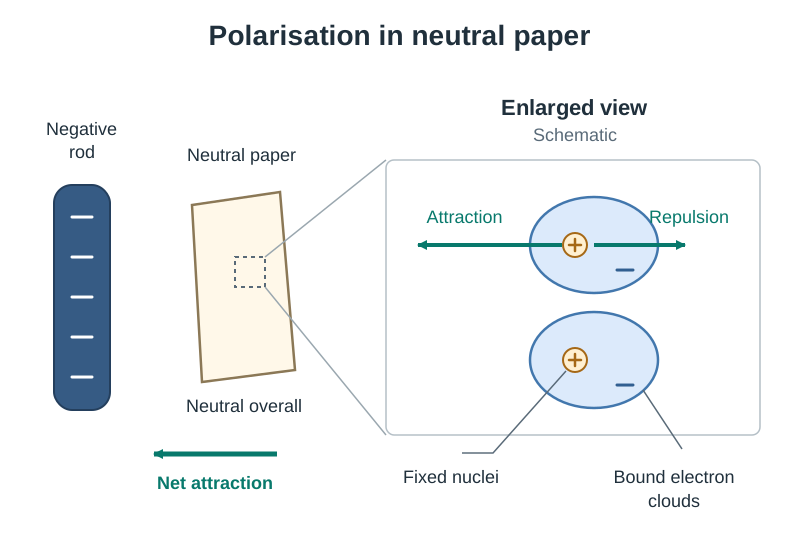
- Bring a negatively charged rod near a neutral scrap of paper. Because paper is an insulator, electrons cannot leave their parent atoms.
- However, the electric field of the rod repels the electron clouds surrounding each atomic nucleus, displacing them slightly away from the rod. Each atom becomes slightly lopsided—it undergoes polarisation.
- This creates an induced layer of positive charge on the near face of the paper, while the repelled negative charge sits on the far face.
- Electrostatic force decreases with distance. Because the induced positive charge is closer to the rod than the induced negative charge, the attractive force exceeds the repulsive force. The net force is attractive.
Why a Charged Rod Attracts a Neutral Conductor (e.g. An Aluminium Can)
Place an empty aluminium drinks can on its side on a smooth bench. When a negatively charged rod is held close to the can without touching, the can rolls towards the rod:
- The negative rod repels delocalised free electrons through the metal to the far side of the can.
- This leaves the near side with an induced positive charge and the far side with an equal induced negative charge. The can remains neutral overall.
- Because the induced positive charge is closer to the rod than the induced negative charge, attraction is stronger than repulsion, pulling the can towards the rod.
Key Distinction: In a conductor, mobile free electrons travel across the entire body. In an insulator, electrons remain tied to their parent atoms and only the electron clouds shift (polarisation).
Because a charged object attracts both oppositely charged bodies and uncharged neutral bodies, attraction cannot prove an object carries a net charge. Repulsion is the only definitive test for charge, as repulsion occurs exclusively between two bodies that both carry a net charge of the same sign.
Charging by Friction, Induction, and Conservation of Charge
Charging by friction happens when two different materials are rubbed together, provided that the charge cannot leak away. It works reliably when the materials are insulators, or when a conductor is mounted on an insulating stand or held by an insulating handle. Rubbing brings surface atoms into close contact, allowing the material with the higher electron affinity to strip electrons from the other.
- Rubbing a polythene rod with a woollen cloth transfers electrons from the wool onto the polythene. The polythene becomes negatively charged, and the wool acquires an equal positive charge.
- Rubbing a Perspex rod with silk transfers electrons from the Perspex onto the silk. The Perspex becomes positively charged, and the silk acquires an equal negative charge.
The Law of Conservation of Charge
The Law of Conservation of Charge states that electric charge cannot be created or destroyed; the total amount of electric charge in an isolated system remains constant.
When two identical conducting spheres on insulating stands touch, their combined charge divides equally between them upon separation:
Grounding (Earthing)
Grounding (earthing) means providing a conducting path between an object and the Earth. The Earth is an enormous reservoir of charge that can accept or donate electrons without changing its own electrical potential. Touching an isolated charged metal object with your finger grounds it through your body:
- If the object is negatively charged, excess electrons flow from the object to Earth.
- If the object is positively charged, electrons flow from Earth onto the object to neutralise it.
Charging a Single Conductor by Induction
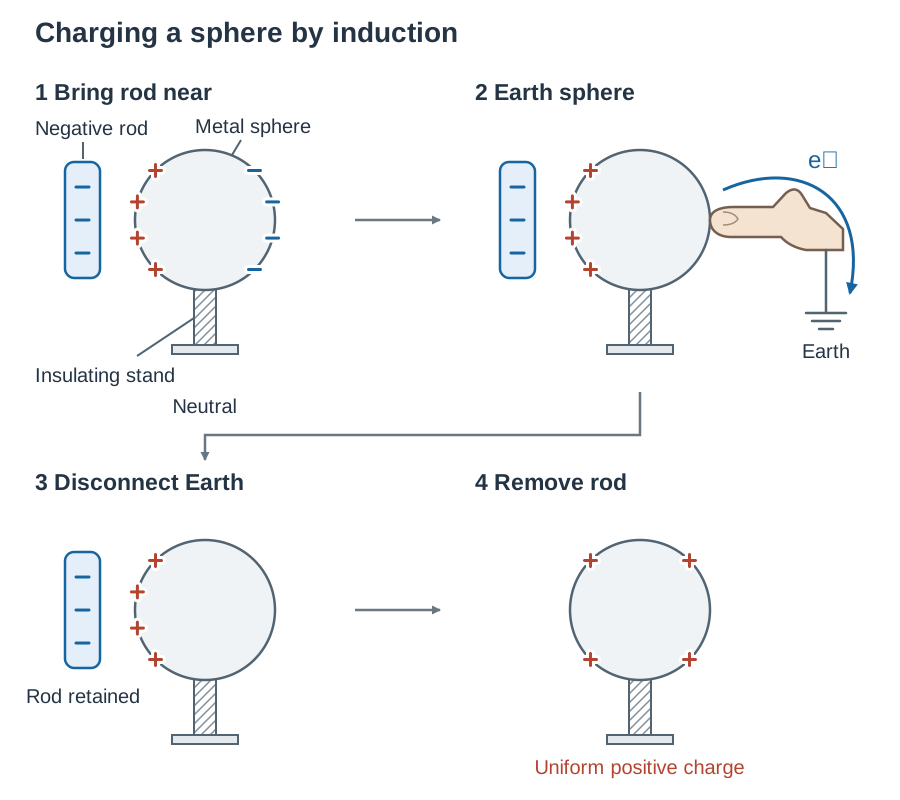
Charging by induction gives a conductor a lasting net charge without direct physical contact with the charging body. To give an insulated metal sphere a permanent positive charge using a negatively charged rod, execute four steps in strict order:
- Bring the rod near: Place an uncharged metal sphere on an insulating stand. Bring a negatively charged rod close to one side without touching. Free electrons are repelled to the far side, leaving the near side with an induced positive charge. The sphere remains neutral overall.
- Ground the sphere: Keeping the rod held firmly in position, touch the far side of the sphere with your finger. Repelled electrons flow through your body to Earth.
- Disconnect the ground: Remove your finger from the sphere while keeping the rod in place. This traps the electron deficit on the sphere.
- Remove the rod: Withdraw the charged rod. The remaining electrons redistribute evenly over the sphere, leaving it with a permanent, uniform positive charge.
Crucial Exam Rule: If the rod is removed before disconnecting the ground, electrons flow straight back from Earth onto the sphere, leaving it neutral. Induction always produces a charge opposite to that of the inducing rod.
Diagram to sketch: Draw four sequential stages showing a circle on a hatched insulating stand. In stage 1, draw a negatively charged rod on the left, with signs on the left side of the sphere and signs on the right side. In stage 2, keep the rod in place and draw a finger touching the right side, showing an arrow indicating electron flow to Earth. In stage 3, show the finger removed with the rod still present. In stage 4, show the rod removed and signs spaced evenly around the entire circumference.
Charge Distribution on Conductors and Insulators
Charge Distribution on a Conductor
Once the charge on an isolated conductor has settled into electrostatic equilibrium, it behaves according to two rules:
- Static charge resides entirely on the outer surface of a conductor. Because like charges repel, free electrons push each other as far apart as possible, settling on the exterior boundary. There is no net electric charge inside a closed hollow conductor. This shields the interior from outside electrostatic effects (electrostatic shielding).
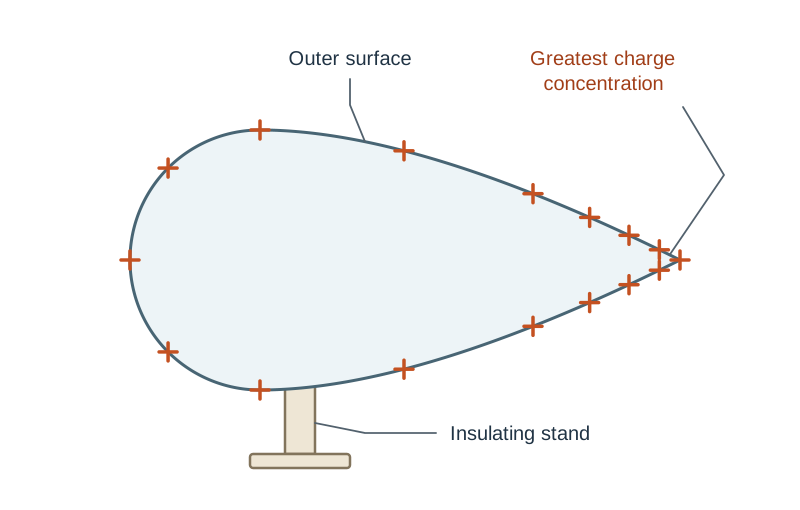
- Charge concentrates at regions of greatest curvature. On a sphere, curvature is identical everywhere, so surface charge density is uniform. On an irregular or pear-shaped conductor, charges cluster at sharp points or regions with small radii of curvature.
Diagram to sketch: For a pear-shaped conductor, draw an oval tapering to a sharp point on an insulating stand. Draw signs directly on the outer line, widely spaced on the broad curved end and packed tightly together at the sharp tip. Never draw charge signs inside the body.
Charge Distribution on an Insulator
On an insulator, charge remains localised where it was deposited because its electrons are bound electrons that cannot move through the material. Charge does not spread across the surface or concentrate at sharp points.
Demonstration: Rub one end of a long polythene strip with a woollen cloth and bring various parts of the strip near small bits of paper. Only the rubbed end picks up the paper; the unrubbed end produces no effect. By contrast, if an insulated metal rod is charged at one end, the whole rod attracts paper because charge spreads over the entire conductor.
Point Discharge and Real-World Applications
The intense surface charge density at a sharp point creates a powerful localised electric field that ionises surrounding air molecules into positive ions and free electrons:
- Ions with charge of the same sign as the point are repelled away, producing a flow of air called an electric wind.
- Ions of opposite sign are attracted to the point, neutralising its charge.
This continuous loss of charge from sharp tips is called point discharge.
- Lightning conductors: A pointed metal rod installed on the roof of a tall building safely bleeds charge from thunderclouds via point discharge, or provides a low-resistance path to Earth to carry a lightning strike safely away from the building structure.
- Industrial precipitators: Electrostatic precipitators in industrial chimney stacks use high-voltage pointed wires to charge airborne smoke and ash particles. These charged particles are then attracted to oppositely charged collection plates, preventing toxic particulate matter from entering the atmosphere and protecting public health.
Key terms
- Elementary charge
- The magnitude of electric charge carried by a single proton or electron, approximately ().
- Electrically neutral
- Having zero net electric charge due to containing equal numbers of protons and electrons.
- Electrical conductor
- A material containing mobile charge carriers, such as delocalised free electrons, that allow electric charge to flow freely through it.
- Electrical insulator
- A material whose electrons are firmly bound to specific atoms and cannot move freely through the substance.
- Free electrons
- Loosely bound outer electrons in a conductor that are free to move throughout the material lattice.
- Bound electrons
- Electrons in an insulator that are locked within atomic or molecular structures and cannot migrate.
- Charging by friction
- The transfer of electrons between two different materials when brought into intimate contact by rubbing.
- Charging by induction
- Charging a conductor by using a nearby charged body to induce charge separation, grounding it temporarily, and trapping the net charge without physical contact.
- Grounding (earthing)
- Providing a conducting path between a charged body and the Earth, allowing electrons to flow to or from the Earth to neutralise the body.
- Law of Conservation of Charge
- The principle stating that electric charge cannot be created or destroyed; the total electric charge in an isolated system remains constant.
- Polarisation
- The slight displacement of positive and negative charges in opposite directions within neutral atoms or molecules caused by an external electric field.
- Point discharge
- The loss of charge from a sharp point on a conductor caused by the intense electric field ionising the surrounding air.
Check yourself
Why cannot a copper rod held in a bare hand be charged by rubbing it with a cloth?
Copper and the human body are both electrical conductors. Any electrons transferred by friction immediately flow through the hand and body to Earth, leaving the rod neutral.
What is the only definitive test to prove an object is electrically charged, and why?
Repulsion. A charged object can attract neutral objects through polarisation or induced charge separation, but repulsion only occurs between two bodies carrying a net charge of the same sign.
How many electrons must be removed from a neutral body to give it a net charge of +3.2 µC?
Using n = Q/e: (3.2 × 10⁻⁶ C) / (1.6 × 10⁻¹⁹ C) = 2.0 × 10¹³ electrons.
Where does excess electric charge reside on an isolated hollow metal container?
Entirely on the outer surface. Mutual repulsion pushes mobile like charges as far apart as possible, leaving zero net charge on the inside surface.
During charging by induction using a positively charged rod, which direction do electrons flow when the metal sphere is grounded?
Electrons flow from Earth onto the sphere, attracted by the nearby positive rod, leaving the sphere negatively charged once the ground is removed.