

Electric fields provide the foundational physical model for explaining how charged objects interact across space without direct physical contact. This topic covers the quantitative inverse square law for electrostatic forces between point charges (Coulomb's law), how the inverse-square relationship can be tested from measurements, the definition and vector properties of electric field strength, field line visualisations, and electric potential and potential difference as work done per unit charge.
The Electric Field as a Non-Contact Model
Charged objects exert electrostatic forces of attraction or repulsion across space without physical contact. Instead of saying that one charge somehow reaches across empty space and grabs the other, we explain the interaction in two steps:
- Any charged object establishes an electric field in the space surrounding it.
- A second charge placed into that region interacts locally with the field present at its exact position, experiencing an electrostatic force.
An electric field is defined as a region of space in which an electric charge experiences an electrostatic force. The field exists around a charge whether or not there is another charge nearby to experience a force.
How the field model explains everyday observations
Consider a plastic comb charged by friction that picks up neutral bits of paper. In step one, the charged comb creates an electric field in the air around it. In step two, this field acts on the atoms in the paper, pulling electrons slightly towards or away from the comb (electrostatic induction). Because the opposite charges in the paper are induced closer to the comb than the like charges, and the electric field is stronger closer to the comb, the force of attraction is stronger than the force of repulsion. The paper is pulled towards the comb without either object having touched beforehand.
Every gravitational formula has an electric twin
Strand 1 introduced Newton's law of universal gravitation. Both gravitational and electric fields are non-contact vector fields that obey an inverse square law, but their quantitative properties differ enormously:
| Gravitational | Electric |
|---|---|
| Weight: | Electric force: |
| Field of a mass: | Field of a charge: |
| Field strength = force per unit mass, in | Field strength = force per unit charge, in |
| Source: mass | Source: electric charge |
| Direction: attractive only | Direction: attractive or repulsive |
| Strength: very weak — only noticeable when one mass is huge, like a planet | Strength: enormously stronger — about times the gravitational force between two protons |
| Shielding: cannot be shielded | Shielding: can be shielded by hollow conductors |
Coulomb's Law and Inverse-Square Modelling
The quantitative law governing electrostatic forces between static point charges was established experimentally by Charles-Augustin de Coulomb.
Coulomb's law states that the electrostatic force between two point charges is directly proportional to the product of the charges and inversely proportional to the square of the distance between them.
In mathematical form, for two charges and separated by distance in a medium of permittivity :
Where:
- is the electrostatic force in newtons (N)
- and are the charge magnitudes in coulombs (C)
- is the distance between the charge centres in metres (m)
- is the permittivity of the intervening medium in farads per metre ()
A point charge is an idealised model of a charged body whose physical size is negligible compared to the separation distance .
In a vacuum or dry air, we use the permittivity of free space, . Take from the Formulae and Tables booklet and work out on your calculator — it comes to about . Slight differences in the last digit depending on rounding are acceptable on the examination; always quote final answers to two or three significant figures.
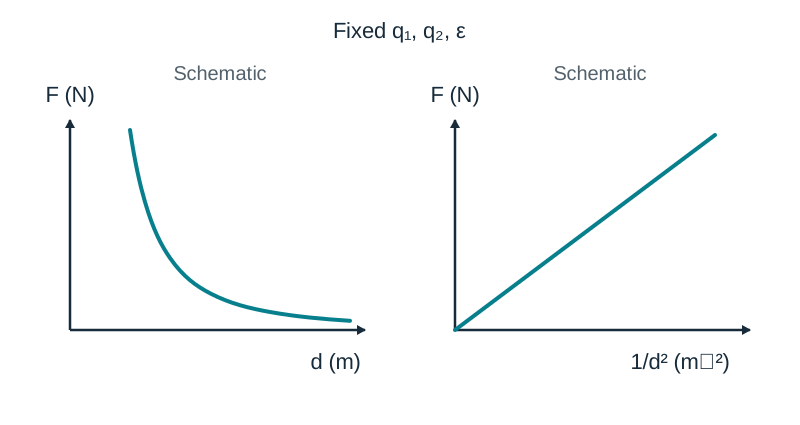
The inverse square relationship
Because :
- Doubling quarters the force ()
- Tripling reduces the force to one-ninth ()
- Halving quadruples the force ()
Testing the inverse-square relationship from data
If you have measured values of force at various separations , you can test whether they obey an inverse square law in two ways:
- Graphing: Plot on the vertical axis against on the horizontal axis. A straight line passing through the origin verifies that . Plotting against gives a curve, which does not prove an inverse square relationship on its own.
- Product check: Check whether gives a constant value across different pairs of readings ().
Direction and Newton's third law
When calculating , put the charge sizes into Coulomb's law as positive numbers. Determine the direction of the force separately: like charges repel, unlike charges attract. The force acts along the straight line joining the two charge centres. By Newton's third law, both charges experience forces of equal magnitude but opposite direction.
Electric Field Strength (E)
Electric field strength () at a point is the electrostatic force per unit positive charge placed at that point.
Rearranging gives the force on any charge placed in an electric field :
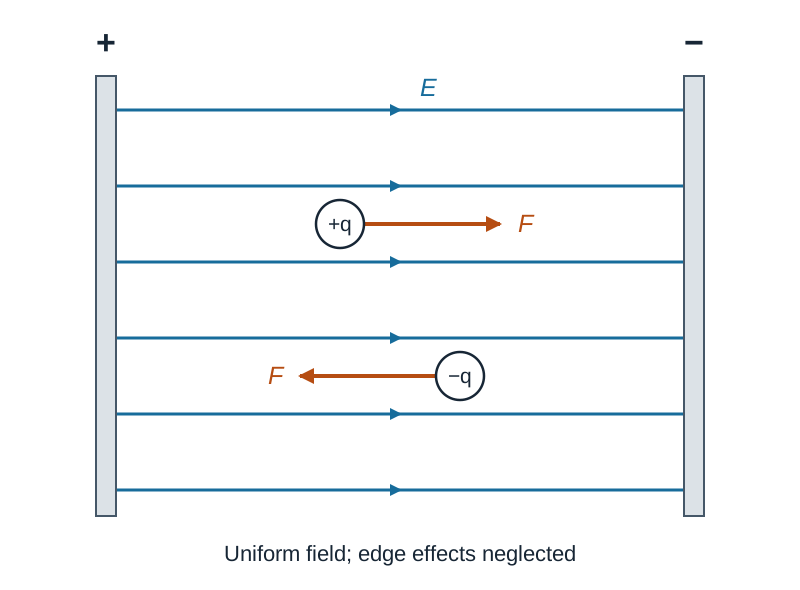
By convention, the direction of at a point is the direction of the force on a small positive charge placed there. A positive charge placed in a field experiences a force in the direction of ; a negative charge experiences a force in the opposite direction.
Why N C⁻¹ and V m⁻¹ are identical units
Electric field strength can be quoted in or — either is accepted in an examination answer:
Use when working from forces and when working with potential and distance.
Field of an isolated point charge
Substituting Coulomb's law for into gives the field strength at distance from a source charge :
Uniformly charged conducting spheres
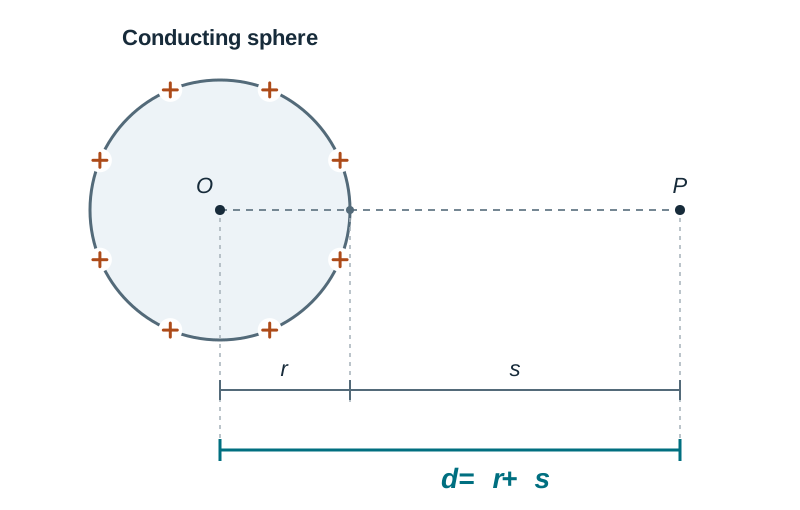
On a charged metal sphere (such as a Van de Graaff generator dome), excess charge spreads out over the outer surface, and the electric field inside the hollow conductor is zero. Outside the sphere, the field behaves as if all the charge were concentrated at the geometric centre.
- If a question asks for the field at the surface of the sphere, the distance is simply the radius .
- If a question asks for the field at a distance from the surface, the total distance from the centre is .
Electric Field Lines and Field Representations
An electric field line is an imaginary line drawn in an electric field such that the tangent to the line at any point gives the direction of the force on a small positive test charge.
Field lines follow strict physical rules:
- Lines start on positive charges and end on negative charges.
- Where lines are closer together, the field is stronger.
- Field lines never cross. If two lines crossed, a charge placed at the intersection would experience two different net forces at once, which is impossible.
- In electrostatic equilibrium, field lines always meet a conducting surface at right angles ().
Common field line configurations
- Isolated positive point charge: Straight lines radiating outwards like spokes on a wheel.
- Isolated negative point charge: Straight lines directed radially inwards towards the centre.
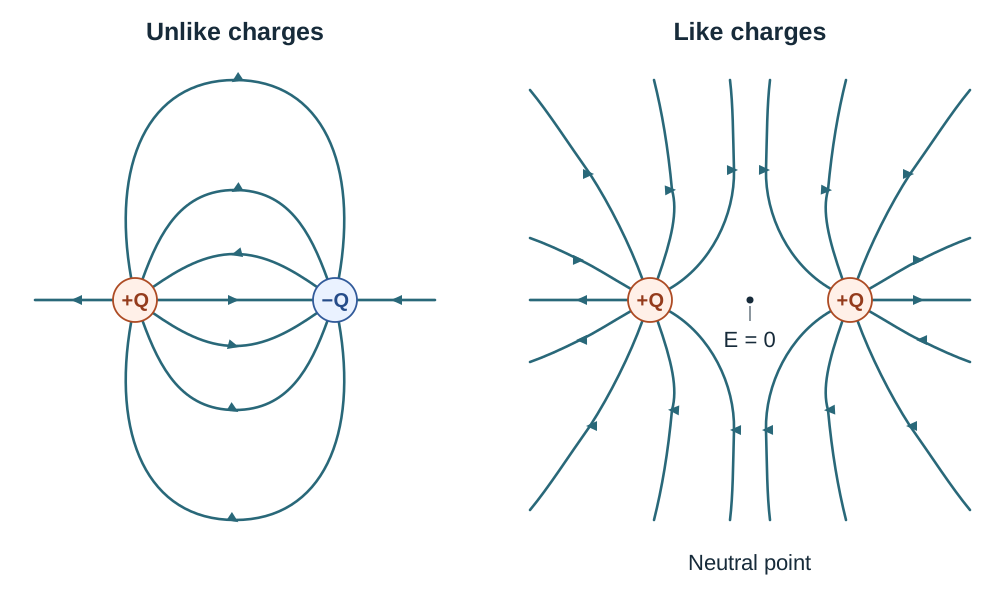
- Electric dipole ( and ): Curved lines leaving and entering . In the region between the charges the lines are close together, showing a strong field there; the field is strongest of all very close to each charge.
- Two like positive charges ( and ): Lines curve away from one another, leaving an empty point at the exact centre called a neutral point, where the resultant field is zero ().
- Parallel oppositely charged plates: Straight, equally spaced parallel lines directed from the positive plate to the negative plate, representing a uniform electric field where the field strength and direction are the same at every point. In a uniform field, the same force acts on a charge wherever it is placed between the plates.
Drawing the diagram in the exam
To secure full marks on a field-drawing question, make sure your sketch includes:
- At least six lines, spaced symmetrically around the charge
- An arrowhead on every single line, pointing the correct way
- Lines meeting or leaving conducting surfaces perpendicular to the surface
- For a charged sphere, lines starting on the surface, never inside
- No lines crossing or touching each other
- The sign of the charge ( or ) clearly indicated.
Vector Addition of Electric Fields
Electric field strength is a vector quantity. When more than one charge creates a field, the total field at any point is found by adding the individual fields as vectors.
To find the resultant field at a point along the same straight line:
- Calculate the magnitude of each field component separately using .
- Determine the direction of each field vector at that point (pointing away from positive charges, pointing towards negative charges).
- Add vectors that point in the same direction; subtract vectors that point in opposite directions.
The field at the midpoint between two charges
- Between two identical charges ( and ): At the midpoint, the two fields have identical magnitudes but point directly away from their respective source charges — meaning they point in opposite directions. They cancel completely, creating a neutral point ().
- Between equal and opposite charges ( and ): At the midpoint, the field from points away from (towards ), and the field from points towards . Because both field vectors point in the exact same direction, they add together ().
Electric Potential, Potential Difference, and Energy
Electric potential () at a point is the work done in bringing a charge of one coulomb (a unit positive charge) from infinity to that point.
Where is electric potential in volts (V), is work done in joules (J), and is charge in coulombs (C). The volt is defined as one joule per coulomb (). Electric potential is a scalar quantity; it has magnitude and sign, but no direction.
Potential difference
The potential difference between two points is the work done in moving a charge of one coulomb from one point to the other.
If a charge moves between two points that have a potential difference , the work done (energy transferred) is:
Potential difference is the quantity measured by a voltmeter. In practical applications, the earth is defined as zero potential ().
Conservation of energy in particle acceleration
When an electron of mass and charge is accelerated from rest through a potential difference in a vacuum, the electrical potential energy lost equals the kinetic energy gained:
This relationship governs electron guns in cathode ray tubes and X-ray tubes.
Electric fields at work
On a charged conductor, charge concentrates most densely on the regions with the sharpest curvature, meaning the electric field is strongest at sharp points or edges.
- Lightning conductor: A sharp metal rod sits on top of a tall building and connects to earth via a heavy copper strip. The high electric field at the sharp point ionises nearby air molecules, allowing charge to leak away quietly (point discharge). If lightning does strike, the copper conductor carries the large current safely into the ground rather than through the building structure.
- Electrostatic precipitator: Dirty flue gas from power plants passes through high-voltage wires that charge airborne dust and soot particles. Oppositely charged collecting plates then attract these particles out of the smoke before it leaves the chimney, reducing air pollution.
- Photocopier and laser printer: An electrostatic pattern of charge is written onto a drum. Oppositely charged toner powder clings to the charged sections by electrostatic attraction without mechanical pressure, transferring the toner to paper.
- Faraday cage shielding: Because excess charge resides entirely on the outer surface of a conductor, the electric field inside a hollow metal enclosure is zero. Metal casings protect sensitive electronic circuits from external stray fields, and passengers inside a car or aircraft remain safe if struck by lightning.
Key terms
- Electric Field
- A region of space in which an electric charge experiences an electrostatic force.
- Coulomb's Law
- The electrostatic force between two point charges is directly proportional to the product of the charges and inversely proportional to the square of the distance between them.
- Permittivity (ε)
- A measure of the resistance of a medium to the formation of an electric field, where higher permittivity reduces the electrostatic force between charges.
- Permittivity of Free Space (ε₀)
- The permittivity of a vacuum, the constant that appears in Coulomb's law when charges are in a vacuum or in air; ε₀ = 8.854 × 10⁻¹² F m⁻¹ (from the Formulae and Tables booklet).
- Electric Field Strength (E)
- The electrostatic force per unit positive charge placed at a point in an electric field (E = F/q), measured in N C⁻¹ or V m⁻¹.
- Point Charge
- An idealised model of a charged body whose physical dimensions are negligible compared to the separation distances being analysed.
- Electric Field Line
- An imaginary line drawn in an electric field such that the tangent to it at any point indicates the direction of the electrostatic force on a small positive test charge.
- Uniform Electric Field
- An electric field whose strength and direction are identical at all points, represented by parallel, equally spaced field lines.
- Neutral Point
- A point in space where the vector sum of two or more electric fields equals zero.
- Electric Potential (V)
- The work done in bringing a charge of one coulomb (a unit positive charge) from infinity to that point (V = W/q), measured in volts (V).
- Potential Difference
- The work done in moving a charge of one coulomb from one point to another, measured in volts (V).
- Inverse Square Law
- A physical law stating that a specified physical quantity is inversely proportional to the square of the distance from the source.
Check yourself
Two point charges of +4.0 nC and +9.0 nC are 5.0 cm apart in air. Calculate the force between them and state whether it is attractive or repulsive. (Take 1 / (4πε₀) = 8.99 × 10⁹ N m² C⁻²)
F = (8.99 × 10⁹)(4.0 × 10⁻⁹)(9.0 × 10⁻⁹) / (0.050)² = 1.3 × 10⁻⁴ N. Repulsive, because both charges are positive.
What happens to the electrostatic force between two point charges if their separation distance is doubled?
Because Coulomb's law obeys an inverse square law (F ∝ 1/d²), doubling the distance reduces the force to one-quarter of its initial value.
State the direction of an electric field line by convention.
An electric field line points in the direction of the force that would act on a small positive test charge placed in the field.
Why is the resultant electric field zero at the midpoint between two identical positive point charges?
The electric fields produced by the two charges at the midpoint are equal in magnitude but point in opposite directions, cancelling out completely to form a neutral point.
A test charge of +4.0 μC experiences an electrostatic force of 0.24 N. Calculate the electric field strength at that location.
Using E = F/q: E = 0.24 N / (4.0 × 10⁻⁶ C) = 6.0 × 10⁴ N C⁻¹ in the direction of the force.
What graph should be plotted to confirm from measurements that the force between two charges obeys an inverse square law?
A graph of electrostatic force F on the y-axis against 1/d² on the x-axis, which yields a straight line passing through the origin.
How much work is done when a charge of 5.0 mC moves through a potential difference of 120 V?
Using W = qV: W = (5.0 × 10⁻³ C)(120 V) = 0.60 J.