

Listening comprehension accounts for 20% of the total Leaving Certificate German marks (80 out of 400 marks at Higher Level). The listening test is one continuous recording that runs under the examiner's control; it contains built-in pauses for reading the questions and writing your answers, but you cannot ask for it to be stopped or replayed. An interview with an invited guest is one of the standard components, frequently appearing as the opening section. In the interview task, a reporter questions a guest about personal experiences, educational choices, community initiatives, environmental action, or contemporary social issues. All questions in your exam booklet are printed in English, and you must write your answers in English or Irish. Success depends on extracting precise factual information, tracing the guest's personal viewpoints, and catching conversational nuances such as irony or reported speech without translating word-for-word.
Exam Format and Note-Taking Mechanics
In the interview part of the aural exam, you hear a reporter questioning a guest in German. Your job is to pick out three things: hard facts (times, numbers, places), what the guest thinks, and how the guest says it (enthusiastic, sarcastic, or quoting somebody else). You write your answers in English or Irish, using your own words rather than a word-for-word translation.
Audio Structure and Answering Rules
The audio track is controlled entirely by the official recording, with set reading pauses before each section and finishing pauses at the end. You must listen to the announcer's instructions on the day for the exact number of playbacks and pause lengths. The questions generally follow the order of the conversation, which helps you keep your place, but broad questions (such as 'Give details about the service' or attitude questions) can draw on information from across the entire extract. If a detail turns up earlier or later than you expected, stay calm and keep listening.
Your answers must be written in English or Irish; transcribing full German sentences directly from the audio will not be credited. However, proper nouns and specific contact details are different: personal names, place names, websites, and phone numbers are written exactly as heard (such as Frau Schütz, nummergegenkummer.de, or 116 111).
Efficient Margin Notes
Do not try to write polished English sentences while the guest is speaking, or you will miss the next question. Use the exam booklet margins actively:
- Write numbers as digits immediately: If you hear vierundvierzig, write down 44 straight away.
- Jot German keywords phonetically: If you catch a word but cannot translate it instantly, jot it down roughly (e.g. write 'kost-lows' for kostenlos) and convert it to 'free of charge' during the pause.
- Use the playbacks systematically: In the first playback, grasp the overall story and secure the straightforward facts. In the second playback, fill in specific explanations, attitudes, and reasons. If a third playback is given, check spellings, numbers, and qualifying words.
- Complete your work in the pause: Once the audio moves to the next section, you cannot go back. Ensure every answer space has your best response before the recording moves on.
Numbers, Clock Times, Dates, and Contact Details
Factual questions often hinge on numerical precision, dates, and contact data. Spoken German has several specific features that regularly catch candidates out.
The Units-First Rule and Clock Times
In German compound two-digit numbers, the unit is always spoken before the ten, linked by und:
- dreiundvierzig = 3 + 40 = 43 (not 34).
- fünfundsechzig = 5 + 60 = 65 (not 56).
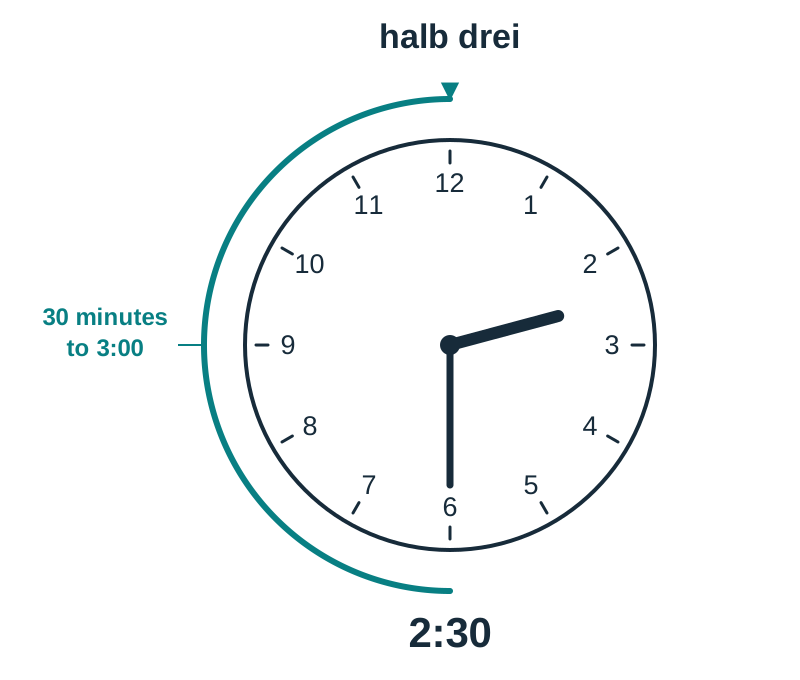
For clock times, the word halb means half an hour before the named hour, never half past:
- halb drei = 2:30 (half past two).
- halb acht = 7:30 (half past seven).
- Viertel nach sieben = 7:15; Viertel vor sieben = 6:45; zehn vor halb acht = 7:20 (ten minutes before 7:30).
Interviews frequently use the 24-hour clock for evening times (zwanzig Uhr = 8:00 pm; sechzehn Uhr dreißig = 4:30 pm).
Dates and Larger Statistics
Dates are spoken using ordinal numbers: am dritten Mai (on the 3rd of May); am einundzwanzigsten Juni (on the 21st of June). Time boundaries often use Anfang Juli (beginning of July), Mitte Juli (mid-July), or Ende Juli (end of July).
Be alert to scale and false friends in statistics:
- eine Milliarde means a billion (1,000,000,000). A German Billion actually means a trillion.
- eineinhalb or anderthalb = 1.5; die Hälfte = half; ein Drittel = a third; ein Viertel = a quarter; doppelt so viele = twice as many.
- Prepositions with changes: um 20 Prozent gestiegen = risen by 20%; auf 20 Prozent gestiegen = risen to 20%.
Spelled-Out Names and Contact Information
Interviewees are often asked „Wie erreicht man Sie?“ (How can people reach you?). Each digit, website segment, or spelled letter often forms an individual marking point. Letters that frequently cause confusion:
- e sounds like English 'ay', i sounds like English 'ee', and a sounds like 'ah'. Reversing ei and ie turns Meier into Mieer.
- j = 'yot', v = 'fau', w = 'vay', y = Ypsilon, and z = 'tset'.
- ä, ö, ü are pronounced a-Umlaut, o-Umlaut, u-Umlaut; they can also be written out as ae, oe, ue (e.g. Schütz → Schuetz).
- ß is Eszett or scharfes S; writing 'ss' is acceptable (e.g. Straße → Strasse).
- doppel- means a repeated letter (doppel-t = tt).
Punctuation terms to recognise:
| German | English |
|---|---|
| Punkt | dot / full stop |
| Bindestrich | hyphen (-) |
| Unterstrich | underscore (_) |
| at / Klammeraffe | @ |
| Schrägstrich | slash (/) |
| alles klein / groß | all lower case / capital letters |
| die Vorwahl | area code / dialling code |
Limiting Words and Implicit Reason Questions
A candidate can understand the main topic of an extract perfectly and still lose the mark by dropping a small qualifying word. German speakers use short, unstressed limiting words that completely alter or reverse the factual meaning of a sentence.
Small Words That Flip the Meaning
| German | Meaning | Spoken Example and English Gloss |
|---|---|---|
| erst | only / not until | „Wir öffnen erst um zehn.“ – We do not open until ten o'clock. |
| erst seit | only since / only for | „Ich mache das erst seit einem Jahr.“ – I have only been doing this for a year. |
| schon | already / as many as | „Sie hat schon 200 Anrufe bekommen.“ – She has already received 200 calls. |
| nur | only / just | „Das Angebot gilt nur am Wochenende.“ – The offer is valid only at the weekend. |
| kaum | hardly / scarcely | „Es gibt kaum Parkplätze vor Ort.“ – There are hardly any parking spaces on site. |
| nicht mehr | no longer / not any more | „Der Service ist nicht mehr kostenlos.“ – The service is no longer free. |
| noch nicht | not yet | „Die Entscheidung ist noch nicht gefallen.“ – The decision has not been made yet. |
| fast / knapp | almost / just under | „Wir haben fast eine Million Anrufe.“ – We have almost one million calls. |
Watch the difference between modal verbs: man muss nicht means 'you do not have to' (an option), whereas man darf nicht means 'you must not / you are not allowed to' (a prohibition). In a helpline extract, „Man muss seinen Namen nicht nennen“ means callers do not have to give their name, which secures the mark for anonymity.
Extracting Reasons When the Speaker Never Says 'Weil'
Higher Level interview questions frequently ask: 'Why is this initiative so popular?' or 'Why do young people use this service? Give three details.' Many students listen exclusively for causal conjunctions like weil or da. When they do not hear them, they panic.
In natural German interviews, the guest rarely says „Das ist beliebt, weil...“. Instead, the guest simply lists positive attributes, practical features, or emotional benefits. In an exam answer, you turn each positive feature directly into a reason:
- If the speaker says „Niemand sieht deine Nummer und es kostet keinen Cent“, your reasons are: (1) It is completely confidential / phone numbers are hidden, and (2) It is free of charge.
- If the speaker adds „Die Jugendlichen bestimmen selbst, wann Schluss ist“, your third reason is: (3) Callers themselves control how long the conversation lasts.
Tenses, Reported Speech, and Irony
Higher Level questions test your ability to separate past reality from future hopes, and to tell whether an interviewee is stating their own belief, reporting what someone else claims, or speaking with irony.
Tense Tracking and Timeframes
Notice how the verb structure signals the precise timeframe:
- Perfekt (Past): „Ich habe eine Lehre gemacht.“ – I completed an apprenticeship.
- Präsens (Present): „Ich arbeite bei einer Bank.“ – I work at a bank.
- Präsens with future adverb: „Morgen treffe ich den Chef.“ – Tomorrow I am meeting the boss.
- Futur I (Definite future): „Ich werde Biologie studieren.“ – I will study biology.
- Konjunktiv II (Hypothetical/Wish): „Ich würde gern im Ausland wohnen.“ – I would like to live abroad (a wish, not an established fact).
- Präsens with seit: „Ich wohne seit fünf Jahren in Köln.“ – I have been living in Cologne for five years (and I still live there today; do not translate this as a finished past action).
Reported Speech (Konjunktiv I)
When an interviewee quotes a third party, an official, or a public report without personally verifying it, German uses reported speech (indirekte Rede), often using Konjunktiv I forms like sei (is), habe (has), or wolle (wants):
„Der Politiker behauptet, die Mieten seien gesunken.“ – The politician claims that rents have fallen.
The verb behaupten (to claim) and the subjunctive verb seien indicate that this is the politician's unconfirmed claim. If the question asks whether rents have fallen according to the speaker, the correct answer is: 'No, the speaker notes that the politician claims they have, but does not confirm it.'
Discerning Tone and Irony
Spoken German often conveys sarcasm through exaggerated positive words combined with sharp intonation:
„Na toll! Noch mehr Hausaufgaben – genau das hat mir gefehlt!“ – Just great! Even more homework – exactly what I needed!
Here, toll (great) is biting irony. Writing down that the speaker was delighted with the homework forfeits the mark. Look out for particles like ja, doch, and sarcastic expressions like Na wunderbar! or Das darf nicht wahr sein! (That can't be true!).
Interrogatives, Discourse Markers, and Speaker Attribution
Interviews are dialogues. Listening actively for the reporter's question words (W-Fragen) tells you what category of information the guest will deliver next:
- Wer? / Mit wem? (Who? / With whom?): Prepares you for a person, colleague, or organisation.
- Wann? / Seit wann? / Bis wann? (When? / Since when? / Until when?): Signals dates, opening days, or durations.
- Wo? / Wohin? / Woher? (Where? / Where to? / Where from?): Pinpoints cities, buildings, or regions.
- Warum? / Weshalb? (Why? / For what reason?): Signals explanations, motivations, or causes.
- Wie viel? / Wie viele? (How much? / How many?): Signals costs, call numbers, percentages, or participant figures.
Causal and Contrast Connectors
German connects clauses using different word-order patterns:
- Subordinating conjunctions (weil, da): Send the conjugated verb to the end of the clause („Er nimmt den Bus, weil die Fahrkarte billig ist.“* – He takes the bus because the ticket is cheap).
- Coordinating conjunction (denn): Leaves the verb in standard position 2 („..., denn die Fahrkarte ist billig.“* – ..., for the ticket is cheap).
- Explanatory adverb (nämlich): Never sits at the start of a clause. It sits in the middle (Mittelfeld), right after the finite verb („Er kommt heute nicht; er ist nämlich krank.“* – He is not coming today; he is, you see, ill).
- Contrast markers: Words like aber (but), obwohl (although), trotzdem (nevertheless), and einerseits ... andererseits (on the one hand ... on the other hand) mark an immediate shift in perspective. Examiners regularly place the mark on the qualification immediately following the contrast word.
Self-Corrections and Speaker Attribution
German audio recordings frequently feature mid-sentence self-corrections: „Das Treffen ist am Dienstag — Entschuldigung, am Donnerstag.“ The first detail is a deliberate distractor; always write down the corrected item (Thursday).
Equally important is distinguishing between the reporter and the guest. An interviewer often introduces an extreme viewpoint or stereotype to provoke a reaction („Viele Leute glauben, dass Jugendliche heute egoistisch sind. Wie sehen Sie das?“). Do not record this introductory statement as the guest's opinion. Wait for the guest's response („Das stimmt überhaupt nicht...“).
Essential Thematic Vocabulary Banks
Leaving Certificate interview extracts draw on standard Senior Cycle themes. Familiarity with these vocabulary clusters enables rapid comprehension during playback.
The Opening: Personal and Biographical Details
The first twenty seconds of an interview often yield an accessible mark about the guest's background:
- Ich bin von Beruf... / Ich arbeite als... (I work as...).
- zuständig sein für... (to be responsible for...); leiten (to manage / lead); der Leiter / die Leiterin (director / manager).
- der Mitarbeiter (staff member / employee); der Freiwillige (volunteer).
- Ich komme ursprünglich aus... (I come originally from...); auf dem Land (in the countryside); in der Vorstadt (in the suburbs).
- verheiratet (married); geschieden (divorced); alleinerziehend (single parent); das Einzelkind (only child).
Youth Helplines and Support Services
- das Sorgentelefon / das Kummer-Telefon (helpline); kostenlos / gebührenfrei (free of charge); bundesweit (nationwide / across Germany).
- anonym (anonymous); vertraulich (confidential); rund um die Uhr (24/7 / around the clock); zuhören (to listen).
- der Leistungsdruck (pressure to achieve); die Zukunftsangst (fear of the future); das Mobbing / Cybermobbing (bullying / cyberbullying); die Einsamkeit (loneliness); der Liebeskummer (lovesickness / heartbreak).
Environment and Sustainability (die Umwelt)
- der Klimawandel (climate change); der Umweltschutz (environmental protection); die Erderwärmung (global warming).
- der Müll / der Abfall (rubbish / waste); Müll trennen (to separate rubbish); recyceln (to recycle); die Verpackung (packaging); die Plastiktüte (plastic bag).
- die öffentlichen Verkehrsmittel (public transport); die erneuerbaren Energien (renewable energy sources); das Windrad (wind turbine).
- Energie sparen (to save energy); verzichten auf (+ acc) (to do without / give up); nachhaltig (sustainable); umweltfreundlich (environmentally friendly); der Radweg (cycle lane).
Health and Lifestyle (Gesundheit und Lebensstil)
- sich ernähren (to nourish oneself / eat); die Ernährung (diet / nutrition); ausgewogen (balanced); Sport treiben (to do sport); sich fit halten (to keep fit).
- der Stress / stressig (stress / stressful); unter Druck stehen (to be under pressure); sich entspannen (to relax); der Schlafmangel (lack of sleep).
- das Rauchen aufgeben (to quit smoking); der Alkoholkonsum (alcohol consumption); die Sucht / süchtig (addiction / addicted); die Bildschirmzeit (screen time).
Deceptive False Friends
| German Word | Actual English Meaning | False Friend (What it does NOT mean) |
|---|---|---|
| bekommen | to get / receive | to become (werden) |
| das Handy | mobile phone | handy / practical (praktisch) |
| also | so / therefore | also / as well (auch) |
| eventuell | possibly / perhaps | eventually (schließlich) |
| sensibel | sensitive | sensible (vernünftig) |
| das Gymnasium | academic secondary school | gym / sports hall (die Sporthalle) |
| die Hochschule | university / higher education college | high school (das Gymnasium / die Realschule) |
Key terms
- der Gast / der Interviewpartner
- The invited interviewee whose statements, opinions, and explanations provide the factual answers required on the exam paper.
- halb drei
- Spoken clock time meaning 2:30 (half past two), representing half an hour before the third hour.
- erst
- Limiting word meaning 'only' or 'not until' (e.g. 'erst um acht' = not until eight o'clock).
- nicht mehr
- Phrase meaning 'no longer' or 'not any more', indicating that a past condition has ceased.
- kostenlos / gebührenfrei
- Free of charge; a regular marking point in descriptions of helplines, public services, and youth clubs.
- bundesweit
- Nationwide; across all federal states in Germany.
- der Leistungsdruck
- Pressure to achieve or perform, especially regarding school exams, points, and university admission.
- die Zukunftsangst
- Anxiety or fear about the future, particularly regarding career prospects, housing, or the environment.
- verzichten auf (+ acc)
- To do without, forgo, or give up something voluntarily (such as giving up using a car).
- behaupten
- To claim or assert; frequently introduces reported speech or unverified statements.
- nämlich
- Explanatory adverb meaning 'you see' or 'namely'; sits after the verb in the main clause and never starts a subordinate clause.
- eine Milliarde
- One billion (1,000,000,000); not to be confused with a trillion.
Check yourself
What digital clock time is represented by the spoken German phrase 'um halb vier'?
3:30 (half past three).
An interviewee says: 'Wir öffnen erst ab sechzehn Uhr und am Sonntag gar nicht.' What are the opening times?
They only open from 4:00 pm onwards, and are not open at all on Sundays.
Convert the spoken number 'siebenundfünfzig' into figures.
57 (units stated before tens: 7 and 50).
What is the meaning of 'Ich wohne seit sechs Jahren in Berlin'?
I have been living in Berlin for six years (and I still live there now).
A guest says: 'Ich fahre mit dem Rad zur Arbeit und verzichte ganz aufs Auto.' What lifestyle choice does the guest describe?
The guest cycles to work and does completely without a car / gives up using a car.
You hear an email address read out as 'info Punkt jugend Bindestrich beratung at web Punkt d-e'. Write the address.
info.jugend-beratung@web.de