

On Leaving Certificate English Paper 1, practical documents appear primarily in Section I as Question B (worth 50 marks) and occasionally in Section II as a full composition option (worth 100 marks). In Section I, three texts are printed, each followed by a Question A (comprehension, 50 marks) and a Question B (functional writing, 50 marks). You must answer one Question A and one Question B, and they must be on different texts. For instance, answering Question A on Text 1 means your Question B must come from Text 2 or Text 3. These tasks test your ability to shape language across distinct genres, matching tone, layout, and purpose to real-world communication situations.
The PCLM Assessment Criteria and the TAGS Framework
Examiners mark Question B and the composition under four headings, known as PCLM:
- Clarity of Purpose (30%): Direct engagement with every element of the task, mastery of the chosen genre conventions, and sustained awareness of the intended audience (15 marks in Question B; 30 marks in Section II).
- Coherence of Delivery (30%): Logical organisation, clear transitions between paragraphs, and sustained focus from opening to close (15 marks in Question B; 30 marks in Section II).
- Efficiency of Language Use (30%): Control of register, vocabulary, sentence structure, and rhetorical techniques matched to the medium and reader (15 marks in Question B; 30 marks in Section II).
- Accuracy of Mechanics (10%): Precision in spelling, grammar, syntax, and punctuation (5 marks in Question B; 10 marks in Section II).
Allow roughly 40 minutes for Question B: spend 5 minutes reading and planning, 30 minutes writing, and 5 minutes proofreading. Most strong responses require roughly one and a half to two pages of handwriting to develop all compulsory elements thoroughly.
The TAGS Planning Method
Before writing, break down the prompt using TAGS:
- Topic: Identify the exact issue, debate, or situation. Underline every compulsory sub-task in the prompt so nothing is left out.
- Audience: Determine who will read the text. A local council, a company director, school peers, or followers on a social platform each expect different language.
- Genre: Establish the physical and structural layout immediately. A formal letter requires addresses and formal sign-offs; an investigative report demands headings and bulleted findings; an open letter needs a broad address and an engaging opening.
- Style: Decide whether the task calls for the language of information, argument, or persuasion. Match the register to the publication context. Formal administrative documents need measured, objective phrasing, while pieces published on online platforms or addressing general audiences can be warmer, personal, or even humorous when the question permits. Whatever tone you choose, keep it consistent and controlled throughout.
Formal Letters: Layout, Applications, and Complaints
A formal letter communicates clear, structured, and respectful information or requests to a specific individual, institution, or commercial body.
Visual Layout of a Formal Letter
                                                    Sender's Street Address
                                                    Town / Locality
                                                    County / Eircode
                                                    Date (e.g. 14 October 2026)

Recipient's Name (if known)
Recipient's Job Title
Organisation Name
Office Address
Town / County

Dear [Title and Surname / Sir or Madam],

Re: [Concise Statement of Subject / Reference Number]

[Opening paragraph: state the direct purpose of the letter immediately.]

[Body paragraph 1: background details and evidence.]

[Body paragraph 2: impacts and reasoned arguments.]

[Concluding paragraph: specific desired action and polite closing statement.]

Yours sincerely, / Yours faithfully,

[Signature]

[Printed Name]
Layout and Language Rules
- Sender's details: Positioned in the top right corner without your name above it. Place the date directly underneath.
- Recipient's details: Placed against the left margin below the date line. Include their name (if given), their job title, and the organisation's address.
- Salutation: Open with Dear Mr Connolly, or Dear Dr Walsh, when the recipient's name is known. Open with Dear Sir/Madam, when addressing an unnamed official.
- Reference line: Insert a concise subject line below the greeting (e.g. Re: Disruption to Route 44 Bus Services). This signals immediate Clarity of Purpose.
- Register and tone: Maintain a polite, reasoned tone. Avoid contractions (write 'do not' rather than 'don't'). State your purpose in the first paragraph, provide factual evidence in the body, and conclude with a specific call to action.
- Valediction: Always match the opening salutation to the sign-off:
- If you open with a person's name (Dear Ms Clarke,), close with Yours sincerely,.
- If you open without a name (Dear Sir/Madam,), close with Yours faithfully,.
- Never mix these forms.
Common Formal Letter Types
- Letter of application: State the advertised role and where you found it in your first sentence. In the body, align two or three of your strengths or achievements with the specific requirements of the position. State your availability for an interview and conclude with the appropriate valediction.
- Letter of complaint: Identify the fault, date, location, and relevant transaction numbers in the opening lines. Detail the disruption or loss factually without emotional exaggeration or aggressive language. Close by requesting a specific remedy, such as an inspection, replacement, or refund by a set date.
- Personal (informal) letter: By contrast, a personal letter places only the sender's address and date at the top right (no recipient address), uses an informal greeting (Dear Liam,), allows contractions and conversational register, and closes with a warm sign-off (All the best, or Warm regards,).
Public Correspondence: Letters to the Editor and Open Letters
Public correspondence is composed for broad readership across newspapers, journals, or digital platforms. The core conventions differ depending on the publication channel.
Letter to the Editor
A letter to the editor contributes to public debate in response to a recent news story, editorial column, or cultural development.
- Salutation: Open with a short greeting: Sir, or Madam,, Dear Editor,, or A Chara,.
- Headline (optional): Broadsheets create their own headlines, but providing a short title that captures your central stance clarifies your focus for the examiner.
- Opening line: Identify the specific article, author, or issue prompting your letter in the first sentence.
- Body: Present two or three compact, analytical points. Use balanced syntax, rhetorical questions, and sharp reasoning.
- Valediction: Use the standard broadsheet sign-off: Yours etc., followed by your name and locality (e.g. Ennis, Co. Clare). Neither the editor's postal address nor your full residential address is needed.
The Open Letter
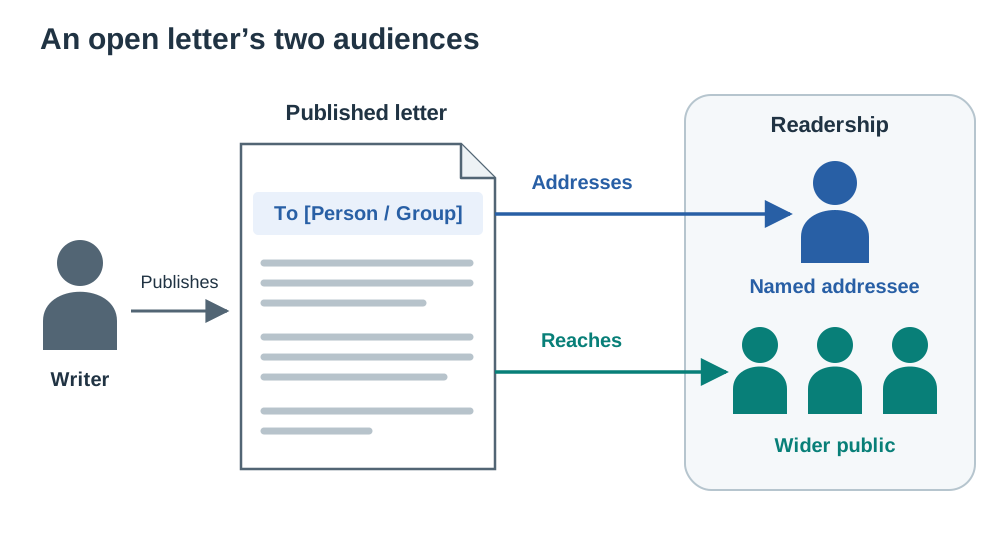
An open letter addresses a specific person, committee, or group (e.g. 'To the Minister for Education,' or 'To all those who offer unwanted advice'), but is published openly in print or online to inform, persuade, stimulate public debate, or entertain.
- Tone and platform: Register follows the medium and the prompt. An open letter published on a social platform should be engaging, direct, and conversational, speaking straight to the audience. If the question states the piece 'may be amusing or serious or both', a light, witty voice is fully rewarded provided it remains controlled and sustained.
- Anticipating and refuting opposition: Persuasive and argumentative prompts often require you to address alternative stances. Use a three-step refutation method:
- State the opposing view fairly ('Some will argue that...' / 'Critics might claim that...').
- Concede what is reasonable in it ('It is true that...').
- Rebut it with a reason, comparison, or evidence showing why your original conclusion still stands ('Yet...').
Comparing Letter Formats
| Feature | Standard Formal Letter | Letter to the Editor | Open Letter |
|---|---|---|---|
| Addresses | Both sender's (top right) and recipient's (left margin) | Sender's locality only; no recipient postal address | None; platform or publication medium identified |
| Salutation | Dear Mr Kelly, or Dear Sir/Madam, | Sir, / Madam, / Dear Editor, / A Chara, | To [Person / Group / Public], |
| Title | Optional Re: subject line | Optional stance headline | Recommended title setting out the theme |
| Valediction | Yours sincerely, or Yours faithfully, | Yours etc., | Courteous closing line, signature, and name |
Administrative Documents: Reports, Proposals, and Civic Petitions
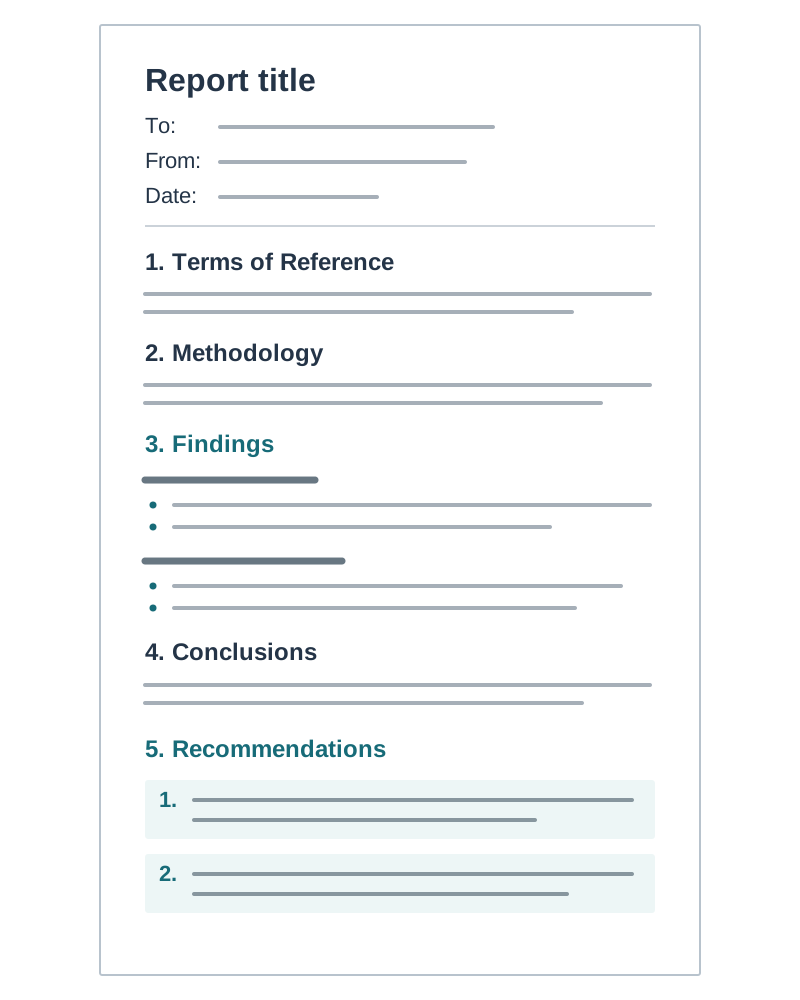
Workplace and civic documents replace continuous narrative prose with visible layout: numbered headings, concise analytical paragraphs, and clear bullet points.
The Investigative Report
A report provides an objective, analytical record of an investigation, incident, or existing condition. It uses the language of information to present facts and evidence calmly.
| Section | Function | Example Phrasing |
|---|---|---|
| Header Block | Identifies the subject, recipient, author, and date | Report on Senior Cycle Study Facilities; To: Board of Management; From: Student Council Executive; Date: 18 November 2026 |
| 1. Terms of Reference | States who commissioned the report, its scope, and its purpose | Commissioned by Principal Murphy to investigate after-school study facilities and identify required equipment upgrades. |
| 2. Methodology | Explains precisely how evidence was gathered | Information was collected through an online questionnaire completed by 180 senior students and an interview with the school librarian. |
| 3. Findings | Presents the facts and figures you found, grouped under headings | 74% of surveyed students reported inadequate desk space; 68% noted a shortage of power outlets for learning devices. |
| 4. Conclusions | States what the findings show based on the evidence | Current library provisions are inadequate for self-directed study and hinder candidate exam preparation. |
| 5. Recommendations | Sets out numbered, practical actions arising from the conclusions | 1. Convert Room 14 into a quiet study annex. 2. Install ten double power sockets along the perimeter wall. |
The Formal Proposal
While a report investigates past or present realities, a proposal looks forward. It pitches a structured initiative to solve a problem and requests administrative backing or funding:
- Title and Aims: Define the project and state who is submitting the proposal.
- Problem Statement: Detail the current difficulty with plausible facts.
- Proposed Solution: Describe the recommended action and its practical advantages.
- Implementation Schedule: Outline realistic, phased milestones (Phase 1: Procurement; Phase 2: Rollout; Phase 3: Review).
- Conclusion: Conclude with a direct request for administrative approval.
The Civic Petition
A petition is a formal collective request, signed by many people, urging an authority to take a specific action. It must balance civic passion with respectful, measured phrasing:
- Addressee line: State the body that holds decision-making authority (To: The Chief Executive, Kildare County Council).
- Title: Express the core goal clearly (Petition to Establish a Dedicated Cycleway along the Mill Road).
- Opening declaration: Identify the collective community voice: 'We, the undersigned residents, commuters, and parents of the Mill Road community...'.
- Grounds for petition: Outline the issue across two or three numbered arguments, providing plausible local details and safety considerations.
- Call to action: Formulate an explicit, actionable demand ('We therefore call upon the Council to allocate funding under the active travel scheme and begin construction before September 2027').
- Signature block: Provide a short signatory call followed by sample signature columns (Name | Address / Locality | Signature).
Key terms
- PCLM
- The four criteria used by the State Examinations Commission to mark Leaving Certificate English compositions: Clarity of Purpose (30%), Coherence of Delivery (30%), Efficiency of Language Use (30%), and Accuracy of Mechanics (10%).
- Register
- The tone, vocabulary, and level of formality chosen to suit a particular audience, publication medium, and social context.
- Terms of Reference
- The opening section of a formal report that specifies who commissioned the investigation, along with its exact purpose and scope.
- Refutation
- The argumentative technique of acknowledging an opposing viewpoint, demonstrating its shortcomings or limitations, and reaffirming your original position.
- Call to Action
- A clear, decisive statement directing the recipient, decision-maker, or public to implement a specific measure.
- Valediction
- The conventional closing formula placed above the signature in correspondence, dictated by the opening salutation used.
- Yours sincerely
- The valediction required in formal correspondence when the recipient is personally named in the salutation (e.g. 'Dear Mr Kelly').
- Yours faithfully
- The valediction required in formal correspondence when the recipient is not named in the salutation (e.g. 'Dear Sir/Madam').
- Yours etc.
- The traditional journalistic sign-off used at the conclusion of a formal Letter to the Editor.
- We, the undersigned
- The conventional opening phrase of a civic petition, establishing the collective identity and authority of the petitioners.
Check yourself
Can you answer Question A and Question B on the same text in Paper 1 Section I?
No. Examination rules require Question A and Question B to be answered on two different texts.
Which valediction must follow a formal letter opening with 'Dear Mr Harrington'?
'Yours sincerely,' followed by your signature and printed name.
What standard valediction is used to conclude a Letter to the Editor in an Irish newspaper?
'Yours etc.,' followed by your name and locality.
What information should be set out in the 'Terms of Reference' section of a formal report?
The person or body who commissioned the report and the specific purpose and scope of the investigation. A completion date may also be added.
If an open letter prompt specifies publication on a social media platform and allows for an amusing tone, what register is expected?
A lively, engaging, and direct register that speaks straight to the reader. Humour is welcome if permitted by the prompt, provided it remains controlled, well-structured, and accurate.