

Mastering persuasive writing for Leaving Certificate English Paper 1 requires an understanding of how language shapes opinion, commands attention, and moves an audience to thought or action. Persuasive and argumentative writing features on both sides of Paper 1: in comprehending tasks under Question A (where you frequently analyse how writers persuade) and in composing tasks: the Question B functional writing task (50 marks) in Section I and the Section II extended composition (100 marks). In Section I, you must answer Question A and Question B on different texts. Functional tasks also encompass formats such as advertising copy, open letters, and public relations statements. Section II accounts for half the paper's total marks; a sensible allocation is roughly 80 to 85 minutes for the composition, leaving 40 to 45 minutes each for Question A and Question B. Responses are evaluated under four core criteria: Clarity of Purpose (30%), Coherence of Delivery (30%), Efficiency of Language Use (30%), and Accuracy of Mechanics (10%).
Argument and Persuasion: What's the Difference?
The Leaving Certificate syllabus distinguishes between the language of argument and the language of persuasion, though real-world texts continually mix and mingle both functions.
The language of argument aims to convince through sound reasoning. It sets out clear propositions, tests assumptions, and connects points using logical signposts (therefore, because, nevertheless, accordingly). It moves from its premises to a conclusion that follows from them using inductive or deductive methods, relying on verifiable facts and structured thought rather than emotional pressure.
The language of persuasion aims to win agreement, provoke solidarity, or spur people into action by whatever means prove most effective. It draws on tone, imagery, rhythm, deliberate word choice, and the selective presentation of detail, often working alongside logical points. While the classical concepts of logos (logic), pathos (emotion), and ethos (authority) help when planning, in an exam you should always name the exact technique used—such as emotive language, anecdote, or inclusive pronouns—and explain how it works on the reader.
Analysing Persuasive Writing in Question A
Comprehending tasks frequently present a speech, article, or essay and instruct you to identify four features of argumentative or persuasive language and evaluate their effectiveness. Marks are awarded for explaining how the technique works on the reader, not merely for spotting devices.
The Four-Step Paragraph Structure
Dedicate a separate, focused paragraph to each feature using this four-step sequence:
- Name the feature precisely (such as anaphora, rhetorical questions, concrete anecdotes, or contrast).
- Quote a short phrase directly from the passage inside quotation marks. Never invent or alter text.
- Explain the effect on the reader or listener. What thoughts, visual impressions, or emotions does it provoke?
- Evaluate how successfully the device achieves the author's purpose as stated in the prompt (for instance, to craft an emotional and inspiring address).
Select four clearly distinct techniques. Grouping emotive nouns and emotive adjectives together counts as one feature, not two.
Critical Reading: Audience, Values, and Interests
Higher Level comprehending questions also expect you to look behind the surface of a text by examining three key elements:
- Audience: Identify who is being addressed by analysing clues like direct address, shared references, formal or informal register, and assumptions about what the reader already knows.
- Value system: Identify what the writer treats as self-evidently good, desirable, or corrupt (such as community solidarity, self-reliance, or commercial profit).
- Whose interests it serves: Determine who benefits if the audience is persuaded. A campaign advertisement serves the party seeking power; a sponsored wellness article serves the brand selling dietary supplements.
Evaluating Arguments: Opinion, Anecdote, and Evidence
Evaluating the validity of an argument requires separating solid substantiation from rhetorical window-dressing:
- An opinion is a subjective personal view: State examinations place unfair pressure on adolescents.
- An anecdote is an illustrative story or personal narrative: A student in my town spent five hours revising one poem and collapsed from exhaustion.
- Evidence consists of verifiable facts, data, research findings, or expert testimony: A national survey of 3,000 second-level students conducted by the ESRI revealed...
While personal anecdotes provide emotional resonance and human warmth, they do not establish factual proof on their own. Evidence provides logical grounding. An argument is valid when its conclusion really follows from its reasons. It is only convincing if those reasons are also true. Watch out for unspoken assumptions—points the writer takes for granted without providing proof. In your own composing, support your primary thesis with evidence while deploying anecdotes to keep the prose vivid and relatable.
The Spoken Word: Speeches, Talks, and Debates
Spoken texts must be crafted for the ear. Listeners cannot turn back a page to re-read a sentence, so spoken language relies on immediate clarity, rhythmic cadences, and direct connection.
Show that the text is spoken through the words themselves rather than stage directions. Use direct address (you, friends, colleagues), oral signposts (Let us turn to the real issue), and varied sentence lengths. Avoid bracketed cues like [pause for applause]; skilled phrasing creates its own pauses.
Comparing Spoken Registers
Notice how the same core message shifts across three different speaking situations:
- Debating chamber: Chairperson, adjudicators, the opposition would have you believe that digital surveillance guarantees public safety. It does nothing of the sort.
- Captain's team-talk: Look across that tunnel. They think our backline will break inside ten minutes. We show them what discipline looks like from the opening whistle.
- Radio broadcast or peer talk: If you have ever stared at a blank screen at two in the morning, wondering where the week went, you know the quiet panic I want to talk about today.
Debating Speeches
- Announce your stance immediately in the opening paragraph.
- Argue on one side of the motion only. Drifting into a balanced, two-sided review turns the speech into a discursive essay and damages your Clarity of Purpose mark.
- Interrogate the motion's exact wording. Defining an ambiguous phrase allows you to direct the debate.
- Include a pointed rebuttal. Introduce the opponent's strongest point and dismantle it: The opposition will tell you that smartphones improve classroom engagement. Yet classroom data shows...
- Finish with a decisive restatement of your position and a strong call to action.
Talks and the Open Letter
A talk addresses a particular group (such as a sports squad, a youth club, or a radio audience). Its tone is dictated by the prompt: it can be reflective and informal or fiery and motivational. The open letter is addressed to a specific person, institution, or peer group but published in print or online for a wide audience. It requires an appropriate opening salutation, an engaging and accessible public register, systematic treatment of every bullet point in the question, and an assertive conclusion.
Journalistic Writing: Feature Articles and Opinion Pieces
Examiners expect genuine journalistic layout and conventions. A newspaper or magazine piece should never read like a standard classroom essay.
The Opinion Piece (Opinion Column)
An opinion column presents a passionate, subjective stance on a pressing issue. You must take a firm position from the outset and defend it with energy and wit.
- Headline: A bold, catchy title indicating your point of view.
- Introduction: Open with a lively observation, provocative statement, or brief anecdote, narrowing steadily toward your core thesis.
- Paragraph progression: Use the PEEL method (Point, Evidence, Explanation, Link) to present arguments and systematically neutralise opposing claims.
- Conclusion: Finish with a forceful final judgment or challenge that sticks in the reader's mind.
The Feature Article
A feature article combines investigative reporting with narrative storytelling. It examines social trends, cultural habits, or human interest stories through colourful description, lively observation, and reflective depth.
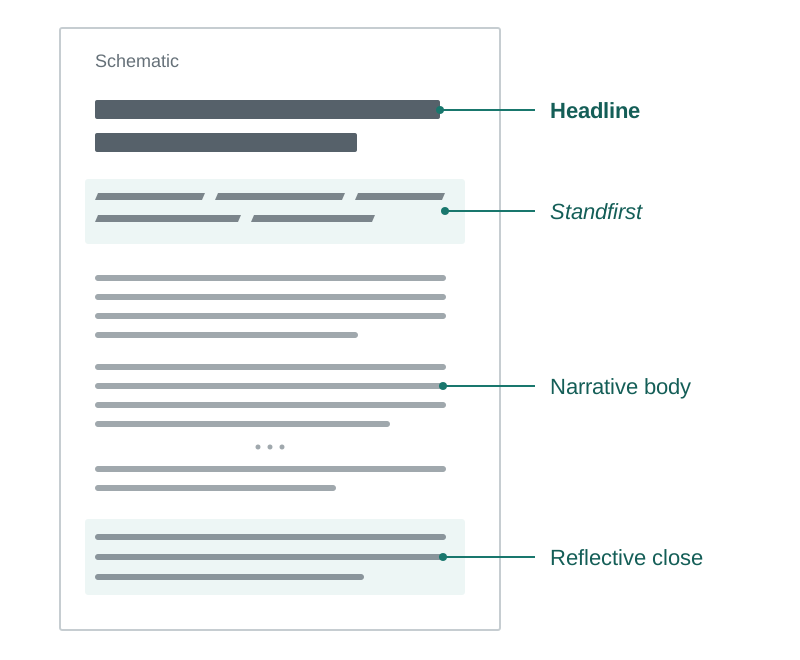
| Article Element | Purpose | Stylistic Technique |
|---|---|---|
| Headline | Grabs immediate attention and sets the tone | Wordplay, striking contrasts, or alliteration |
| Standfirst | A one- or two-sentence framing deck beneath the headline | An italicised summary that introduces the angle and atmosphere |
| Narrative body | Explores the subject from multiple viewpoints | Controlled narrative vignettes, sensory detail, and plausible quotes from representative figures (e.g. a commuter from Dundalk) |
| Reflective close | Broadens the lens to consider wider implications | A provocative question, future forecast, or memorable philosophical reflection |
Knowing Your Essay Form: Persuasive, Argumentative, or Discursive
Section II composition prompts specify distinct essay genres. Conflating these forms leads to lost marks under Clarity of Purpose:
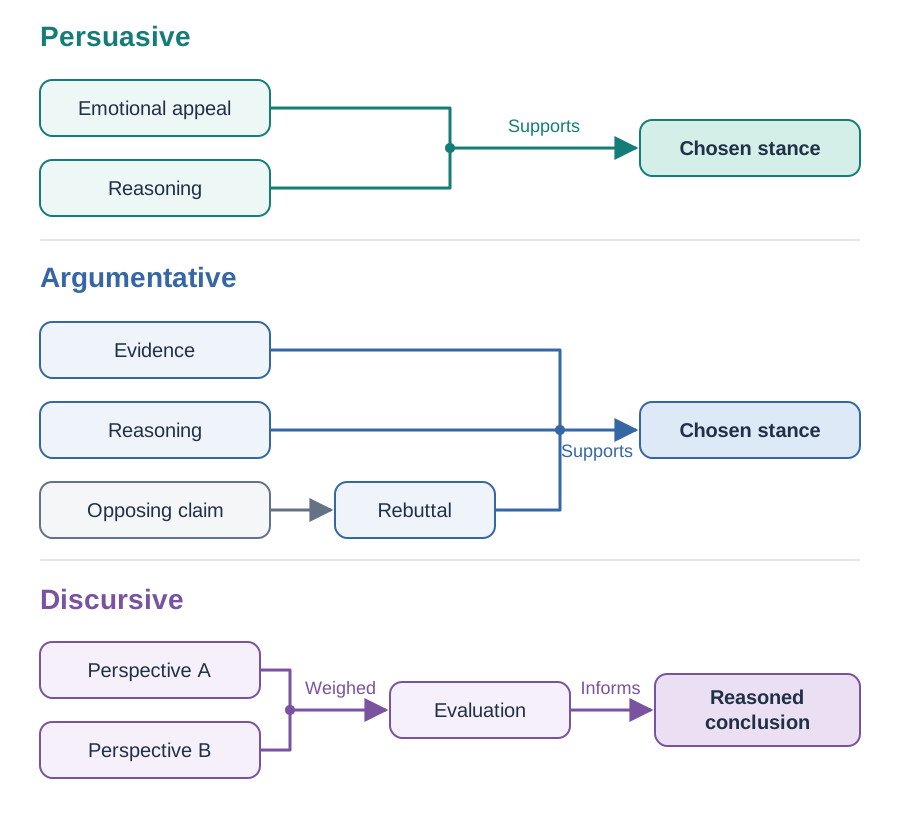
- Persuasive essay: Commits fully to one side of an argument, employing both emotional appeal and logical reasoning to win the reader over. It requires an essay title, not a newspaper headline or oral greeting.
- Argumentative essay: Commits firmly to one side, relying predominantly on cold logic, factual evidence, and the deliberate refutation of counter-arguments.
- Discursive essay: Explores multiple perspectives in an open-minded, balanced manner. It weighs competing claims fairly before reaching an objective, reasoned conclusion.
If the examination question asks for a discursive essay, exploring only one side will cost you marks. Conversely, if you are asked to argue for or against a motion, presenting an even-handed middle ground fails the brief.
The Rhetorical Toolkit and Paragraph Architecture
Rhetorical devices earn high marks under Efficiency of Language Use only when they advance your underlying argument rather than acting as showy padding.
Key Rhetorical Devices
- Anaphora: Repeating a word or phrase at the start of successive clauses to establish an emphatic cadence. We saw the decay. We heard the warnings. We chose to act.
- Antithesis: Balancing two opposing concepts within parallel grammatical clauses. We are buying immediate digital convenience at the cost of enduring civic privacy.
- Triadic structure: Arranging phrases or examples in threes to create rhythm and rhetorical completeness. Courage, clarity, and unyielding focus.
- Rhetorical question: A question designed to steer the audience toward an inescapable conclusion. Always follow up and unpack the question yourself; never leave several consecutive questions dangling unanswered.
- Emotive and figurative language: Concrete metaphors and descriptive verbs that make abstract ideas tangible without sliding into over-sentimental melodrama.
- Anecdotes: Short, pointed personal or observational accounts that establish rapport and illustrate larger arguments.
- Statistics and expert evidence: Grounding assertions in realistic data or recognised authorities to construct credibility.
Paragraph Craft: The PEEL Method
To preserve Coherence of Delivery throughout functional writing and long essays, develop each body paragraph around a single major point:
- Point: Open with a clear topic sentence containing your claim.
- Evidence: Back that claim with a concrete real-world example, data point, or focused narrative illustration.
- Explanation: Unpack the evidence, explaining precisely how it demonstrates your claim.
- Link: Connect the observation back to your overall thesis, motion, or title.
Key terms
- PCLM
- The criteria used by the State Examinations Commission to evaluate written English: Clarity of Purpose (30%), Coherence of Delivery (30%), Efficiency of Language Use (30%), and Accuracy of Mechanics (10%).
- Language of Argument
- A style of language that seeks to convince an audience primarily through logic, propositions, evidence, deductive and inductive reasoning, and the systematic testing of assumptions.
- Language of Persuasion
- A style of language designed to influence thought, values, or behaviour by deploying rhetorical devices, emotive imagery, rhythmic patterns, and selective detail alongside argument.
- Register
- The tone, vocabulary, and degree of formality adopted to suit a specific medium, audience, and context, ranging from casual peer conversation to public debating.
- Anaphora
- The intentional repetition of a word or phrase at the start of consecutive clauses or sentences to build momentum and rhythm.
- Antithesis
- The pairing of sharply contrasting ideas balanced within parallel sentence structures to highlight an essential conflict.
- Triadic Structure
- The rhetorical grouping of words, phrases, or clauses into sets of three to create balance, resonance, and memorable rhythm.
- Rebuttal
- The deliberate raising of an opposing viewpoint followed immediately by evidence or reasoning that exposes its flaw and disproves it.
- Standfirst
- A short introductory summary or hook positioned directly underneath the headline of a feature article to establish its premise and tone.
- Call to Action
- An explicit appeal near the end of a speech, article, or persuasive essay urging the audience to adopt a stance or take concrete action.
- PEEL Method
- A structured method for paragraph development: Point (topic assertion), Evidence (illustration or data), Explanation (analytical reasoning), and Link (tying back to the thesis).
- Anecdote
- A brief, vivid personal story or observational account used to give concrete human interest to an abstract claim.
Check yourself
What four elements should you include when answering a Question A prompt that asks you to analyse a persuasive feature?
Name the specific technique, provide an exact quotation from the text, explain its psychological or emotional effect on the reader, and evaluate how successfully it supports the author's stated purpose.
What is the critical rule regarding text selection between Section I Question A and Question B?
You must answer Question A and Question B on two different texts; answering both on the same text breaks the paper's instructions.
How does a discursive essay differ from a persuasive essay in Section II?
A discursive essay explores multiple viewpoints in an objective, balanced manner before offering a measured conclusion, whereas a persuasive essay champions one side of an issue using rhetorical and emotional appeals.
Why are bracketed stage directions discouraged in Leaving Certificate speech compositions?
They read as superficial gimmicks; pacing, vocal presence, and emphasis should be built directly into the rhythm, vocabulary, and syntax of the speech itself.
What is the function of a rebuttal in a competitive debate speech?
To anticipate a major point made by the opposition and systematically dismantle it using evidence, logic, or counter-examples, thereby reinforcing your own stance.