

The Comparative Study on Paper II carries 70 marks out of the 200 marks available for the paper. At Higher Level, you study three texts comparatively through specific critical lenses known as modes. For the 2027 Leaving Certificate examination, the three prescribed modes are Theme or issue, Cultural Context, and General Vision and Viewpoint. On the examination paper, questions are set on only two of these three modes, and you cannot predict which mode will be omitted. You must prepare all three modes across your three chosen texts, anchoring your analysis in key moments without slipping into narrative plot summary.
Course Regulations and Examination Layout
The comparative study is governed by specific syllabus rules that dictate text choice, question format, and assessment standards.
Prescribed Texts and Curriculum Rules
You must study three texts comparatively from the official prescribed list, entirely separate from the single text studied for Section I. You may include one film from the prescribed film list as one of your three comparative texts. Only texts listed as films may be studied as films. Your other two comparative texts and your single text will then be written texts. Furthermore, Shakespearean drama is compulsory at Higher Level: if your single text is not a Shakespeare play, one of your comparative texts must be a Shakespearean drama.
Examination Structure: Section II
On the examination paper, the comparative study appears as Section II – The Comparative Study. Questions are set on two of the three prescribed modes for 2027. You choose one mode to answer on. Under your chosen mode, you normally choose between two formats:
- The Two-Part Question (30 marks / 40 marks): Part (a) examines an aspect of the mode in one text alone (30 marks). Part (b) requires continuous comparison of that same aspect across your remaining two texts (40 marks). You must never reuse the text from part (a) in part (b).
- The Single 70-mark Essay: A continuous comparative essay comparing all three of your texts together under one overarching prompt.
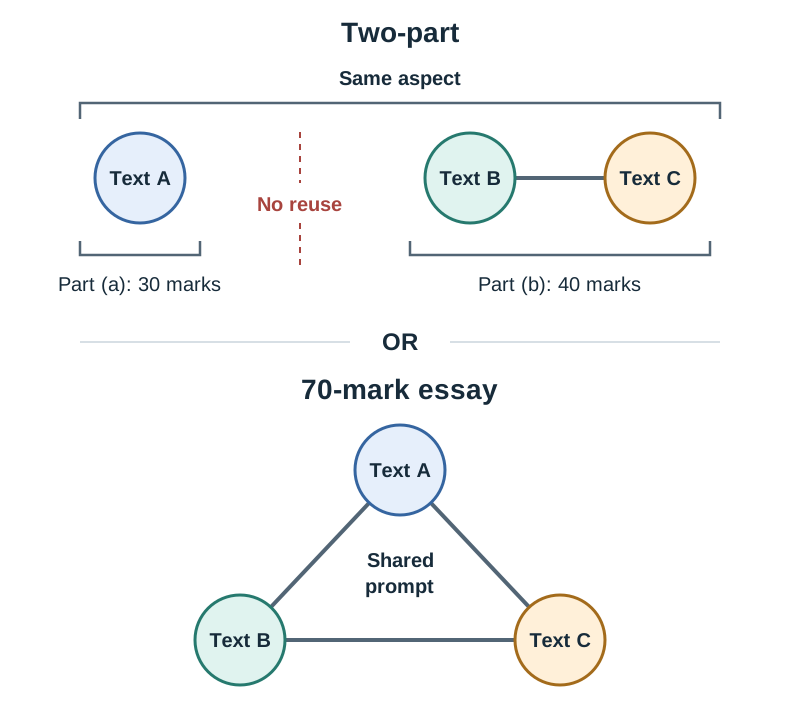
Allocate 65 to 70 minutes in total to Section II: if tackling the two-part question, spend roughly 25 to 30 minutes on part (a) and 35 to 40 minutes on part (b).
Marking Criteria: PCLM
Every comparative answer is marked according to four criteria:
- Clarity of Purpose (30%): Directly addressing the prompt, maintaining a sharp thesis, and embedding the question's operative terms.
- Coherence of Delivery (30%): Sustained comparison, logical structure, and seamless transitions.
- Efficiency of Language Use (30%): Expressive, analytical vocabulary, precision, and varied sentence structure.
- Accuracy of Mechanics (10%): Accurate spelling, grammar, punctuation, and proper paragraph division.
Mode 1: Theme or issue
In Theme or issue, you examine how a central human concern or moral question is established, developed, and resolved across different narratives. You choose the theme or issue you have studied (such as power, isolation, justice, or the individual versus society).
How Questions Are Usually Phrased
Questions frequently ask how a central character's mindset or dilemma aids the author's exploration of the complexity of the theme, or how key moments deepen your understanding of the issue. You must name your chosen theme or issue explicitly in your opening sentence and use that exact phrase throughout your answer. In a two-part question, part (b) will ask you to explore the same theme or issue discussed in part (a) across your other two texts; never switch themes halfway through your answer.
Angles for Analysis
- Introduction of the Theme: How is the conflict or dilemma first presented? What does the opening environment tell us about the stakes?
- Escalation through Mindset and Decisions: Characters' choices, motives, and states of mind are one of the main ways a theme is explored. How do their psychological conflicts expose the complexities of the issue?
- Key Turning Points: Which specific confrontations or decisions alter the trajectory of the issue?
- Resolution and Insight: What final moral or philosophical insight does the text offer? Is the dilemma resolved, or does it endure as an inescapable human struggle?
Mode 2: Cultural Context
Cultural Context investigates the social world of the text: the customs, values, laws, and power dynamics that dictate human behaviour. Rather than offering historical background notes, analyse how characters navigate, accept, or rebel against the prevailing social expectations of their environment.
How Questions Are Usually Phrased
Prompts typically focus on behaviour considered unacceptable within the world of the text, aspects of the world that foster social division or unity, or how cultural factors dictate the extent to which a character can achieve happiness or personal success.
Angles for Analysis
- Social Hierarchies and Economic Power: Who controls wealth and status, and who is marginalised? How do class barriers or economic dependence restrict personal freedom?
- Gender Expectations and Family Structures: What constitutes acceptable conduct for men and women? What financial, emotional, or social penalties are inflicted on those who defy these rigid conventions?
- Institutions, Religion, and Community Surveillance: How do churches, courts, or community pressures enforce compliance? Does the community provide solidarity, or does it enforce an oppressive culture of silence and complicity?
Mode 3: General Vision and Viewpoint
General Vision and Viewpoint evaluates the overall outlook on life conveyed by the text. It asks whether the creator presents a world that is fundamentally hopeful, bleak, cynical, or resilient, and how that perspective strikes you as a reader or viewer.
How Questions Are Usually Phrased
Questions usually ask about your sense of the general vision and viewpoint. They often focus on the extent to which that vision is influenced by key relationships, turning points, or personal beliefs. Because the prompt asks for your sense of the outlook, personal response is required: write in the first person where appropriate (for example: "I found the opening world profoundly claustrophobic...") and trace how your impression evolves over the course of the text.
Angles for Analysis
- The Opening World: What initial impression of life is established? Does the text open with warmth and community, or suspicion, isolation, and confinement?
- The Influence of Key Relationships and Crises: Do personal relationships offer emotional sanctuary and mutual loyalty, or are they tainted by exploitation and betrayal? When a crisis occurs, does individual agency triumph, or do hostile forces crush human effort?
- The Ending and Lingering Impression: Examine the final scene or closing lines. Does the text conclude on an optimistic note of renewal, bleak despair, or a fragile, hard-won glimmer of hope? When asked to discuss the extent to which a factor shapes the vision, provide a measured judgement of degree rather than a simple affirmative statement.
The Integrated Method and Incorporating Film
Examiners reward comparison that runs through the entire answer. If you write about each text separately in large, isolated blocks and add a few linking lines at the end, the comparative task is not sustained, which costs marks under Clarity of Purpose and Coherence of Delivery. Linking your texts within each body paragraph is the most effective way to demonstrate sustained comparison.
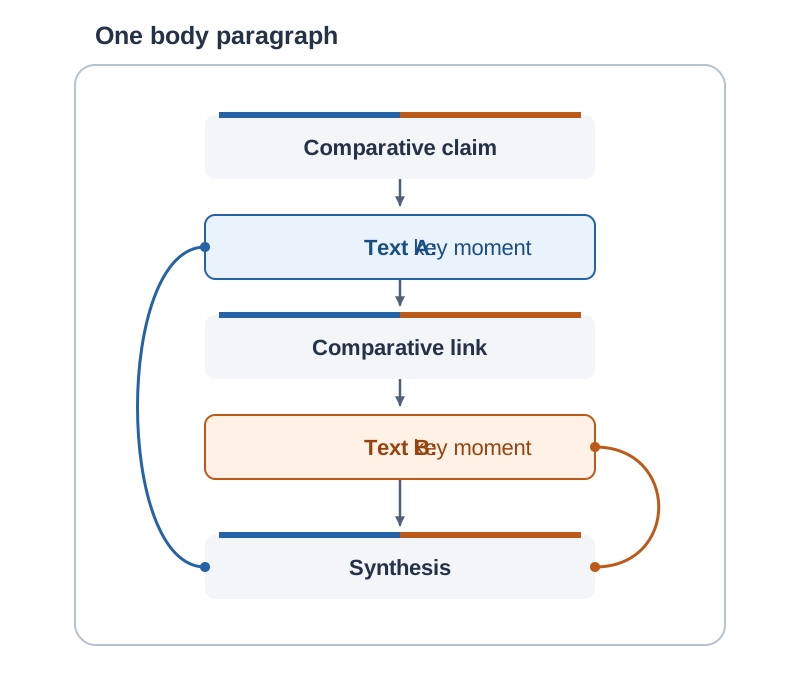
The Five-Step Integrated Paragraph Structure
- Comparative Topic Sentence: State your claim directly, linking two texts through the lens of the prescribed mode.
- Text A Exploration: Focus on a specific key moment, integrating a short, accurate quotation or specific detail.
- Comparative Link: Pivot into your second text using a precise comparative linking phrase.
- Text B Exploration: Analyse the corresponding key moment in Text B, highlighting sharp contrasts or unexpected parallels.
- Synthesis: Conclude the paragraph by evaluating what both texts reveal about the mode when considered together.
Comparative Linking Phrases
- Showing Similarity: Similarly, in the same vein, this dynamic is closely mirrored in, likewise, parallel to this experience, both authors establish.
- Showing Contrast: Conversely, in sharp contrast, whereas, on the other hand, a starkly different social code operates in, departures from this outlook occur in.
- Nuanced Distinction: While both characters face isolation, the nature of their solitude differs; although the setting appears equally oppressive, the underlying mood is far more resilient.
Analysing a Film Text
If you study a prescribed film as one of your three texts, satisfy syllabus learning outcome 4.5.1 by treating it as a visual medium. Support your analysis with film techniques alongside character actions and dialogue: camera framing (close-ups, extreme long shots), lighting and colour palette, musical score, and editing cuts.
Revision Planning: The Key Moments Grid
To prepare effectively under exam conditions, build a comparative revision grid for each of the three prescribed modes. For each mode, map out three essential milestones across your three texts:
| Narrative Milestone | Text 1 (e.g. Novel) | Text 2 (e.g. Drama) | Text 3 (e.g. Film) |
|---|---|---|---|
| The Opening | Initial social setting, opening tone, or first statement of the dilemma. | Exposition of societal codes, dominant outlook, or initial conflict. | Visual composition, lighting, soundscape, and opening atmosphere. |
| The Turning Point | Crucial crisis or decision that tests character and theme. | Climactic confrontation exposing cultural limits or shifting the mood. | Editing pace, shifting visual palette, and central dramatic turning point. |
| The Resolution | Closing chapter: final social fate, lasting insight, or ultimate tone. | Final dialogue, character destiny, and enduring emotional impact. | Final camera shot, closing music, and lingering visual message. |
Mastering these concrete anchor points ensures you can answer any prompt without hesitating or relying on vague recollection.
Key terms
- Theme or issue
- The comparative mode examining a central philosophical, moral, or societal concern (such as isolation, power, or identity) as it develops across texts.
- Cultural Context
- The comparative mode investigating the social world of a text, including its class structures, gender norms, legal codes, and religious values.
- General Vision and Viewpoint
- The comparative mode exploring the overarching outlook on life, dominant mood, and moral perspective conveyed by the author or director.
- Key moment
- A significant scene, turning point, or resolution in a text that provides specific, concrete evidence for comparative analysis.
- PCLM Criteria
- The four marking criteria used by examiners: Clarity of Purpose (30%), Coherence of Delivery (30%), Efficiency of Language Use (30%), and Accuracy of Mechanics (10%).
- Comparative link
- A transitional phrase or analytical pivot that connects two texts within an integrated paragraph to demonstrate similarity, contrast, or nuance.
Check yourself
Which comparative modes are prescribed for Higher Level English in 2027, and how many appear on Paper II?
Theme or issue, Cultural Context, and General Vision and Viewpoint are prescribed; exactly two of these three will appear on the examination paper.
If you choose the two-part question (30 marks / 40 marks), which texts must you discuss in part (b)?
You must compare your two remaining texts together in part (b); you must never reuse the text analysed in part (a).
What must your thesis statement contain when answering a prompt about 'your sense of' the general vision and viewpoint?
It must state the text or texts, specify the overall outlook (such as hopeful, bleak, or resilient) using a first-person judgement, and directly address the key factor named in the prompt.
What are the four PCLM marking criteria and their respective percentage weightings?
Clarity of Purpose (30%), Coherence of Delivery (30%), Efficiency of Language Use (30%), and Accuracy of Mechanics (10%).