

Section II of Leaving Certificate English Paper 1 requires you to write an extended composition worth 100 marks, which accounts for 25% of your total subject grade. You will choose one title from a selection (typically seven options) and write in the specific genre that title sets, such as a personal essay, short story, discursive essay, persuasive essay, speech, or article. Each title is prompted by one of the texts in Section I, often by quoting a key phrase from it. While you do not summarise the comprehension text itself, your composition must directly engage with the prompt's central theme and fulfill every instruction in the title. Producing an H1 composition requires careful planning, a sustained and appropriate register, clear paragraph progression, expressive vocabulary, and rigorous grammatical control.
The Composition Framework and PCLM Marking Scheme
In current examination practice, Paper 1 runs for 170 minutes and is divided equally between Section I (Comprehending, 100 marks) and Section II (Composing, 100 marks). Candidates should check the 2027 examination timetable and layout when finalized by the State Examinations Commission (SEC). A dependable time strategy for Section II is roughly 80 to 85 minutes: 10 minutes of planning, about 65 minutes of sustained writing, and 5 to 10 minutes of proofreading. Do not let Section I run over; every lost minute directly reduces your composition mark.
Every composition is assessed according to four criteria established by the SEC:
- Clarity of Purpose (P – 30%): Assesses how directly you engage with the chosen title, fulfill every instruction, follow the conventions of the set genre (a specific category or type of written text), and maintain a consistent register (the tone and level of formality chosen to suit the audience and genre). Examiners evaluate this criterion first, and your success here sets the baseline for the rest of your marks.
- Coherence of Delivery (C – 30%): Assesses how well your composition is planned and held together, including a clear structure, logical sequencing, smooth transitions between paragraphs, and ideas that develop rather than repeat.
- Efficiency of Language Use (L – 30%): Assesses your control of style, vocabulary, sentence structures, imagery, and rhetorical devices appropriate to the task.
- Accuracy of Mechanics (M – 10%): Assesses technical accuracy in spelling, punctuation, grammar, and paragraph divisions.
Reading the Title and Deconstructing Prompts
You choose the title, but the title dictates the genre. Before you begin writing, underline three essential elements:
- The genre: identifies whether you must write a personal essay, a short story, a speech, or another format.
- The audience or setting: identifies who you are addressing (for example, "a submission to a national newspaper" or "a speech to your year group").
- Every task word and condition: for example, "identify three achievements", "reflect on the significance", or "in which a character makes a difficult decision". Failing to address any condition costs marks in Clarity of Purpose.
Planning and Structuring: The 10-Minute Method
A 10-minute outline establishes a strong structural spine before you write. An effective plan maps the prompt's core words into clear paragraph goals, ensuring you never run out of ideas halfway through your essay.
Sample Plan for a Past Paper Prompt
Prompt (2022 Paper 1): "Write a personal essay in which you identify some of the items or objects that have become 'faithful companions' in your life and reflect on the importance of these items or objects to you."
- Genre: personal essay (reflective, first-person voice).
- Task 1: Identify multiple objects ("some" requires at least two or three).
- Task 2: Reflect on why these objects matter to your inner life.
- Central Phrase: 'faithful companions' (implies loyalty, reliability, comforting endurance through change).
Ten-Minute Outline:
- Introduction: Hook with the idea that our possessions often carry our emotional histories; introduce the phrase 'faithful companions' as an anchor for memory.
- Body Paragraph 1 (Object 1: A battered leather jacket): Describe its worn cuffs and weathered collar. Anecdote: wearing it during a rainy walk home after a failed driving test. Reflection: it serves as protective armour during moments of personal vulnerability.
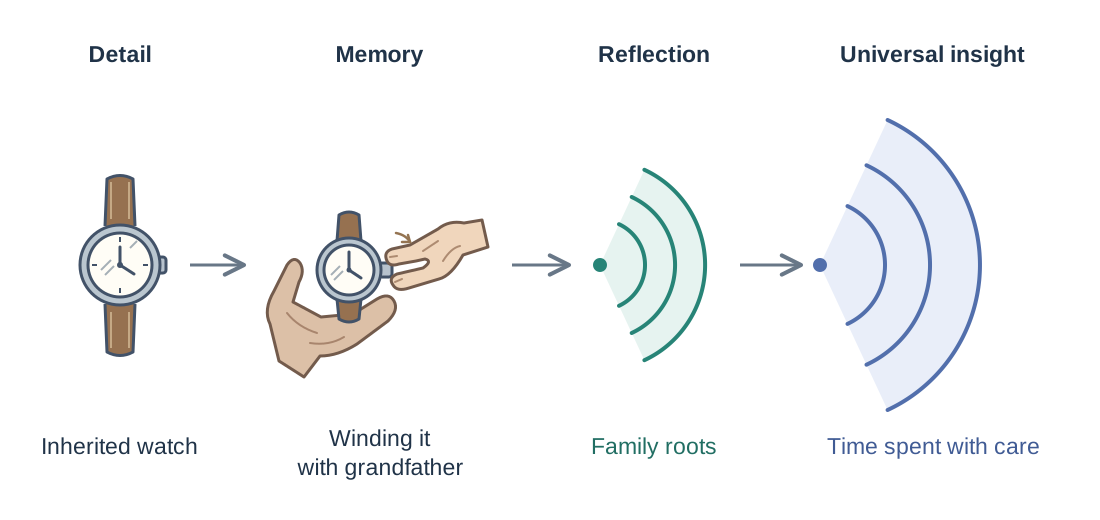
- Body Paragraph 2 (Object 2: An inherited mechanical wristwatch): Describe the rhythmic tick and scratched glass face. Anecdote: winding it with my grandfather during childhood visits. Reflection: it anchors me to family roots and reminds me that time cannot be paused, only spent with care.
- Body Paragraph 3 (Object 3: A creased notebook): Describe ink-stained margins and dog-eared pages. Anecdote: writing uncensored thoughts during quiet late nights. Reflection: it acts as a non-judgemental confidant, teaching me that writing clarifies thought.
- Conclusion: Synthesise the three items. Universal insight: we treasure these objects not for their retail worth, but because they witness our quiet transformations.
The Personal Essay: Authentic Reflection
The personal essay draws on the language of narration (telling your experiences) and the aesthetic use of language (vivid, crafted phrasing). It relies on an authentic first-person ('I') voice to explore memories, relationships, and observations, drawing out universal insights that connect with any reader.
Key Conventions
- Authentic Voice: Establish a conversational, thoughtful, and candid persona. Your essay does not need to be literally true in every biographical detail, but it must feel emotionally genuine and believable.
- From Concrete to Universal: Avoid leaving an anecdote (a brief account of a real or personal incident) as simple trivia. Describing a failed camping trip or an argument with a friend works only when you use that moment to explore broader human realities, such as pride, fragility, endurance, or family dynamics.
- Balancing Story and Thought: Ground your scene in sharp sensory details, then pause to reflect: What did this encounter teach me about how people live?
- Focused Scope: Explore two or three well-developed episodes in depth rather than summarizing your entire childhood.
The Discursive Essay: Balanced Exploration and Debate
The discursive essay draws on the syllabus's language of argument. It examines a complex or contentious issue from multiple angles with intellectual composure, analytical balance, and reasoned enquiry.
Structuring the Discussion
- Balanced Exploration: Unlike a persuasive piece, which argues a single side from the outset, a discursive essay investigates competing perspectives. You explore opposing views with serious consideration and evidence before drawing the threads together in a considered conclusion.
- Developing Your View: Your own perspective can emerge naturally as the discussion develops, or it can be stated after weighing the counter-arguments. What examiners penalise is an aggressive, one-sided rant that ignores counter-arguments.
- Supporting Claims: Support each point with concrete examples: cultural trends, historical precedents, philosophical ideas, or logical deductions.
- Register: Maintain a measured, thoughtful, and civil tone. You may write with wit, seriousness, or quiet irony, provided the enquiry remains balanced.
Persuasive Writing: Essays, Speeches, and Articles
Persuasive writing draws on the language of persuasion to convince an audience to accept a specific viewpoint. The exam usually tests this through a persuasive essay, a public speech, or a journalism article.
The Persuasive Essay
Unlike a discursive essay, a persuasive essay takes a side from the start. It does not use speech greetings. You state your claim in the introduction, develop three or four powerful supporting arguments, systematically include a rebuttal (answering and dismantling the primary opposing argument), and conclude with an emphatic call to action.
Format Conventions for a Speech or Talk
- Address the audience immediately in your opening line: "Good morning, members of the student council..."
- State who you are and establish your core premise clearly.
- Maintain direct engagement throughout using direct address ("you", "we"), conversational turns, and clear signposting ("My second concern is...").
- Conclude with a memorable final thought and a formal "Thank you."
Format Conventions for an Article
- Provide a clear, engaging headline at the top.
- You may include an optional standfirst (a one-line introductory summary beneath the headline) and a byline.
- Hook the reader in the opening paragraph using an anecdote, a surprising fact, or an intriguing question.
- Match the tone to the stated publication (for example, a serious broadsheet editorial versus an energetic student magazine).
- Never use live spoken greetings like "Good morning, ladies and gentlemen" in a written article.
Core Rhetorical Devices
- Tricolon: Grouping three parallel words or phrases to create rhythmic emphasis ("a pattern of indifference, delay, and neglect").
- Rhetorical question: A question posed for effect rather than an answer, prompting the reader to reach your conclusion.
- Anaphora: Deliberately repeating an opening phrase across successive sentences to build emotional power.
- Antithesis: Placing two contrasting ideas side by side to highlight a contradiction or injustice.
The Short Story and the Descriptive Essay
Both genres draw heavily on the aesthetic use of language, requiring precise diction, sensory engagement, and careful pacing.
The Short Story
An effective exam story must be written within roughly 70 minutes, which requires strict economy:
- Narrow Scope: Focus on one dominant setting, a timeframe of a few hours, and no more than two or three characters.
- Thematic Core: Translate a one-word title (such as 'Silence') into a central statement (for example, Unspoken grievances eventually tear apart close friendships). This thematic spine prevents your narrative from wandering into random events.
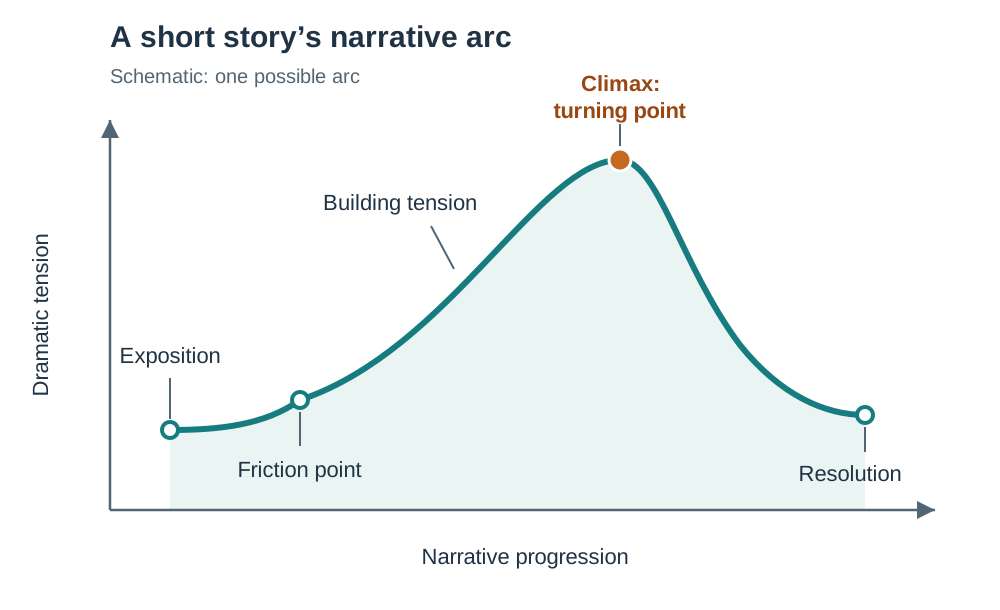
- Narrative Arc: Ground the character's baseline world in the exposition, introduce a friction point, build tension toward a climax (the decisive turning point of highest emotional or dramatic intensity), and finish with a quiet, resonant resolution. Avoid cliché twist endings or waking up from dreams.
- Show, don't tell: Demonstrate character emotions and conflict through physical reactions, dialogue, and actions rather than flat statements.
The Descriptive Essay
A descriptive essay creates an evocative portrait of a place, person, or atmosphere. Because plot is minimal, momentum relies on structured observation:
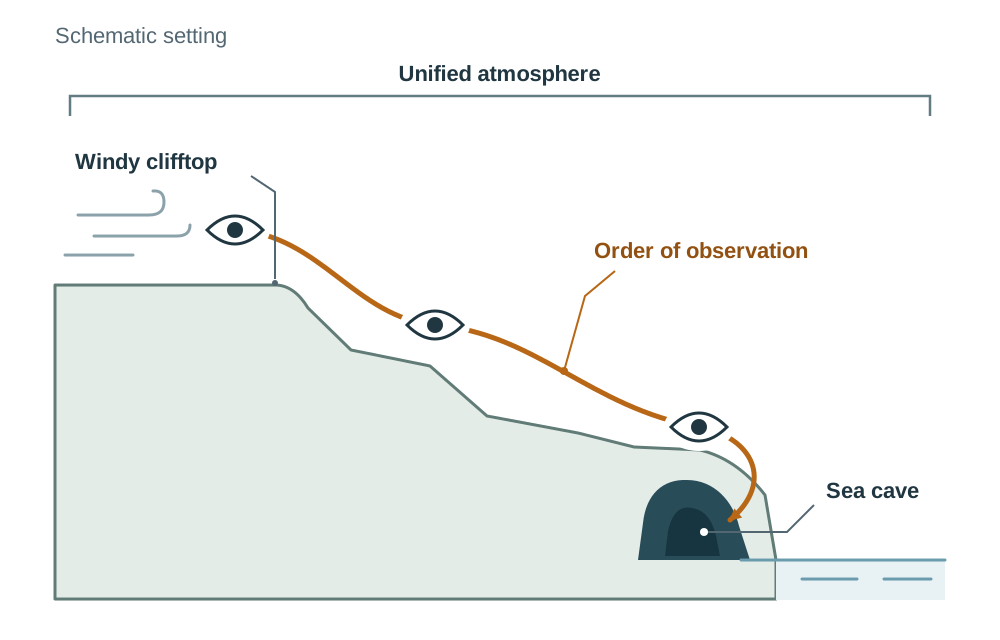
- Organisational Spine: Move systematically through space (from a windy clifftop down to a sea cave) or time (from pre-dawn silence to bustling midday at an open market).
- Sensory Engagement: Evoke all five senses. Use sound devices such as sibilance (repetition of hissing 's' sounds) and onomatopoeia (words that imitate the sound they describe) alongside tactile, visual, and olfactory details.
- Unified Atmosphere: Ensure every chosen detail supports a coherent mood, such as decay, nostalgic warmth, or tense foreboding.
Key terms
- Clarity of Purpose
- The SEC marking criterion (weighted at 30%) that evaluates engagement with the prompt, adherence to genre conventions, and control of register.
- Coherence of Delivery
- The SEC marking criterion (weighted at 30%) that evaluates structural planning, paragraph linking, logical development, and progression of ideas or plot.
- Efficiency of Language Use
- The SEC marking criterion (weighted at 30%) that evaluates stylistic control, vocabulary range, sentence variety, imagery, and phrasing.
- Accuracy of Mechanics
- The SEC marking criterion (weighted at 10%) that evaluates correct spelling, punctuation, syntax, and paragraphing.
- register
- The tone, vocabulary, and level of formality chosen to suit a specific audience, context, and genre.
- personal essay
- An extended, reflective piece of non-fiction written in the first person, using personal experiences and anecdotes to explore universal ideas.
- discursive essay
- A formal essay that explores a complex topic from multiple viewpoints, weighing arguments with reasoned evidence before reaching a considered conclusion.
- persuasive essay
- An essay that adopts a clear position from the outset and uses structured arguments, rhetorical devices, and rebuttals to convince the reader.
- descriptive essay
- A piece of writing focused on creating a vivid sensory portrait of a place, person, or scene, structured along a spatial or temporal axis rather than a plot.
- short story
- A work of narrative prose fiction focused on a tight cast of characters, a compact timeframe, and a central dramatic turning point.
- show, don't tell
- The writing technique of revealing emotion, characterisation, and atmosphere through concrete physical details, actions, and sensory description rather than direct statement.
- climax
- The decisive turning point or peak moment of dramatic tension in a narrative where the central conflict comes to a head.
- tricolon
- A rhetorical device that arranges three parallel words, phrases, or clauses in quick succession to create rhythm and emphasis.
- anaphora
- The deliberate repetition of a word or phrase at the beginning of successive sentences or clauses for rhetorical impact.
- antithesis
- The juxtaposition of two contrasting ideas in balanced phrases or clauses to highlight a conflict or contradiction.
- rhetorical question
- A question asked to make a point or stimulate thought rather than to elicit an answer, guiding the audience toward the writer's stance.
Check yourself
What are the four PCLM marking criteria for the Leaving Certificate English composition and what percentage of marks does each carry?
Clarity of Purpose (30%), Coherence of Delivery (30%), Efficiency of Language Use (30%), and Accuracy of Mechanics (10%).
The title reads: 'Write a speech, to be delivered to your class, in which you argue for greater environmental action in your school.' Name the genre, the target audience, the expected register, and two required format features.
Genre: speech. Target audience: classmates. Register: lively, direct, and persuasive while remaining controlled. Two format features: an opening address to your class and a closing line thanking them for listening.
How does the approach to personal opinion differ between a discursive essay and a persuasive essay?
A persuasive essay argues for one side from the start and works to convince the reader. A discursive essay explores multiple viewpoints with balanced evidence before presenting a considered conclusion.
Why should you reframe a one-word short story title (such as 'Journeys') into a complete thematic statement during planning?
It provides a clear thematic focus for the plot, ensuring the narrative explores a meaningful human dilemma rather than drifting through aimless events.
What does 'show, don't tell' mean in descriptive and narrative writing?
It means conveying character emotions and atmosphere through physical details, actions, dialogue, and sensory imagery rather than relying on blunt summary statements.