
This revision note covers all twenty-five mandatory practical investigations for Leaving Certificate Chemistry. In the terminal written examination, experimental questions assess core methods, apparatus diagrams, precautions, observations, and calculations at the concise level rewarded by State Examinations Commission marking schemes. Candidates must state specific colour changes, use balanced equations for stoichiometric calculations, and give clear, syllabus-credited reasons for each experimental step.
Conservation of mass
Aim Verify the law of conservation of mass in a chemical reaction.
Apparatus and materials Electronic balance, conical flask, small test tube, rubber stopper, barium chloride solution, sodium sulfate solution.
Method
- Place sodium sulfate solution in the conical flask.
- Place barium chloride solution in the small test tube.
- Lower the test tube upright into the flask and seal with the stopper.
- Record the initial mass of the sealed assembly on the balance.
- Invert the flask to mix the solutions and form a white precipitate.
- Reweigh the sealed flask and record the final mass.
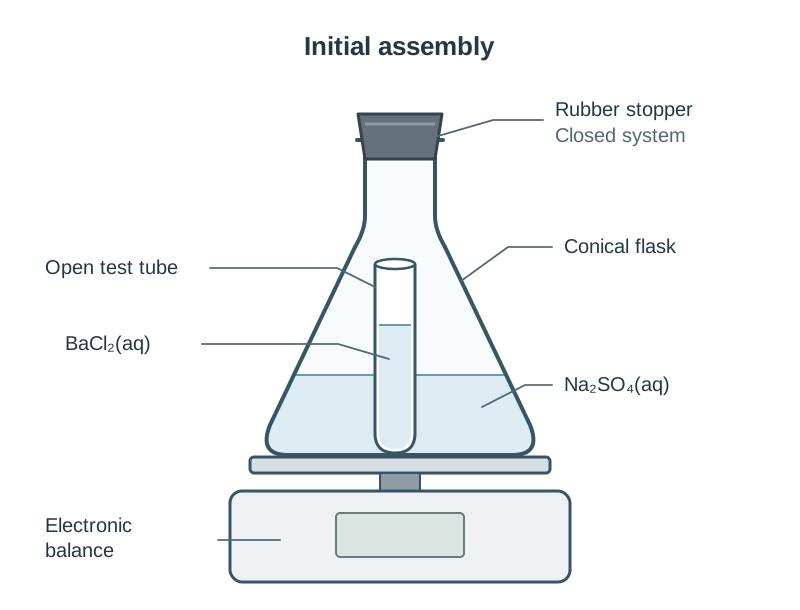
Results and calculation A white precipitate of barium sulfate forms: BaCl2 + Na2SO4 -> BaSO4 + 2NaCl. The final mass equals the initial mass within experimental balance precision, showing that matter is neither created nor destroyed.
Accuracy and safety
- Keep the flask stoppered so no liquid or spray escapes.
- Ensure the flask exterior is dry before each weighing to prevent mass errors.
How it is asked This experiment has not appeared on recent papers; questions would ask for the apparatus diagram, the formula of the precipitate, or an explanation using the particle model.
Flame tests
Aim Identify metal cations by flame test observations.
Apparatus and materials Bunsen burner, pre-soaked wooden splint or nichrome wire, concentrated hydrochloric acid, salts of lithium, sodium, potassium, copper, barium, strontium.
Method
- Dip a clean nichrome wire or pre-soaked wooden splint into the salt sample.
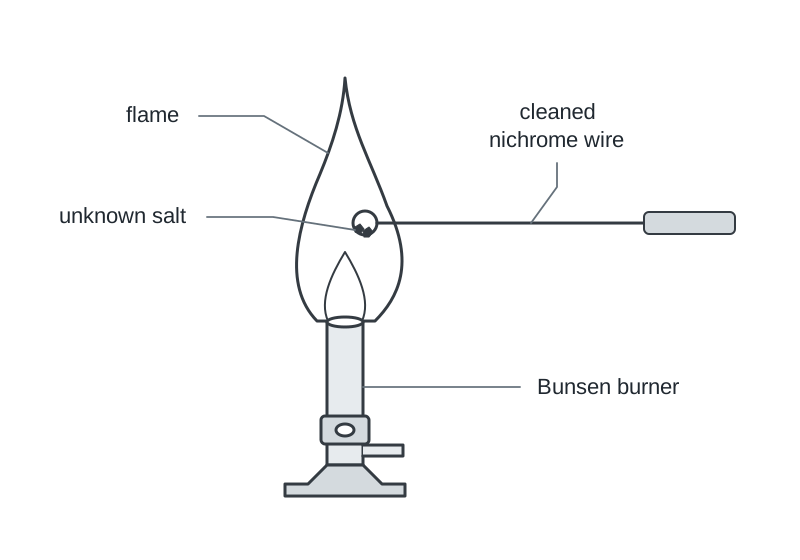
- Hold the sample in the hot, blue part of a Bunsen flame.
- Observe and record the characteristic flame colour.
- Clean the wire in concentrated hydrochloric acid between trials.
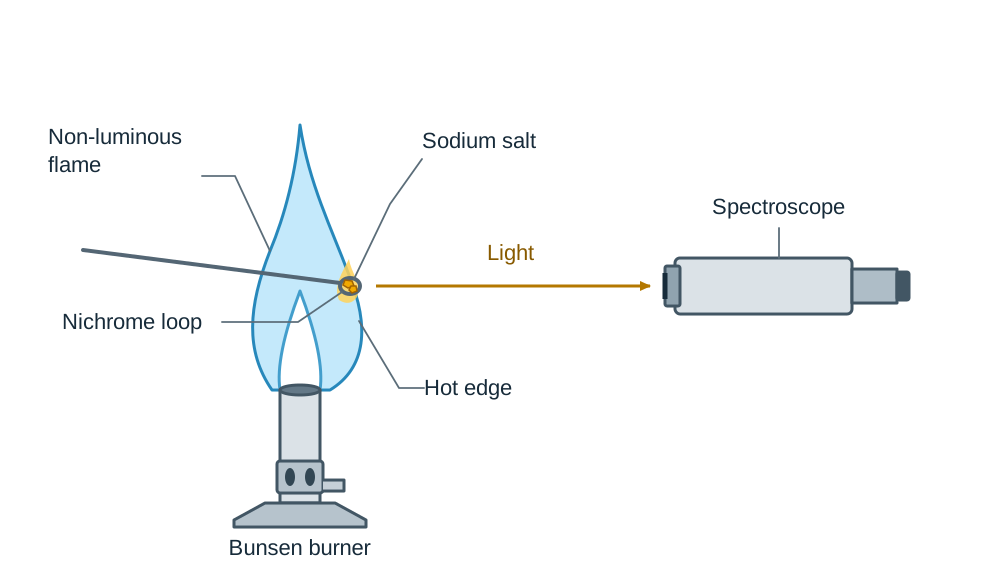
Results and calculation Flame colours observed: lithium is crimson; sodium is yellow-orange; potassium is lilac; copper is blue-green; barium is yellow-green; strontium is red. Heat excites electrons to higher levels; when they fall back, they emit photons of fixed frequency (E2 - E1 = hf), seen as discrete lines when the flame is viewed through a spectroscope (spectrometer).
Accuracy and safety
- Use a blue Bunsen flame so the flame colour is visible.
- Clean the wire thoroughly in acid to avoid sodium contamination masking other colours.
How it is asked
- Describing a method to distinguish metal salts using a splint or nichrome wire has been asked.
- Linking emission spectra to electron transitions has been asked.
Relative molecular mass of a volatile liquid
Aim Determine the relative molecular mass of a volatile liquid.
Apparatus and materials Conical flask, aluminium foil, pin, rubber band, propanone, boiling water bath, balance, thermometer, barometer, graduated cylinder.
Method
- Cover the conical flask with foil, secure with a rubber band, pierce a tiny pinhole, and weigh it.
- Add volatile liquid to the flask.
- Heat the flask in a boiling water bath until all liquid vaporises.
- Record atmospheric pressure and the temperature of the boiling water.
- Cool the flask, dry the outside, and reweigh to find the mass of condensed vapour.
- Fill the flask with water and measure its volume with a graduated cylinder.
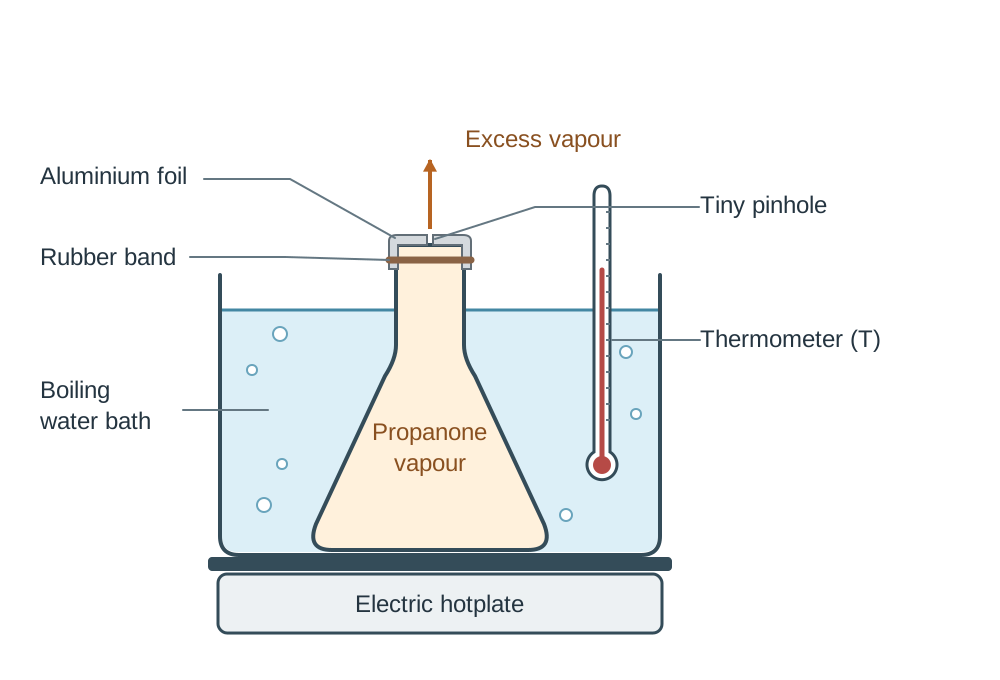
Results and calculation Mass of vapour = final mass - initial mass. Calculate molar mass using pV = (m/M)RT, where p is in Pa, V in m^3, and T in K.
Accuracy and safety
- Dry the outside of the flask thoroughly before reweighing to avoid extra mass from water droplets.
- The pinhole must be tiny to prevent air entering before the vapour condenses.
How it is asked This experiment has not come up in the supplied papers; a question would reasonably ask for the Mr calculation using pV = nRT, the purpose of the pinhole, or why the liquid must be volatile.
Tests for anions
Aim Identify chloride, sulfate, sulfite, carbonate, hydrogencarbonate, nitrate, and phosphate anions in aqueous solutions.
Apparatus and materials Test tubes, droppers, aqueous salt solutions, dilute nitric acid, silver nitrate, barium chloride, dilute hydrochloric acid, magnesium sulfate, freshly prepared iron(II) sulfate, concentrated sulfuric acid, ammonium molybdate, limewater.
Method
- Chloride: Add dilute nitric acid followed by silver nitrate solution.
- Sulfate and sulfite: Add barium chloride solution to separate samples. Add dilute hydrochloric acid to both.
- Carbonate and hydrogencarbonate: Add dilute hydrochloric acid; test gas with limewater. Add magnesium sulfate to fresh cold solutions of each.
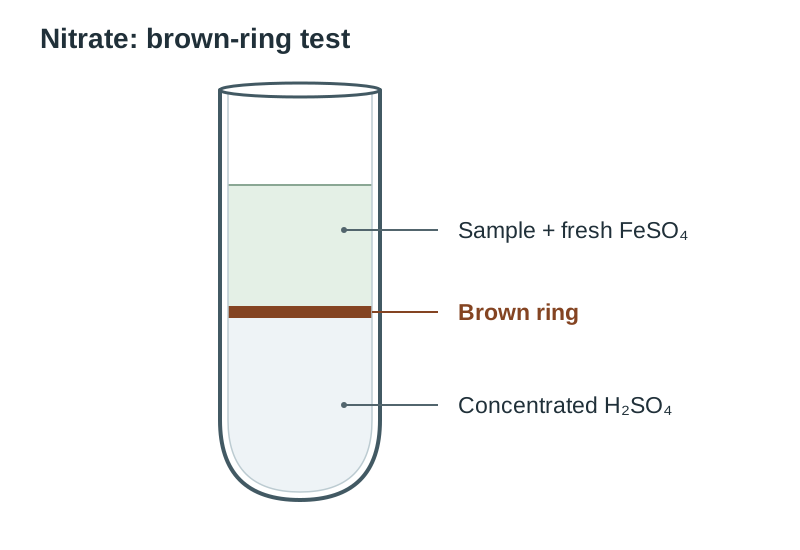
- Nitrate: Add fresh iron(II) sulfate solution; trickle concentrated sulfuric acid down the inside of the tube.
- Phosphate: Add ammonium molybdate and concentrated nitric acid; warm gently.
Results and calculation
- Chloride gives a white precipitate of AgCl, soluble in ammonia.
- Sulfate and sulfite give a white precipitate with BaCl2; sulfate precipitate remains after adding HCl, while sulfite precipitate dissolves.
- Carbonate and hydrogencarbonate produce CO2 that turns limewater milky. Magnesium sulfate gives a white precipitate in the cold with carbonate, but only on boiling with hydrogencarbonate.
- Nitrate forms a brown ring at the interface.
- Phosphate gives a yellow precipitate.
Accuracy and safety
- Prepare iron(II) sulfate freshly to prevent oxidation by air.
- Add concentrated sulfuric acid slowly down the wall without shaking so layers do not mix.
How it is asked
- Confirming nitrate by adding iron(II) sulfate and concentrated sulfuric acid to observe a brown ring has been asked.
- Distinguishing sulfate from sulfite with barium chloride and hydrochloric acid has been asked.
Identifying an unknown salt
Aim Identify the cation and anion in an unknown ionic salt.
Apparatus and materials Unknown salt, Bunsen burner, nichrome wire, concentrated hydrochloric acid, test tubes, deionised water, anion test reagents (AgNO3, BaCl2, dilute HCl, dilute HNO3, FeSO4, concentrated H2SO4, limewater).
Method
- Carry out a flame test using a cleaned nichrome wire dipped in concentrated hydrochloric acid to identify the cation.
- Dissolve a sample of the salt in deionised water to prepare a test solution.
- Add dilute hydrochloric acid to test for carbonate or hydrogencarbonate; test gas with limewater.
- Test separate portions of solution with silver nitrate (for chloride) and barium chloride followed by hydrochloric acid (for sulfate or sulfite).
- Test a portion with iron(II) sulfate and concentrated sulfuric acid for nitrate.
Results and calculation Combine the identified cation and anion to deduce the chemical formula of the salt.
Accuracy and safety
- Use deionised water to make solutions to prevent false precipitate tests from tap water ions.
- Handle concentrated acids with care inside a fume cupboard.
How it is asked
- Identifying anions and cations from experimental observations and flame colours has been asked.
- Writing ionic equations for confirmatory precipitation tests has been asked.
Preparing and testing ethene
Aim Prepare ethene gas by dehydration of ethanol and examine its properties.
Apparatus and materials Boiling tube, glass wool, ethanol, aluminium oxide, delivery tube, pneumatic trough, test tubes, Bunsen burner, bromine water, acidified potassium manganate(VII), wooden splints.
Method
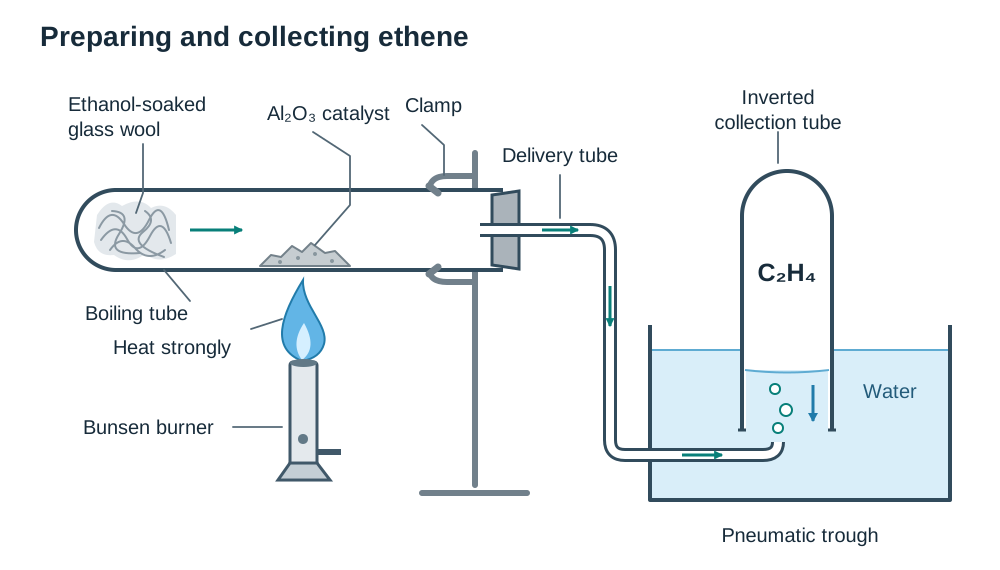
- Place ethanol absorbed on glass wool at the bottom of a boiling tube.
- Place aluminium oxide catalyst in the middle of the tube and clamp horizontally.
- Heat the aluminium oxide strongly with a Bunsen burner.
- Collect ethene gas over water in test tubes, discarding the first tube.
- Remove the delivery tube from the water trough before turning off the Bunsen burner.
- Test the gas with a lighted splint, with bromine water, and with acidified potassium manganate(VII).
Results and calculation Reaction: C2H5OH -> C2H4 + H2O. Ethene is a colourless gas, insoluble in water. It burns with a luminous, smoky flame. It decolourises bromine water from red-brown to colourless and acidified potassium manganate(VII) from purple to colourless, showing it is unsaturated.
Accuracy and safety
- Remove the delivery tube from the water before turning off the heat to prevent suck-back of cold water, which shatters the hot tube.
- Keep ethene gas and ethanol away from flames to prevent fire.
How it is asked
- Drawing the labelled apparatus and stating how to avoid suck-back and fire have been asked.
- Decolourising bromine water or acidified potassium manganate(VII) to show unsaturation has been asked.
Enthalpy change of neutralisation
Aim Determine the enthalpy change of neutralisation for hydrochloric acid and sodium hydroxide.
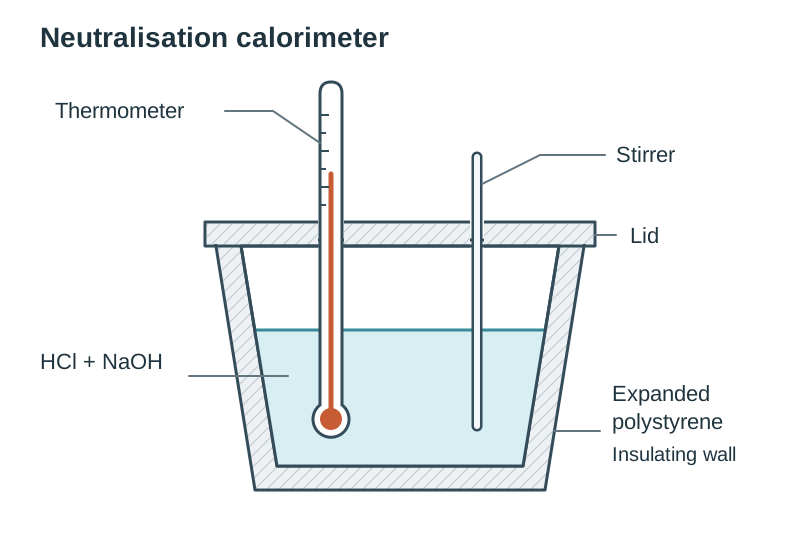
Apparatus and materials Polystyrene cup with lid, thermometer, stirrer, graduated cylinders, 1.0 M HCl, 1.0 M NaOH.
Method
- Measure equal volumes of 1.0 M HCl and 1.0 M NaOH into separate containers.
- Record the initial temperature of each solution until both are constant.
- Add the base quickly to the acid in the polystyrene cup.
- Put the lid on immediately, stir, and record the maximum temperature reached.
Results and calculation Temperature rise delta-T = T_max - T_initial. Heat produced: q = mc(delta-T), where m is the total mass of solution in kg and c = 4.2 kJ kg^-1 K^-1. Moles neutralised: n = M x V. Enthalpy of neutralisation: delta-H = -(q/n) kJ mol^-1.
Accuracy and safety
- Use a polystyrene cup because it is a good insulator with low heat capacity, minimising heat loss.
- Add solutions quickly and lid the cup immediately to reduce heat loss to surroundings.
How it is asked
- Calculating moles, heat produced (mc*delta-T), and delta-H with a negative sign has been asked.
- Stating why polystyrene is used instead of glass has been asked.
Heat of combustion of alcohols
Aim Measure the heat of combustion of an alcohol using a spirit burner and calorimeter.
Apparatus and materials Spirit burner with ethanol, copper calorimeter, thermometer, draught shield, electronic balance, graduated cylinder, water.
Method
- Place a known volume of water in the calorimeter and record its initial temperature.
- Weigh the capped spirit burner containing ethanol.
- Place the burner under the calorimeter inside a draught shield, uncap, and light the wick.
- Stir the water and heat until the temperature rises by about 20 °C.
- Extinguish the flame by replacing the cap, and record the highest temperature reached.
- Reweigh the spirit burner to determine the mass of fuel burned.
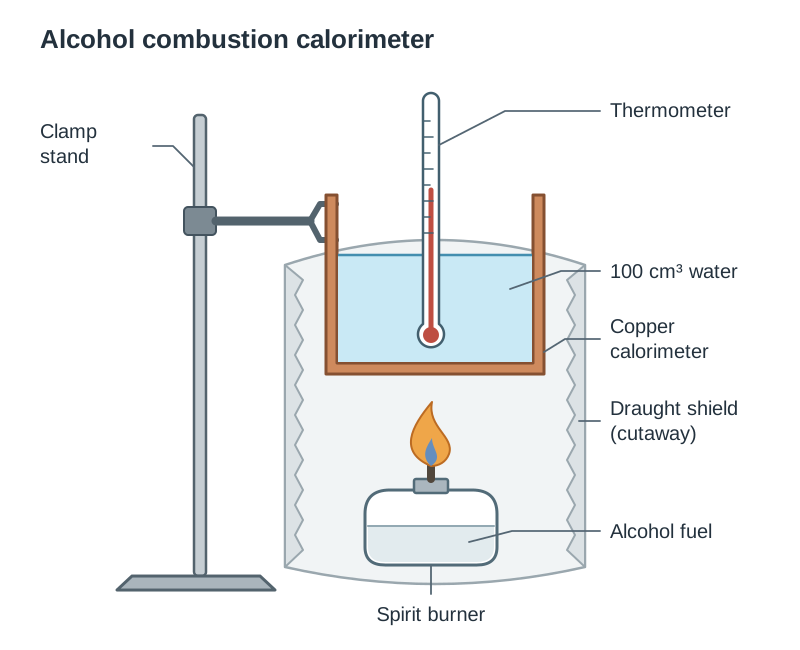
Results and calculation The heat of combustion is the heat released when one mole of a substance is burned completely in excess oxygen. Heat absorbed: q = mc(delta-T). Moles of alcohol burned: n = mass / molar mass. Enthalpy of combustion: delta-H_c = -(q/n) kJ mol^-1.
Accuracy and safety
- Experimental values are lower than theoretical values due to heat loss to surroundings, heat absorbed by the calorimeter, and incomplete combustion.
- Cap the burner promptly after extinguishing to prevent fuel loss by evaporation.
How it is asked
- Defining heat of combustion has been asked.
- Naming the bomb calorimeter as the instrument used for accurate determination has been asked.
Rate of reaction: calcium carbonate and hydrochloric acid
Aim Investigate the effect of surface area and concentration on the reaction rate of calcium carbonate and hydrochloric acid.
Apparatus and materials Conical flask, cotton wool plug, electronic balance, stopwatch, graduated cylinder, marble chips (large and small), 1.0 M and 2.0 M HCl.
Method
- Place 50 cm^3 of 1.0 M HCl in a conical flask.
- Place marble chips and a cotton wool plug on the balance with the flask; record total initial mass.
- Add chips to the acid, insert the cotton wool plug, and start the stopwatch.
- Record the mass every 30 seconds until the reaction stops.
- Repeat using the same mass of smaller marble chips.
- Repeat using 2.0 M HCl.
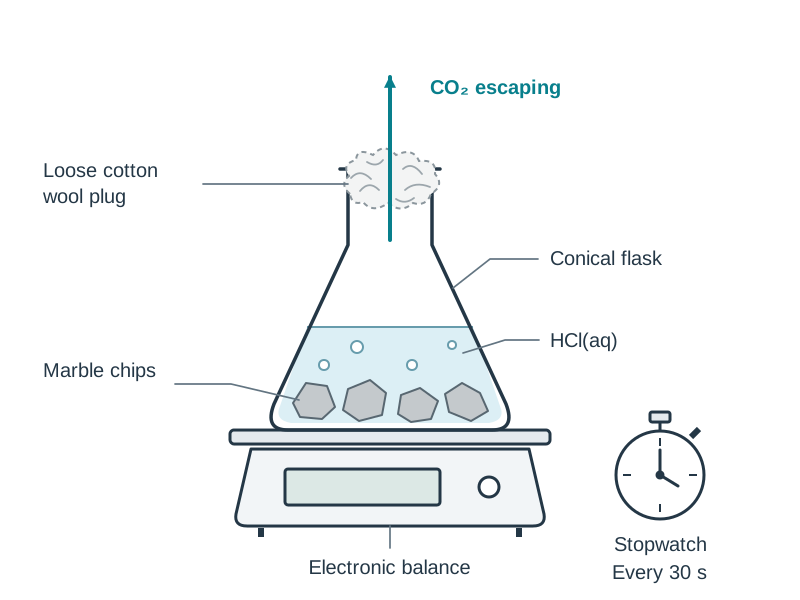
Results and calculation Reaction: CaCO3 + 2HCl -> CaCl2 + H2O + CO2. Mass of CO2 lost = initial mass - mass at time t. Plot mass lost (y-axis) against time (x-axis). Smaller chips produce a steeper curve due to greater surface area, reaching the same final mass loss. Using 2.0 M HCl gives a steeper curve and roughly doubles the final mass loss, because twice as many moles of acid react.
Accuracy and safety
- The cotton wool plug allows carbon dioxide gas to escape while preventing acid spray from escaping.
How it is asked This experiment has not come up in the supplied papers; a question would reasonably ask for the labelled apparatus, a plot of mass loss against time, an instantaneous rate from a tangent, or the effect of particle size.
Rate of reaction: sodium thiosulfate and hydrochloric acid
Aim Investigate the effect of temperature on the reaction rate between sodium thiosulfate and hydrochloric acid.
Apparatus and materials Conical flask, white paper marked with a cross, stopwatch, graduated cylinder, thermometer, water bath, sodium thiosulfate solution, hydrochloric acid.
Method
- Place sodium thiosulfate solution in a conical flask over a paper marked with a cross.
- Record the initial temperature of the mixture.
- Add hydrochloric acid, swirl the flask once, and start the stopwatch.
- Look down through the solution and stop the timer the moment the cross is obscured by yellow sulfur precipitate.
- Repeat at different temperatures by warming the thiosulfate in a water bath before adding acid.
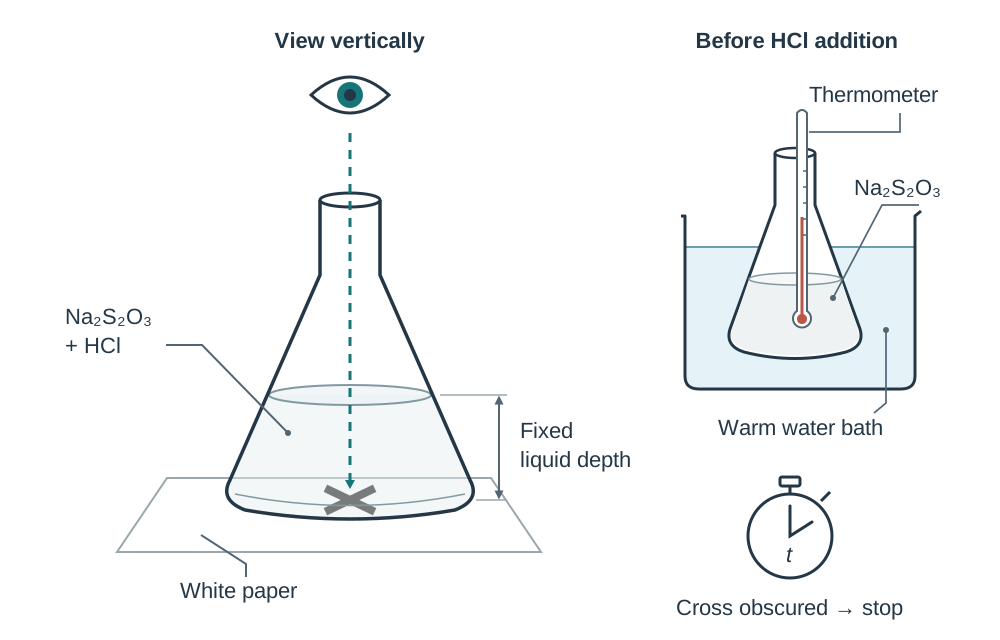
Results and calculation Reaction: Na2S2O3 + 2HCl -> 2NaCl + SO2 + S + H2O. Rate is proportional to 1/t. Plot rate (1/t) on the y-axis against temperature on the x-axis. The resulting curve shows that rate roughly doubles for every 10 °C rise in temperature because more collisions have energy greater than or equal to activation energy.
Accuracy and safety
- Use identical flasks and equal total volumes so the depth of liquid viewed remains constant.
How it is asked
- Describing how temperature is adjusted and plotting 1/t against temperature have been asked.
- Calculating the temperature rise needed to double the reaction rate has been asked.
Rate of reaction: decomposition of hydrogen peroxide
Aim Investigate the rate of catalytic decomposition of hydrogen peroxide using manganese(IV) oxide.
Apparatus and materials Conical flask, graduated cylinder or gas syringe, delivery tube, stopwatch, balance, manganese(IV) oxide, hydrogen peroxide solution.
Method
- Measure hydrogen peroxide solution into a conical flask.
- Add manganese(IV) oxide powder, seal the flask quickly, and start the stopwatch.
- Record the volume of oxygen gas collected at regular intervals until the reaction stops.
- Repeat with half the concentration of hydrogen peroxide.
- Repeat with granular manganese(IV) oxide instead of powder.
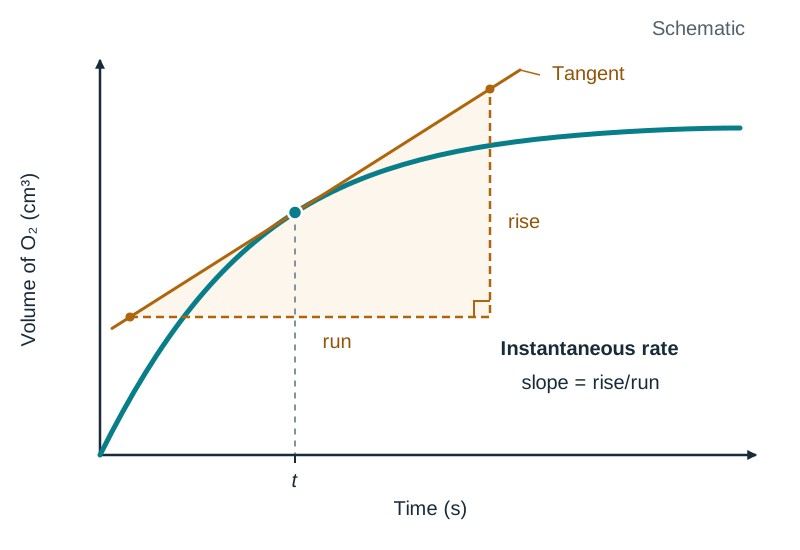
Results and calculation Reaction: 2H2O2 -> 2H2O + O2 (heterogeneous catalysis). Plot volume of oxygen (y-axis) against time (x-axis). Calculate instantaneous rate by drawing a tangent at time t and finding its slope (rise/run). Halving peroxide concentration gives a less steep curve and half the final volume of oxygen. Granular catalyst gives a less steep curve than the powder because of its smaller surface area, but reaches the same final volume of oxygen.
Accuracy and safety
- Seal the flask and connect to the gas collector immediately to avoid gas loss.
- Hydrogen peroxide is an oxidiser and irritant; avoid skin contact.
How it is asked
- Drawing the apparatus and plotting volume versus time have been asked.
- Calculating instantaneous rate from a tangent and explaining heterogeneous catalysis have been asked.
Measuring pH
Aim Measure the pH of solutions and investigate factors affecting pH using a meter.
Apparatus and materials Calibrated pH meter with electrode, buffer solutions (pH 4, 7), wash bottle with deionised water, beakers, 0.1 M HCl, 0.1 M ethanoic acid, 0.1 M NaOH.
Method
- Calibrate the pH meter using buffer solutions.
- Rinse the electrode with deionised water and immerse it in the test solution.
- Record the stable pH reading.
- Dilute 0.1 M HCl tenfold repeatedly and record the pH of each diluted solution.
- Measure and compare the pH of 0.1 M HCl and 0.1 M ethanoic acid.
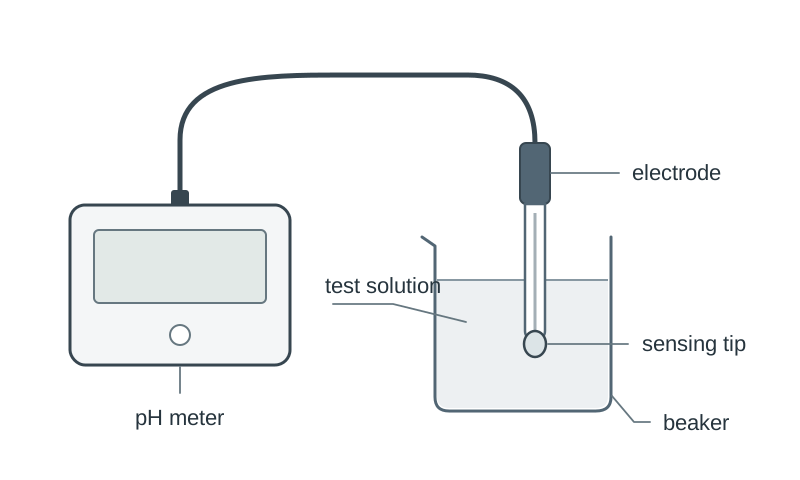
Results and calculation Strong acid (0.1 M HCl) dissociates fully, giving pH 1. Diluting tenfold raises its pH by 1 unit (0.01 M gives pH 2). Ethanoic acid (0.1 M) gives pH around 2.9 because it is a weak acid that is only slightly dissociated.
Accuracy and safety
- Rinse the probe with deionised water between samples to prevent cross-contamination.
- Calibrate the meter with two buffers to ensure accurate readings across the range.
How it is asked
- Calculating [H+] from pH using antilog(-pH) has been asked.
- Explaining the difference between strong and weak acids in terms of dissociation has been asked.
A simple galvanic cell
Aim Construct a zinc-copper galvanic cell and demonstrate the generation of an electric current.
Apparatus and materials Zinc strip, copper strip, emery paper, 1.0 M zinc sulfate, 1.0 M copper(II) sulfate, two beakers, salt bridge (filter paper soaked in KNO3), digital voltmeter, leads.
Method
- Clean the zinc and copper strips with emery paper.
- Place zinc sulfate solution in one beaker with the zinc electrode.
- Place copper(II) sulfate solution in the second beaker with the copper electrode.
- Connect the electrodes to the voltmeter with leads.
- Insert the salt bridge with one end in each beaker and record the voltage.
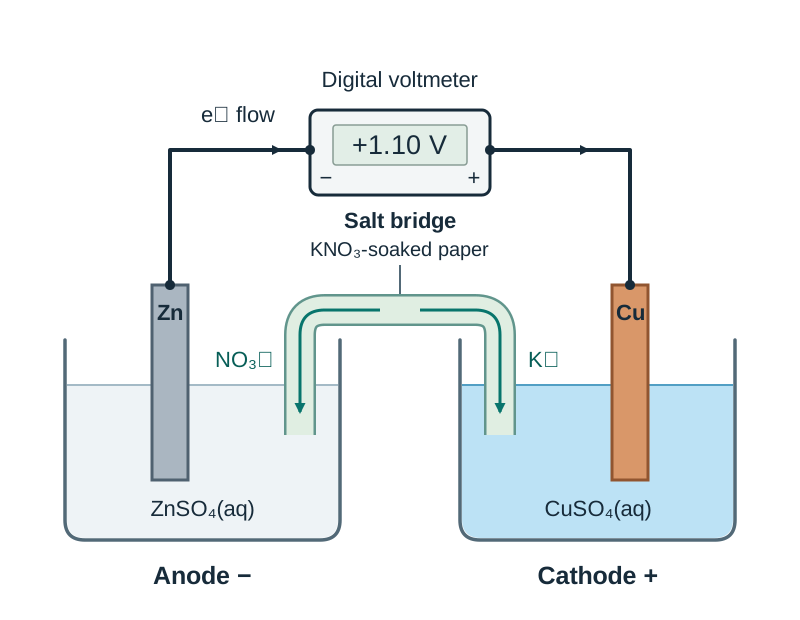
Results and calculation The voltmeter reads approximately 1.1 V. Oxidation occurs at the zinc anode: Zn -> Zn2+ + 2e-. Reduction occurs at the copper cathode: Cu2+ + 2e- -> Cu. Electrons flow from zinc to copper through the external wire. The salt bridge maintains electrical neutrality.
Accuracy and safety
- Clean metal strips with emery paper to remove surface oxide layers that resist current flow.
- Ensure the salt bridge contacts both solutions to complete the circuit.
How it is asked This experiment has not appeared on recent papers; questions would ask to identify the anode and cathode, state the function of the salt bridge, or write electrode half-equations.
Electrolysis of acidified water
Aim Split water into hydrogen and oxygen gas by electrolysis using inert electrodes.
Apparatus and materials Hofmann voltameter, platinum electrodes, DC power supply, connecting leads, dilute sulfuric acid, wooden splints.
Method
- Fill the Hofmann voltameter with dilute sulfuric acid and close both taps.
- Connect platinum electrodes to the DC power supply: anode to positive, cathode to negative.
- Turn on the current until measurable volumes of gas collect in both limbs.
- Measure and compare the volumes of gas collected at each electrode.
- Test the cathode gas with a lit splint (pop confirms hydrogen).
- Test the anode gas with a glowing splint (relights confirms oxygen).
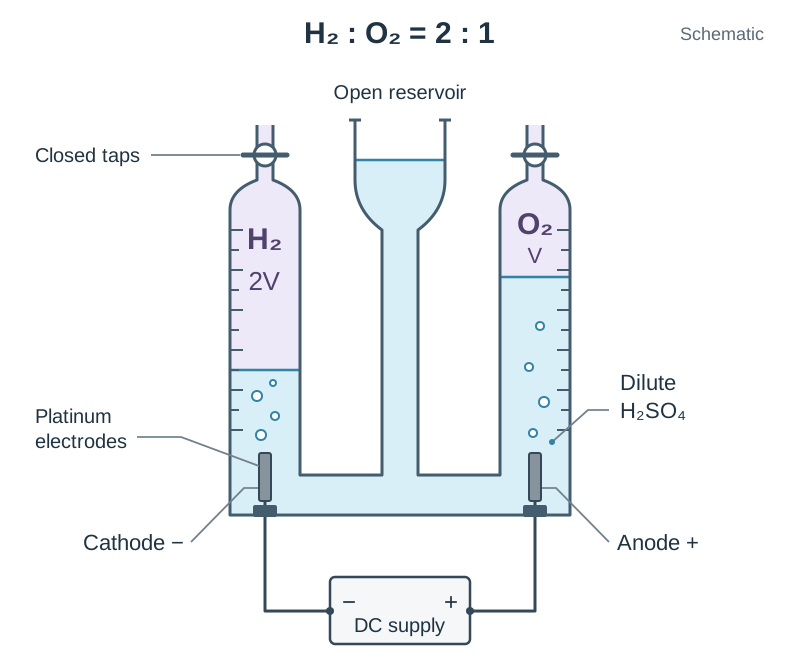
Results and calculation The volume ratio of hydrogen to oxygen is 2 : 1. Cathode reaction: 2H+ + 2e- -> H2. Anode reaction: 2H2O -> O2 + 4H+ + 4e-.
Accuracy and safety
- Acid is added because pure water is a poor electrical conductor; acid provides mobile ions.
- Hydrogen gas is flammable; extinguish flames near the cell.
How it is asked
- Identifying products at electrodes and writing half-equations have been asked.
- Explaining why platinum electrodes are inert has been asked.
Titration: strong acid and strong base
Aim Standardise a sodium hydroxide solution using a standard hydrochloric acid solution.
Apparatus and materials 50 cm^3 burette, 25 cm^3 pipette, pipette filler, conical flask, white tile, 0.10 M HCl, NaOH solution, phenolphthalein indicator, deionised water.
Method
- Rinse the burette with deionised water and then with HCl solution; fill the burette and remove air bubbles.
- Rinse the pipette with deionised water and then with NaOH solution; pipette 25.0 cm^3 of NaOH into a conical flask rinsed only with deionised water.
- Add 2 to 3 drops of phenolphthalein indicator (pink colour).
- Titrate by adding acid dropwise near the end point while swirling over a white tile.
- Record the titre when the solution changes from pink to colourless permanently.
- Repeat to obtain concordant titres agreeing within 0.1 cm^3.
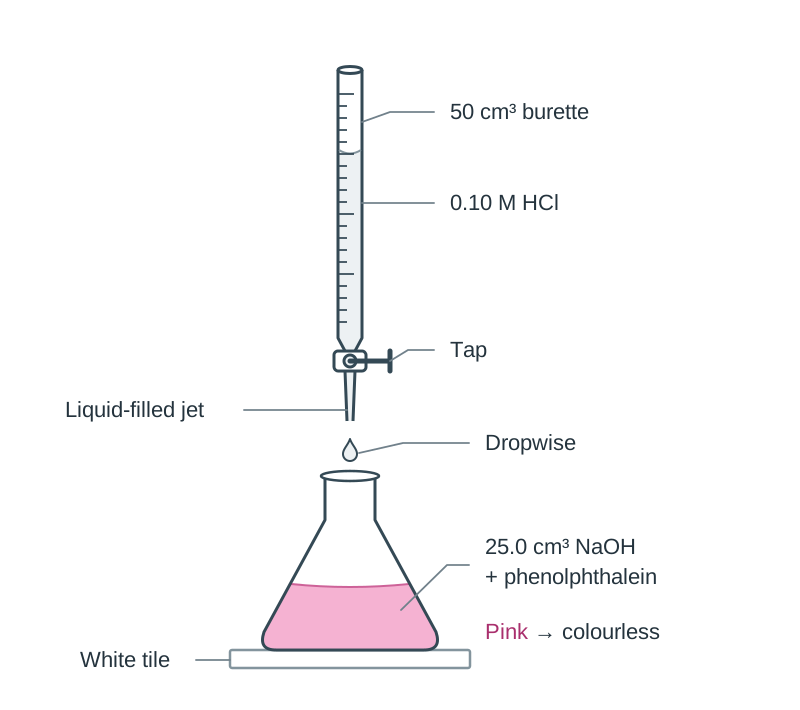
Results and calculation Reaction: HCl + NaOH -> NaCl + H2O. Calculate molarity of NaOH using (M_a x V_a) / n_a = (M_b x V_b) / n_b, with n_a = 1 and n_b = 1.
Accuracy and safety
- Rinse the conical flask with deionised water only so the number of moles of base is unchanged.
- Read the bottom of the meniscus at eye level with the burette vertical.
How it is asked
- Stating rinsing procedures for the burette, pipette, and conical flask has been asked.
- Precautions as the end point is approached (drop by drop, swirling, rinsing walls with water) have been asked.
Titration: strong acid and weak base
Aim Standardise hydrochloric acid using a primary standard sodium carbonate solution, or determine water of crystallisation in washing soda.
Apparatus and materials 250 cm^3 volumetric flask, 25 cm^3 pipette, burette, conical flask, white tile, anhydrous sodium carbonate or washing soda crystals, HCl solution, methyl orange indicator, deionised water.
Method
- Weigh sodium carbonate, dissolve in deionised water in a beaker, and transfer using a funnel to a 250 cm^3 volumetric flask.
- Add rinsings from the beaker, make up to the mark with deionised water until the bottom of the meniscus is on the line, stopper, and invert several times.
- Pipette 25.0 cm^3 of carbonate solution into a water-rinsed conical flask.
- Add 2 to 3 drops of methyl orange indicator (turns yellow).
- Titrate with HCl until the colour changes from yellow/orange to pink/red.
- Repeat to obtain concordant titres within 0.1 cm^3.
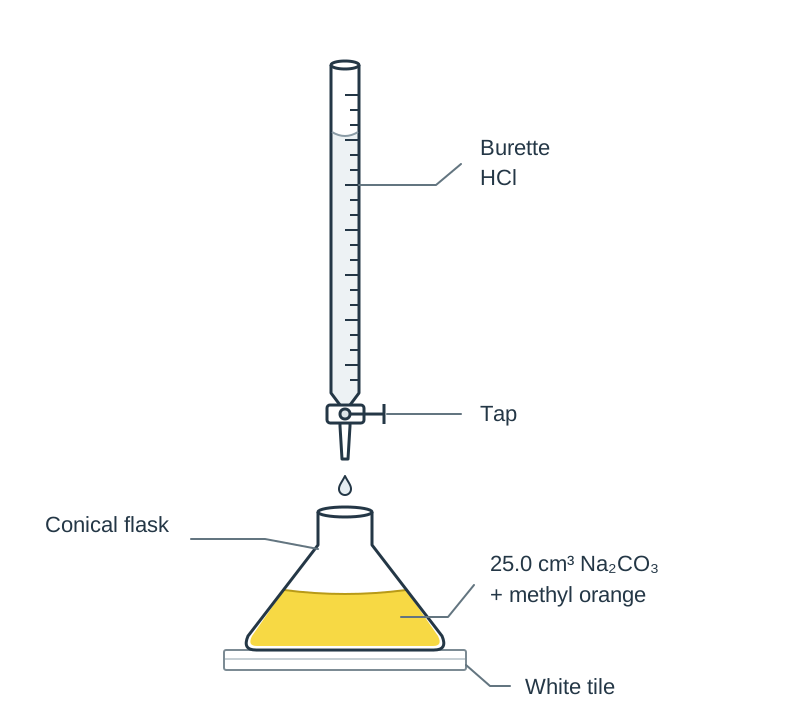
Results and calculation Reaction: 2HCl + Na2CO3 -> 2NaCl + H2O + CO2. Use (M_a x V_a) / 2 = (M_b x V_b) / 1. For washing soda (Na2CO3.xH2O), find mass of anhydrous Na2CO3, subtract from total sample mass to find water mass, and find x from the mole ratio of water to Na2CO3.
Accuracy and safety
- Hydrated sodium carbonate is not a primary standard because it effloresces in air; anhydrous sodium carbonate is stable and pure.
- Swirl constantly and add acid drop by drop near the end point.
How it is asked
- Describing how to transfer solid into a volumetric flask and make to the mark has been asked.
- Naming methyl orange and stating its colour change (yellow to red/pink) have been asked.
- Calculating moles, mass, and water of crystallisation (x) has been asked.
Titration: iodine and thiosulfate
Aim Determine the concentration of hypochlorite in bleach by titrating the liberated iodine with standardised sodium thiosulfate solution.
Apparatus and materials Burette, 25 cm^3 pipette, conical flask, diluted bleach, potassium iodide, sulfuric acid, sodium thiosulfate solution, starch indicator.
Method
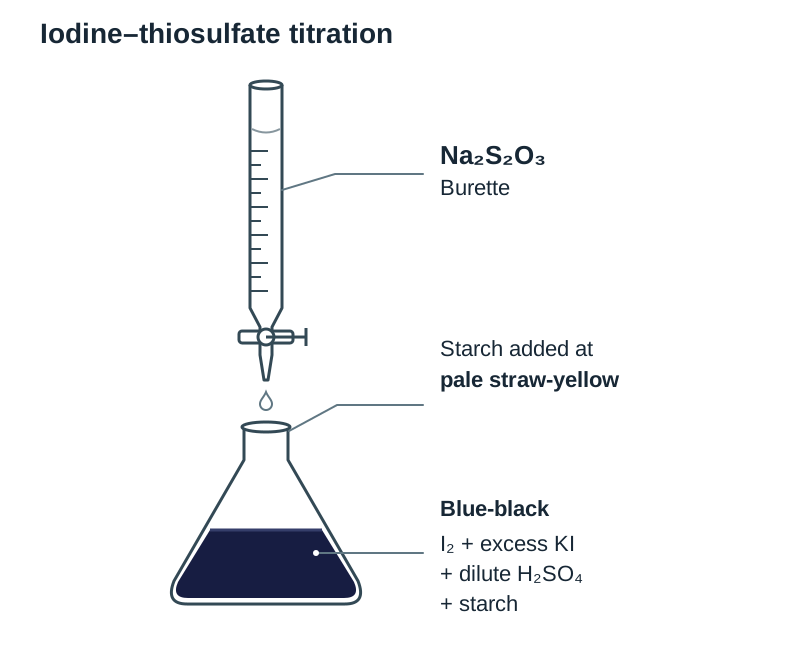
- Pipette 25.0 cm^3 of diluted bleach into a conical flask.
- Add excess potassium iodide and dilute sulfuric acid; solution turns reddish-brown due to liberated iodine.
- Titrate with sodium thiosulfate solution until the reddish-brown colour fades to pale straw-yellow.
- Add starch indicator; solution turns blue-black.
- Continue adding thiosulfate dropwise until the solution turns permanently colourless.
- Repeat to obtain concordant titres.
Results and calculation Reactions: ClO- + 2I- + 2H+ -> Cl- + I2 + H2O, and I2 + 2S2O3^2- -> 2I- + S4O6^2-. Mole ratio is 1 ClO- : 1 I2 : 2 S2O3^2-. Calculate moles of thiosulfate, divide by 2 for moles of iodine/hypochlorite, and scale up for original bleach concentration.
Accuracy and safety
- Add starch indicator only when the solution reaches straw-yellow, as starch binds irreversibly to high concentrations of iodine.
- Add excess potassium iodide to ensure all hypochlorite reacts and to keep iodine dissolved as triiodide.
How it is asked
- Explaining why excess KI is added has been asked.
- Stating the indicator colour changes (straw-yellow to blue-black to colourless) has been asked.
- Calculating moles of thiosulfate and percentage (w/v) of hypochlorite has been asked.
pH titration curves and choosing an indicator
Higher level only.
Aim Generate pH titration curves for acid-base combinations and justify indicator choice.
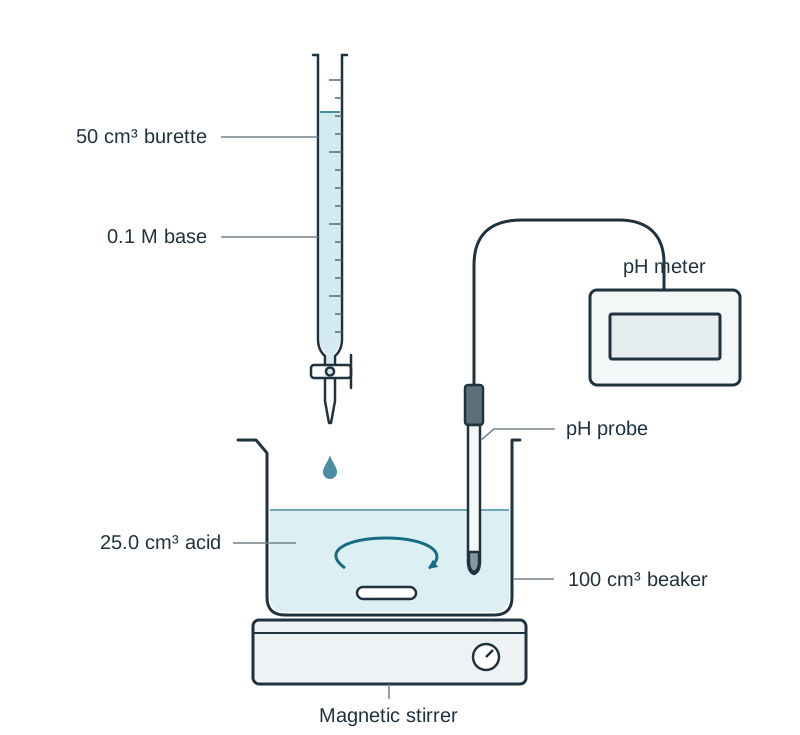
Apparatus and materials pH meter, burette, pipette, beaker, magnetic stirrer, 0.1 M solutions of HCl, ethanoic acid, NaOH, ammonia, buffer solutions.
Method
- Calibrate the pH meter using buffer solutions.
- Pipette 25.0 cm^3 of acid into a beaker and record the initial pH.
- Add base from the burette in 1.0 cm^3 increments, stirring and recording pH.
- Near the rapid pH change, add base in 0.1 cm^3 drops.
- Continue adding base past equivalence until pH levels off.
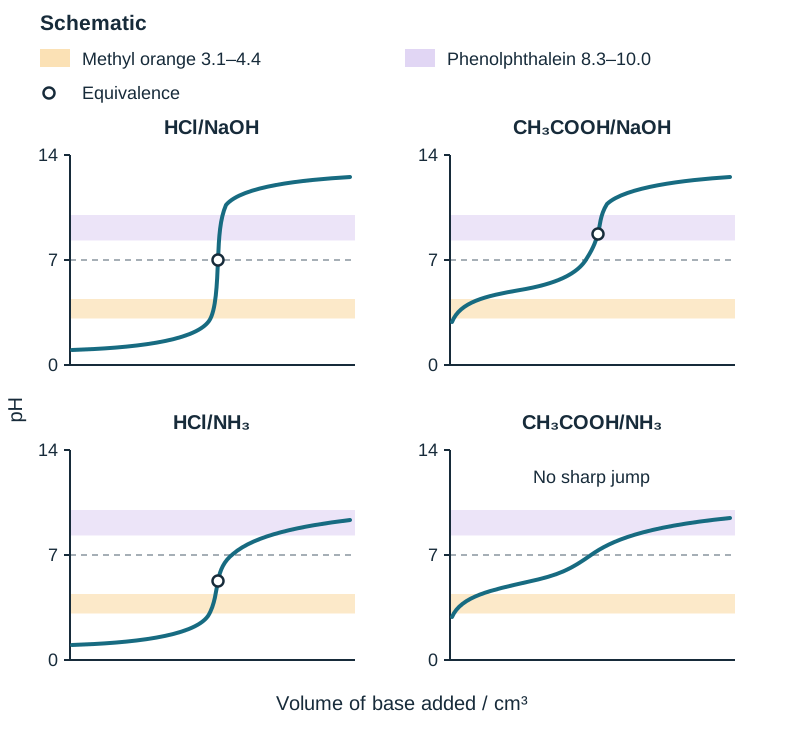
Results and calculation Plot pH (y-axis) against volume of base added (x-axis). The equivalence point is the midpoint of the steep vertical section. Strong acid-strong base has a steep jump from pH 3 to 10 (methyl orange or phenolphthalein suitable). Strong acid-weak base has a jump below pH 7 (methyl orange suitable). Weak acid-strong base has a jump above pH 7 (phenolphthalein suitable). Weak acid-weak base has no sharp jump; no indicator gives a sharp end point.
Accuracy and safety
- Calibrate the meter with two buffers to ensure accurate readings.
- Add base dropwise at the end point to locate the inflection point accurately.
How it is asked
- Naming an indicator for a titration and justifying it using the pH range has been asked.
- Stating end point colour changes has been asked.
Ethanoic acid in vinegar
Aim Determine the concentration of ethanoic acid in commercial vinegar by volumetric analysis.
Apparatus and materials Commercial vinegar, 250 cm^3 volumetric flask, 25 cm^3 pipette, burette, conical flask, white tile, standardised 0.10 M NaOH, phenolphthalein indicator, deionised water.
Method
- Pipette 25.0 cm^3 of vinegar into a 250 cm^3 volumetric flask.
- Make up to the mark with deionised water, stopper, and invert several times.
- Pipette 25.0 cm^3 of diluted vinegar into a conical flask rinsed only with deionised water.
- Add 2 to 3 drops of phenolphthalein indicator.
- Titrate against standardised 0.10 M NaOH until the solution turns permanently pale pink.
- Repeat to obtain concordant titres within 0.1 cm^3.
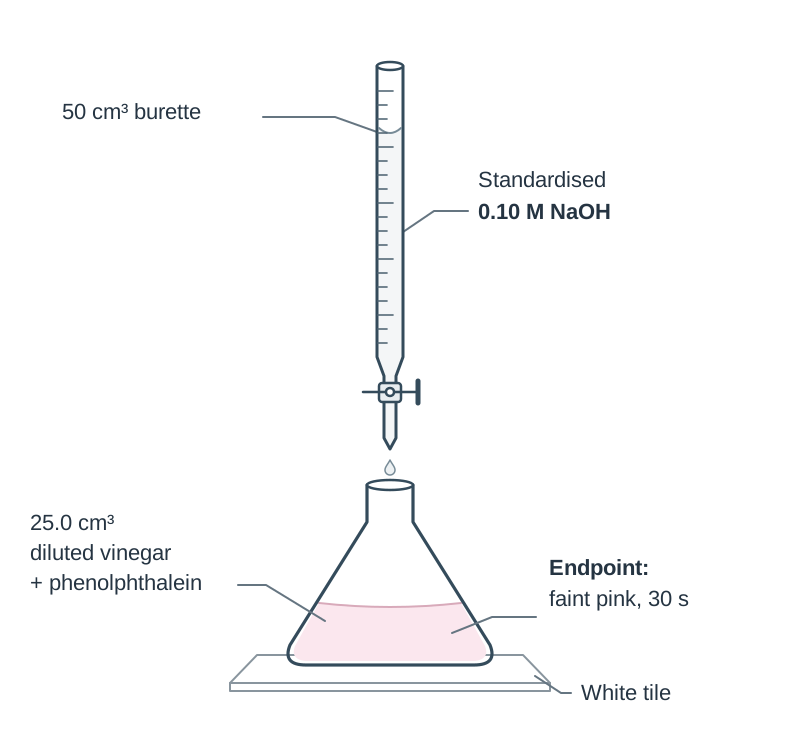
Results and calculation Reaction: CH3COOH + NaOH -> CH3COONa + H2O. Calculate diluted vinegar molarity: M_dil = (M_b x V_b) / V_a. Molarity of original vinegar = M_dil x 10. Concentration in g/L = molarity x 60. Concentration in % (w/v) = (g/L) / 10.
Accuracy and safety
- Vinegar is diluted so a convenient burette volume of NaOH is used.
- Phenolphthalein is used because this weak acid-strong base titration has an end point in the alkaline range (pH 8 to 10).
How it is asked This experiment has not come up in the supplied papers; a question would reasonably ask why the vinegar is diluted, how the volumetric flask is filled to the mark, why phenolphthalein is chosen, or the % (w/v) calculation.
Iron in iron tablets
Aim Determine the percentage of iron in iron tablets using potassium manganate(VII) titration.
Apparatus and materials Iron tablets, mortar and pestle, balance, 250 cm^3 volumetric flask, funnel, filter paper, 25 cm^3 pipette, burette, conical flask, dilute sulfuric acid, standardised 0.010 M KMnO4.
Method
- Weigh iron tablets and crush them in a mortar.
- Dissolve the powder in dilute sulfuric acid and transfer with washings to a 250 cm^3 volumetric flask.
- Make up to the mark with deionised water and invert to mix.
- Pipette 25.0 cm^3 of tablet solution into a conical flask and add extra dilute sulfuric acid.
- Titrate against 0.010 M KMnO4, reading the top of the meniscus, until the first permanent faint pink colour appears.
- Repeat for concordant titres.
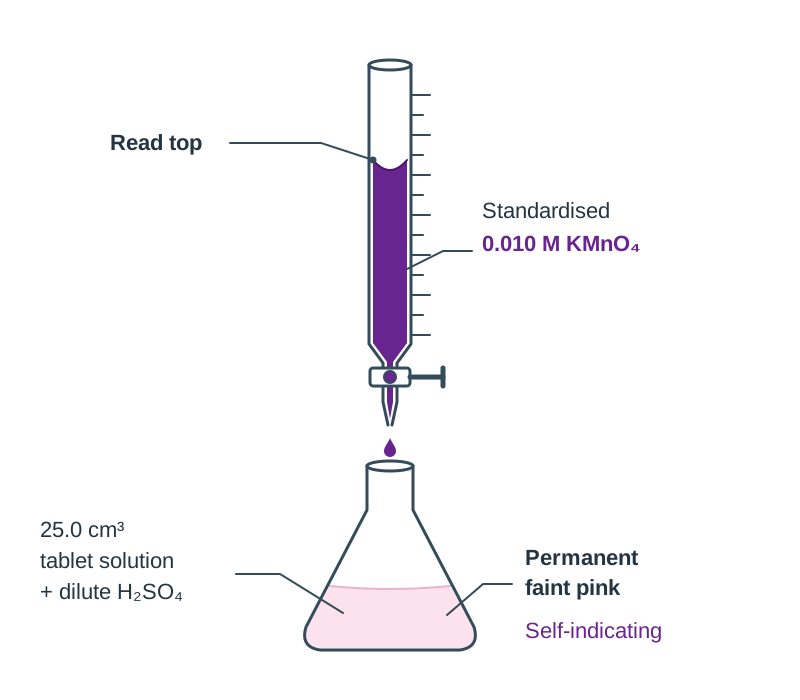
Results and calculation Reaction: MnO4- + 5Fe2+ + 8H+ -> Mn2+ + 5Fe3+ + 4H2O. Moles Fe2+ in 25 cm^3 = 5 x moles MnO4-. Multiply by 10 to find total moles in 250 cm^3. Total mass Fe = moles x 56. Calculate mass per tablet and percentage by mass.
Accuracy and safety
- Multiple tablets are used to reduce percentage weighing error.
- Sulfuric acid is added when dissolving to prevent air oxidation of Fe2+ to Fe3+, and in the conical flask to ensure Mn7+ reduces completely to colourless Mn2+ rather than brown MnO2 precipitate.
- KMnO4 is self-indicating; no indicator is needed.
How it is asked
- Explaining why extra sulfuric acid is added and naming the self-indicating end point have been asked.
- Calculating mass of iron per tablet and percentage by mass has been asked.
Fehling's test: aldehydes and ketones
Aim Distinguish between aldehydes and ketones using Fehling's reagent.
Apparatus and materials Test tubes, hot water bath, droppers, Fehling's solution A, Fehling's solution B, ethanal, propanone, acidified potassium manganate(VII).
Method
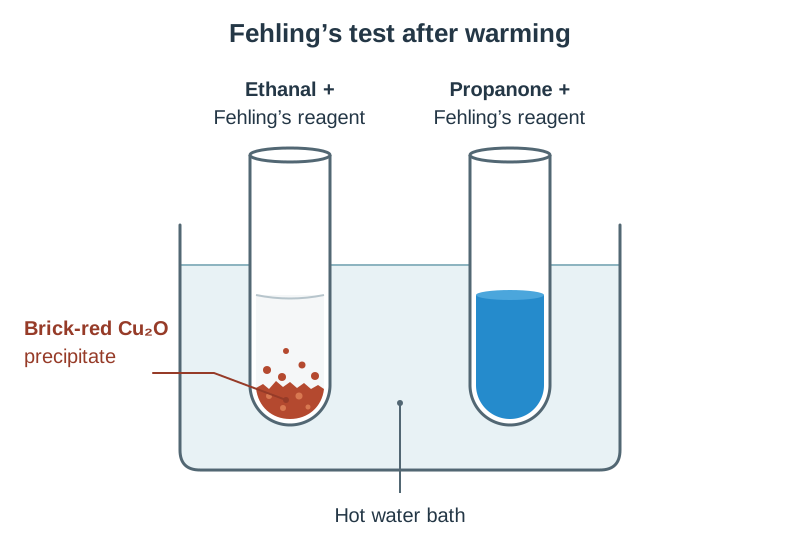
- Prepare Fehling's reagent by mixing equal volumes of Fehling's A and Fehling's B.
- Add ethanal to one tube containing Fehling's reagent and propanone to another.
- Place both tubes in a hot water bath for a few minutes.
- Observe and record colour changes.
- Test separate samples with warm acidified potassium manganate(VII).
Results and calculation With ethanal, the blue solution forms a brick-red precipitate of copper(I) oxide (Cu2O): Cu2+ + e- -> Cu+. Propanone gives no reaction (stays blue). With acidified KMnO4, ethanal turns purple to colourless, while propanone remains purple.
Accuracy and safety
- Heat using a water bath rather than a naked flame, as aldehydes and ketones are volatile and flammable.
- Mix Fehling's solutions A and B freshly before use.
How it is asked
- Stating the observation for Fehling's test (blue to brick-red precipitate) has been asked.
- Writing the half-equation for the reduction of Cu2+ has been asked.
Acidic nature of carboxylic acids
Aim Investigate the acidic properties of ethanoic acid with metals, bases, and carbonates.
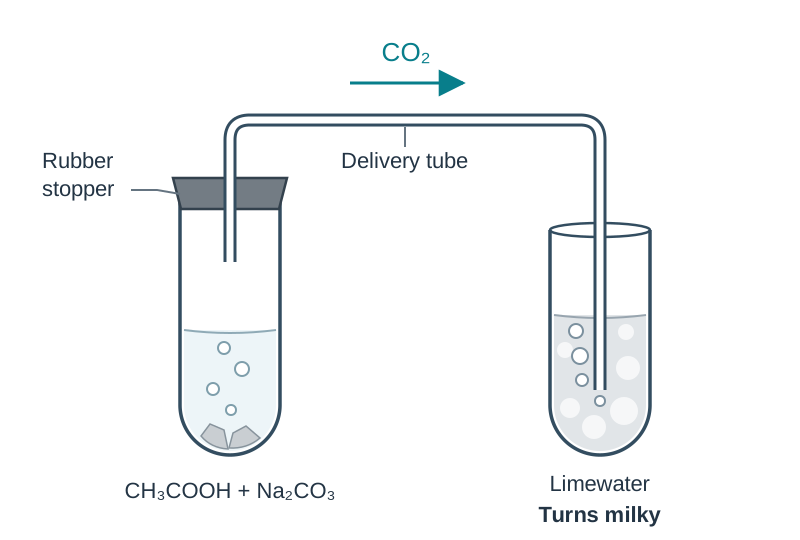
Apparatus and materials Test tubes, delivery tube, limewater, blue litmus paper, dilute ethanoic acid, magnesium ribbon, solid sodium carbonate, sodium hydroxide solution, phenolphthalein.
Method
- Test ethanoic acid with blue litmus paper.
- Add magnesium ribbon to ethanoic acid in a test tube; test the evolved gas with a lit splint.
- Add ethanoic acid to sodium hydroxide solution coloured pink with phenolphthalein.
- Add solid sodium carbonate to ethanoic acid; bubble the evolved gas through limewater.
Results and calculation
- Litmus turns red, showing ethanoic acid is acidic.
- Magnesium produces hydrogen gas (pop with lit splint): 2CH3COOH + Mg -> (CH3COO)2Mg + H2.
- Sodium hydroxide neutralises the acid; phenolphthalein changes from pink to colourless: CH3COOH + NaOH -> CH3COONa + H2O.
- Sodium carbonate effervesces, and CO2 turns limewater milky: 2CH3COOH + Na2CO3 -> 2CH3COONa + H2O + CO2.
Accuracy and safety
- Clean magnesium ribbon with emery paper to remove the oxide layer before reacting.
How it is asked
- Writing balanced equations for reactions with magnesium and sodium carbonate has been asked.
- Calculating the volume of gas produced has been asked.
Preparing an ester by reflux
Aim Prepare ethyl ethanoate by refluxing ethanol and ethanoic acid with concentrated sulfuric acid.
Apparatus and materials Pear-shaped flask, Liebig condenser, heating mantle, anti-bumping granules, separating funnel, ethanol, glacial ethanoic acid, concentrated sulfuric acid, sodium carbonate solution, anhydrous magnesium sulfate.
Method
- Place ethanol and glacial ethanoic acid in the flask.
- Add concentrated sulfuric acid dropwise with cooling, and add anti-bumping granules.
- Attach a reflux condenser with water entering at the bottom and leaving at the top.
- Heat under reflux using a heating mantle for 20 minutes, leaving the condenser top open.
- Cool the flask, transfer contents to a separating funnel, and wash with sodium carbonate solution, venting regularly.
- Separate the organic layer and dry with anhydrous magnesium sulfate.
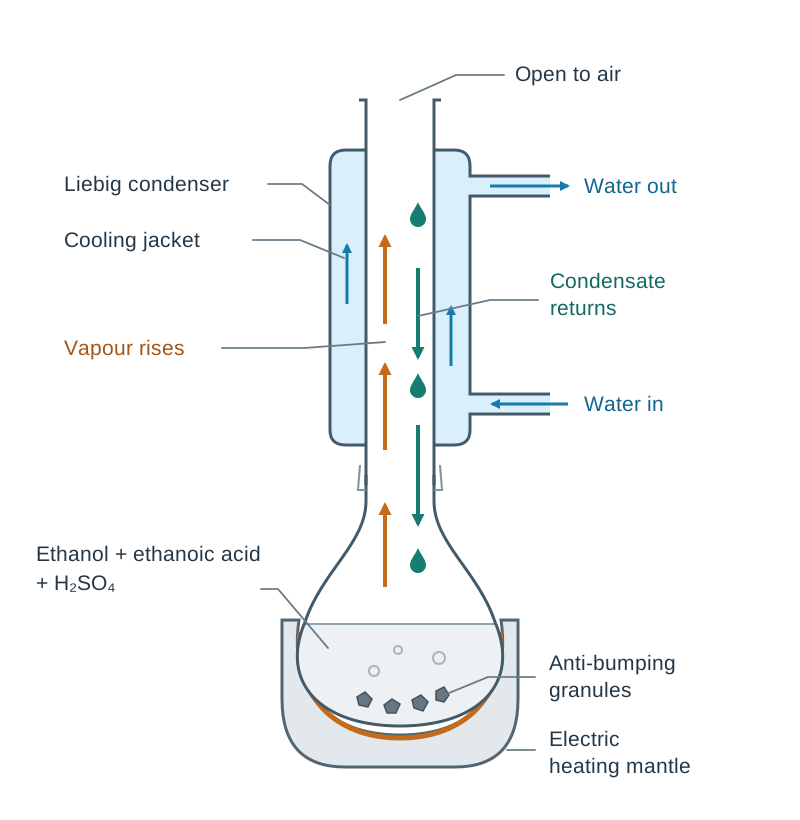
Results and calculation Reaction: CH3COOH + C2H5OH <=> CH3COOC2H5 + H2O. Ethyl ethanoate is a colourless liquid with a fruity odour. Reflux allows heating without loss of volatile reactants or products.
Accuracy and safety
- Never seal the top of a reflux condenser, as pressure build-up could burst the apparatus.
- Use a heating mantle instead of a Bunsen flame because organic reagents are flammable.
How it is asked This experiment has not come up in the supplied papers; a question would reasonably ask for the purpose of refluxing, the role of the concentrated sulfuric acid, or the washing of the product with sodium carbonate solution.
Synthesis of benzoic acid
Aim Synthesise benzoic acid by alkaline oxidation of phenylmethanol and determine its melting point.
Apparatus and materials Conical flask, water bath, ice bath, Buchner funnel, filter paper, capillary tube, melting point apparatus, phenylmethanol, KMnO4, Na2CO3, concentrated HCl, sodium sulfite.
Method
- Heat phenylmethanol, KMnO4, and Na2CO3 in a flask in a boiling water bath until purple turns to brown MnO2 precipitate.
- Cool and add concentrated HCl in a fume cupboard until acidic.
- Add sodium sulfite solution until the brown MnO2 precipitate dissolves to colourless Mn2+.
- Chill in an ice bath to crystallise benzoic acid, then filter crystals under suction.
- Recrystallise from minimum boiling water, filter while hot to remove insoluble impurities, cool slowly, and filter cold crystals.
- Pack dry crystals into a capillary tube and measure the melting point range.
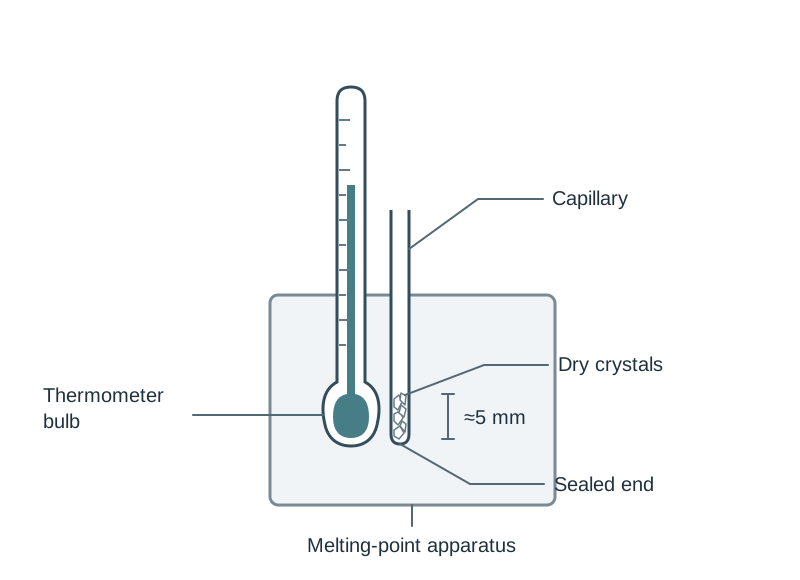
Results and calculation Reaction: 3C6H5CH2OH + 4KMnO4 -> 3C6H5COOH + 4MnO2 + H2O + 4KOH. Pure benzoic acid melts sharply at 121–122 °C; impure samples melt over a wider, lower range. Percentage yield = (actual mass / theoretical mass) x 100.
Accuracy and safety
- Add HCl in a fume cupboard; adding Na2SO3 in acid generates toxic sulfur dioxide gas.
- Wash crystals with ice-cold water to minimise dissolving the product.
How it is asked
- Roles of Na2CO3, concentrated HCl, and Na2SO3 have been asked.
- Describing melting point determination and recrystallisation has been asked.
- Calculating theoretical and percentage yield has been asked.
Preparing soap
Aim Prepare soap by base hydrolysis of a fat and investigate limiting versus excess alkali.
Apparatus and materials Beakers, water bath, hotplate, Buchner funnel, vegetable oil, sodium hydroxide, ethanol, saturated brine, ice-cold water.
Method
- Place vegetable oil into two beakers with ethanol as a solvent.
- Add excess sodium hydroxide to one beaker and limiting sodium hydroxide to the other.
- Heat both beakers in a hot water bath, stirring for 20 minutes.
- Pour the reaction mixtures into beakers of ice-cold saturated brine with stirring.
- Filter the precipitated soap curds using a Buchner funnel and wash with ice-cold water.
- Test products by shaking with water to observe lather.
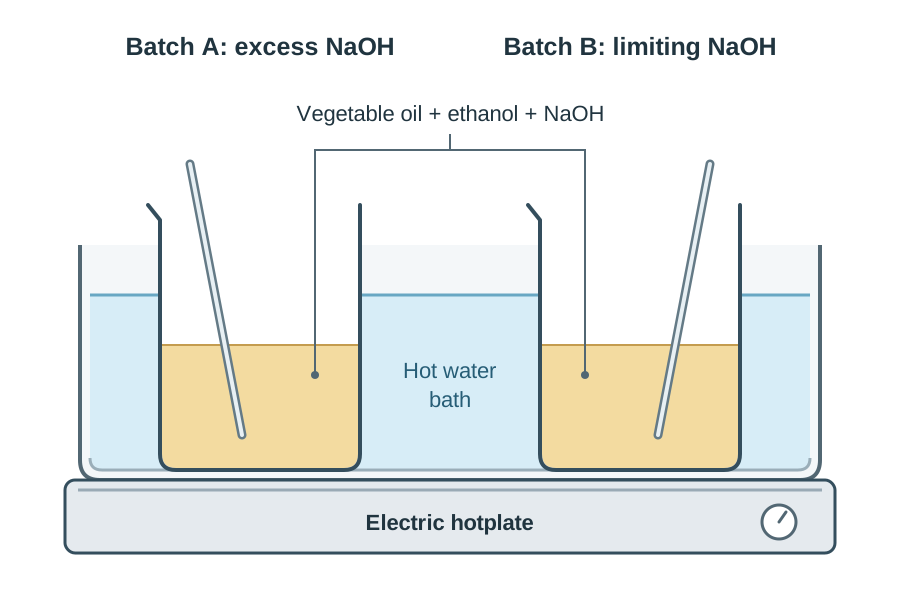
Results and calculation Reaction: fat + 3NaOH -> glycerol + 3 soap (saponification / base hydrolysis). Brine precipitates soap by salting out. Excess NaOH gives complete conversion and firm soap; limiting NaOH leaves unreacted fat, giving greasy soap.
Accuracy and safety
- Heat using a water bath with no naked flames because ethanol vapour is flammable.
- Brine separates soap from glycerol and unreacted NaOH.
How it is asked
- Naming the reaction (saponification/base hydrolysis) and co-product (glycerol) has been asked.
- Explaining the function of ethanol (solvent) and brine (precipitates soap) has been asked.
Key terms
- Primary standard
- A substance that is pure, stable, anhydrous, has a high relative molecular mass, and dissolves directly in water to give a solution of accurately known concentration.
- Standard solution
- A solution whose concentration is accurately known.
- End point
- The point in a titration where the indicator permanently changes colour, indicating reaction completion.
- Concordant titres
- Titration volumes that agree with each other within 0.10 cm³.
- Heat of reaction
- The heat change when the number of moles of reactants in a balanced chemical equation react completely.
- Heat of neutralisation
- The heat change when one mole of H+ ions from an acid reacts with one mole of OH- ions from a base to form one mole of water.
- Rate of reaction
- The change in concentration of a reactant or product per unit time.
- Instantaneous rate
- The reaction rate at a specific moment in time, determined from the slope of a tangent drawn to a concentration-time or volume-time curve.
- Heterogeneous catalysis
- Catalysis in which the catalyst and reactants are in different phases.
- Saponification
- The base hydrolysis of fats or oils using sodium hydroxide to produce soap and glycerol.
Check yourself
Why is hydrated sodium carbonate not suitable as a primary standard?
It effloresces (loses water of crystallisation to dry air), so its exact composition and molar mass vary.
What observation confirms that a gas is unsaturated when shaken with bromine water?
The reddish-brown solution turns colourless.
Why is dilute sulfuric acid added when preparing the iron tablet solution?
To prevent air oxidation of Fe2+ ions to Fe3+ ions, and to prevent hydrolysis.
What is the function of brine in soap preparation?
It precipitates (salts out) the soap by lowering its solubility, separating it from glycerol and excess sodium hydroxide.
How do you distinguish between sulfate and sulfite ions using chemical tests?
Add barium chloride solution to get a white precipitate with both. Add dilute hydrochloric acid: the sulfite precipitate dissolves, but the sulfate precipitate remains insoluble.