
Chemical bonds hold atoms together within molecules, but the physical properties of molecular substances—such as boiling points, states of matter, and solubility—depend directly on the forces operating between separate molecules. In the Leaving Certificate specification, intermolecular forces fall collectively under the umbrella of van der Waals forces: London dispersion forces, permanent dipole–dipole forces (including hydrogen bonding), and ion–dipole forces. Using Valence Shell Electron Pair Repulsion (VSEPR) theory, we predict and model three-dimensional molecular geometries for ABn systems containing up to four single-bonded electron pairs around a central atom. Combining geometry with molecular symmetry allows us to determine whether a molecule is polar or non-polar overall, directly explaining observed physical trends in both inorganic and organic substances.
Intramolecular Bonding Versus Intermolecular Forces
To understand physical changes and chemical reactions, keep two distinct scales of attraction clear:
- Intramolecular bonding refers to the strong chemical forces holding atoms together within a molecule, such as pure covalent and polar covalent bonds. Breaking these bonds requires large amounts of energy and involves a chemical reaction.
- Intermolecular forces are the attractions occurring between separate neighbouring molecules. In molecular substances, intermolecular forces are significantly weaker than intramolecular covalent bonds.
When water boils, thermal energy overcomes the intermolecular hydrogen bonds between molecules, while the intramolecular covalent bonds within each molecule remain intact. The escaping steam consists of intact molecules, not separate hydrogen and oxygen atoms.
Under the Leaving Certificate specification, intermolecular forces are grouped collectively under the umbrella of van der Waals forces:
- London dispersion forces (instantaneous, induced dipole–dipole forces)
- Permanent dipole–dipole forces (including hydrogen bonding)
- Ion–dipole forces
When answering exam questions, always name the specific force involved rather than simply writing 'van der Waals forces'.
Types and Relative Strengths of Intermolecular Forces
London Dispersion Forces
London dispersion forces are temporary attractive forces caused by the continuous movement of electrons. At any given instant, the electron cloud of an atom or molecule may become unevenly distributed, creating an instantaneous dipole. This temporary dipole repels electrons in an adjacent particle, creating an induced dipole. The opposite partial charges attract.
London dispersion forces exist between all particles, including polar molecules. However, they are the only intermolecular force present in non-polar substances, such as the noble gases, diatomic elements (, , , ), and hydrocarbons like methane ().
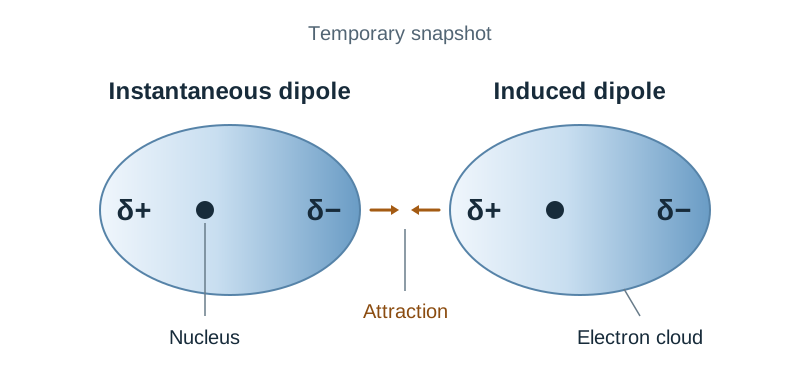
The strength of London dispersion forces depends on two factors:
- Number of electrons and molecular size: Larger electron clouds are held less tightly by the nucleus and are more easily deformed—a property known as polarisability. Stronger temporary dipoles form, leading to higher boiling points. For example, boiling points increase down Group 17: () and () are gases, () is a liquid, and () is a solid.
- Molecular shape and surface contact: Unbranched molecules allow greater surface contact between neighbours than compact, spherical isomers. Pentane (boiling point ) boils higher than its branched isomer 2,2-dimethylpropane (boiling point ) because straight pentane chains pack together along an extended surface area.
Permanent Dipole–Dipole Forces
In polar molecules, unequal electron sharing creates a permanent separation of charge. The permanent partial positive end () of one molecule electrostatically attracts the permanent partial negative end () of an adjacent molecule (for example, in propanone or ). Because permanent dipoles do not depend on fleeting electron shifts, dipole–dipole forces are generally stronger than the dispersion forces between non-polar molecules of similar electron count.
Hydrogen Bonding
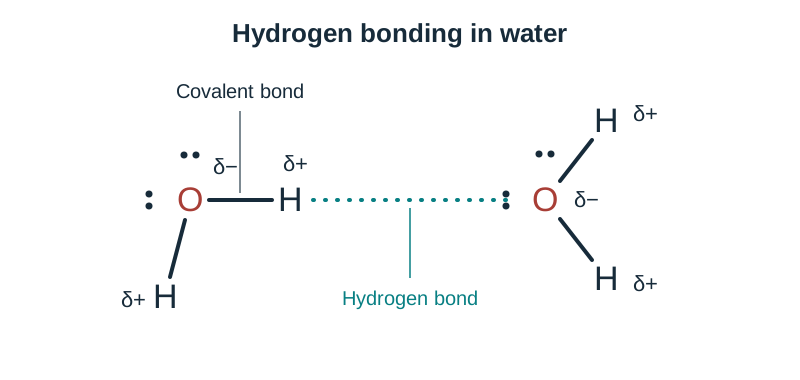
Hydrogen bonding is an especially strong type of permanent dipole–dipole attraction. It happens only when both of the following are true:
- A hydrogen atom is covalently bonded directly to one of the three smallest, most electronegative elements: nitrogen (), oxygen (), or fluorine ().
- The exposed hydrogen attracts a non-bonding lone pair of electrons on an adjacent , , or atom.
Hydrogen has only one electron and no inner shells, so when , , or pulls the shared electrons away, the hydrogen nucleus is left almost bare. This gives a very concentrated charge, which is strongly attracted to a lone pair on the , , or atom of a neighbouring molecule.
Ion–Dipole Forces and Hydration
Ion–dipole forces act between a fully charged ion and the partial charge of a polar molecule. When an ionic solid like dissolves in water, the negative ends ( oxygen) of polar water molecules cluster around cations, while the positive ends ( hydrogen) cluster around anions. This process is called hydration. The salt dissolves because the energy given out when many ion–dipole attractions form is enough to overcome the energy needed to pull the ions out of the crystal lattice.
Ranking the Forces
For molecules of similar size and electron count, the relative strength ranking is:
All intermolecular forces are far weaker than covalent bonds. For example, overcoming hydrogen bonds between liquid water molecules takes roughly , whereas breaking intramolecular covalent bonds takes about .
Important comparison rule: This ranking holds strictly when comparing molecules of similar size. London dispersion forces grow significantly stronger as the number of electrons increases, so a large non-polar molecule can have stronger total intermolecular attraction than a small polar one. For instance, non-polar iodine (, 106 electrons) is a solid at room temperature, while polar hydrogen chloride (, 18 electrons) is a gas. Always compare the type of force first, then compare the number of electrons, and state which factor dominates.
VSEPR Theory: Predicting and Modelling Molecular Shapes
Valence Shell Electron Pair Repulsion (VSEPR) theory models the geometry of molecules. Its core principle states that pairs of valence electrons in the outer shell of a central atom repel each other and arrange themselves in space as far apart as possible to minimise electrostatic repulsion.
The Repulsion Hierarchy
Non-bonding lone pairs sit closer to the central atomic nucleus than bonding pairs, concentrating their negative charge over a wider angular space. This establishes the repulsion hierarchy:
Because a lone pair repels adjacent bonding pairs more strongly, each lone pair reduces the bond angle below the ideal value. The size of the reduction varies from molecule to molecule: in and it is about to per lone pair ( to and then to ), but in and the angles are compressed much further.
The Electron-Pair Counting Method
For molecules with single bonds on this course:
- Find the number of valence electrons on the central atom from its group number.
- Add one electron for each surrounding atom bonded to .
- Divide by 2 to determine the total number of electron pairs.
- The number of bonding pairs equals the number of bonded atoms. Any remaining pairs are lone pairs.
Standard Single-Bonded ABn Geometries
| Total Pairs | Bonding Pairs | Lone Pairs | Shape Name | Ideal / Approx. Bond Angle | 3D Representation Notes | Typical Examples |
|---|---|---|---|---|---|---|
| 2 | 2 | 0 | Linear | Two collinear lines in the plane of the page | ||
| 3 | 3 | 0 | Trigonal planar (triangular planar) | Three bonds at in the plane of the page | , | |
| 4 | 4 | 0 | Tetrahedral | Two standard lines in-plane, one solid wedge forward, one dashed wedge back | , , | |
| 4 | 3 | 1 | Pyramidal (trigonal pyramidal) | less than 109.5° (about 107° in NH3) | Three bonds forming a tripod; one lone pair on central atom | , , |
| 4 | 2 | 2 | V-shaped (bent / angular) | less than 109.5° (about 104.5° in H2O) | Two bonds in a V-arrangement; two lone pairs on central atom | , |
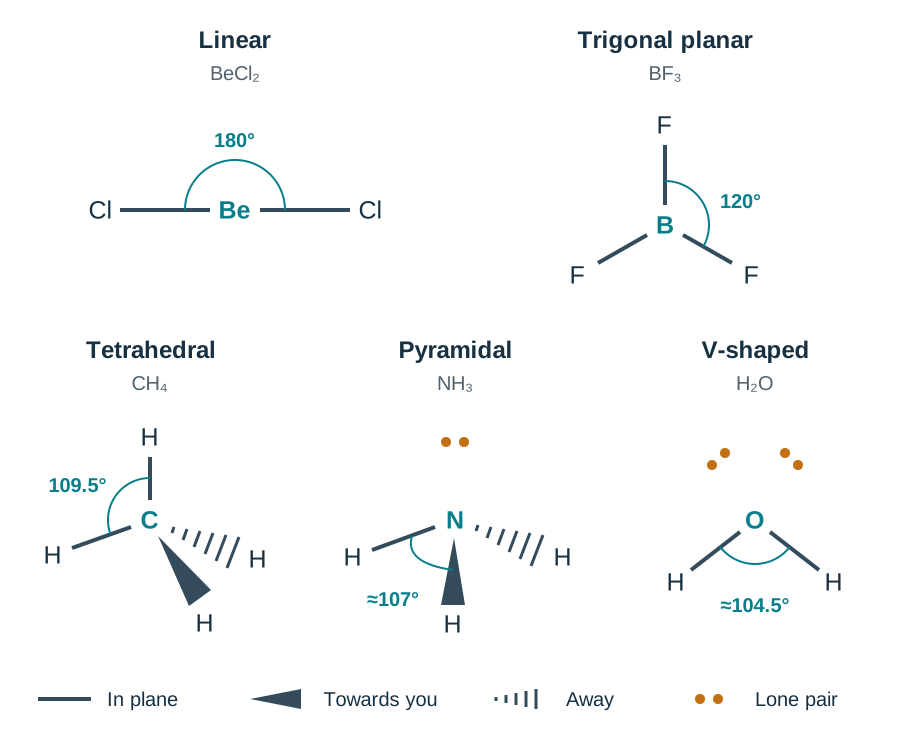
Electron arrangement versus shape: Always answer in two parts if asked about water or ammonia. In water, the four electron pairs are arranged tetrahedrally around oxygen, but because two are non-bonding lone pairs, the shape of the molecule—which describes where the atoms are—is V-shaped with a bond angle of about . Note that is also linear, but contains double bonds, placing it outside the single-bond-only scope of VSEPR on this course.
Ball-and-stick kits and on-screen 3D models are useful ways to see these shapes, and you are expected to be able to draw them as well as construct them.
Assumptions and Limitations of VSEPR Theory
Like all scientific models, VSEPR has definite limitations:
- It predicts molecular shape and approximate bond angles, but cannot calculate exact bond angles or bond lengths.
- It treats electron pairs as localised points of negative charge that repel uniformly; it does not describe how electrons are distributed across quantum mechanical atomic orbitals.
- On this course, it is restricted to molecules with single bonds and up to four electron pairs around a single central atom; it is not applied here to systems with multiple bonds or multiple central atoms.
Molecular Symmetry and Overall Polarity
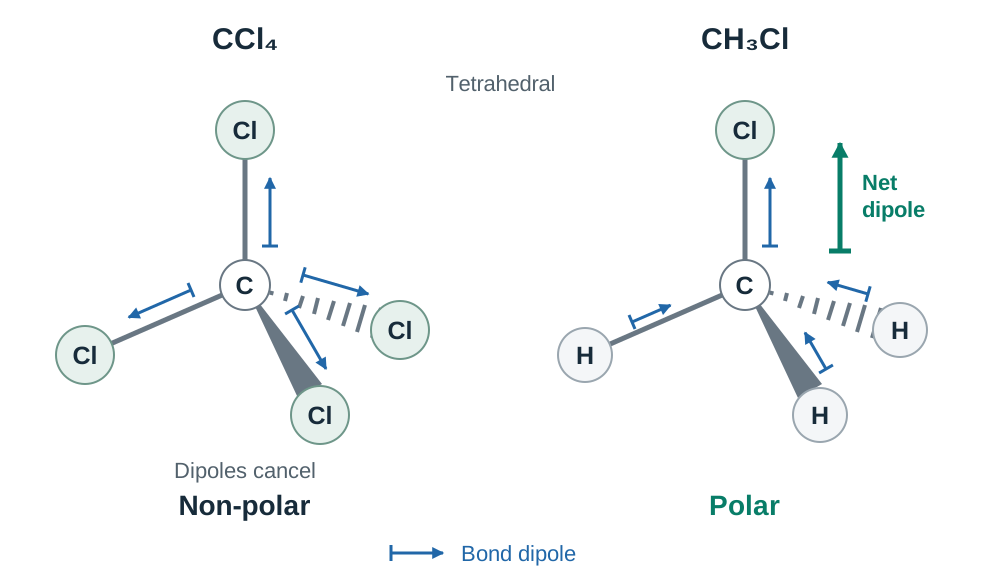
A molecule that contains polar bonds is not necessarily polar overall. Bond polarity is determined by the difference in electronegativity between bonded atoms, whereas overall molecular polarity depends on 3D geometry and symmetry.
Each polar bond pulls electrons in a particular direction and by a particular amount, so you have to add the pulls up in three dimensions:
- If polar bonds are arranged with complete spatial symmetry around the central atom, the individual dipoles pull with equal magnitude in opposing directions and cancel each other out. The net molecular dipole is zero, leaving the molecule non-polar.
- If the dipoles do not cancel—due to lone pairs creating an asymmetrical layout or different terminal atoms being present—the dipoles reinforce or fail to balance, leaving the molecule polar.
The 4-Step Polarity Decision Sequence
- Check for polar bonds: Are the bonding atoms different in electronegativity (e.g. Pauling values: , , , , , )? If no polar bonds exist (such as in or ), the molecule is non-polar.
- Count central atom lone pairs: Do lone pairs exist on the central atom? If the bonds are polar and there are lone pairs on the central atom, the arrangement of bonds is not symmetrical, so the bond dipoles cannot cancel and the molecule is polar—for example, pyramidal and V-shaped . (If the bonds are not polar in the first place, the molecule is non-polar no matter what shape it has.)
- Check terminal atoms: If there are no central lone pairs, are all surrounding terminal atoms identical? If all terminal atoms are identical (such as , , or ), the molecule is completely symmetrical.
- Deduce net dipole: If symmetrical, the bond dipoles cancel out completely (non-polar molecule). If different outer atoms are attached (such as in ), the dipoles do not cancel, and the molecule is polar.
Classroom demonstration: A charged plastic rod brought near a thin, continuous stream of water from a burette causes the stream to deflect noticeably because the polar molecules align with the electric field. A stream of non-polar cyclohexane shows no deflection.
Trends in Physical Properties: Boiling Points and Solubility
Intermolecular forces directly dictate the physical properties of molecular substances.
Secondary Data Trends: Group Hydrides
Consider the published boiling points of the Group 16 hydrides:
| Hydride | Relative Molecular Mass () | Number of Electrons | Boiling Point () |
|---|---|---|---|
| 18 | 10 | ||
| 34 | 18 | ||
| 81 | 36 | ||
| 130 | 54 |
- Trend from to : From hydrogen sulfide to hydrogen telluride, boiling points increase steadily from to . All three are V-shaped polar molecules. As relative molecular mass and total electron count increase, the electron clouds become larger and more polarisable, increasing the strength of intermolecular London dispersion forces. More thermal energy is required to separate the molecules, raising the boiling point.
- The anomaly: Water does not follow the trend down the group. Despite having the fewest electrons and lowest molecular mass, water boils at . This is because oxygen is small and highly electronegative, so water molecules form strong hydrogen bonds with one another. Substantially more energy is needed to break hydrogen bonds than the weaker dipole–dipole and London dispersion forces in .
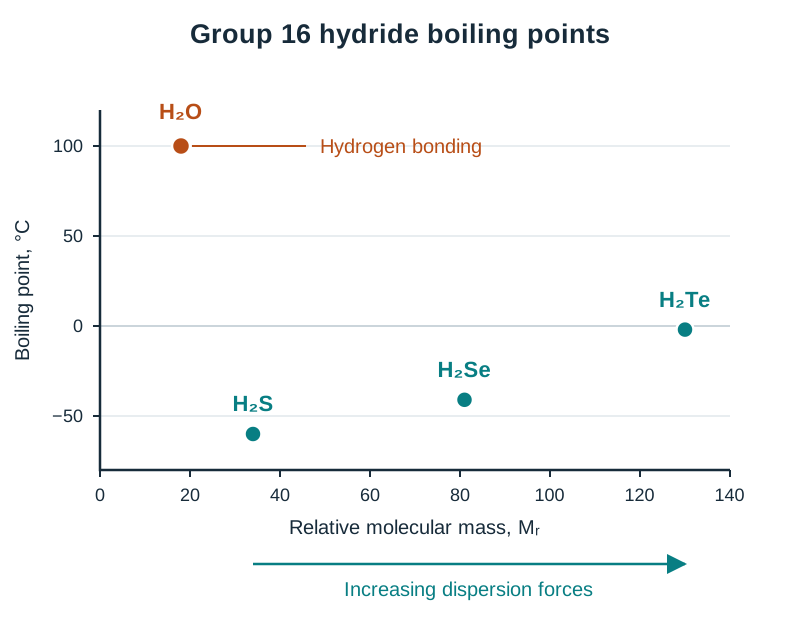
Water is not the only anomaly. In Group 15, boils at while boils at , even though has more electrons. In Group 17, boils at while boils at . In each group, the first hydride has an unexpectedly high boiling point because , , and form hydrogen bonds; hydrides further down form only dipole–dipole and London dispersion forces, and their boiling points then rise smoothly with increasing electron count.
The Open Crystal Lattice of Ice
In liquid water, hydrogen bonds constantly break and re-form, allowing molecules to pack relatively close together. When freezing at , each water molecule forms four fixed hydrogen bonds directed towards the corners of a regular three-dimensional tetrahedral lattice. This creates an open cage structure with considerable empty space, making ice less dense than liquid water at , so ice floats.
Comparing Organic Compounds of Similar Relative Molecular Mass
When comparing boiling points, examiners regularly contrast organic compounds with identical or very close relative molecular masses ():
- Ethanol (, ) boils at , while methoxymethane (, ) boils at . Ethanol contains an bond and forms intermolecular hydrogen bonds. In methoxymethane, all hydrogen atoms are bonded directly to carbon; it can only form permanent dipole–dipole and London dispersion forces. Hydrogen bonds require far more energy to overcome.
- Propanone (, ) boils at , whereas butane (, ) boils at . Propanone is polar and experiences dipole–dipole forces in addition to dispersion forces; butane is non-polar and held together only by London dispersion forces.
Explaining Solubility: 'Like Dissolves Like'
- Polar and ionic solutes in water: Ethanol is completely miscible with water because its polar group forms hydrogen bonds with water molecules. Ionic salts like dissolve through strong ion–dipole hydration attractions.
- Non-polar solutes in water: Non-polar hydrocarbons like hexane are immiscible with water. London dispersion forces between hexane and water are too weak to compensate for breaking the strong hydrogen bonds between water molecules.
- Non-polar solutes in non-polar solvents: When iodine is added to cyclohexane, London dispersion forces form between the and cyclohexane molecules that are similar in strength to the forces broken in each pure liquid, so the iodine dissolves.
Key terms
- Intramolecular bonding
- The chemical forces of attraction holding atoms together within a molecule, such as covalent bonds.
- Intermolecular forces
- The forces of attraction that act between separate neighbouring molecules.
- van der Waals forces
- The collective umbrella term used in this course for all intermolecular forces: London dispersion forces, permanent dipole–dipole forces (including hydrogen bonding), and ion–dipole forces.
- London dispersion forces
- Weak attractive forces arising from temporary fluctuations in electron density that produce instantaneous dipoles, which induce dipoles in neighbouring particles.
- Permanent dipole–dipole force
- An electrostatic attraction between the permanent partially positive region of one polar molecule and the permanent partially negative region of an adjacent polar molecule.
- Hydrogen bonding
- An especially strong type of permanent dipole–dipole attraction occurring when hydrogen is bonded directly to nitrogen, oxygen, or fluorine and is attracted to a lone pair on a neighbouring electronegative atom.
- Ion–dipole force
- The electrostatic attraction between a fully charged ion and the oppositely charged partial dipole of a neutral polar molecule.
- VSEPR theory
- Valence Shell Electron Pair Repulsion theory; a model stating that valence electron pairs around a central atom repel one another and arrange themselves as far apart as possible to minimise repulsion.
- Lone pair
- A pair of valence electrons on an atom that is not involved in chemical bonding.
- Bonding pair
- A pair of valence electrons shared between two atoms to form a covalent bond.
- Polarisability
- The ease with which the electron distribution around an atom or molecule can be distorted by an external electrical influence.
- Electronegativity
- The relative attraction that an atom in a molecule has for the shared pair of electrons in a covalent bond.
- Hydration
- The process where water molecules surround and interact with dissolved ions through ion–dipole attractions.
- Miscible
- Liquids that mix completely in all proportions to form a single homogeneous phase.
Check yourself
What is the difference between an intramolecular bond and an intermolecular force?
An intramolecular bond holds atoms together within a molecule (such as a covalent bond), whereas an intermolecular force is an attractive force between separate neighbouring molecules.
State the VSEPR repulsion hierarchy for electron pairs around a central atom.
Lone pair–Lone pair > Lone pair–Bonding pair > Bonding pair–Bonding pair.
Predict the shape and bond angle of beryllium chloride (BeCl2).
Linear with a bond angle of 180° (beryllium has 2 valence electrons, forming 2 bonding pairs and 0 lone pairs).
Why is boron trifluoride (BF3) non-polar even though its B–F bonds are highly polar?
BF3 has a symmetrical trigonal planar geometry with three identical B–F bonds at 120°, causing the three bond dipoles to cancel each other out completely.
Propan-1-ol boils at 97 °C, but butane, which has a similar relative molecular mass, boils at −0.5 °C. Explain this difference.
Propan-1-ol contains an O–H group, so its molecules form intermolecular hydrogen bonds. Butane is non-polar and forms only much weaker London dispersion forces. Far more thermal energy is needed to separate propan-1-ol molecules.
Why does ice float on liquid water?
In ice, water molecules are locked into an open 3D tetrahedral crystal lattice held by fixed hydrogen bonds, creating empty space that makes ice less dense than liquid water.
State two limitations of VSEPR theory.
It predicts general shape and approximate bond angles but cannot calculate exact bond lengths or angles, and on this course it only applies to ABn molecules with single bonds and up to four electron pairs around one central atom.