
Sub-strand 1.1 Matter introduces the particulate model of chemistry for Leaving Certificate Higher Level. It explains how macroscopic observations—such as diffusion, Brownian motion, and state changes—arise from the motion and arrangements of sub-microscopic particles. The topic establishes the distinction between pure substances and mixtures, classifies physical and chemical properties and changes, and details separation techniques justified by physical properties. It also covers the laws of conservation of mass and energy, including experimental verification using primary data in open and closed systems.
1. Pure Substances, Mixtures, and Testing Purity
Matter is anything that has mass and occupies space. At the particulate level, matter consists of atoms, molecules, or ions. Chemists classify any given sample of matter by its composition and purity.
A pure substance has a fixed, definite composition and constant, characteristic properties. Pure substances are either elements or compounds:
- Element: a substance that cannot be broken down into simpler substances by chemical means. An element contains only one type of atom, such as copper (), sulfur (), or oxygen gas ().
- Compound: a substance composed of two or more different elements chemically combined in fixed proportions by mass. Water () and sodium chloride () are examples. A compound's properties are entirely different from those of its constituent elements.
A mixture consists of two or more substances mingled together without chemical bonding. The components can be present in any proportion and retain their individual chemical properties.
| Feature | Compound | Mixture |
|---|---|---|
| Composition | Fixed, definite proportion of elements by mass | Variable proportions of components |
| Properties | Completely distinct from constituent elements | Each component retains its original properties |
| Formation | Chemical reaction involving bond breaking/forming | Mixed physically; may absorb or release heat during dissolving, but no new substances form |
| Separation | Requires chemical reactions to break bonds | Separated by physical methods (e.g. filtration, distillation) |
| Melting / Boiling | Melts and boils sharply at a constant temperature | Melts or boils gradually over a range of temperatures |
For example, mixing iron filings and sulfur powder produces a mixture: the grey iron can be pulled out with a magnet, and the yellow sulfur remains. If you heat that mixture strongly, a chemical reaction occurs to form iron(II) sulfide (), a compound: it is a uniform black solid that cannot be separated with a magnet, and its elements are chemically combined in a fixed ratio.
Mixtures are grouped into two macroscopic categories:
- Homogeneous mixture: has a uniform composition and appearance throughout, with no visible phase boundaries. Examples include clean air and aqueous solutions like salt water. Being clear and colourless does not make something pure: salt water looks identical to pure water, but the dissolved sodium and chloride ions are still present throughout the solution.
- Heterogeneous mixture: lacks a uniform composition and consists of two or more distinct phases with visible boundaries, such as sand suspended in water, oil mixed with water, or granite.
Using Melting and Boiling Points to Test Purity
A pure substance melts and boils sharply at a fixed, characteristic temperature (for example, pure benzoic acid melts at , and pure water boils at at standard pressure).
An impure sample melts lower and over a range (for instance, ) because foreign particles disrupt the regular lattice structure.
To measure a melting point in the laboratory, pack a small amount of the dry solid into a thin glass capillary tube sealed at one end. Place the tube alongside a thermometer inside a melting-point apparatus or an oil bath. Heat the sample slowly while observing it closely. Record the temperature at which the first crystal melts and the temperature at which the last solid disappears. A narrow melting range of indicates high purity. Impure liquids show a boiling point that is higher than normal and drifts upwards as the more volatile component evaporates first.
2. Kinetic Theory and Experimental Evidence
The kinetic theory of matter states that all matter consists of tiny particles in continuous, random motion. The average kinetic energy of these particles is directly proportional to absolute temperature measured on the Kelvin scale:
Doubling the temperature in kelvin doubles the average kinetic energy of the particles; doubling the temperature in degrees Celsius does not. Because individual molecules cannot be seen with an optical microscope, we rely on experimental evidence to confirm that particles are moving.
Brownian Motion
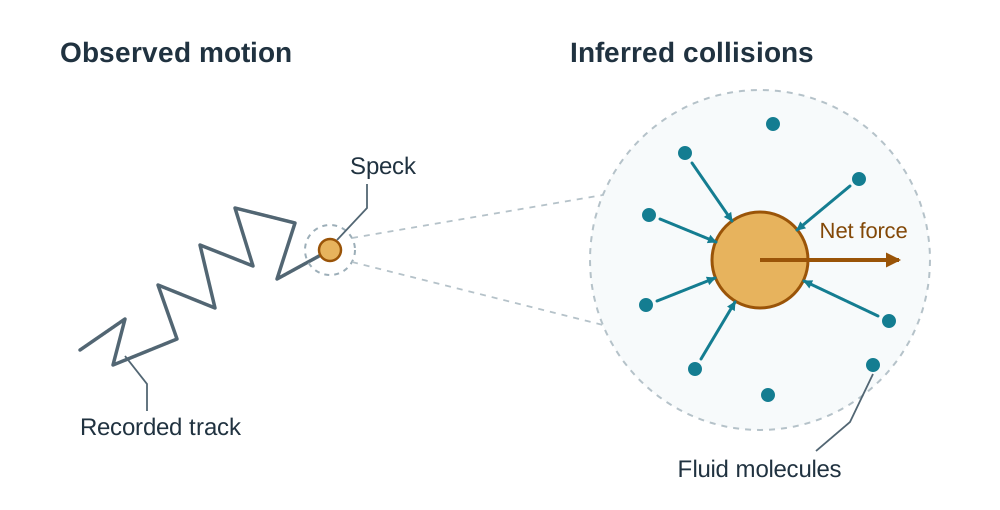
In 1827, Robert Brown observed pollen grains suspended in water under a microscope and noted that tiny microscopic specks jerked about in an erratic, zig-zag path. This phenomenon is known as Brownian motion.
A clear distinction must be made between the direct observation and the scientific inference:
- Direct Observation: Visible microscopic specks (such as pollen fragments in water or smoke particles in an illuminated smoke cell) dance in a continuous, random, zig-zag motion without any external stirring.
- Scientific Inference: The surrounding fluid consists of countless invisible molecules moving rapidly in random directions. These invisible molecules collide unevenly with the larger speck from all sides, producing a net force that nudges it first one way, then another.
Diffusion of Gases
Diffusion is the spontaneous spreading out of particles from a region of higher concentration to a region of lower concentration until they are evenly distributed, driven by their random thermal motion.
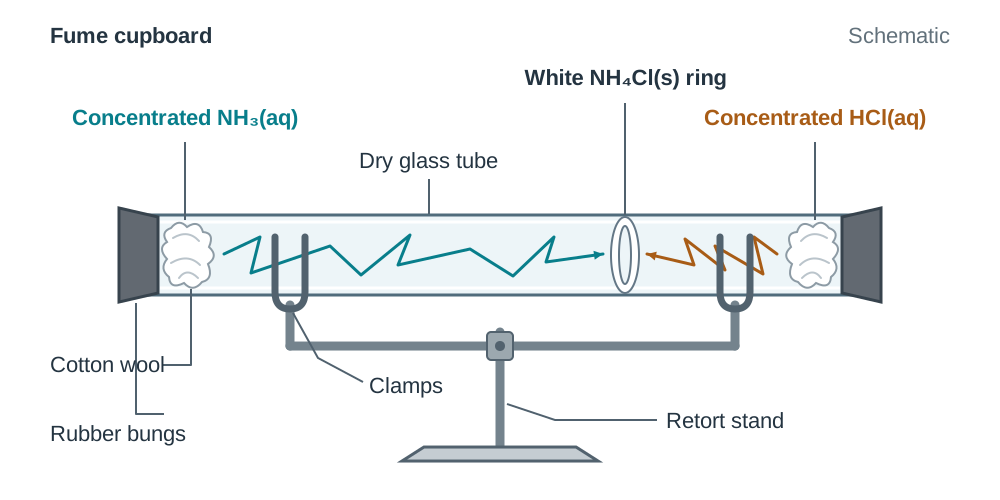
A standard demonstration uses concentrated aqueous ammonia () and concentrated hydrochloric acid () placed at opposite ends of a dry, horizontal glass tube:
Volatile ammonia gas and hydrogen chloride gas evaporate and diffuse through the air inside the tube. When they meet, they react to form a dense white ring of solid ammonium chloride.
The ring consistently forms closer to the hydrochloric acid plug. At any given temperature, all gas particles have the same average kinetic energy (). Ammonia has a lower relative molecular mass () than hydrogen chloride (). Because ammonia molecules are lighter, they move at a higher average speed and travel further along the tube in the same time. The white ring takes several minutes to form because the gas molecules repeatedly collide with air molecules, forcing them along an indirect, zig-zag path rather than a straight line.
Drawing the Diffusion Tube
When asked to draw this apparatus in an exam, include:
- A long horizontal glass tube held in clamps on a retort stand.
- A rubber bung at each end.
- A plug of cotton wool soaked in concentrated ammonia solution inside the left bung.
- A plug of cotton wool soaked in concentrated hydrochloric acid inside the right bung.
- A white ring labelled 'white ring of ammonium chloride' positioned roughly one-third of the way from the hydrochloric acid end.
- A label noting that the experiment is set up inside a fume cupboard.
3. States of Matter, State Changes, and Model Boundaries
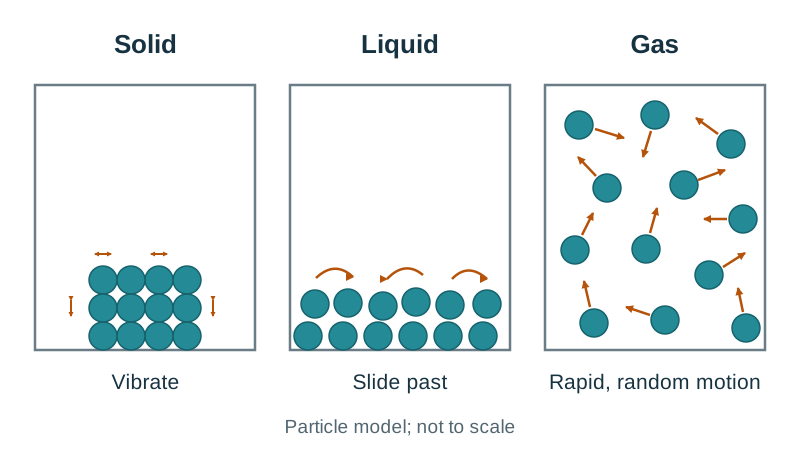
The macroscopic behaviour of solids, liquids, and gases stems directly from the arrangement, motion, and attractions of their particles:
| Property | Solid | Liquid | Gas |
|---|---|---|---|
| Arrangement | Closely packed in a regular, fixed lattice | Close together in a disordered arrangement | Widely separated with large empty spaces |
| Movement | Vibrate about fixed positions | Slide past one another randomly | Move rapidly in straight lines in random directions |
| Forces | Strong attractive forces | Moderate attractive forces | Negligible attractive forces under everyday conditions |
| Shape & Volume | Definite shape and fixed volume | Takes the shape of the container; fixed volume | Fills the container completely; no fixed shape or volume |
| Compressibility | Virtually incompressible | Incompressible for practical purposes | Highly compressible due to large spaces between particles |
State Changes and Heating Curves
State changes are physical transformations. The chemical identity of the substance does not alter; only the spacing, arrangement, and energy of the particles change.
- Melting and Freezing (Solid Liquid): Heating a solid increases the vibrational kinetic energy of its particles until they overcome fixed lattice forces. Freezing releases thermal energy to the surroundings as attractive forces lock particles back into a rigid structure.
- Vaporisation and Condensation (Liquid Gas): Evaporation happens only at the surface of the liquid, and it can happen at any temperature: the fastest-moving particles at the surface have enough energy to escape the attractions holding them in the liquid. Boiling occurs throughout the bulk liquid at a fixed temperature (the boiling point), where vapour pressure equals external atmospheric pressure.
- Sublimation and Deposition (Solid Gas): Sublimation is the direct transition from solid to gas without forming a liquid (for example, heating iodine crystals or solid carbon dioxide). Deposition is the direct conversion of vapour to solid.
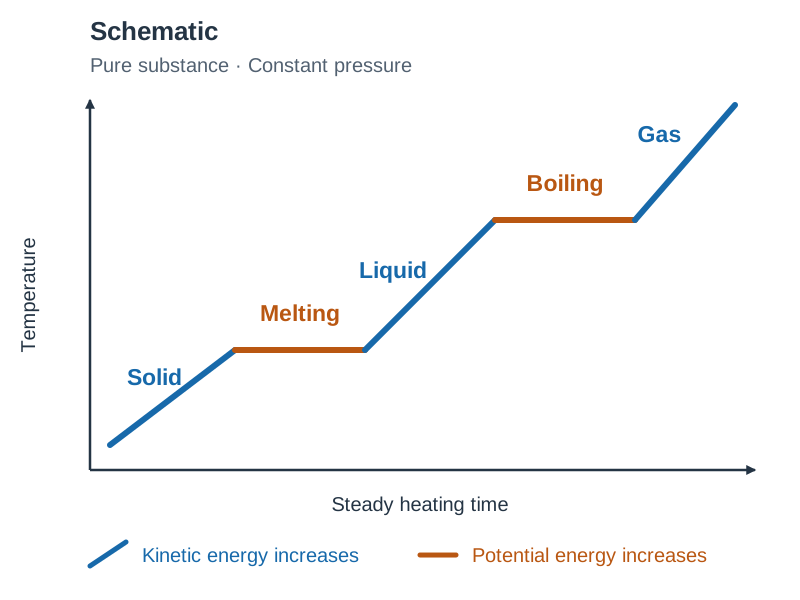
On a heating curve (temperature plotted against steady heating time), the temperature climbs during single-phase heating because the heat supplied increases the average kinetic energy of the particles. During a phase change (the flat plateaus at the melting and boiling points), the temperature remains constant. The thermal energy supplied is absorbed as latent heat to overcome intermolecular attractions (increasing particulate potential energy) rather than increasing kinetic energy.
Assumptions and Limitations of the Particle Model
The particle model assumes that particles are small, hard spheres in continuous random motion, and that their collisions transfer energy without any net loss of kinetic energy.
The model works well for gases at everyday temperatures and pressures, but it has clear limits:
- High Pressure and Low Temperature: Under high pressure, particles are squeezed together and their physical volume is no longer negligible compared to the container volume. At low temperatures, particles slow down and attractive forces pull them together, eventually causing the gas to liquefy. If intermolecular forces were truly zero, gases could never condense into liquids.
- Absence of Internal Structure: The model treats particles as identical, featureless spheres. It says nothing about whether particles are atoms, ions, or molecules, or what chemical bonds hold them together. Because of this, it cannot explain why sodium chloride melts at while ice melts at .
4. Justifying Separation Techniques
Separation techniques exploit differences in physical properties between the components of a mixture. Exam questions that ask you to 'justify' a method require a three-part structure:
- Name the technique and identify whether the mixture is homogeneous or heterogeneous.
- State the specific physical property that differs between the components.
- Explain what gets collected and where.
Model response: Justify using filtration to separate a mixture of chalk and water. 'Filtration is suitable because chalk is insoluble in water, making this a heterogeneous mixture. Chalk particles are much larger than the microscopic pores in filter paper, so they are trapped on the paper as the residue. Water molecules pass through the pores and are collected in the flask as the filtrate.'
Standard Separation Techniques
- Filtration (Heterogeneous): Separates an insoluble solid from a liquid or solution based on particle size. Larger solid particles remain on the filter paper as the residue; the liquid passes through as the filtrate.
- Decantation and Centrifugation (Heterogeneous): Decantation involves carefully pouring off a liquid layer once an insoluble solid has settled. Centrifugation spins the mixture at high speed, forcing denser solid particles to the bottom of the tube to separate them from the liquid above.
- Separating Funnel (Heterogeneous): Separates two immiscible liquids that form separate layers (such as oil and water). The method relies on differing densities and immiscibility. The denser liquid forms the bottom layer and is run off through the stopcock at the base, leaving the less dense layer in the funnel.
- Evaporation / Crystallisation (Homogeneous): Separates a non-volatile dissolved solid solute from a liquid solvent based on volatility and boiling point. The solvent evaporates when heated, leaving the solute behind. Slow cooling of a concentrated solution yields well-formed crystals.
- Simple Distillation (Homogeneous): Recovers a volatile liquid solvent from a non-volatile solute, or separates two miscible liquids whose boiling points are well apart (as a rough guide, a difference of about or more). The component with the lower boiling point boils first; its vapour enters a water-cooled Liebig condenser, condenses back to a liquid, and is collected as the distillate.
- Fractional Distillation (Homogeneous): Separates miscible liquids with close boiling points (such as ethanol at and water at ). The fractionating column contains glass beads that provide a large surface area for repeated vaporisation and condensation cycles. The ascending vapour becomes richer in the more volatile component, which distils over first.
- Solvent Extraction (Homogeneous or Heterogeneous): Used to remove a dissolved solute from one solvent by shaking it with a second solvent that is immiscible with the first. The solute must be much more soluble in the second solvent. For example, iodine dissolved in water can be shaken with cyclohexane in a separating funnel. The iodine moves into the upper cyclohexane layer, turning it purple. Invert the funnel and open the tap regularly while shaking to release built-up vapour pressure, then run the two layers off separately.
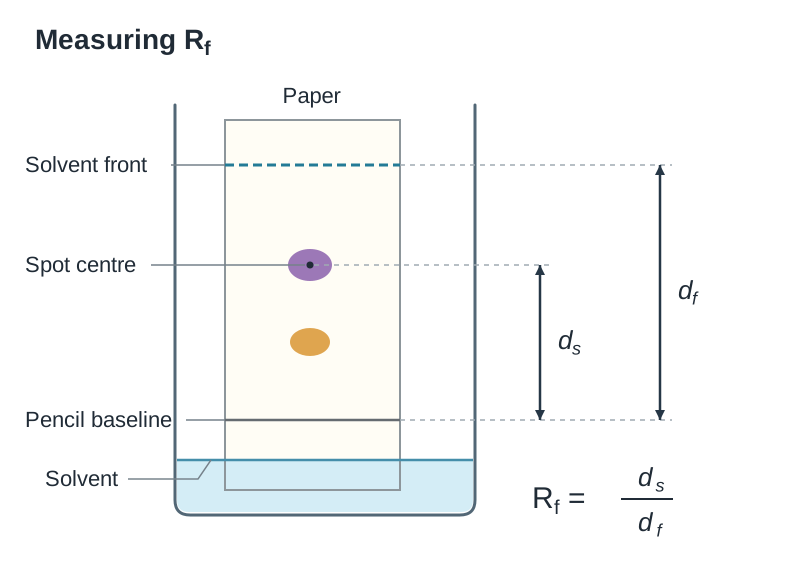
- Paper Chromatography (Homogeneous): Separates mixtures of soluble substances (such as ink dyes) based on their differing affinities for a stationary phase (paper) and a mobile phase (solvent). Components that are more soluble in the solvent and less strongly adsorbed to the paper travel further.
The Value in Chromatography
The retardation factor () quantifies how far a substance travels:
Both distances are measured from the starting baseline. has no units and is always between and .
Always draw the baseline in pencil, because pen ink would dissolve in the solvent and interfere with the chromatogram. Ensure the solvent level sits below the pencil baseline so the spots do not wash off directly into the solvent pool.
5. Physical vs Chemical Properties, Changes, and Conservation Laws
Chemists distinguish between properties of matter and changes in matter:
Physical and Chemical Properties
- Physical property: a characteristic you can measure or observe without altering the chemical identity of the substance. Examples include melting point, boiling point, density, colour, solubility, electrical conductivity, and state of matter.
- Chemical property: describes how a substance reacts to form new substances. Examples include flammability, reactivity with dilute acid, corrosion resistance, and thermal decomposition.
For example, magnesium is a shiny grey metal that conducts electricity and melts at (physical properties). It burns in oxygen with a bright white flame to form magnesium oxide, and it reacts with dilute hydrochloric acid to release hydrogen gas (chemical properties). You can measure its melting point and still have magnesium at the end, but you cannot test its flammability without chemically altering it.
Physical vs Chemical Change
- Physical change: alters physical state, shape, or particle arrangement without forming any new chemical substance. No bonds within molecules or formula units are broken or made. Examples: melting ice, dissolving sugar in water, shredding paper, or condensing steam. Physical changes are usually straightforward to reverse.
- Chemical change (chemical reaction): breaks bonds in reactant substances and forms new bonds, rearranging atoms to produce one or more new substances with different properties. Chemical change is often accompanied by signs such as a temperature change, a permanent colour change, gas bubbles, or a precipitate—but none of these on its own proves a chemical change. The only reliable test is: has a new substance with different properties been formed?
The Governing Conservation Laws
- Law of Conservation of Mass: in any chemical reaction or physical change, matter is neither created nor destroyed. The total mass of the products equals the total mass of the reactants:
- Law of Conservation of Energy: energy cannot be created or destroyed; it can only be transformed from one form to another or transferred between a system and its surroundings.
In an exothermic reaction (such as neutralisation), the products store less chemical potential energy than the reactants; the difference is transferred to the surroundings as heat, raising the temperature of the solution and glassware. In an endothermic process (such as dissolving ammonium chloride), energy is absorbed from the surroundings, cooling the solution. Physical changes obey conservation of energy too: the heat supplied during melting is stored as increased potential energy in the separated particles, and that exact amount of energy is released again when the liquid freezes. In exams, describe where energy went (e.g. 'transferred to the surroundings as heat'), and never say energy was 'lost' or 'used up'.
Conservation of Mass Calculations
Because mass is conserved, any apparent change in mass during an experiment must be due to a substance entering or leaving the container:
Worked Example 1 (Mass lost as gas): of calcium carbonate chips are added to excess dilute hydrochloric acid in an open conical flask on a balance. The total mass of the flask and contents drops from to .
Mass was not destroyed: of carbon dioxide escaped into the air. If the flask had been sealed, the balance reading would have remained constant.
Worked Example 2 (Mass gained from air): of magnesium ribbon is heated in an open crucible until completely converted to magnesium oxide (). The final mass of solid is .
The extra mass came from oxygen gas in the air combining with the magnesium.
6. Experimental Investigation: Verifying Conservation of Mass
Outcome 1.1.5 is marked EI, meaning it is achieved mainly through experimental work: you are expected to carry this investigation out yourself and gather your own primary data. Written examination questions can present you with apparatus, data, or an account of this kind of investigation and ask you to analyse it, so learn the reasoning rather than memorising one procedure. This laboratory work is separate from the Chemistry in Practice Investigation, which is the 40% component based on the annual brief published by the SEC.
The Core Question and Apparatus Design
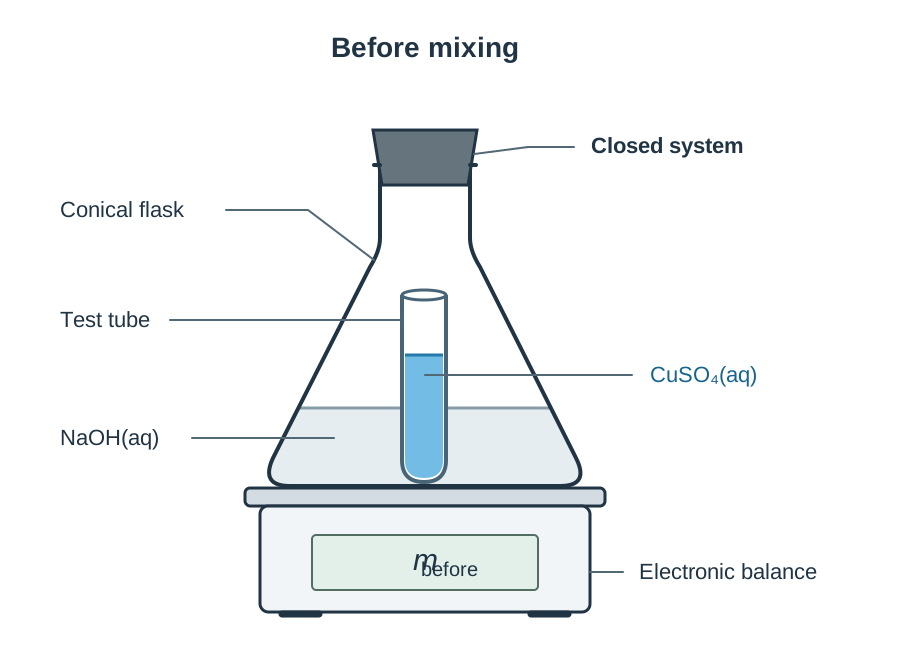
If atoms are merely rearranged in a reaction, the total mass should remain strictly constant. To test this on a balance, the reaction must occur in a closed system—a sealed vessel that prevents any matter from entering or escaping.
Apparatus
Draw and label the closed-system apparatus as:
- An electronic balance (drawn as a box with a digital mass display).
- A conical flask resting on the balance.
- A small test tube standing upright inside the conical flask containing copper(II) sulfate solution.
- Sodium hydroxide solution in the bottom of the flask, unmixed with the test tube liquid.
- A rubber stopper firmly inserted in the neck of the flask, labelled 'stopper—closed system, nothing can enter or leave'.
Method (Precipitation Reaction)
- Measure of sodium hydroxide solution into the conical flask.
- Place of copper(II) sulfate solution into a small test tube.
- Using forceps, carefully lower the test tube upright into the flask so the solutions do not mix.
- Firmly insert the rubber stopper. Ensure the outside of the flask is clean and dry.
- Place the sealed flask on the balance and record the initial mass () to two decimal places.
- Remove the flask and tip it gently to mix the solutions. Observe the pale blue precipitate of copper(II) hydroxide, confirming a chemical change.
- Place the sealed flask back on the balance and record the final mass ().
- Do not pour the copper residues down the sink. Put the precipitate and the solution into the labelled heavy-metal waste container.
Results and Analysis
Work out the mass change for each trial:
| Trial | Initial Mass / g | Final Mass / g | Mass Change / g |
|---|---|---|---|
| 1 | 142.36 | 142.35 | |
| 2 | 142.31 | 142.31 | |
| 3 | 142.40 | 142.39 |
For a balance with an uncertainty of , the combined uncertainty of two weighings is . Because the recorded values of ( and ) fall within instrument uncertainty bounds, the primary data verify that mass is conserved.
Explaining It with a Particle Model
Chemical reactions involve breaking existing bonds and rearranging atoms into new configurations. Counting the atoms on both sides of the balanced equation shows:
- Reactants:
- Products:
Every atom present in the reactants is accounted for in the products. Because atoms retain their individual masses, the total mass must remain constant.
Second Trial: A Reaction That Makes a Gas
To show that the law holds even when a reaction produces a gas, compare open and closed systems:
- Open beaker: Weigh hydrochloric acid in a beaker with a weighing boat of marble chips. Add the chips. The balance reading falls as carbon dioxide escapes.
- Closed flask: Place marble chips in a small tube inside a stoppered flask containing acid. Weigh, tip to mix, and reweigh. The balance reading remains unchanged within balance tolerance.
Mass is conserved in both trials. The apparent mass loss in the open beaker is simply due to gas escaping from the balance pan into the room.
Sources of Error
- Flask exterior: Moisture or fingerprints on the glass can evaporate between weighings, causing random mass variations. Always wipe the flask dry.
- Sealing with a balloon: If you seal a gas-producing reaction with a balloon, the balance reading may fall slightly as the balloon inflates. This is not lost matter: the inflated balloon displaces more air, and the upthrust from that displaced air reduces the reading on the balance pan. A rigid stoppered flask avoids this problem.
Key terms
- Pure Substance
- A single type of matter with a fixed, definite composition and constant physical and chemical properties.
- Element
- A substance that cannot be broken down into simpler substances by chemical means (containing only one type of atom).
- Compound
- A substance composed of two or more different elements chemically combined in fixed, definite proportions.
- Mixture
- Two or more substances mingled together but not chemically combined, present in variable proportions.
- Homogeneous Mixture
- A mixture possessing a uniform composition and appearance throughout, with no visible phase boundaries.
- Heterogeneous Mixture
- A mixture that lacks a uniform composition and consists of two or more distinct phases separated by visible boundaries.
- Kinetic Theory of Matter
- The model stating that all matter consists of tiny particles in constant, random motion, whose average kinetic energy is directly proportional to absolute temperature in kelvin.
- Brownian Motion
- The continuous, erratic, zig-zag motion of visible microscopic particles suspended in a fluid, caused by uneven collisions with invisible, moving fluid molecules.
- Diffusion
- The spontaneous spreading out of particles from a region of higher concentration to a region of lower concentration until uniformly distributed, driven by random thermal motion.
- Physical Property
- A characteristic of a substance that can be observed or measured without altering its chemical identity.
- Chemical Property
- A characteristic describing how a substance reacts to form new substances.
- Physical Change
- A transformation altering physical state, shape, or particle arrangement without forming any new chemical substances.
- Chemical Change
- A process involving the rearrangement of atoms through bond breaking and bond making, producing one or more new substances with different properties.
- Law of Conservation of Mass
- The principle stating that matter is neither created nor destroyed during a chemical reaction or physical change; total reactant mass equals total product mass.
- Law of Conservation of Energy
- The principle stating that energy cannot be created or destroyed; it can only be transformed from one form to another or transferred between a system and its surroundings.
- Closed System
- A physical system completely sealed so that no matter can enter or leave, though energy may be transferred across the boundary.
- Primary Data
- First-hand quantitative measurements and qualitative observations collected directly by a student or investigative group during laboratory work.
- Secondary Data
- Data collected by someone else and accessed through books, databases, research papers, or shared results from another class group.
- Miscible Liquids
- Liquids that dissolve completely in one another in all proportions to form a single, homogeneous liquid phase.
- Immiscible Liquids
- Liquids that do not dissolve in one another to any significant extent and form separate, distinct layers.
- Retardation Factor (Rf)
- The ratio of the distance travelled by a solute spot to the distance travelled by the solvent front, measured from the pencil baseline.
Check yourself
Define an element.
An element is a substance that cannot be broken down into simpler substances by chemical means (and contains only one type of atom).
Classify each of the following as a physical or a chemical property: density, reactivity with dilute acid, boiling point, flammability.
Density: physical property; Reactivity with dilute acid: chemical property; Boiling point: physical property; Flammability: chemical property.
Why does the white cloud of ammonium chloride form closer to the hydrochloric acid plug in the gas diffusion demonstration?
Ammonia molecules have a lower relative molecular mass (Mr = 17) than hydrogen chloride molecules (Mr = 36.5). At the same temperature, lighter molecules have a higher average velocity and diffuse faster.
Why does the temperature of pure water remain constant at 100 °C while boiling at atmospheric pressure?
Thermal energy absorbed during boiling is used to overcome intermolecular attractive forces (increasing particulate potential energy) rather than increasing average kinetic energy. Because temperature measures average kinetic energy, it remains constant.
Which separation technique would you justify using to separate kerosene from water, and why?
A separating funnel, because kerosene and water are immiscible liquids with different densities that form two separate layers, allowing the denser bottom layer to be tapped off.
3.20 g of copper is heated in air until fully converted to copper(II) oxide; the final mass is 4.00 g. What mass of oxygen combined with the copper, and why did the mass increase in an open crucible?
Mass of oxygen = 4.00 g − 3.20 g = 0.80 g. The mass increased because oxygen gas from the air chemically combined with the solid copper to form solid copper(II) oxide. Total mass, taking the oxygen into account, remained strictly conserved.