

Organisational planning is the systematic process of setting corporate objectives, evaluating internal and external drivers of change, and allocating resources to achieve long-term commercial goals while safeguarding operational continuity. In Senior Cycle Business, this topic examines why enterprises experience change, the reasons employees and other stakeholders resist transition, and the practical methods used to foster innovation and intrapreneurship. It covers core planning instruments including continuous strategic roadmaps, Kurt Lewin's force-field analysis, contingency planning, and crisis management, while developing the analytical skills needed to evaluate business decisions reported in contemporary media.
Drivers of Organisational Change and Cross-Cutting Pressures
Every enterprise operates in a dynamic business environment where standing still leads to commercial failure. Organisational change refers to any structural, operational, technological, or strategic alteration in how an enterprise conducts its activities. A real-world Irish example is Bank of Ireland closing over one hundred physical branches and redeploying staff towards digital and remote customer care. Change originates from two distinct environments.
Internal Drivers of Change
Internal drivers arise from strategic decisions made within the enterprise, giving management substantial control over their scope and timing:
- Leadership and vision: A newly appointed Chief Executive Officer or board of directors often shifts company direction, such as expanding direct-to-consumer digital channels.
- Restructuring and delayering: Delayering removes intermediate layers of management to flatten the organisational structure. This cuts wage overheads, speeds up internal communication, and shortens chains of command.
- Expansion and scaling: Entering international export markets or acquiring a rival requires an overhaul of production capacity, logistics, and workforce requirements.
- Financial performance: Falling profit margins, cash-flow deficits, or declining return on capital employed compel management to cut costs, renegotiate supplier contracts, or discontinue unprofitable lines.
- Human resource policies: Adopting blended working arrangements or updated employment contracts changes day-to-day work patterns.
External Drivers of Change
External drivers emerge from outside the direct control of the firm, meaning the enterprise must adapt to remain competitive. These forces are evaluated through STEEPLE factors:
- Technological developments: Advances such as cloud logistics, machine learning, and automated payment gateways render legacy operational models obsolete.
- Economic conditions: Movements in European Central Bank interest rates, domestic inflation rates, and consumer disposable income alter borrowing costs and demand.
- Social and demographic trends: An ageing population and shifting employee expectations regarding work-life balance influence hiring and product design.
- Environmental and sustainability pressures: Mandatory corporate reporting under ESG (environmental, social, and governance) criteria, packaging waste directives, and emissions reduction targets compel businesses to green their supply chains.
- Political and legal obligations: Statutory minimum wage adjustments, consumer rights statutes, and workplace safety rules require mandatory compliance.
The Impact of Cross-Cutting Themes on Change
Digital transformation remains a major disruptive driver. Digitalisation, artificial intelligence, and big data reshape operational routines, customer purchasing journeys, and executive decision-making. This disruption can be positive, offering operational efficiencies and richer analytics, or negative, creating cyber-security vulnerabilities and making specific staff skills obsolete.
Ethics and sustainability dictate how change is carried out. Announcing sudden redundancies without warning or genuine consultation damages morale and breaches trust. Ethical leadership prioritises transparent dialogue, redeployment, and reskilling programmes. Similarly, environmental sustainability requires proactive planning to reduce resource waste and ensure circular production models.
Resistance to Change and Fostering Innovation
Even positive commercial initiatives provoke pushback. Employees and managers establish routines, social bonds, and professional competence around familiar systems, making alterations stressful.
Why Resistance Occurs
Resistance is not merely stubbornness. It arises from well-documented human and structural anxieties:
- Parochial self-interest: Individuals oppose change when they fear losing something they personally value, such as job security, overtime earnings, workplace status, or professional autonomy.
- Misunderstanding and lack of trust: When leadership fails to communicate openly, staff suspect hidden agendas, such as unannounced job losses or covert pay cuts.
- Low tolerance for change: Staff resist when they feel overwhelmed by new routines or fear they lack the technical competence to operate upgraded software or equipment.
- Different assessments of the situation: Experienced employees may agree that a problem exists, but genuinely believe that management's proposed solution is flawed, ill-timed, or counterproductive.
- Everyday workplace causes: Fear of the unknown, extra workload during transitional phases, poor past experiences with mishandled change, and operational complacency ('we have always done it this way').
Resistance can also come from external stakeholders: trade unions may dispute working conditions, shareholders may resist costly capital outlays that depress short-term dividends, customers may push back against discontinued product lines or mandatory digital checkouts, and the local community may oppose site redevelopments on environmental grounds.
Management Styles: Controller versus Facilitator
The approach a manager adopts dictates how smoothly change occurs:
- A controller manager retains absolute authority, makes decisions autocratically, supervises closely, and relies on downward instructions. While this style enforces quick compliance in immediate emergencies, it demotivates employees and magnifies workplace resistance.
- A facilitator manager adopts a consultative, democratic approach, delegating authority, providing coaching, and treating errors in trials as constructive learning. Staff who help shape the transition take ownership of it, reducing resistance and improving intrapreneurship.
Approaches to Overcoming Resistance
Effective leaders match their strategy to the underlying cause of resistance:
| Cause of Resistance | Management Strategy | Practical Application | How to Write It |
|---|---|---|---|
| Misunderstanding / lack of trust | Clear two-way communication | Management hosts depot briefings and town halls before rolling out changes. | State: Two-way communication. Explain: Informs staff and dispels rumours. Apply: Liam holds team briefings on the factory floor to clarify that automation will not cause redundancies. Evaluate: Highly effective at rebuilding trust, though time-consuming. |
| Low tolerance / technical fear | Targeted training and support | Providing hands-on coaching and practical workshops to build employee confidence. | State: Practical training. Explain: Develops operational competence. Apply: Frontline staff receive paid supplier workshops to master digital touchscreens. Evaluate: Removes the root cause of anxiety and improves long-term productivity. |
| Different assessment of situation | Consultation and participation | Giving staff a voice in project design, such as asking delivery drivers to test route-planning software. | State: Employee consultation. Explain: Builds shared ownership. Apply: Supervisors help test automated packing lines. Evaluate: Improves the final workflow, though it requires patience. |
| Parochial self-interest | Negotiation and incentives | Management offers written agreements against compulsory redundancies or introduces productivity bonuses. | State: Formal negotiation. Explain: Replaces lost benefits. Apply: Trade union secures redeployment agreements. Evaluate: Calms immediate fears, but can increase transition costs. |
| Structural inertia / anxiety | Phased introduction and pilots | Rolling out the initiative in a single branch or production line before enterprise-wide adoption. | State: Phased rollout. Explain: Demonstrates feasibility. Apply: Hotel tests cashless payment in one restaurant first. Evaluate: Minimises operational disruption and proves the concept works. |
Forcing change through by order (coercion) should be an absolute last resort: it damages morale, destroys trust, and can trigger industrial action.
Practices that Promote Innovation and Intrapreneurship
Innovation is the process of translating a novel concept into a viable product, service, or operational method that creates commercial value. While entrepreneurship involves launching a new commercial venture and bearing personal financial risk, intrapreneurship refers to employees using that same enterprise mindset within an established company without risking their own capital.
Organisations promote innovation and intrapreneurial thinking through specific structural practices:
- Research and development (R&D): Investing dedicated capital and assigning specialist teams to pioneer new products and modernise processes.
- Time and resources for personal projects: Granting employees paid work time and a ring-fenced budget to explore independent commercial ideas, similar to Google's famous policy of allowing engineers time for side projects.
- Employee suggestion schemes with tangible rewards: Establishing formal digital portals where workers submit cost-saving or revenue-generating ideas and receive a percentage of the savings or profit gained.
- Cross-functional teams and brainstorming: Bringing staff together from design, marketing, and operations into quality circles to solve operational challenges collectively.
- Training in creative methodologies: Upskilling employees in design thinking (a user-centred, non-linear problem-solving process that focuses on practical solutions for the end user).
- Open, flat corporate culture: Removing bureaucratic layers so creative ideas reach decision-makers quickly, and treating failed trials as valuable learning rather than punishable mistakes.
- External collaboration and market scanning: Partnering with third-level institutions, engaging customer focus groups, and analysing industry data to identify unmet market demand. An Post demonstrated this by innovating its parcel delivery infrastructure and financial services portfolio to offset falling letter mail volumes.
Strategic Planning as an Ongoing Process
A strategic plan is a comprehensive, long-term operational roadmap (typically spanning three to five years) formulated by senior management and the board of directors. It translates the firm's overarching mission statement into measurable corporate targets, such as market share growth, profit objectives, and capital investment schedules.
Planning operates down an established organisational hierarchy:
Strategic Plan (3 to 5 Years, Senior Management: Corporate Vision & Capital Allocations)
       ↓
Tactical Plans (1 to 2 Years, Middle Management: Departmental Goals & Budgets)
       ↓
Operational Plans (Daily to Weekly, Frontline Supervisors: Shift Rotas & Quality Targets)
The Importance of Planning for Change
Planning for change is vital because:
- It reduces employee resistance by opening communication, consulting staff, and scheduling training well before new systems go live.
- It guarantees that essential resources—finance, machinery, IT infrastructure, and replacement labour—are in place before rollout begins.
- It establishes clear timeframes and accountability, assigning specific roles to named managers so projects do not stall.
- It identifies operational hazards in advance, enabling the business to prepare backup measures rather than improvising under pressure.
- It protects operational efficiency and customer satisfaction, preventing service drops that damage brand equity.
- It secures competitive advantage by allowing the firm to adapt to legislative shifts or technological advances faster than market rivals.
Why Strategic Planning Must Be Continuous
A strategic plan is not a once-off document that is written and then left in a drawer. Senior management must review it, measure actual performance against its targets, and update it as the business environment changes. Consumer expectations, digital technology, competitor strategies, and interest rates shift constantly. Maintaining an ongoing strategic review process—supported by regular environmental scanning such as SWOT analysis—allows leaders to reallocate capital and adjust operational tactics before small deviations escalate into serious financial losses.
Core Benefits of Strategic Planning
When asked to explain the benefits of strategic planning, use the ECDC memory hook, while being ready to discuss two further rewarded advantages:
- Empowerment: Because long-term targets are clear, managers can delegate day-to-day decisions to departments and teams with confidence that they are pulling in the right direction. Staff who make their own operational decisions are better motivated.
- Clear direction: Senior management directs capital expenditure, staffing, and marketing budgets towards high-priority commercial milestones, aligning every department behind a shared vision.
- Decision-making: Leaders make proactive, evidence-based choices based on market research and performance analytics instead of making hasty decisions under competitive pressure.
- Communication: Articulating long-term objectives across internal newsletters, team briefings, and intranet portals builds transparent relationships between management and employees, which reduces friction during change.
- Helps raise finance: Commercial banks, venture capital funds, and state agencies such as Enterprise Ireland refuse to commit significant funding without a detailed strategic business plan displaying multi-year cash flow forecasts, operational roadmaps, and repayment viability.
- Acts as an operational control mechanism: Strategic targets serve as benchmarks against which actual performance is measured. Variances between planned targets and actual results alert management to underperformance early, triggering corrective interventions.
Force-Field Analysis in Strategic Decisions
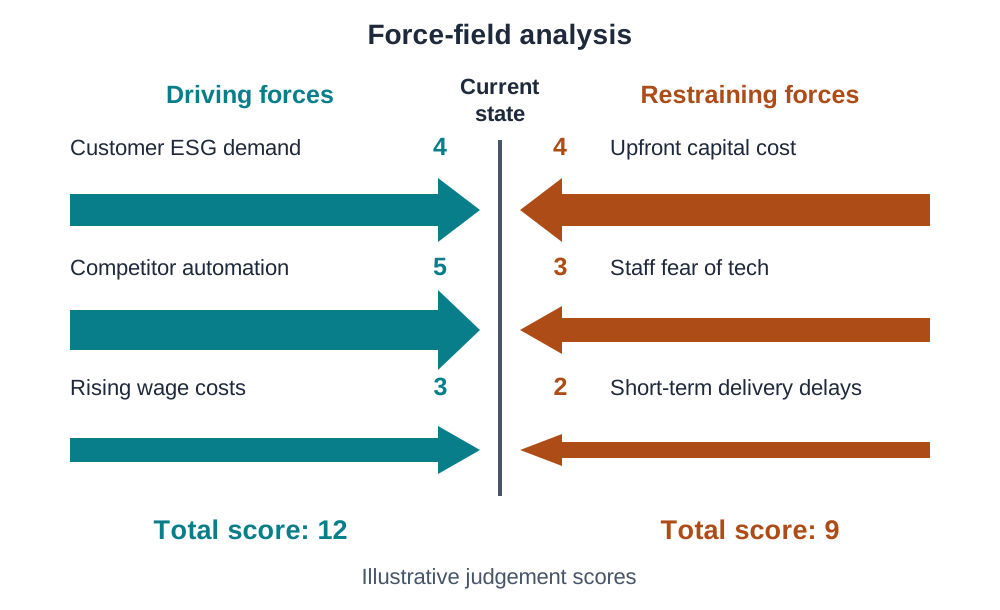
Kurt Lewin's force-field analysis is defined as an approach used to identify and analyse forces which drive and inhibit change. Forces can be both internal and external. Lewin viewed any business situation as a state of equilibrium between competing pressures:
- Driving forces: Factors that push the organisation toward adopting a proposed change (e.g. rising operational costs, competitor automation, customer demand for digital services).
- Restraining forces: Obstacles, anxieties, resource deficits, or regulatory constraints that inhibit, resist, or block the change (e.g. staff technophobia, trade union pushback, capital shortages).
Systematic Six-Step Procedure
- Define the change proposal: State the planned transition clearly (e.g. converting a hotel to a cashless, mobile check-in model).
- Identify driving forces: Brainstorm all internal and external factors supporting the change.
- Identify restraining forces: Brainstorm all internal and external factors opposing or obstructing the change.
- Assign relative weightings: Allocate a numeric value (1 to 5) to each force according to its perceived influence, urgency, and scale.
- Develop an action plan: Construct targeted management measures to systematically weaken the restraining forces while reinforcing driving forces.
- Evaluate viability: Recalculate the totals. If restraining forces still dominate, management must modify, pause, or abandon the proposal rather than forcing implementation.
Contingency Planning and Crisis Management
Contingency planning is the advance preparation of alternative operational procedures, backup resources, and communication systems to handle unexpected disruptions or crises. It is proactive preparation completed before an emergency strikes. Crisis management, by contrast, is the reactive coordination and operational execution carried out when a disruption occurs to safeguard human life, protect assets, and restore business operations.
Crises range from local incidents (a warehouse fire, machine breakdown, or sudden supplier insolvency) to national emergencies. In January 2024, Storm Isha brought destructive gale-force winds that cut electrical power to hundreds of thousands of Irish homes and commercial premises, shutting down businesses lacking standby power. Similarly, the May 2021 cyberattack on the Health Service Executive (HSE) demonstrated how ransomware can paralyse an entire public healthcare IT network for months.
What a Contingency Plan Contains
A standard corporate contingency plan includes:
- A formal risk assessment register categorising operational vulnerabilities.
- Specific alternative operational procedures for each identified threat.
- A designated crisis response team with clear decision-making authority.
- Emergency contact details for staff, suppliers, utility services, and insurers.
- Off-site digital backup and IT data-restoration protocols.
- Comprehensive insurance policy schedules (business interruption, public liability, cyber-risk).
- Site evacuation plans and dedicated emergency assembly procedures.
- A schedule for routine testing, staff drills, and annual updates.
Five Steps of Effective Crisis Management
When an emergency occurs, leaders must execute a disciplined five-step response:
- Protect life and safety first: Immediately evacuate facilities, account for all employees and visitors, and contact emergency services.
- Activate the contingency plan and crisis team: The designated crisis leader takes charge, assembling team members who execute assigned duties.
- Communicate quickly and honestly: Direct all statements through a single corporate spokesperson. Acknowledge verified facts, refrain from speculation, and outline the corrective steps underway. Silence or evasive messaging inflicts severe reputational damage.
- Take corrective operational action: Switch to backup power generators, transfer computing to cloud mirrors, reroute supplies to secondary vendors, or issue a formal product recall (such as notifying the Competition and Consumer Protection Commission (CCPC) and Food Safety Authority of Ireland (FSAI) when product contamination is uncovered).
- Review and learn: Once operations stabilise, investigate the root cause of the crisis, amend operational procedures, update the contingency plan, and provide remedial staff training.
Factors to Consider When Developing a Contingency Plan
Three factors are named in the course—cost, time, and risk—and an exam answer should always deal with these first. A full answer then explores further vital factors:
- Risk assessment (Likelihood vs Impact): Management identifies potential operational threats and rates them based on probability and severity using a risk matrix (likelihood × impact). High-impact emergencies, such as total system outages, demand detailed contingency plans even if their likelihood is low.
- Cost and financial resources: Management balances the expense of preventative safeguards (standby generators, cloud storage, retainers for alternate transport fleets) against the financial losses of operational downtime. Smaller firms must prioritise spending on life-or-death operational assets.
- Time and response speed: The plan defines recovery time objectives, establishing how rapidly backup systems must be functional. A refrigerated distribution warehouse must restore chillers within hours, whereas an office consultancy might have two days.
- People and assigned responsibilities: The plan must assign clear duties to a crisis team, designate an official spokesperson, and appoint deputies for all critical roles.
- Standby resources: Securing alternative premises, secondary suppliers, emergency equipment, and cloud-hosted data mirrors.
- Legal and insurance obligations: Complying with statutory workplace safety duties, fire codes, GDPR data-breach notification deadlines (within 72 hours), and maintaining adequate business interruption insurance.
- Communication channels: Establishing reliable channels to contact employees, suppliers, regulatory bodies, and customers during system shutdowns.
- Testing and review: Running regular fire drills, simulated tabletop crises, and digital restore tests to ensure protocols work when an emergency occurs.
- Stakeholders affected: Prioritising the safety of employees and visitors first, followed by safeguarding client data and maintaining supplier relationships.
Applying the Risk Matrix to Budget Decisions
Consider Tús Tech Ltd, which has a €10,000 contingency budget to allocate across three competing operational hazards:
- Severe power failure: Likelihood (3) × Impact (4) = Priority Score 12
- Total ransomware lockout: Likelihood (2) × Impact (5) = Priority Score 10
- Temporary water supply disruption: Likelihood (3) × Impact (2) = Priority Score 6
Where should the money go first, and why? The €10,000 budget must prioritise the power failure first because it carries the highest risk rating (12), justifying expenditure on an uninterruptible power supply (UPS) and emergency generator. The remaining funds should support cybersecurity patching and automated cloud backups to mitigate the catastrophic impact of ransomware (10). The water disruption scores lowest (6) and requires no heavy capital investment; it can be managed through simple operational agreements with an adjacent premises.
Applying Planning Concepts to Business News and Media
Senior Cycle Business requires students to examine contemporary news reports through the lens of leadership, planning, and organisational change (Strand 3, Sub-strand 5). High-scoring exam answers go beyond summarising headlines to deliver reasoned evaluations of leadership choices.
Step-by-Step Media Analysis Method
- Identify the core event: Determine whether the report concerns long-term strategic restructuring, technological disruption, an industrial dispute, or an unexpected external crisis.
- Distinguish internal from external drivers: Identify external pressures (such as changes in EU regulations, rising interest rates, or competitor moves) and separate them from the firm's internal choices (such as delayering or entering e-commerce).
- Evaluate leadership and resistance: Identify which stakeholders are resisting and classify their concerns (e.g. trade unions disputing job security or customers resisting digital checkouts). Assess whether managers acted as autocrats or facilitators.
- Assess contingency preparedness: Look for evidence indicating whether leadership anticipated the disruption with tested backup procedures or was caught unprepared.
- Formulate a reasoned personal perspective: State a clear personal judgement supported by business logic. Evaluate trade-offs (such as short-term financial savings versus long-term brand damage) and identify any gaps in the published reporting.
Model Media Response: Bank Branch Closures
- Core event: Planned strategic restructuring driven by technological change.
- External drivers: Widespread adoption of smartphone banking apps, digital-only fintech rivals, and overhead cost pressures.
- Internal response: Closing physical branches, delayering administrative roles, and redirecting capital expenditure into mobile app development.
- Stakeholder resistance: Staff and trade unions feared compulsory redundancies (parochial self-interest); elderly and rural customers worried about losing access to services and struggling with digital apps (low tolerance for change); local business communities objected to losing cash-handling facilities.
- Informed perspective: The transition to digital platforms is strategically essential for commercial survival given consumer banking habits. However, executive leadership handled the restraining forces poorly. A phased transition featuring dedicated digital training kiosks within remaining hubs, combined with redeployment agreements negotiated early with trade unions, would have secured the desired cost efficiencies while preserving community goodwill.
- Information gap / limitation: The news report omits precise redundancy figures and actual operational cost savings, limiting full financial evaluation.
Key terms
- Strategic Planning
- An ongoing, long-term planning process (typically covering three to five years) led by senior management to set overall corporate objectives, allocate resources, and achieve the firm's mission.
- Organisational Change
- Any alteration in an enterprise's structure, working practices, operational processes, technology, or strategy, prompted by internal initiatives or external environmental pressures.
- Force-Field Analysis
- An approach used to identify and analyse forces which drive and inhibit change. Forces can be both internal and external.
- Driving Forces
- Internal or external factors that support and push an organisation toward adopting a proposed change or strategic goal.
- Restraining Forces
- Internal or external obstacles, fears, costs, or restrictions that resist, hinder, or block the successful adoption of organisational change.
- Contingency Planning
- The advance preparation of backup procedures, alternative resources, and emergency protocols to handle unexpected disruptions or crises.
- Crisis Management
- The practical coordination and execution of decisions, emergency protocols, and communication channels to respond to an active disruption and restore operations.
- Parochial Self-Interest
- Resistance to change triggered when employees fear losing something personally valuable, such as income, job security, workplace status, or established working habits.
- Intrapreneurship
- When employees think and act like entrepreneurs within an existing business, using corporate resources to develop new products, services, or efficiencies without bearing personal financial risk.
- Facilitator Manager
- A collaborative leadership style where the manager consults employees, provides training, empowers independent problem-solving, and guides staff through transitions.
- Controller Manager
- An autocratic leadership style where the manager retains full authority, issues directives, supervises closely, and demands strict compliance with little consultation.
- Delayering
- The removal of one or more intermediate management tiers from an organisation's hierarchy to flatten the structure, cut overhead costs, and speed up communication.
- Change Management
- The structured approach an organisation uses to transition individuals, teams, and business units from a current state to a desired future operational state.
- Risk Assessment
- The systematic evaluation of potential threats by measuring the likelihood of their occurrence against the severity of their operational and financial impact.
Check yourself
A competitor launches an automated mobile shopping app, and an Irish retailer responds by retraining staff to manage online orders. Which change is external and which is internal?
The competitor's app launch is an external technological change in the market. The retailer's decision to retrain staff is an internal operational response.
What four root causes of employee resistance were identified by Kotter and Schlesinger?
Parochial self-interest, misunderstanding and lack of trust, low tolerance for change, and different assessments of the situation.
What do the letters of the ECDC mnemonic stand for when explaining the benefits of strategic planning, and what two other benefits should you know?
ECDC stands for Empowerment, Clear direction, Decision-making, and Communication. Two additional benefits are that it helps the business raise finance and serves as an operational control tool to measure actual results against targets.
According to the official syllabus definition, what is a force-field analysis?
An approach used to identify and analyse forces which drive and inhibit change. Forces can be both internal and external.
In a force-field analysis, the total driving score is 8 and the total restraining score is 12. What should management do?
The proposal should not proceed in its current form. Management must first implement measures to weaken the restraining forces (e.g. through training, consultation, or negotiation) or modify the plan before continuing.
Which three factors are specifically named in the course as needing to be considered in a contingency plan, and name two others you could add?
Cost, time, and risk; plus other factors such as people and responsibilities (the crisis team), legal and insurance duties, communication channels, or testing and reviewing the plan.
What is the difference between a controller manager and a facilitator manager when introducing change?
A controller manager uses an autocratic style, giving orders and demanding obedience, which often increases resistance. A facilitator manager consults, coaches, and supports staff, building ownership and reducing resistance.
A retailer announces it is closing its town-centre shop and moving fully online. Name one external driver, one group likely to resist and why, and give your own justified view.
External driver: consumer shift to e-commerce or rising town-centre rates. Resisting group: shop staff fearing redundancy (parochial self-interest) or older customers unable to shop online. Justified view: moving online cuts overheads, but closing completely alienates loyal customers; a phased transition or click-and-collect hub would preserve local trade while cutting costs.