
Diversity of living things explores how organisms are classified, how natural selection drives evolution, and how species interact within habitats. In the Junior Cycle exam, you will be asked to compare cell structures, describe habitat sampling techniques, explain adaptations, and evaluate conservation methods.
Classifying Organisms and Cells
Scientists sort living things into groups by looking at their physical characteristics and cell structures. You can identify unknown organisms in the field by using a dichotomous key, which offers pairs of descriptive choices.
| Feature | Plant Cell | Animal Cell |
|---|---|---|
| Outer layer | Cell wall and membrane | Cell membrane only |
| Food production | Chloroplasts present | No chloroplasts |
| Vacuole | Large and permanent | Small and temporary |
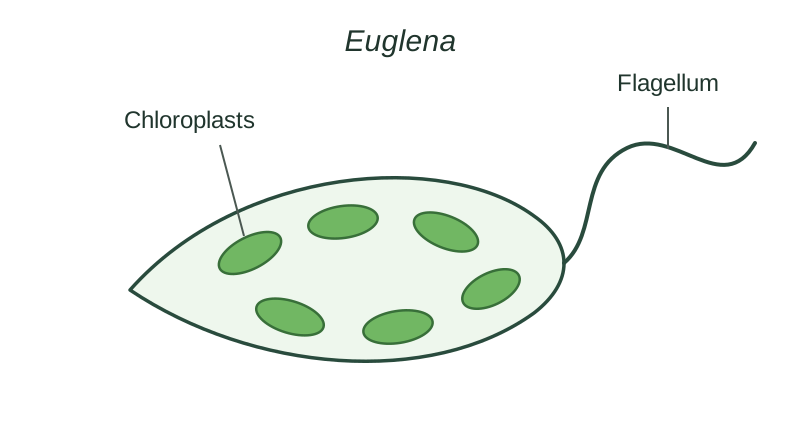
Single-celled organisms are too small to see with the naked eye, so we use a light microscope. Some microscopic organisms, such as Euglena, share traits from both kingdoms. When an exam question asks about Euglena, point to its chloroplasts as evidence that it behaves like a plant, and point to its moving flagellum or food-intake reservoir as evidence that it behaves like an animal.
Evolution by Natural Selection
Evolution is the gradual change in the inherited characteristics of a population over many generations. Charles Darwin explained that this process happens through natural selection.
- Overproduction: Living things produce more offspring than the environment can feed or support.
- Variation: Individuals within the same species have slight genetic differences in their traits.
- Competition: A struggle takes place for limited resources like food, water, light, and shelter.
- Survival of the suited: Individuals with helpful adaptations are more likely to survive predators and disease.
- Reproduction: The surviving organisms breed and pass advantageous genes to their offspring.
Over long periods, these helpful characteristics become common, while unhelpful traits fade out.
Conducting a Habitat Study
A habitat is the natural place where an organism lives, while an ecosystem includes all living communities interacting with their non-living environment.
To study a habitat, we measure abiotic (non-living) factors such as soil temperature with a thermometer and light intensity with a light meter. We also collect organisms using dedicated sampling equipment:
- Quadrat: A square frame placed randomly across an area to estimate the abundance of plants or slow-moving animals.
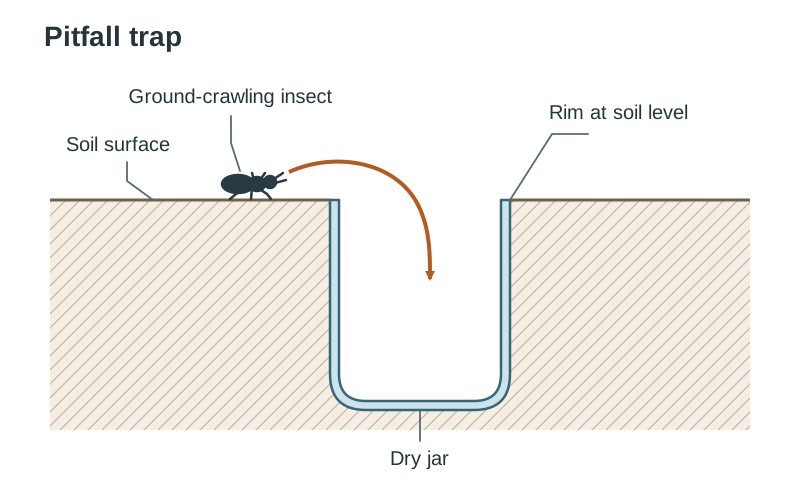
- Pitfall trap: A small jar buried level with the soil surface to collect ground-crawling insects.
- Sweep net: Swept through tall meadow grass to catch flying and crawling insects.
- Beating tray: Held under tree branches while tapping them with a stick to dislodge small animals.
Always release captured creatures safely back into their habitat to avoid disturbing the ecosystem.
Ecosystem Interactions and Conservation
Organisms within an ecosystem depend on one another to survive. For example, bees rely on flowering plants for sugary nectar, while the plants rely on bees for pollination. People depend on ecosystems too: they give us food, clean water and medicines, and insect pollination keeps crop production going.
| Interaction | Meaning | Common Example |
|---|---|---|
| Adaptation | An inherited feature helping survival | Broad leaves to absorb sunlight |
| Competition | The contest for scarce resources | Weeds and crops competing for soil minerals |
| Interdependence | Species relying on each other | Caterpillars eating nettles and birds eating caterpillars |
Human activity often damages biodiversity through habitat destruction, pollution, and the spread of invasive species like grey squirrels. We can conserve biodiversity by setting strict fishing quotas, replanting native woodland, and only spreading slurry during dry spells so it cannot wash into rivers.
Key terms
- Biodiversity
- The variety of all living organisms and ecosystems found on Earth.
- Natural Selection
- The process where organisms with traits best suited to their environment survive and reproduce.
- Adaptation
- An inherited physical or behavioural feature that helps an organism survive in its habitat.
- Interdependence
- The way in which two or more species in a community rely on each other for survival.
- Abiotic Factor
- A non-living physical condition of an environment, such as light, temperature, or soil pH.
- Conservation
- The wise management of natural habitats to protect wildlife and prevent extinction.
Check yourself
Which organelle allows plant cells to absorb sunlight and make food?
Chloroplast.
What sampling piece of equipment is used to capture crawling beetles on the soil surface?
A pitfall trap.
Name two resources that animals compete for in a woodland.
Food and territory (or water, shelter, and mates).
Why must quadrats be thrown or placed randomly in a habitat study?
To prevent human bias and collect a fair, representative sample.
Give one practical action farmers can take to protect water biodiversity from slurry run-off.
Spread slurry only in dry weather conditions.