
The breathing system takes in oxygen for cellular respiration and removes carbon dioxide and water vapour from the body. Junior Cycle questions test organ functions, inhalation and exhalation mechanics, gas exchange in the alveoli, and links with other body systems.
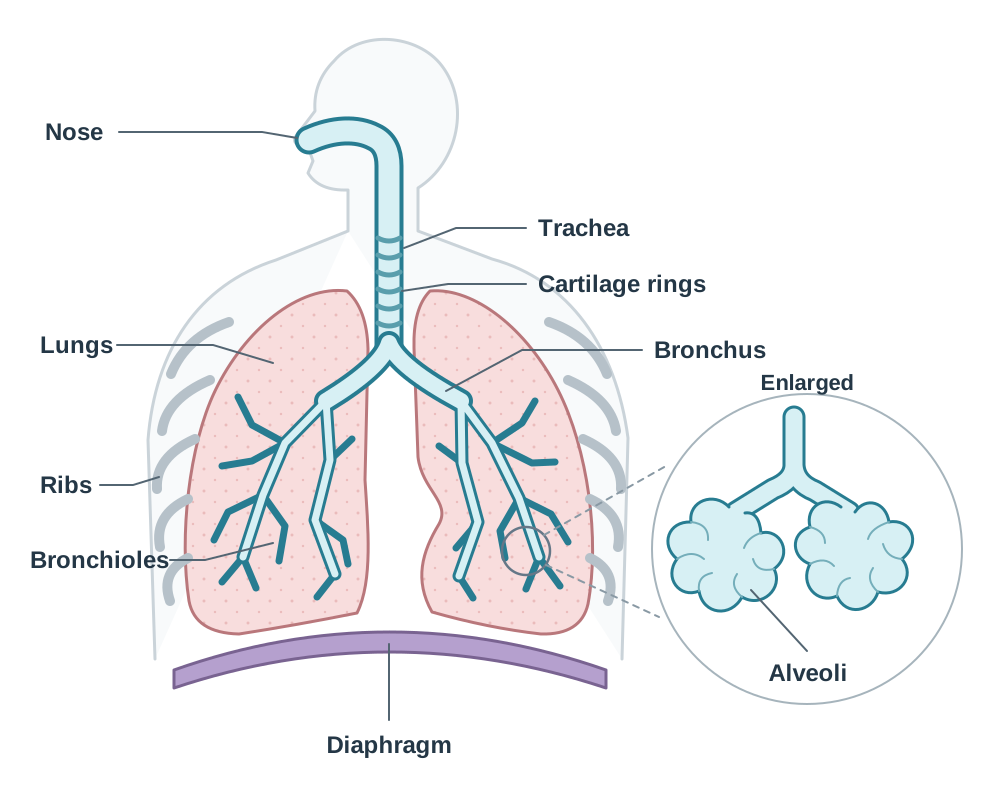
Organs of the Breathing System
Breathing is the physical movement of air into and out of the lungs. It is distinct from respiration, which is the chemical release of energy from food inside cells:
glucose + oxygen → carbon dioxide + water (+ energy released)
Air travels through a connected system of organs to reach the bloodstream:
| Organ | Function |
|---|---|
| Nose | Hairs and mucus filter dust while warming and moistening incoming air. |
| Trachea | Windpipe held open by rings of cartilage to prevent collapse. |
| Bronchi | Two main tubes branching from the trachea, one leading into each lung. |
| Bronchioles | Narrow branching tubes that carry air deep into the lungs. |
| Lungs | Two spongy organs in the chest, protected by the ribcage, containing the bronchioles and alveoli. |
| Alveoli | Millions of tiny air sacs where gas exchange with the blood occurs. |
| Diaphragm | Muscle sheet below the lungs that changes chest volume during breathing. |
The Mechanics of Breathing
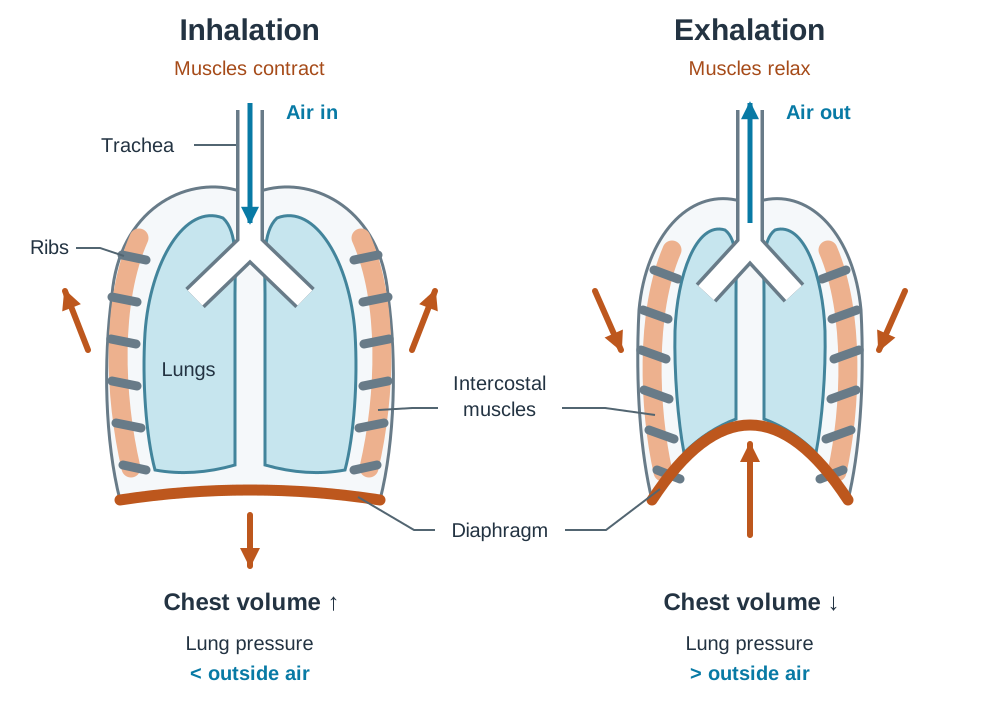
Breathing depends on changing the volume and air pressure inside the chest cavity:
| Feature | Inhalation (Breathing In) | Exhalation (Breathing Out) |
|---|---|---|
| Intercostal muscles | Contract (pull ribs up and out) | Relax (ribs move down and in) |
| Diaphragm | Contracts and flattens downwards | Relaxes and domes upwards |
| Chest volume | Increases | Decreases |
| Pressure in lungs | Drops below atmospheric pressure | Rises above atmospheric pressure |
| Airflow | Air rushes into the lungs | Air is pushed out of the lungs |
Lungs do not move on their own; they expand and deflate passively as the muscles change chest volume.
Gas Exchange in the Alveoli
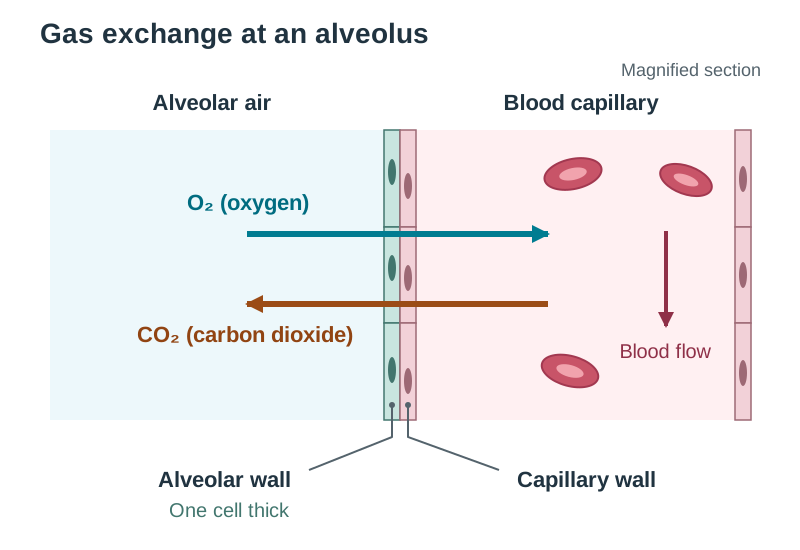
Gas exchange occurs in the alveoli by diffusion, where gases move from an area of higher concentration to an area of lower concentration. Oxygen diffuses from the alveoli into the blood, while carbon dioxide diffuses from the blood into the alveoli to be exhaled.
Alveolar adaptations
- Walls are one cell thick to provide a very short diffusion distance.
- A huge collective surface area across millions of alveoli speeds up gas transfer.
- A dense capillary network carries oxygen away quickly, keeping a steep concentration gradient.
| Gas | Inhaled Air (%) | Exhaled Air (%) |
|---|---|---|
| Oxygen | 21 | 16 |
| Carbon dioxide | 0.04 | 4 |
Bubbling exhaled air through clear limewater turns it milky within seconds; inhaled air takes much longer because it has far less carbon dioxide.
System Interactions and Lung Health
The breathing system works closely with other body systems to sustain cells and protect the body:
- Circulatory system: Blood picks up oxygen at the alveoli and delivers it to respiring cells, while returning carbon dioxide to the lungs. During exercise, muscle cells respire faster, so heart rate and breathing rate increase together.
- Digestive system: The epiglottis is a flap of tissue that closes over the top of the trachea when swallowing, preventing food from entering the airway.
- Lifestyle factors: Smoking damages the cilia and alveoli, reducing the surface area available for gas exchange and lowering fitness.
Key terms
- Breathing
- The physical process of taking air into and out of the lungs.
- Respiration
- The chemical process inside cells that releases energy by breaking down glucose using oxygen.
- Gas exchange
- Oxygen passing from the alveoli into the blood, and carbon dioxide passing from the blood into the alveoli.
- Diffusion
- The movement of particles from an area of higher concentration to an area of lower concentration.
- Intercostal muscles
- The muscles between the ribs that contract to pull the ribcage up and out during inhalation.
- Diaphragm
- A large sheet of muscle beneath the lungs that contracts and flattens during inhalation.
- Alveoli
- Microscopic, thin-walled air sacs in the lungs where gas exchange takes place.
- Epiglottis
- A flap of tissue that covers the trachea during swallowing to stop food entering the lungs.
Check yourself
What is the function of the rings of cartilage in the trachea?
They keep the trachea held open and prevent it from collapsing.
Give two features of an alveolus that make diffusion fast.
Walls one cell thick (short diffusion distance) and a very large total surface area.
What happens to chest volume and lung pressure during exhalation?
Chest volume decreases, causing air pressure inside the lungs to rise.
Why does limewater turn milky faster when exhaled air is bubbled through it rather than inhaled air?
Exhaled air contains about 4% carbon dioxide compared to only 0.04% in inhaled air.
Which structure stops swallowed food from entering the trachea?
The epiglottis.