

A tertiary activity provides services to people and businesses rather than extracting raw materials or manufacturing goods. In the Junior Cycle examination, you will assess how physical landscapes attract visitors, how relief shapes transport links, and how tourism impacts local communities and environments.
The Tertiary Sector and Tourism Growth
As economies develop, employment shifts away from primary and secondary work into services. In Ireland about three-quarters of workers are now in tertiary jobs, with roughly a fifth in secondary and under 5% in primary.
- Higher disposable income leaves households with more spare money to spend on recreation, holidays, and dining out.
- Budget airlines and package deals provide cheaper air travel, allowing people to travel abroad more frequently.
- Improved accessibility through motorways, regional airports, and ferry ports lets visitors reach scenic rural destinations quickly.
How the Physical Landscape Drives Tourism and Transport
Natural landforms create the scenery that attracts visitors, while physical relief directly shapes the transport links built to reach them.
| Physical Feature | Irish Example | Tourist Activity | Transport Impact |
|---|---|---|---|
| Glaciated valley | Glendalough, Co. Wicklow | Hillwalking by ribbon lakes and viewing waterfalls | Steep valley sides force roads and car parks onto the flat valley floor |
| Karst limestone | The Burren, Co. Clare | Touring caves and studying rare Alpine flora | Thin soils and bare rock make road building costly, so visitors reach the area on narrow regional roads |
| Coastal cliffs | Cliffs of Moher, Co. Clare | Sightseeing and coastal cliff-path walking | Cliffs and inlets force roads to bend inland; large car parks and coach bays must be built at viewing points |
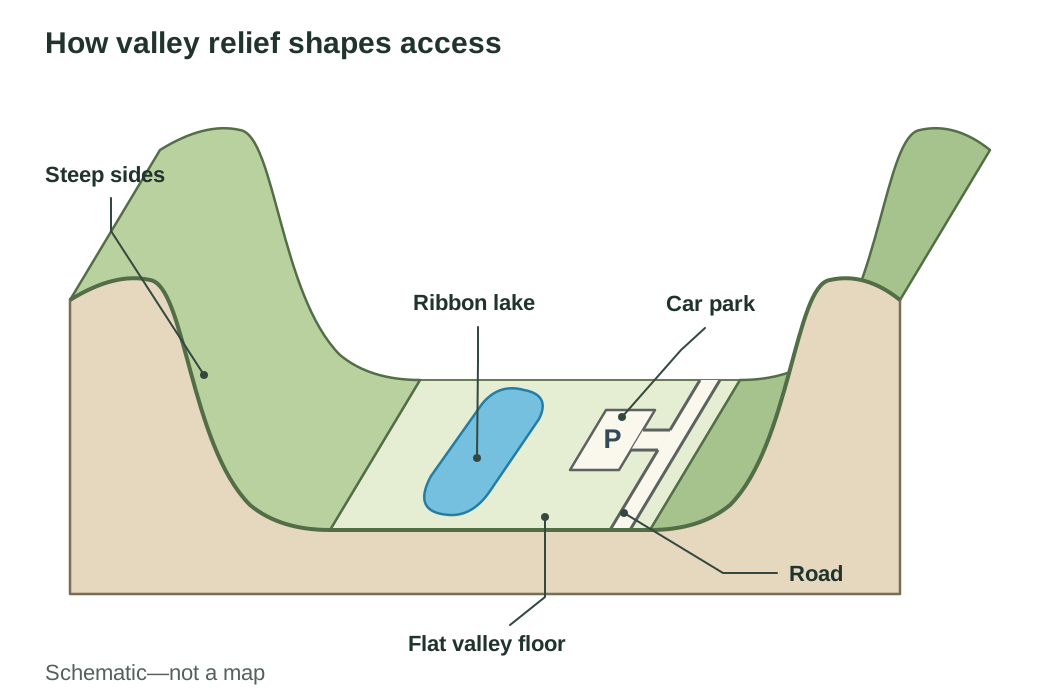
Transport and tourism share a two-way relationship:
- Tourism can improve transport: large visitor numbers make new bus routes, better roads, or a bigger airport worth the cost.
- Local people also benefit, because they use the same improved roads, buses, and airports all year round.
Economic and Social Impacts of Tourism
Tourism brings vital wealth to peripheral regions, but rapid growth also strains local infrastructure.
| Impact Category | Positive Benefits | Negative Pressures |
|---|---|---|
| Economic | Creates jobs in hotels, cafés, and tour guiding, and brings money into local shops | Many jobs offer only seasonal employment with low winter earnings, and housing costs rise |
| Social | Slows outward migration by providing young people with jobs in their home community | Tour buses cause severe traffic congestion and parking shortages on narrow roads |
| Services | Justifies building better leisure centres, broadband, and water networks for towns | Overcrowding in peak summer months puts heavy pressure on local water supplies and waste services |
Rapid resort growth, such as in Cancún, Mexico, shows how tourism can transform a small settlement into a major city. Constructing hotels, apartments, and an international airport brings rapid employment, but municipal water and sewage networks must expand rapidly to keep pace.
Landscape Management and Sustainability
Unmanaged visitor numbers can easily destroy the natural scenery that tourists travel to see.
- Constant walking wears away thin upland soils, causing severe footpath erosion on popular trails.
- Clearing land for holiday chalets and access roads destroys natural wildlife habitats and delicate vegetation.
- National parks, such as Wicklow Mountains National Park, protect the landscape, plants, and wildlife by law.
- Dedicated traffic management, such as park-and-ride shuttle buses, cuts exhaust emissions and reduces car park gridlock during peak holiday weekends.
Key terms
- tertiary activity
- An economic activity that provides a service to people or businesses rather than extracting raw materials or making products.
- accessibility
- A measure of how easily and quickly people can reach a place using transport networks.
- seasonal employment
- Jobs that are available only during a specific part of the year, such as summer hotel work.
- footpath erosion
- The wearing away of soil and ground vegetation caused by repeated trampling along walking trails.
- sustainability
- Meeting our present-day needs without stopping future generations being able to meet their own needs.
Check yourself
What is the defining characteristic of a tertiary economic activity?
It provides a commercial, personal, or public service rather than producing physical goods.
Name two physical landscape features that attract tourists to Glendalough, Co. Wicklow.
A glaciated U-shaped valley and ribbon lakes.
Explain one way tourism can improve local transport for permanent residents.
High visitor demand justifies better roads and extra bus routes that residents can use year-round.
Identify one piece of evidence on an Ordnance Survey map that proves an area is used for tourism.
A campsite symbol, youth hostel, walking trail, viewing point, or golf course.
State one practical management method used to prevent footpath erosion on fragile soils.
Building raised wooden boardwalks or paved stone paths to keep visitors off bare ground.