

Primary economic activities extract or gather raw natural resources directly from the land, sea, or ground. In the Junior Cycle exam, you must classify economic sectors, identify how the physical landscape affects primary activities, and assess how natural resources are used and managed.
Primary Activities and Farming as a System
Economic activities are divided into three main sectors based on what workers do:
| Sector | Function | Example Workers |
|---|---|---|
| Primary | Extracts raw materials directly from nature | Farmer, miner, fisher, forestry worker |
| Secondary | Manufactures finished goods from raw materials | Baker, brewer, car-assembly worker |
| Tertiary | Delivers a commercial, public, or personal service | Garda, teacher, hairdresser, dentist |
A high percentage of workers in primary activities usually indicates a less economically developed country.
Farming is Ireland's main primary activity. It works as a system with inputs, processes, and outputs:
- Inputs are items put into the farm, such as land, seeds, livestock, machinery, capital, and labour.
- Processes are tasks carried out, such as ploughing, sowing, fertilising, milking, and harvesting.
- Outputs are products sold off the farm, such as milk, beef, and barley, as well as by-products like slurry.
Farms are classified as pastoral (rearing animals), arable (tillage) (growing crops), or mixed (both crops and livestock).
Physical Landscape Influences on Farming
The physical landscape determines which farming activities can take place in a region:
- Relief and slope: Flat or gently rolling lowlands allow tractors to plough and harvest easily. Steep upland slopes make heavy machinery unsafe, restricting farming to hill sheep grazing or forestry.
- Soils: Deep, fertile brown earth soils in the east and south support commercial tillage and dairy farming. Thin, acidic peat soils and waterlogged gley soils in the west and uplands limit land use to rough grazing.
- Climate and altitude: Grass begins to grow at about 6°C, so colder upland areas have a shorter growing season and crops do poorly there. Uplands are colder and wetter, so heavy rain washes nutrients out of the soil.
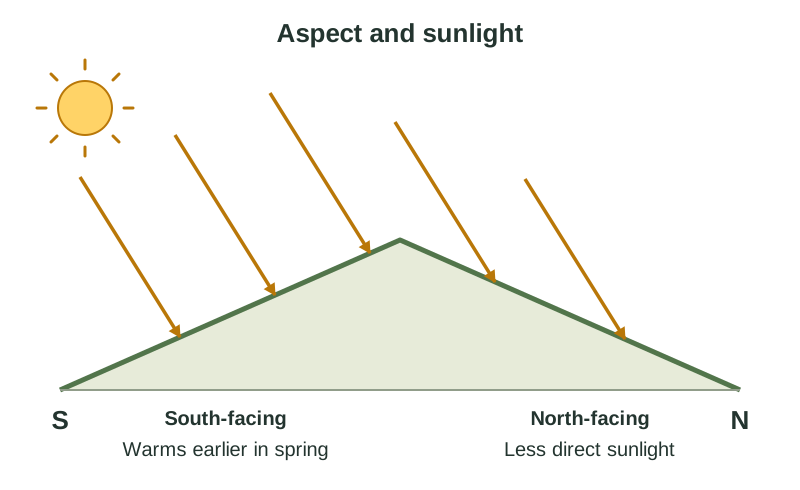
- Aspect: South-facing slopes receive direct sunlight and warmth, heating the soil earlier in spring than north-facing slopes.
Using Natural Resources Sustainably
A natural resource is any material or feature of the physical world that people use. Some resources are easily damaged or cannot be replaced, so using them causes problems.
- Soil: Overgrazing leaves bare soil open to erosion. Farmers use crop rotation (growing different crops each year) to maintain nutrients and break pest lifecycles.
- Water: Water is collected from lakes and rivers, treated, and distributed through pipes. Irrigation provides artificial watering in dry regions. For example, the Aswan High Dam in Egypt provides year-round water to boost crop yields, but causes salt build-up (salinisation) that lowers soil fertility.
- Forestry: Coillte manages commercial plantations of fast-growing conifers like Sitka spruce. Clear-felling large areas causes soil erosion, so sustainable forestry requires planned replanting.
- Fish: Super-trawlers and sonar equipment cause overfishing. Killybegs, Co. Donegal is Ireland's largest fishing port. Solutions include an EU fishing quota (strict legal catch limits), larger net mesh sizes to let juvenile fish escape, and marine exclusion zones that close breeding grounds to fishing.
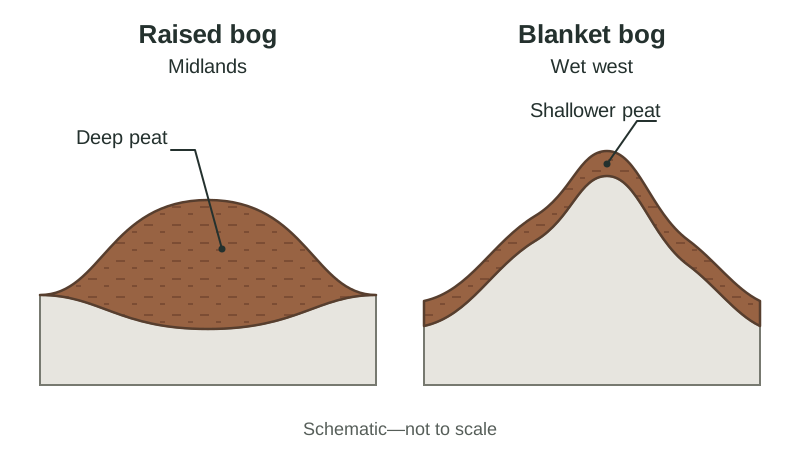
- Peat: Peat is a non-renewable fossil fuel. A raised bog is deep and found in the Midlands; a blanket bog is shallower and spreads across the wet west and over mountain tops. Ireland's peat-fired power stations have closed and large-scale commercial peat harvesting has ended, although some turf is still cut for home heating.
Rock Exploitation and Energy Resources
Extractive industries remove valuable materials from the ground.
- Surface quarrying extracts rock like limestone, sand, and gravel for construction. Quarries create local jobs and supply building materials, but heavy lorries cause traffic and dust, and blasting creates noise.
- Energy resources are renewable (wind, solar, hydro) or non-renewable (coal, oil, gas, turf). Burning fossil fuels releases greenhouse gases that drive climate change, whereas renewables generate electricity cleanly.
- Ways to cut energy use: turn off lights and appliances when leaving a room; insulate attic spaces and walls to prevent heat loss; walk, cycle, or take the bus instead of using a car for short journeys.
- Local resources: Learn two natural resources from your own area and their uses, such as limestone quarried for concrete blocks, river water treated for drinking, or grassland soil used for dairy farming.
Key terms
- Natural resource
- A material or feature of the physical world that people use, such as soil, water, fish, timber, rock, or wind.
- Primary economic activity
- An economic activity that extracts or gathers raw materials directly from the earth, sea, or ground.
- System
- A way of describing how something is done, set out as inputs (what goes in), processes (what is done), and outputs (what comes out).
- Renewable resource
- A natural resource that can replenish itself naturally over time if carefully managed, such as timber or fish stocks.
- Non-renewable resource
- A finite resource that cannot be replaced within a human lifespan once consumed, such as peat, coal, oil, or limestone.
- Fishing quota
- A legal limit set on the weight and species of fish that a vessel or country may catch.
- Irrigation
- The artificial watering of land and crops to help them grow in dry conditions.
- Crop rotation
- Changing the type of crop grown in a field year by year to preserve soil nutrients and control pests.
Check yourself
Which economic sector includes a miner, a farmer, and a forestry worker?
The primary economic sector.
Why is tillage farming common in the south-east of Ireland but rare in Connemara?
The south-east has flat land, fertile brown earth soils, and drier weather, whereas Connemara has steep slopes, thin peat soils, and heavy rainfall.
Name one positive and one negative effect of the Aswan High Dam irrigation scheme.
Positive: provides a reliable year-round water supply for crops. Negative: leads to salinisation, where salts build up and reduce soil fertility.
State two measures used to prevent overfishing in Irish waters.
Enforcing EU fishing quotas and setting minimum net mesh sizes so undersized fish can escape.
List two actions an individual can take at home to reduce energy consumption.
Switch off lights and appliances when leaving a room, and insulate walls and attics to reduce heat loss.