
A myth is a traditional story about a people’s legendary past, often involving gods, goddesses, and extraordinary heroes. In the Junior Cycle examination, you will analyse mythical themes and storytelling techniques, interpret visual sources, explain variant versions, and evaluate characters' choices.
The Nature of Myth and Storytelling Conventions
Classical myths explained natural phenomena, taught community values, and gave ancient peoples a shared sense of identity.
- An aetiological myth explains how something began, such as Demeter's grief for Persephone causing the cycle of the seasons.
- Create and share an image conveying a myth’s message: Icarus’s melting wings show the danger of ignoring advice.
Narrative Techniques
- Plot is the sequence of events, while characterisation reveals personality through actions, speech, and decisions.
- Myths use set conventions: events grouped in threes, unavoidable prophecies, and sudden physical transformations.
- Warnings build suspense by making the audience fear what happens next, such as Daedalus warning Icarus before flight.
- Stories evolved through oral tradition, changing naturally across regions and authors before being written down.
- Retell myths in your own words; together, plan characters, conflict, a turning point and an ending conveying your message.
Gods, Attributes, and Visual Sources
Ancient artists depicted myths on painted pottery, wall frescoes, and stone reliefs. Deities and heroes are identified by visual symbols called attributes:
| Deity | Greek / Roman Name | Domain | Visual Attributes |
|---|---|---|---|
| King of the gods | Zeus / Jupiter | Sky, weather, justice | Thunderbolt, eagle, sceptre |
| Queen of the gods | Hera / Juno | Marriage, women | Crown, peacock, sceptre |
| Sea god | Poseidon / Neptune | Sea, earthquakes | Trident, horses, dolphins |
| Wisdom goddess | Athena / Minerva | Wisdom, crafts, war strategy | Helmet, spear, owl, aegis (protective shield or breastplate) |
| War god | Ares / Mars | Violent warfare, bloodshed | Armour, weapons, helmet |
| Hero | Heracles / Hercules | Strength, labours | Lion skin, wooden club |
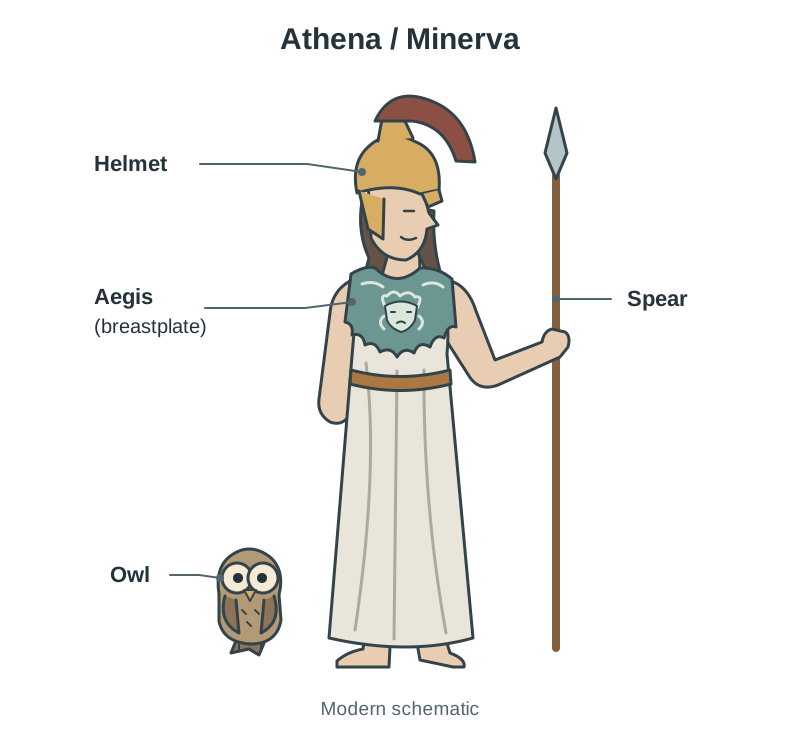
To read a visual source in an exam, follow four steps: identify figures by their attributes, describe their actions, examine the setting for clues, and interpret the gestures and emotions shown.
Themes, Gender, and Character Choices
Classical myths explore universal dilemmas and social expectations through recurring themes:
- Hubris means excessive pride or arrogance that oversteps human limits; Arachne’s challenge to Athena leads to divine punishment.
- Love and marriage include Penelope’s loyalty, Hades’s forced marriage to Persephone, and Orpheus’s grief for Eurydice.
- Same-sex love appears in myths such as Apollo and Hyacinthus, and, in later retellings, Achilles and Patroclus.
- Most myths were shaped by men and favour male heroes, but female characters often hold real influence.
- Ariadne’s thread helps Theseus escape the Labyrinth; Medea’s potions help Jason win the Golden Fleece.
- Both heroes later abandon these women, which provides useful evidence when discussing whether female characters get fair credit.
- Evaluate choices using motives, available options, consequences and relevant ancient or modern values.
Everyday Idioms and CBA 1
Classical mythology directly shapes everyday English expressions:
- Achilles heel: A vulnerable point in an otherwise strong person.
- Pandora's box: An action that unleashes uncontrollable troubles.
- Trojan horse: A deceptive gift or trick hiding a hostile threat inside.
Classroom-Based Assessment 1
If your school undertakes CBA 1, you complete Storytelling using myth over a maximum of three weeks. You explore a chosen myth individually, in a pair, or in a group across four stages: Scoping (surveying myths), Framing (developing the theme and message), Refining (choosing the presentation format), and Displaying (presenting your display and submitting your individual reflection note). Group members must declare their personal contributions.
Key terms
- Myth
- A traditional story about a people’s legendary past, often involving gods or extraordinary heroes.
- Aetiological myth
- A myth that explains the origin or cause of a natural event, custom, or name.
- Oral tradition
- The passing down of stories, songs, and customs by word of mouth across generations before they are written down.
- Attribute
- A distinctive object, animal, or symbol consistently used in art to identify a specific god or hero.
- Aegis
- A protective shield or breastplate associated with Zeus and Athena, often featuring the head of Medusa.
- Hubris
- Excessive pride or arrogance where a mortal defies divine authority or oversteps human limits.
- Theme
- A central idea explored throughout a story, such as love, duty, justice, or fate.
- Motif
- A recurring narrative detail, pattern, or image in storytelling, such as a prophecy or a forbidden action.
Check yourself
What is an aetiological myth?
A myth that explains the origin of a natural phenomenon, custom, or name.
How does Daedalus's warning to Icarus create suspense in the story?
It foreshadows disaster and makes the audience anxious that Icarus will disobey and fly too close to the sun.
Name two female characters who helped male heroes, and state what aid they provided.
Ariadne gave Theseus a thread to escape the Labyrinth, and Medea gave Jason a sleeping potion and protective ointment to win the Golden Fleece.
Use the expression 'Achilles heel' in a sentence that demonstrates its modern meaning.
French grammar is my Achilles heel because I score high marks in every other subject.
What are the four student stages of CBA 1: Storytelling using myth?
Scoping, Framing, Refining, and Displaying.