

This topic examines how public architecture supported civic life, leisure, and imperial power in ancient Rome between the second century BC and third century AD. The Junior Cycle exam assesses your ability to identify building shapes and architectural terms, write imagined visits to public events, explain political motives for building, and evaluate historical sources.
Public Architecture and Building Shapes
Roman towns were planned around distinct public structures:
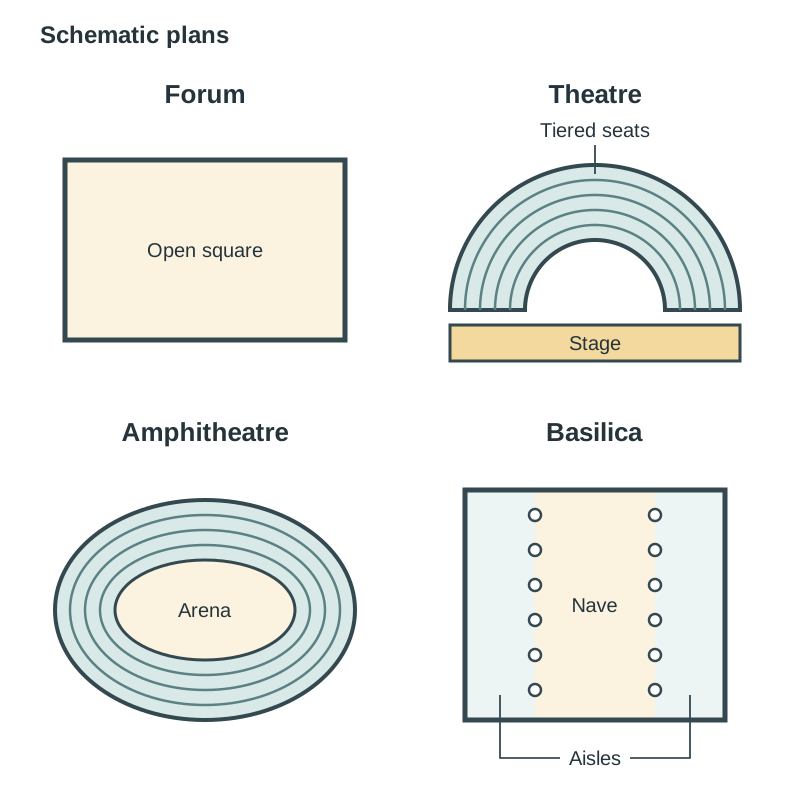
- A forum is an open rectangular public square used for markets, public speeches, and business.
- A theatre is a semi-circular building with tiered seats facing a stage, used for drama and pantomime.
- An amphitheatre is an oval building with tiered seating around an arena, used for gladiators and beast hunts.
- A basilica is a large rectangular hall with a central nave and aisles, used for law courts and business.
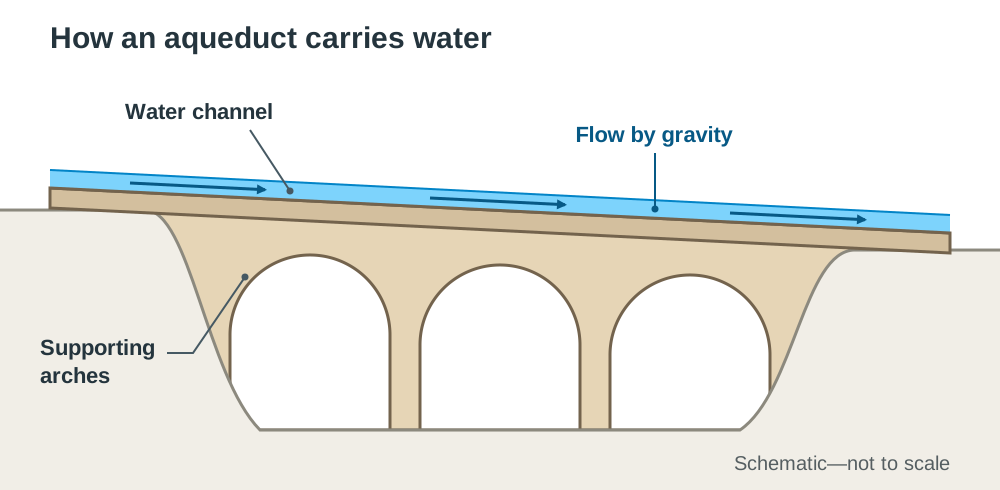
- An aqueduct carried water through channels using gravity; arches supported some sections.
- A triumphal arch is a free-standing stone gateway decorated with carvings to commemorate military victories.
- Revise your class’s three chosen Roman sites.
- Work with classmates to draw or model a favourite Roman building, structure or site.
Daily Life and Public Events
Public buildings hosted regular civic routines, communal relaxation, and state entertainment:
- Amphitheatre events followed a set order: animal hunts in the morning, executions at midday, and gladiators in the afternoon.
- Arena seating reflected social rank, placing senators nearest the arena floor and women or enslaved people at the top.
- Public baths or thermae served as daily social centres where citizens exercised, received massages, and bathed.
- Bathers moved through the warm room (tepidarium), hot bathing room (caldarium), and cold bathing room (frigidarium).
- In a circus, four rival teams (Reds, Whites, Blues, Greens) raced seven laps around a central barrier.
Power, Politics, and Benefaction
Roman leaders did not commission grand structures simply for decoration; public building served practical, religious, and political needs:
- Republican politicians funded public works to gain popularity and win votes in elections.
- Emperors used public buildings and games to win support for their rule.
- Vespasian built the Colosseum on land taken by Nero, returning public space to gain popular support.
- Domitian commissioned the Arch of Titus to commemorate his brother's capture of Jerusalem.
- Building inscriptions displayed leaders’ names, linking them with public projects.
Irish Comparisons and Historical Sources
Modern Irish architecture deliberately borrows Roman forms to project dignity, order, and authority:
- Dublin's Four Courts shares a Roman basilica's legal function, but has a Round Hall instead of a rectangular layout.
- Irish banks and courthouses use classical columns and pediments to appear permanent, trustworthy, and powerful.
Historians investigate Roman public life by cross-referencing four types of evidence:
- Architecture demonstrates physical scale and engineering methods, but ruins cannot explain personal thoughts or feelings.
- Inscriptions preserve authentic names, dates, and titles, but official examples usually offer flattering praise of their sponsors.
- Literature describes events and attitudes vividly, but ancient authors were usually wealthy men who held strong personal biases.
- Visual art depicts clothing, weapons, and tools, but carvings on monuments often served as state propaganda.
Key terms
- Aqueduct
- An artificial channel, often supported across valleys on stone arches, supplying fresh water using gravity.
- Thermae
- A large public bathing and leisure complex containing rooms of different temperatures and exercise areas.
- Portico
- A covered entrance porch or walkway supported by a row of columns.
- Capital
- The decorated top section of an architectural column.
- Dome
- A rounded roof covering a space, often shaped like half a sphere.
- Basilica
- A large rectangular public hall used for law courts, public administration, and business.
- Amphitheatre
- A fully enclosed oval arena with rising tiers of seats used for gladiatorial fights and beast hunts.
- Triumphal Arch
- A free-standing arched monument honouring a victory or important person.
Check yourself
What is the key difference in shape between a Roman theatre and an amphitheatre?
A theatre is semi-circular with seating facing a stage, while an amphitheatre is a complete oval surrounding an arena.
What were the tepidarium, caldarium, and frigidarium in Roman public baths?
The warm, hot and cold bathing rooms, respectively.
Why did Emperor Vespasian choose the site of Nero's palace lake for the Colosseum?
To return private land taken by a hated tyrant back to the Roman people for public entertainment.
Give one similarity in use and one difference in layout between the Four Courts and a Roman basilica.
Both served legal functions, but the Four Courts has a central Round Hall while a Roman basilica was rectangular.
State one strength and one limitation of carved Roman inscriptions as historical evidence.
They provide authentic contemporary names and dates, but official inscriptions often present a one-sided, flattering view of their sponsors.