

Roman daily life was shaped by social class, household authority, work, and public spectacles. In the Junior Cycle exam, questions may ask about family roles, the layout of the Roman house, schooling, jobs, and archaeological evidence.
Family Hierarchy and Social Status
Roman households placed formal authority in the paterfamilias. Many modern households share decisions more equally.
- Paterfamilias: The legally independent male head of a Roman household.
- Patria potestas: His legal authority over children and descendants through the male line, continuing into adulthood.
- Matrona: The respected female head of the house who managed domestic tasks, supervised enslaved staff, and raised children.
- Enslaved people: Enslaved people were treated as property and lacked freedom; their work included domestic service, workshops and mining.
- Freedmen (liberti)*: Former enslaved people who were granted freedom and often kept ties with former masters as patrons.
- Citizens and non-citizens: Free male citizens could vote and wear togas, while foreigners (peregrini) lacked political rights.
The Roman Home: Domus and Insula
A domus was a private Roman town house, usually occupied by a wealthy household. Domus, meaning house, gives us domestic, meaning relating to the home.
- Many poorer residents rented flats in insulae.
- Upper floors often lacked running water.
- Open flames created fire risks.
- Street shops called thermopolia sold hot food.
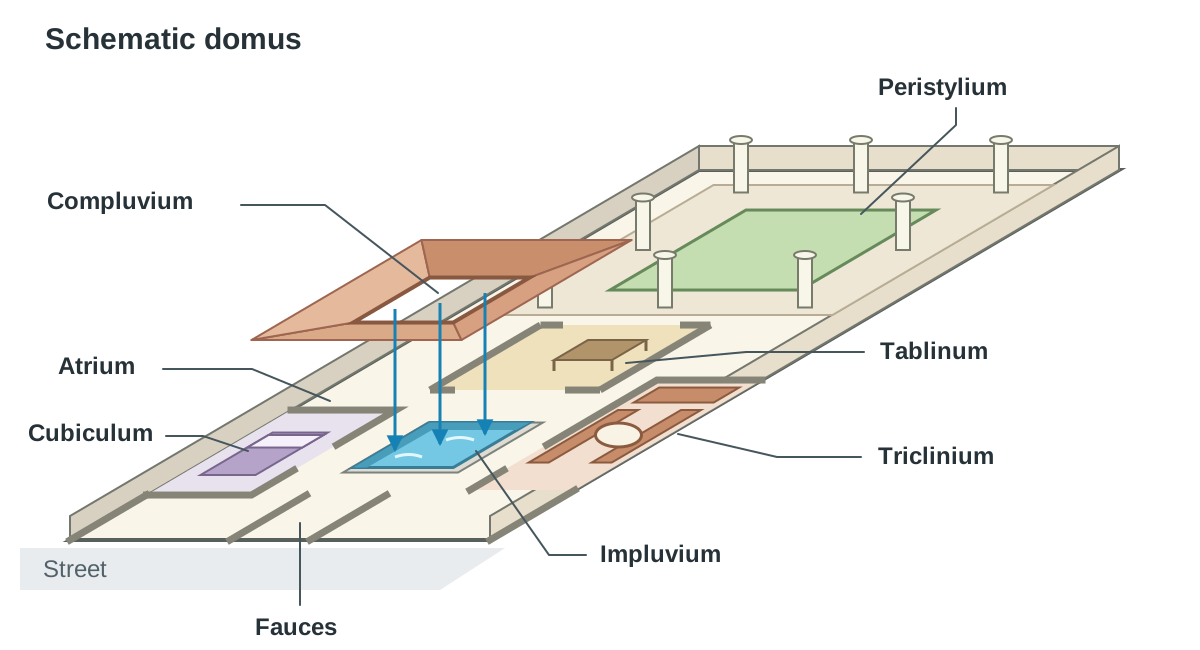
Rooms in the Domus
- Fauces: The entrance corridor from the street.
- Atrium: The central reception hall where the master greeted visitors.
- Compluvium: The ceiling opening that let in light, air, and rain.
- Impluvium: The shallow floor basin that collected falling rainwater.
- Tablinum: The master's office and family archive room.
- Triclinium: The dining room where guests reclined on three couches.
- Peristylium: A colonnaded garden at the back of the house.
- Cubiculum: A small bedroom used for sleeping.
Growing Up: Education, Play, and Daily Food
Roman childhood was brief, with distinct roles for boys and girls based on wealth.
- Protection: Freeborn Roman boys wore a protective charm called a bulla.
- Elementary school (ludus): Children learned reading, writing, and basic arithmetic from a teacher called a ludi magister*.
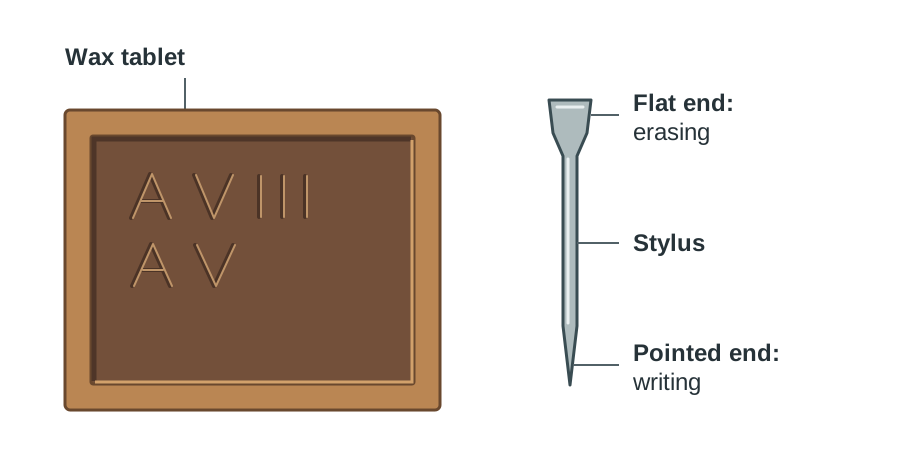
- Writing tools: Pupils wrote on wax tablets with a pointed stylus and erased mistakes using its flat end.
- Advanced study: Wealthy boys studied literature and rhetoric, while girls were usually taught household management at home.
- Play: Children played with dolls, hoops, spinning tops, and knucklebones (tali).
- Diet: The core diet was bread, olive oil, and wine, with vegetables and cheese; meat was rare.
Work, Leisure, and Archaeological Evidence
Work and leisure varied with wealth, status and occupation.
- Occupations: Common occupations included soldiers, farmers, doctors, midwives, teachers, sailors, craftworkers, and priestesses.
- Household religion: Families prayed at the lararium, a shrine dedicated to household protective spirits (Lares).
- Baths (thermae)*: Romans visited public baths to exercise, socialise, and clean their skin with a strigil.
- Chariot racing: Charioteers competed in the Circus Maximus, racing teams around a central barrier called the spina.
- Archaeological evidence: Objects provide clues about Roman lives, but one find cannot represent everyone or fully explain its owner's thoughts.
Key terms
- Paterfamilias
- The legally independent male head of a Roman household who held authority over his family.
- Patria potestas
- His legal authority over children and descendants through the male line, continuing into their adulthood.
- Domus
- A private Roman town house, usually occupied by a wealthy household.
- Insula
- A multi-storey urban apartment block where many poorer residents rented flats.
- Atrium
- The main reception hall of a Roman domus, featuring an open roof and a rainwater pool.
- Lararium
- A domestic shrine dedicated to the Lares, the protective spirits of the household.
- Spina
- The raised central dividing barrier running down the middle of a Roman chariot racetrack.
Check yourself
What was the purpose of the impluvium in the atrium of a domus?
It was a sunken floor basin that collected rainwater falling through the open roof.
How did a Roman pupil erase words written on a wax tablet?
They smoothed the soft wax flat using the blunt, wide end of the stylus.
What was the central dividing wall of the Circus Maximus called?
The spina.
Which protective charm was worn around the neck by freeborn Roman boys?
The bulla.
Give one modern English word derived from the Latin word domus.
Domestic (or domicile).