

A budget is a written plan that tracks expected income and planned spending over a future period. The Junior Cycle exam tests your ability to prepare budget tables, calculate cash balances, evaluate a family's financial position, and recommend practical actions.
Purpose of Budgeting and Timeframes
A budget helps a household plan ahead, spot shortfalls before bills arrive, and set money aside for savings.
Always enter net pay (take-home pay after deductions) rather than gross pay, since only net pay is money in hand.
Exam questions often mix timeframes that you must convert to monthly amounts before completing a table:
- Multiply weekly amounts by 4 (for example, €60 per week becomes €240 per month).
- Multiply daily amounts by the days used (for example, €4 per day over 20 school days gives €80).
- Divide lump sums across the relevant months (for example, €2,700 saved for 9 college months gives €300 monthly).
Classifying Household Spending
Household spending is grouped into three distinct categories:
- Fixed expenditure: Essential spending that stays the same regardless of use, such as rent, mortgage repayments, and motor tax.
- Irregular expenditure: Essential spending where the amount changes based on use, such as groceries, heating oil, and electricity.
- Discretionary expenditure: Non-essential spending on personal wants and lifestyle choices, such as cinema tickets, streaming subscriptions, and takeaways.
Essentials come first. If money gets tight, discretionary items are always the easiest and fastest costs to trim back.
Layout and Core Cash Calculations
A budget lists income first, sums total income, and then lists spending subtotals to find total expenditure.
Three connected formulas link each monthly column:
- Net cash = Total income − Total expenditure
- Closing cash = Net cash + Opening cash
- Opening cash of any new month equals the closing cash of the month before.
A positive net figure is a surplus, while a negative net figure is a deficit, written in brackets like (€400).
In the Total column, opening cash is strictly the opening cash from Month 1. Never add across the opening cash row.
Analysing the Position and Action Plans
Analysing a budget means looking at net cash and closing cash to see whether a household is living within its means. A deficit in one month might not cause panic if previous savings keep closing cash positive.
When suggesting solutions, tailor them to the exact situation:
- To fix a deficit: Cut discretionary items first, such as dining out or paid subscriptions.
- To cut irregular bills: Switch to cheaper energy tariffs or buy own-brand groceries.
- To boost income: Work overtime, take extra weekend shifts, or seek a side job.
- To manage large bills: Spread annual payments into monthly direct debits.
- With a surplus: Pay off expensive debt early, or build an emergency fund in a savings account.
Never advise cutting fixed costs like rent or agreed loan repayments, as these are legal contracts.
Visual Presentations and Pie Charts
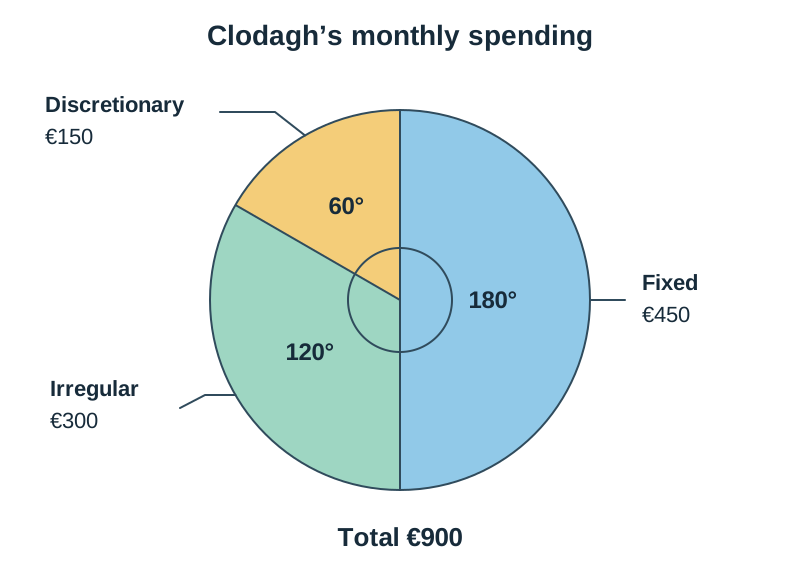
Charts make budget patterns obvious at a glance. Bar charts help compare spending between different months, while pie charts show how total spending splits between fixed, irregular, and discretionary categories.
To calculate the slice of a pie chart:
Round each angle to the nearest whole degree, and check that all slices add up to 360°.
Key terms
- Budget
- A written financial plan of expected income and planned spending over a future time period.
- Fixed Expenditure
- Regular, predictable spending that does not change with usage, such as rent or mortgage payments.
- Irregular Expenditure
- Essential spending where the cost changes depending on usage, such as groceries or electricity.
- Discretionary Expenditure
- Non-essential spending on personal wants and entertainment rather than basic needs.
- Net Cash
- The difference between total expected income and total planned spending in a budget period.
- Opening Cash
- The cash or bank balance available at the beginning of a budget period.
- Closing Cash
- The cash remaining at the end of a period, found by adding net cash to opening cash.
- Budget Deficit
- A situation where planned spending is greater than expected income for a given period.
Check yourself
What is the formula to calculate Net Cash?
Net Cash = Total Income − Total Expenditure.
Which spending category does an electricity bill belong to, and why?
Irregular expenditure, because it is an essential bill that varies based on consumption.
If opening cash is €400 and net cash is (€150), what is closing cash?
€400 + (€150) = €250.
How should a weekly grocery spend of €120 be shown in a monthly budget?
Multiply by 4, giving €480 per month.
What happens to June's closing cash figure in a continuous personal budget?
It becomes the opening cash figure for July.