

Taxation is a compulsory payment made by individuals and businesses to the Irish government through the Revenue Commissioners. The Junior Cycle exam tests how taxes are classified and why the government collects them from financial, social, legal, and ethical perspectives.
Direct and Indirect Taxes
Taxes in Ireland are collected by the Revenue Commissioners. We divide all taxes into two main groups based on how people pay them:
- Direct taxes are charged straight on the income, wealth, or profits earned by individuals and businesses. Examples include PAYE on wages, Universal Social Charge (USC), Corporation Tax at 12.5% on company profits, and DIRT on savings interest.
- Indirect taxes are added to the selling price of goods and services when people spend money. Examples include VAT, customs duty on goods imported from outside the EU, and excise duty on petrol, alcohol, and cigarettes.
Retailers collect indirect taxes from shoppers at the checkout and send that money on to Revenue.
The Four Purposes of Taxation
Governments do not collect tax just to gather cash. Under Junior Cycle Business Studies, we look at taxation through four distinct lenses:
- Financial: Tax brings in revenue to run public services like hospitals and schools, and to build infrastructure like the Luas. A low corporation tax rate also attracts foreign firms that set up jobs in Ireland.
- Social: Taxes discourage harmful habits to protect public health and the environment. Higher excise duties on cigarettes and the sugar tax on fizzy drinks cut consumption, while motor tax penalises high-carbon cars.
- Legal: Paying tax is a legal duty for every worker and firm. The funds collected also pay for our courts and An Garda Síochána.
- Ethical: Tax redistributes wealth from high earners to support vulnerable groups. It pays for vital social welfare payments, including pensions and Child Benefit.
Progressive and Regressive Taxes
Tax fairness depends on how a charge impacts people on different incomes:
- Progressive taxes take a larger percentage of income as a person earns more. PAYE is progressive because higher income is taxed at 40% while lower income is taxed at 20%.
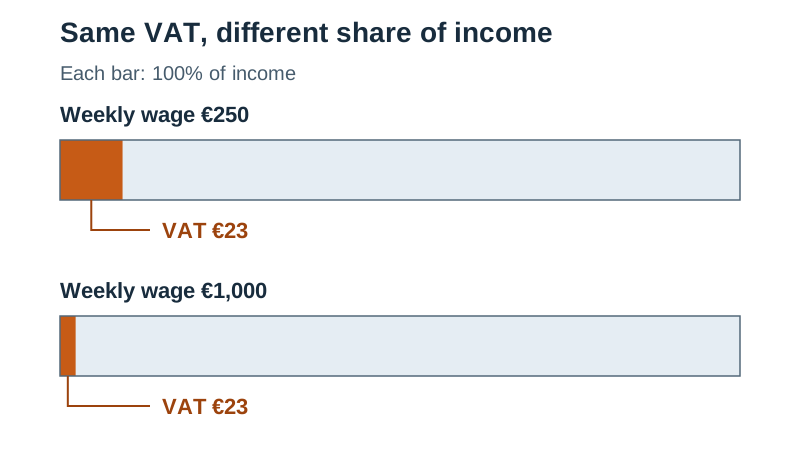
- Regressive taxes take a larger share of income from a low earner than from a high earner. VAT is regressive because everyone pays the same 23% rate on an item, no matter what they earn. For instance, €23 VAT on a jacket takes a much bigger chunk out of a €250 weekly wage than a €1,000 wage.
- Tax evasion is deliberately hiding income to avoid paying what you owe, which is illegal and punishable by fines or prison.
- Tax avoidance is arranging your finances legally to pay less tax, though many people still consider it unfair.
Evaluating Tax Policy Changes
When the Minister for Finance changes tax rules in the national budget, the government generally pursues three main goals: raising revenue, treating taxpayers fairly, or changing behaviour.
| Policy Change | Economic Impact | Social Impact |
|---|---|---|
| VAT on sunbeds raised to 23% | Generates extra indirect tax revenue for the state, but raises costs for salon owners. | Higher prices discourage sunbed use, supporting the National Cancer Strategy to lower skin cancer rates. |
| Sugar Tax on soft drinks | Raises tax revenue and pushes drinks firms to cut sugar in their recipes. | Encourages shoppers to choose healthier drinks, helping to tackle obesity and protect public health. |
Key terms
- Direct Tax
- A tax levied straight on personal income, wealth, or business profits, such as PAYE or Corporation Tax.
- Indirect Tax
- A tax levied on spending and added onto the retail price of goods and services, such as VAT.
- VAT (Value Added Tax)
- An indirect tax paid on the purchase of most goods and services, charged at a standard rate of 23% in Ireland.
- Progressive Tax
- A tax where the percentage rate rises as a person's income increases, placing a higher relative burden on higher earners.
- Regressive Tax
- A tax that takes a larger proportion of income from lower earners than from higher earners.
- Tax Evasion
- The illegal crime of deliberately hiding income or lying to avoid paying taxes owed to the state.
- Tax Avoidance
- The legal practice of organising financial affairs within tax law to reduce the amount owed.
- Revenue Commissioners
- The Irish government agency responsible for assessing and collecting taxes and duties.
Check yourself
Which state body collects taxes in Ireland?
The Office of the Revenue Commissioners.
Why is VAT classified as an indirect tax?
Because it is added directly to the selling price of goods and services when spent.
Why is PAYE considered a progressive tax?
Because people on higher incomes pay a higher percentage rate of tax on their top earnings.
What is the key difference between tax evasion and tax avoidance?
Tax evasion is illegal fraud, whereas tax avoidance uses legal tax rules to reduce a bill.
Name the three main objectives the government has when changing tax policies.
Raising government revenue, treating taxpayers fairly, and influencing taxpayer behaviour.