

Demand and supply work together in every market to set the prices we pay for everyday goods and services. In your Junior Cycle exam, you will sketch and read market curves, find equilibrium from data tables, and explain how outside changes shift these curves.
Understanding Demand and the Law of Demand
Demand means the quantity of a product or service that buyers are willing and able to buy at different prices over a specific time. Simply wishing for an item isn't enough; you must also have the money to pay for it.
The Law of Demand says that when the price of an item goes up, quantity demanded falls. When the price drops, quantity demanded rises, assuming nothing else changes.
- A demand curve always slopes downwards from left to right.
- Label your vertical axis Price (€) and your horizontal axis Quantity.
- A change in the item's own price causes a movement along the curve.
- Other factors, like higher wages or a viral social media trend, shift the whole curve left or right.
Supply and How Sellers React to Prices
Supply looks at the seller's side of the market. It shows the quantity of a good or service that businesses are willing and able to put up for sale at different prices.
The Law of Supply states that as the selling price rises, the quantity supplied increases. If the price falls, quantity supplied drops too. Businesses want to supply more stock when prices are high because each sale brings in greater profit.
- A supply curve slopes upwards from left to right.
- A change in the selling price causes a movement along the existing curve.
- Changes in business costs, technology, or weather shift the entire curve to a brand new position.
Market Equilibrium: Shortages and Surpluses
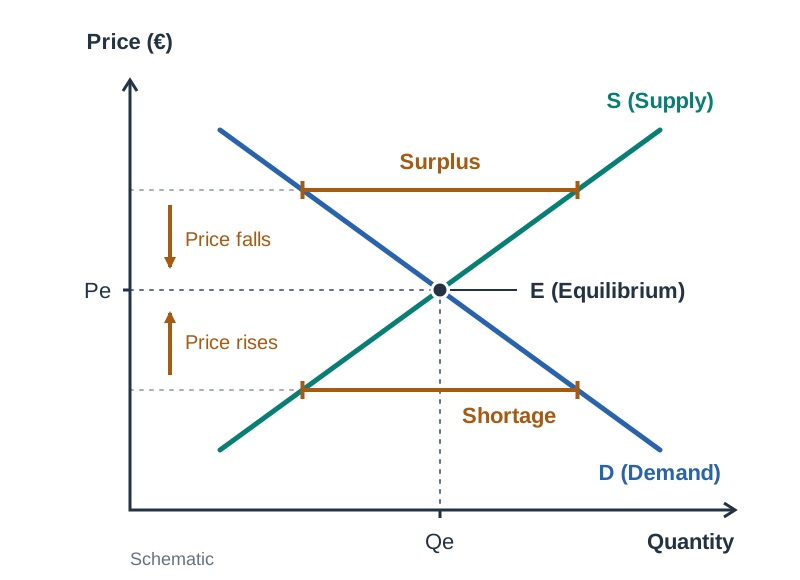
Market equilibrium happens at the exact point where the demand curve crosses the supply curve. At this meeting point, the amount consumers want to buy matches the amount sellers want to supply.
- Equilibrium price: the agreed price where buyers and sellers trade without stock running short.
- Equilibrium quantity: the total number of units bought and sold at that agreed price.
- Excess demand (shortage): if the price sits below equilibrium, shoppers want more goods than shops have in stock, which pushes prices upward.
- Excess supply (surplus): if the price sits above equilibrium, unsold stock gathers dust, which forces shops to run sales and cut prices.
What Causes Curves to Shift?
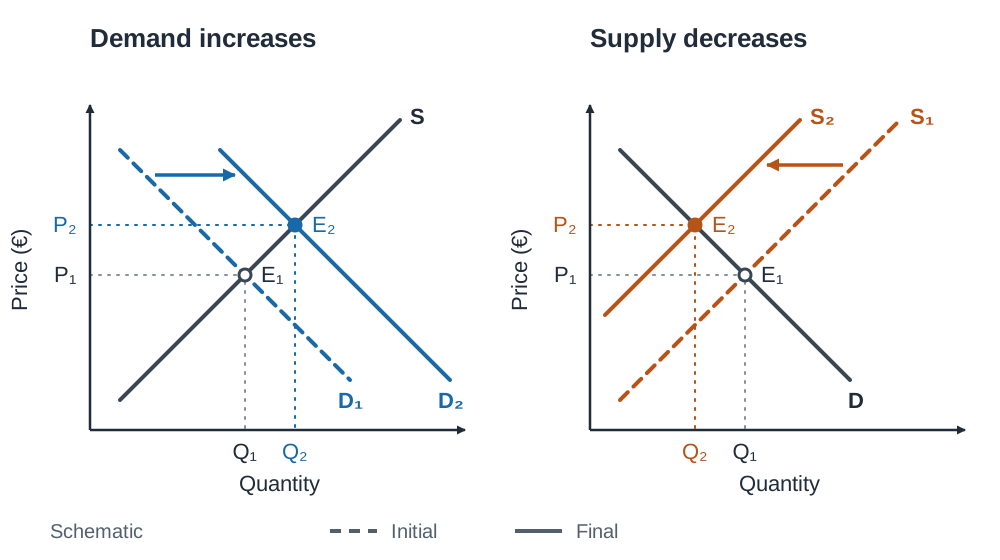
When something other than the item's own price changes, the whole curve shifts. A shift to the right means a higher quantity at every price, while a shift to the left means a lower quantity.
Shifting demand
- Consumer income: higher wages mean families have extra cash for cinema tickets and dining out.
- Advertising: clever marketing campaigns build brand awareness and pull in new buyers.
- Substitute goods: if tea prices jump, demand for coffee shifts to the right.
- Complementary goods: if games consoles get cheaper, demand for console video games shifts right.
Shifting supply
- Running costs: dearer electricity bills make baking bread more expensive, shifting supply left.
- Modern equipment: robotic milking machines let dairy farmers produce more milk, shifting supply right.
- Indirect taxes: a sugar sweetened drinks tax adds to factory costs, shifting soft drink supply left.
| Curve Shift | Effect on Equilibrium Price | Effect on Equilibrium Quantity |
|---|---|---|
| Demand shifts right | Rises | Rises |
| Demand shifts left | Falls | Falls |
| Supply shifts right | Falls | Rises |
| Supply shifts left | Rises | Falls |
Key terms
- Demand
- The quantity of a good or service that consumers are willing and able to buy at various prices.
- Supply
- The quantity of a good or service that producers are willing and able to offer for sale at various prices.
- Law of Demand
- The rule that quantity demanded falls as price rises, and rises as price falls.
- Law of Supply
- The rule that quantity supplied rises as price rises, and falls as price falls.
- Market Equilibrium
- The point where demand and supply curves cross, so quantity demanded equals quantity supplied.
- Substitute Good
- An alternative product that consumers can easily buy instead of another, like tea and coffee.
- Complementary Good
- A good used together with another, such as a games console and console video games.
Check yourself
Why does a normal demand curve slope downwards from left to right?
Shoppers buy more units as the price drops because goods become more affordable.
What happens to the supply curve for local bakeries if commercial electricity rates rise?
Higher production costs shift the entire supply curve to the left.
At €12, demand for a novel is 500 copies and supply is 500 copies. What is the equilibrium price?
The equilibrium price is €12 because quantity demanded matches quantity supplied.
If Avonmore runs a successful marketing campaign for protein milk, what happens to its equilibrium price?
The equilibrium price rises because stronger consumer demand creates competition for available stock.