
Writing is worth 25% of the total marks for Spanish at Higher Level. In Section C of the written examination you must produce written Spanish. Question 1 gives you a choice of tasks, and the letter/email is option (b). You cannot skip Section C, so you should prepare both formal and informal styles of correspondence. Question 1(b) is marked as five separate points. In most recent years each point was worth a maximum of 6 marks, while in some years, such as 2021 and 2022, each point carried 5 marks. Check the mark figure printed on your examination paper. Whatever the total, the arithmetic is identical: five distinct points, each marked for communicative intention, vocabulary range, and grammatical correctness of verbs. A missing or underdeveloped point costs a full fifth of the available marks. Success requires managing your layout conventions, maintaining strict registro without slipping between usted and tú, and expanding each point into a coherent paragraph of three to five sentences.
Task Types, Prompt Styles, and Exam Timing
Higher Level examination papers present three recurring correspondence formats under Section C Question 1(b):
- Formal opinion letter or email to a newspaper editor (el director / la directora): You respond to an article on contemporary society, such as tourism, environmental issues, smartphones, or language learning. You react to the author's claims, present arguments, and suggest solutions.
- Formal transactional letter or email: You write to an organisation, language school, or business to make a booking, request information, or lodge a formal complaint (reclamación) demanding a refund (reembolso).
- Informal letter or email to a friend: You write to a Spanish friend or exchange partner using informal language (tú or vosotros) to discuss holidays, school exchanges, part-time jobs, or future visits.
Prescribed Points versus Loosely Based Prompts
Always check how the task is phrased on your examination paper before you write a single word:
- Prescribed tasks: When the paper lists numbered instructions (for instance, state that you saw an advert, explain why you want to enrol, and ask three specific questions), every single listed item is compulsory. Leaving one out loses a whole point — a full fifth of the marks for the question (up to 6 marks in the years where each point carries 6).
- Loosely based prompts: When the paper provides eight suggestions, you choose five. You may agree, disagree, adapt the wording, or introduce your own relevant points instead. Disagreeing with the stimulus often produces more interesting and ambitious Spanish.
- What does not count as a point: Your greeting, your opening line acknowledging the article, and your sign-off formula are assessed under layout and register. They do not count towards your five content points. You must write five separate content paragraphs beyond those opening and closing lines.
- Recasting the prompts: The prompts on the examination paper are printed in English. Never translate them word for word. Recast the underlying idea using vocabulary and structures you control. For example, recast the prompt 'Food is cheaper in Spain' into natural Spanish: Comer fuera en España resulta mucho más barato que en Irlanda, sobre todo si se pide el menú del día.
Practical Exam Management
Allow roughly 25 to 30 minutes for Question 1(b). Aim for five paragraphs of three to five sentences each, flanked by your greeting and sign-off. Reserve the final three minutes exclusively for proof-reading verb endings, accents, and agreements.
Layout Skeletons for Postal Letters and Emails
The first thing an examiner sees is your layout, so get the greeting, date, and sign-off right from the start. Memorise these three structural skeletons.
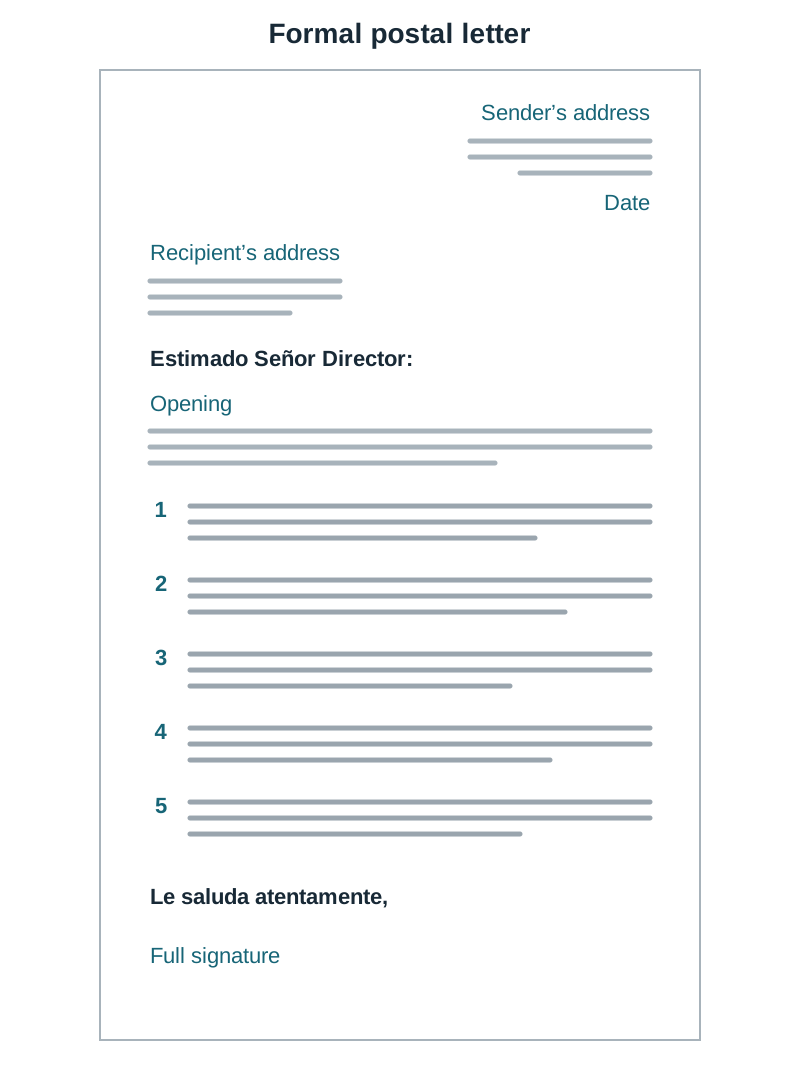
Formal Postal Letter Skeleton
- Top right: Your street address, town, and county, with the date on the line directly below (Dublín, 14 de mayo de 2027). Calendar months in Spanish never take a capital letter.
- Top left: Recipient's name or title, business or newspaper name, street, and city, placed below the level of the date.
- Salutation on the left: Formal greeting followed by a colon (:), never a comma (Estimado Señor Director: or Muy señor mío:).
- Five body paragraphs: Indented or separated by a blank line.
- Closing formula: Followed by a comma and your full signature (Le saluda atentamente,).
Formal Email Skeleton
- Subject line at the very top: Open with *Asunto: followed by a concise summary (for example, Asunto: Reclamación sobre el pedido n.º 45872 or Asunto: Opinión sobre el artículo del 12 de mayo*). Omit postal addresses and top-right date blocks completely.
- Salutation: Directly below the subject line, followed by a colon (Estimada Señora Directora:).
- Five body paragraphs: Separated by clear line spaces.
- Sign-off: Atentamente, or Le saluda atentamente, followed by your full name.
Informal Letter or Email Skeleton
- Date: Top right for a postal letter (Galway, 20 de junio de 2027); omitted in an informal email.
- Subject line (email only): Asunto: ¡Hola desde Dublín! or Asunto: Mis vacaciones de verano.
- Greeting: Querido Carlos: (to a male friend), Querida Lucía: (to a female friend), or Querida familia: (to an exchange family), strictly followed by a colon.
- Five body paragraphs: Personal, lively conversational Spanish.
- Informal sign-off: Un abrazo, Un beso, or ¡Hasta pronto! followed by your first name.
Paragraph Expansion and Two-Minute Planning
A bare one-line assertion can communicate an idea, but it cannot reach the top mark band because there is too little vocabulary and too few verbs to reward. A developed point reaches the top band when the intention is clearly fulfilled, the vocabulary is varied, and the verbs are grammatically correct, which in practice requires three to five sentences.
The 4-Step Expansion Method
- State: Announce your clear reaction or argument regarding the chosen prompt.
- Explain: Supply the underlying cause using conjunctions such as ya que (seeing that), puesto que (given that), or dado que (since).
- Illustrate: Ground the point in a concrete example, real town, personal trip, or comparison using por ejemplo (for example) or en mi caso (in my case).
- Conclude: State a logical consequence or recommendation using por lo tanto (therefore), por eso (for that reason), or an impersonal subjunctive formula.
Contrast: Underdeveloped versus Fully Developed Paragraph
- Underdeveloped: El turismo causa problemas en España porque hay mucha gente y los pisos son caros. (Lacks lexical range and grammatical depth; contains only two basic present-tense verbs).
- Fully developed: Por una parte, no se puede negar que la masificación turística está perjudicando gravemente la calidad de vida de los residentes locales. Ya que muchos propietarios prefieren destinar sus viviendas exclusivamente al alquiler vacacional, los precios del alquiler convencional han subido de forma desorbitada. Por ejemplo, en ciudades como Barcelona o Palma, muchos jóvenes se ven obligados a marcharse de sus barrios natales. Por lo tanto, considero imprescindible que los ayuntamientos impongan normativas estrictas para regular las licencias turísticas. (Displays four logical stages, rich topical nouns, past and present verb forms, and a correct subjunctive structure).
Two-Minute Planning Grid
Spend two minutes jotting down your five points and their grammar triggers before writing continuous text. Here is how you can map the 2025 examination prompts on over-tourism:
- Point 1 (employment): Creación de empleo -> Grammar trigger: Impersonal assertion (no se puede negar que el sector crea...).
- Point 2 (housing): Subida de alquileres -> Grammar trigger: Cause connector dado que + present perfect (han subido).
- Point 3 (respect for locals): Comportamiento cívico -> Grammar trigger: Impersonal requirement (es fundamental que los turistas respeten... + subjuntivo).
- Point 4 (overcrowding): Transporte público saturado -> Grammar trigger: Narrative anecdote combining preterite and imperfect (Cuando estuve en Sevilla, los autobuses estaban abarrotados).
- Point 5 (regulation): Medidas municipales -> Grammar trigger: Recommendation clause (sugiero que los ayuntamientos limiten... + subjuntivo).
Essential Phrase Banks for Correspondence
Bank 1: Formal Opinion Letter to an Editor
- Opening line: Le escribo esta carta con motivo del artículo publicado en su diario el pasado lunes sobre... (I am writing this letter regarding the article published in your newspaper last Monday about...).
- Expressing point of view: Quisiera exponer mi punto de vista sobre este asunto. (I would like to set out my point of view on this matter).
- Affirmative opinion (indicative): Estoy convencido/a de que el gobierno tiene los medios para intervenir. (I am convinced that the government has the means to intervene).
- Negative opinion or doubt (triggers subjuntivo): No creo que los jóvenes tengan la culpa de esta situación. (I do not think young people are to blame for this situation) / Dudo que sea una solución justa. (I doubt that it is a fair solution).
- Balancing views: Por un lado... por otro lado... (On the one hand... on the other hand...) / Reconozco que el sector aporta beneficios; sin embargo,... (I recognise that the sector brings benefits; however,...).
- Demanding action: Es imprescindible que las autoridades tomen medidas inmediatas. (It is imperative that the authorities take immediate action).
- Sign-off: Agradeciendo de antemano su atención a este asunto, le saluda atentamente, (Thanking you in advance for your attention to this matter, yours sincerely,).
Bank 2: Transactional Enquiries, Bookings, and Complaints
- Booking accommodation: Quisiera reservar una habitación doble con media pensión del 5 al 12 de agosto. (I would like to book a double room with half board from 5 to 12 August) / Seríamos cuatro personas: dos adultos y dos adolescentes. (There would be four of us: two adults and two teenagers).
- Direct enquiry questions: Direct questions open with ¿ and close with ?, retaining graphic accents on all interrogative words:
- ¿Cuánto cuesta el curso intensivo de dos semanas? (How much does the two-week intensive course cost?)
- ¿Qué tipo de alojamiento ofrecen: familia de acogida o residencia de estudiantes? (What kind of accommodation do you offer: host family or student residence?)
- ¿Qué actividades culturales organizan por las tardes y los fines de semana? (What cultural activities do you organise in the afternoons and at weekends?)
- ¿Cómo puedo matricularme en el curso? / ¿Cómo se realiza la inscripción? (How can I enrol in the course? / How is registration carried out?)
- ¿Quedan plazas disponibles para el mes de julio? (Are there places available for the month of July?)
- Polite conditional enquiries: ¿Podría indicarme el precio total del viaje? (Could you indicate the total price of the trip?) / ¿Podrían enviarme un folleto con las tarifas vigentes? (Could you send me a brochure with current rates?).
- Direct versus indirect questions: A question placed inside a declarative statement keeps its written accent but drops the inverted question marks: Quisiera saber cuándo empieza el curso y cuánto cuesta la matrícula. (I would like to know when the course begins and how much the registration fee costs).
- Confirming and altering dates: Le agradecería que me confirmara la reserva por correo electrónico. (I would appreciate it if you would confirm the reservation by email) / ¿Es posible cambiar la fecha de llegada al día 7? (Is it possible to change the arrival date to the 7th?).
- Registering a complaint (reclamación): Me dirijo a ustedes para presentar una reclamación formal. (I am contacting you to register a formal complaint) / El servicio recibido dejó mucho que desear ya que la habitación no estaba limpia. (The service received left a lot to be desired since the room was not clean).
- Demanding a refund (reembolso): Por consiguiente, le solicito el reembolso íntegro de la cantidad abonada. (Consequently, I request a full refund of the amount paid) / Le adjunto una copia del justificante de pago. (I attach a copy of the proof of payment).
Bank 3: Informal Letter or Email to a Friend
- Friendly openings: ¡Hola, Marta! / Querida Marta: (Hi Marta! / Dear Marta:) / ¿Qué tal estás? ¿Cómo te va todo? (How are you? How is everything going?).
- Apologising for delays: Perdona que no te haya escrito antes, pero he estado muy ocupado/a con los exámenes. (Forgive me for not having written sooner, but I have been very busy with exams) / Muchas gracias por tu correo; me encantó leerte. (Thanks so much for your email; I loved hearing from you).
- Stating your news: Te escribo para contarte lo que hice durante las vacaciones. (I am writing to tell you what I did during the holidays) / ¡No te lo vas a creer! (You won't believe it!) / Me lo pasé genial / fenomenal. (I had a great time) / Lo que más me gustó fue la comida. (What I liked most was the food) / Me hizo mucha ilusión ver a mis primos. (I was delighted to see my cousins).
- Enquiring and inviting: Cuéntame qué tal te fue el curso. (Tell me how the course went for you) / ¿Por qué no vienes a visitarme en verano? (Why don't you come and visit me in the summer?) / Me encantaría que vinieras a Irlanda. (I would love it if you came to Ireland — note the imperfect subjunctive vinieras).
- Informal closings: Bueno, te dejo, que tengo que ponerme a estudiar. (Anyway, I must go, as I have to study) / Escríbeme pronto y cuéntame tus noticias. (Write to me soon and tell me your news) / Dale un saludo a tus padres de mi parte. (Give my regards to your parents) / Un abrazo, / Un beso, / ¡Hasta pronto!
Topic-Specific Vocabulary for Recurring Exam Themes
Using precise topical vocabulary lifts a point from a general assertion into the highest mark band. Learn these core terms for the four themes that dominate Section C Question 1(b):
Tourism (El turismo)
- el turismo de masas / la masificación turística — mass tourism
- el alquiler vacacional — holiday letting
- la vivienda asequible — affordable housing
- los vecinos / los residentes locales — neighbours / local residents
- el patrimonio histórico — historic heritage
- la temporada alta / baja — high season / low season
- los puestos de trabajo — jobs / employment positions
- los ingresos turísticos — tourist revenue
Environment (El medio ambiente)
- el cambio climático — climate change
- el reciclaje — recycling
- los residuos / la basura — waste / rubbish
- las especies en peligro de extinción — endangered species
- el plástico de un solo uso — single-use plastic
- concienciar a la sociedad — to raise awareness in society
- las energías renovables — renewable energies
- la huella de carbono — carbon footprint
Technology (La tecnología y las redes sociales)
- el móvil / el teléfono inteligente — mobile phone / smartphone
- la pantalla — screen
- las redes sociales — social networks / social media
- la adicción a internet — internet addiction
- el ciberacoso — cyberbullying
- desconectar del mundo virtual — to disconnect from the virtual world
- el aislamiento social — social isolation
- las herramientas educativas — educational tools
Languages and Education (Los idiomas y la lectura)
- los hablantes nativos — native speakers
- el intercambio escolar — school exchange
- mejorar el nivel de idioma — to improve language level
- las salidas profesionales — career opportunities / professional prospects
- la lectura en papel / en formato digital — reading in print / in digital format
- el hábito de leer — the reading habit
- la estancia en el extranjero — stay abroad
- la fluidez comunicativa — communicative fluency
Proof-Reading Checklist for the Final Three Minutes
In the final three minutes of your examination, systematically scan your text using this targeted checklist:
- Verb agreements: Check that every verb ending strictly matches its subject pronoun, and verify that the tense matches your timeframe (fui for a completed action, iba for habitual background).
- Register consistency: Verify that your mode of address does not slip. In a formal letter, check that only le, su, and third-person verbs appear. In an informal letter, ensure you have used te, tu, and tú forms throughout.
- Essential accents: Inspect preterite past tenses (visité, decidió, nació), future tenses (será, tendré), and question interrogatives (qué, cuándo, dónde, cómo, cuánto).
- Spanish punctuation marks: Confirm that every question opens with ¿ and closes with ?, and every exclamation opens with ¡ and closes with !.
- Adjective-noun agreement: Ensure every adjective agrees in gender and number with its noun (una experiencia maravillosa, unos problemas graves).
- Letter mechanics: Verify that a colon follows your salutation (Estimado Director: / Querida Sofía:), calendar months are written in lower case (junio, octubre), and your sign-off links correctly.
- Paragraph count: Verify at a glance that you have written five clearly separated body paragraphs, each representing an expanded content point.
Key terms
- Registro (Register)
- The consistent level of formality maintained across correspondence, determined by whether the writer addresses the recipient as 'tú' / 'vosotros' (informal) or 'usted' / 'ustedes' (formal).
- Punto desarrollado (Developed Point)
- A prompt expanded into a coherent paragraph of three to five sentences containing an assertion, an explanation, and a concrete example or consequence.
- Impersonal se
- A construction pairing 'se' with a third-person verb ('se puede observar', 'se aprende') to state general truths without addressing the reader as 'tú'.
- Subjuntivo (Subjunctive Mood)
- A verb mood used to express wishes, doubts, recommendations, and impersonal necessity following triggers like 'es imprescindible que' or 'no creo que'.
- Asunto
- The email subject line placed above the salutation that summarises the purpose of the message (for example, 'Asunto: Solicitud de información').
- Reclamación
- A formal complaint regarding poor service, defective goods, or breached agreements, usually requesting an explanation or compensation.
- Reembolso
- A complete or partial financial refund requested from a business following unsatisfactory service or returned merchandise.
- Conectores discursivos
- Linking words and discourse markers (such as 'por una parte', 'dado que', 'sin embargo', 'por lo tanto') that give paragraphs logical structure.
Check yourself
How many points must be developed in Section C Question 1(b), and what criteria determine the mark for each point?
You must develop five distinct points. Each point is marked individually for communicative intention fulfilled, vocabulary range, and grammatical correctness of verbs.
What layout element replaces the sender and recipient postal address blocks in an email?
The subject line, written as 'Asunto:' followed by a concise description of the email's topic.
Why is 'En mi opinión, aprendes mucho cuando viajas' incorrect in a formal letter to an editor, and how is it corrected?
'Aprendes' and 'viajas' are informal 'tú' forms, which inappropriately address the editor. Correct it using the impersonal 'se': 'En mi opinión, se aprende mucho cuando se viaja'.
How do you punctuate a direct question asking the price of a course compared to the same question within a statement?
A direct question takes inverted and regular question marks with an accent: '¿Cuánto cuesta el curso?'. Inside a statement, it keeps the accent but drops the question marks: 'Quisiera saber cuánto cuesta el curso.'
What punctuation mark must immediately follow greetings such as 'Estimada Señora Directora' or 'Querido amigo' in Spanish correspondence?
A colon (:), for example 'Estimada Señora Directora:' or 'Querido amigo:'.
Expand the English prompt 'Food is cheaper in Spain' into a top-band paragraph for a letter to an editor.
'Por otra parte, no cabe duda de que comer fuera resulta mucho más barato en España que en Irlanda. Dado que la mayoría de los restaurantes ofrecen un menú del día por unos doce euros, incluso los estudiantes pueden permitirse almorzar en un bar. En mi caso, cuando estuve en Valencia el año pasado, pagué menos por una comida completa que por un bocadillo en Dublín. Por lo tanto, creo que la gastronomía asequible es uno de los grandes atractivos del país.' (Includes claim, reason with 'dado que', personal anecdote with preterite past, and concluding summary).