
In the Leaving Certificate Spanish Higher Level examination, the Listening Comprehension (Aural) accounts for 20% of your total marks. A weather forecast has been a frequent item on the aural paper, usually towards the end of the recording. Do not assume a fixed question number: read the whole aural paper during the reading time so you know where the weather questions are, if there are any. Under Syllabus Theme 1.3, you are expected to understand spoken forecasts, extract specific meteorological details, pass on weather predictions to others, and assess whether travel or outdoor activities are feasible. Because aural answers must be answered in English or Irish, building sharp recognition of Spanish weather scales, time markers, and regional geography is just as critical as mastering production grammar for your oral and written papers.
Broadcast Structure and Key Listening Vocabulary
Spoken forecasts follow a predictable broadcast sequence: a broad national overview, regional breakdowns across the peninsula and islands, marine warnings, and daytime temperature trends. SEC marking schemes award marks detail by detail. A single phenomenon like 'rain' or 'wind' rarely secures full credit; you must capture the exact degree, direction, and time frame.
Cloud Cover (from clearest to greyest)
- despejado: clear (e.g. cielos despejados = clear skies)
- poco nuboso: slightly cloudy
- intervalos nubosos: cloudy intervals or sunny spells
- muy nuboso: very cloudy
- cubierto: overcast
- se abrirán claros: it will brighten up
Rain and Storms (from lightest to heaviest)
- llovizna / lluvia débil: drizzle / light rain
- lluvia: rain
- chubascos: showers
- chubascos fuertes / lluvias intensas: heavy showers / heavy rain
- aguacero: heavy downpour
- tormentas con aparato eléctrico: thunderstorms with lightning
- granizo: hail
- temporal: severe storm spell (often coastal or at sea)
Wind Intensity
- viento flojo: light wind
- viento moderado: moderate wind
- viento fuerte: strong wind
- muy fuerte / racha de viento huracanada: very strong wind / hurricane-force gusts (soplará = it will blow)
Probability and Hedging Language
Forecasters hedge frequently, and leaving out a hedge can cost you the mark:
- probabilidad de / posibilidad de: chance of / possibility of (if the speaker says posibilidad de tormentas, your English answer must say 'possibility of storms', not 'storms')
- no se descarta: it cannot be ruled out
- puede que + present subjunctive: it may (puede que llueva = it may rain)
- chubascos aislados / dispersos: isolated / scattered showers
- localmente: locally / in places; en general: generally
- tendencia a: a tendency towards
- el tiempo mejorará / empeorará: the weather will improve / get worse
Time and Day Markers
- de madrugada: in the early hours (before dawn)
- a primeras horas de la mañana: first thing in the morning
- por la mañana / por la tarde / por la noche: in the morning / afternoon or evening / at night
- al mediodía: at midday
- al atardecer / al anochecer: at dusk / nightfall
- a lo largo del día / durante la jornada: throughout the day
- hoy (today), mañana (tomorrow), pasado mañana (the day after tomorrow)
- de cara al fin de semana: looking ahead to the weekend
Spanish Regions, Directions, and Geographic Clues
Aural questions always anchor conditions to a specific part of Spain. Attributing the correct weather to the wrong region scores nothing, so you must recognise both autonomous communities and general geographical zones immediately.
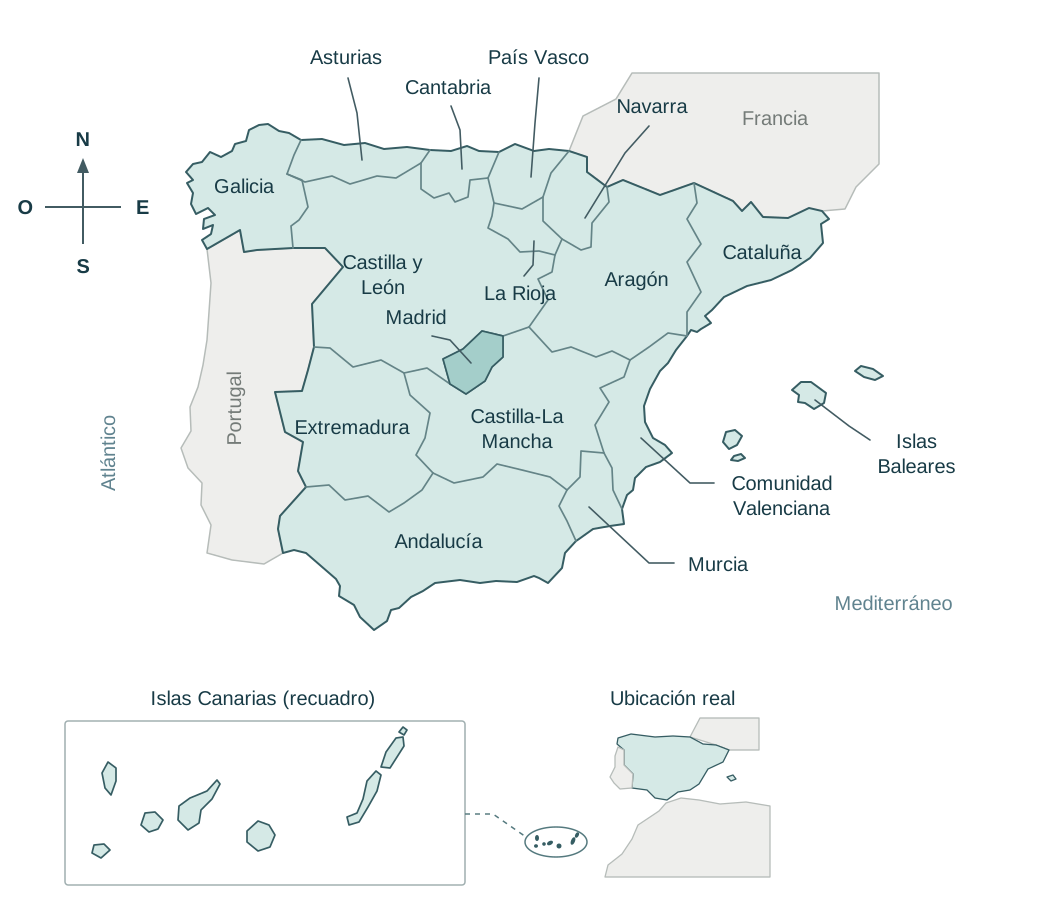
Named Regions You Must Recognise
- Galicia: north-west corner; renowned for persistent rain, drizzle, and fog.
- Asturias, Cantabria, el País Vasco: the northern Atlantic coast (Cantabrian strip).
- Navarra, La Rioja, Aragón: north-eastern inland regions.
- Cataluña: north-east Mediterranean coast.
- La Comunidad Valenciana and Murcia: eastern and south-eastern coast (frequently referred to together as el Levante).
- Andalucía: the entire south of Spain.
- Extremadura: western inland area bordering Portugal.
- Castilla y León and Castilla-La Mancha: the vast central plateau; Madrid sits right in the centre.
- Las Islas Baleares: Mallorca, Menorca, Ibiza, and Formentera.
- Las Islas Canarias: Tenerife, Gran Canaria, Lanzarote, Fuerteventura, etc.
Broad Groupings and Physical Landscapes
- la Península: mainland Spain (excluding the Balearic and Canary islands)
- la mitad norte / la mitad sur: the northern half / southern half
- el tercio norte: the northern third of the country
- el litoral / la costa: the coast; el interior: inland areas
- la cordillera cantábrica: the Cantabrian mountain range
- los Pirineos / zona pirenaica: the Pyrenees along the French border
- el valle del Ebro: Ebro River valley (north-east inland)
- el valle del Guadalquivir: Guadalquivir valley (Andalucía)
Compass Points and Wind Origins
- Compass points: el norte (north / septentrional), el sur (south / meridional), el este (east / oriental), el oeste (west / occidental), el nordeste / noreste (north-east), el noroeste (north-west), el sureste (south-east), el suroeste (south-west).
- Notice the preposition de: viento del norte is a northerly wind blowing from the north, not towards the north.
- El levante is an easterly wind off the Mediterranean; el poniente is a westerly wind coming off the Atlantic.
Temperatures, Alerts, and Auditory Traps
Questions frequently test temperature thresholds, comparisons with seasonal norms, and official meteorological warnings.
Máximas vs Mínimas and Norm Comparatives
- máximas: highest daytime temperatures; mínimas: lowest night-time temperatures. These sound similar at natural speed; listen for the distinct first vowel sound (má- vs mí-).
- por encima de la media / de lo normal: above average / above normal
- por debajo de la media / de lo normal: below average
- más seco de lo normal: drier than normal
- más cálido / caluroso de lo habitual: warmer than usual
- sin grandes cambios: with no major change
- subirán hasta los 20 grados: will rise to 20 degrees (target figure)
- subirán 2 grados: will rise by 2 degrees (margin of increase)
- bajo cero: sub-zero / below zero (cuatro grados bajo cero = -4 °C)
Auditory Traps (Words and Numbers)
At normal speaking pace, several common words and numbers sound alike. Train your ear for these pairs:
- viento (wind) vs veinte (twenty)
- nieve (snow) vs niebla (fog)
- sur (south) vs sol (sun)
- doce (12) vs dos (2)
- trece (13) vs treinta (30)
- catorce (14) vs cuarenta (40)
- quince (15) vs cincuenta (50)
- dieciséis (16) vs sesenta (60)
- cien (100) vs ciento diez (110)
Alerts and Official Warnings
- aviso amarillo / naranja / rojo: yellow, orange, or red weather alert.
- cota de nieve: the snowline altitude (e.g. la cota de nieve se situará en 1.000 metros = snow level will be at 1,000 metres).
- Marine conditions: fuerte marejada (rough sea), mar rizada (calm / rippled sea).
Mini Listening Drill: How Marks Split
- Snippet 1: 'En Galicia habrá mucha niebla y algo de viento.'
Answer: A lot of fog (1) and a little wind (1) in Galicia.
- Snippet 2: 'Aviso amarillo por lluvias intensas y tormentas en Andalucía y Murcia.'
Answer: Yellow alert (1) for heavy rain (1) and storms (1) in Andalucía and Murcia.
- Snippet 3: 'En Canarias las temperaturas subirán hasta una máxima de 26 y una mínima de 14 grados.'
Answer: Temperatures will rise to a maximum of 26 (1) and a minimum of 14 degrees (1) in the Canaries.
Core Weather Grammar: Hacer, Haber, Estar, and Defective Verbs
While listening questions require English answers, your oral exam and written production demand active control of Spanish weather structures. Spanish uses three different verbs to describe the weather, and each takes a different kind of word after it: hacer and haber are used impersonally (third person only, with no subject), and estar is followed by an adjective.
1. Impersonal Hacer + Weather Noun
Use hacer for atmospheric conditions perceived by touch or sight:
- Hace sol (It is sunny), hace viento (It is windy), hace frío (It is cold), hace calor (It is hot), hace fresco (It is cool / fresh), hace buen / mal tiempo (The weather is good / bad).
- The mucho / muy rule: because frío, calor, and viento are nouns, modify them with the adjective mucho, never the adverb muy. Say Hace mucho frío (It is very cold), never hace muy frío.
2. Impersonal Haber + Phenomenon Noun
Use third-person forms of haber (hay, habrá, hubo, ha habido) for observable phenomena or occurrences:
- Hay niebla (There is fog), habrá tormentas (There will be storms), hubo granizo (There was hail), hay heladas (There is frost / there are freezes).
3. Estar + Adjective or Participle
Use estar to describe the physical state of the sky or ambient conditions:
- El cielo está despejado (The sky is clear), está nublado (It is cloudy), está cubierto (It is overcast).
- When qualifying adjectives after estar, use muy: Está muy nublado (It is very cloudy).
4. Radical-Changing Weather Verbs
Weather verbs are defective, used only in the third person singular. They undergo vowel stem changes in the present indicative and present subjunctive:
- Llover (o -> ue): Llueve (It rains / it is raining). Present subjunctive: llueva.
- Nevar (e -> ie): Nieva (It snows / it is snowing). Present subjunctive: nieve.
- Tronar (o -> ue): Truena (It thunders / it is thundering). Present subjunctive: truene.
The stem change appears in the present indicative (llueve, nieva, truena) and in the present subjunctive (llueva, nieve, truene), which you need after puede que and cuando: Puede que llueva mañana (It may rain tomorrow). It does not appear in the future, conditional, preterite, or imperfect, which all build on the regular infinitive: lloverá, llovería, llovió, llovía.
Tenses in Use, Climate Descriptions, and Environmental Vocabulary
Weather Verbs in the Tenses You Actually Need
Exams reference past trends as well as upcoming forecasts. Here are the core forms illustrated in working sentences:
- Present: hace (Hoy hace sol en Valencia), hay (Hay niebla matinal), llueve (Llueve sin parar), nieva (Nieva en la sierra).
- Future: hará (Mañana hará sol), habrá (Habrá tormentas aisladas), lloverá (Lloverá en el norte), nevará (Nevará en cotas altas).
- Going to (ir a + inf.): va a hacer (Va a hacer calor), va a haber (Va a haber chubascos), va a llover (Va a llover pronto), va a nevar (Va a nevar mañana).
- Present Perfect: ha hecho (Ha hecho mucho viento esta semana), ha habido (Ha habido inundaciones), ha llovido (Ha llovido toda la noche), ha nevado (Ha nevado bastante).
- Preterite: hizo (Ayer hizo un frío espantoso), hubo (Hubo granizo en el interior), llovió (Llovió durante el partido), nevó (Nevó el fin de semana pasado).
- Imperfect: hacía (Hacía sol cuando salimos), había (Había mucha niebla en la pista), llovía (Llovía a cántaros), nevaba (Nevaba con fuerza).
Use soler (o -> ue) + infinitive for habitual regional weather: En Galicia suele llover a menudo (In Galicia it usually rains often).
El Tiempo vs El Clima
Do not mix these words up. El tiempo refers to the weather right now or in a forecast; el clima refers to the long-term climate of an area:
- ¿Qué tiempo hace hoy? (What is the weather like today?)
- ¿Cómo es el clima en Irlanda? (What is the climate like in Ireland?)
- The seasons take en: en primavera, en verano, en otoño, en invierno.
- Useful climate adjectives: templado (temperate), suave (mild), húmedo (damp / humid), seco (dry), cambiante (changeable), caluroso (hot), soleado (sunny).
Model comparative sentences for the oral or written exam:
- En Irlanda el clima es templado pero muy cambiante; llueve a menudo y no suele hacer mucho calor en verano. (In Ireland the climate is temperate but very changeable; it rains often and it is not usually very hot in summer.)
- En el sur de España los veranos son secos y muy calurosos, mientras que en el norte el clima es mucho más húmedo. (In the south of Spain summers are dry and very hot, whereas in the north the climate is much wetter.)
Weather and the Environment
Environmental issues often link directly to weather conditions in reading comprehensions and opinion essays:
- el cambio climático (climate change), el calentamiento global (global warming), la sequía (drought), las inundaciones (floods), los incendios forestales (forest fires).
- Reusable opinion sentence: Debido al cambio climático, las olas de calor y las sequías son cada vez más frecuentes e intensas en España. (Due to climate change, heatwaves and droughts are increasingly frequent and intense in Spain.)
Indirect Reporting, Travel Disruptions, and Written Formats
Syllabus Theme 1.3 requires passing on forecasts to others and determining whether outdoor pursuits (driving, sailing, skiing, hiking, flying) are feasible.
Indirect Reporting Patterns
Introduce the information using a past reporting formula followed by que:
- han dicho que / han anunciado que: Han dicho que lloverá el sábado. (They have said it will rain on Saturday.)
- Han anunciado que las temperaturas mínimas bajarán por la noche. (They have announced that minimum temperatures will drop at night.)
- Según los meteorólogos, las condiciones empeorarán. (According to meteorologists, conditions will worsen.)
Feasibility of Activities and Travel
State both positive opportunities and cancellations clearly:
- Positive: Si hace buen tiempo, podemos ir a la playa. (If the weather is good, we can go to the beach.)
- Positive: Las condiciones son ideales para navegar. (Conditions are ideal for sailing.)
- Positive: Han dicho que se podrá esquiar todo el fin de semana. (They said skiing will be possible all weekend.)
- Negative / Disruption: El vuelo se retrasó por la densa niebla. (The flight was delayed due to dense fog.)
- Negative / Disruption: Cancelaron la salida en barco por el fuerte temporal. (They cancelled the boat trip because of the severe storm.)
- Negative / Disruption: Las carreteras están cortadas por la nieve y son obligatorias las cadenas. (The roads are blocked by snow and snow chains are compulsory.)
Written Layout Conventions
When writing about weather in Section C of the written paper, always observe standard layout:
- Diary entry: Place the date at the top (viernes, 12 de junio), open with Querido diario:, write in the personal first person, and close with a natural sign-off (Ya es muy tarde y tengo sueño. ¡Hasta mañana!).
- Formal letter / email to an editor: Open with Estimado señor director: or Estimada señora directora:, begin with Le escribo en relación con el artículo sobre..., and sign off with Le saluda atentamente, followed by your name.
Key terms
- el tiempo vs el clima
- 'El tiempo' is the day-to-day weather or current atmospheric state; 'el clima' is the long-term regional climate pattern.
- el chubasco
- A sudden, brief rain shower (heavier than steady light rain, la lluvia débil, but reserve 'heavy showers' for chubascos fuertes / lluvias intensas).
- despejado
- Clear; used to describe skies without cloud cover ('cielos despejados').
- intervalos nubosos
- Cloudy intervals or sunny spells where clouds and clear patches alternate.
- cubierto
- Overcast; completely covered in cloud.
- la niebla
- Fog. Easily misheard in listening exams as 'la nieve' (snow).
- la cota de nieve
- The snow level or altitude down to which precipitation falls as snow.
- la racha de viento
- A gust of wind (e.g. 'rachas de viento de hasta 80 km/h').
- el levante / el poniente
- Easterly wind originating from the Mediterranean / westerly wind originating from the Atlantic.
- la ola de calor
- A heatwave (an extended period of excessively high temperatures; opposite of 'ola de frío', a cold snap).
- bajo cero
- Below zero; sub-zero temperatures (e.g. 'tres grados bajo cero' = -3 °C).
- máximas / mínimas
- Maximum daytime temperatures and minimum night-time temperatures.
- aviso amarillo / naranja / rojo
- Official meteorological warning levels: yellow alert (minor risk), orange alert (significant risk), red alert (extreme risk).
- mucho / muy
- Grammatical modifier distinction: use 'mucho' before weather nouns ('hace mucho frío') and 'muy' before adjectives ('está muy nublado').
- han dicho que / han anunciado que
- Reporting verbs in the present perfect used to relay spoken forecast details to a third party.
Check yourself
A forecast says: 'En el litoral cantábrico y en Galicia, chubascos; en Andalucía, cielos despejados con máximas de 30 grados.' Which parts of Spain get rain and which get sun?
The north/north-west coast (Cantabrian coast and Galicia) gets showers; the south (Andalucía) gets sunny/clear skies with highs of 30 degrees.
What is the grammatical difference between 'hace frío' and 'está frío'?
'Hace frío' describes ambient atmospheric weather ('it is cold outside'), whereas 'está frío' describes a specific item or surface that is cold to the touch ('el café está frío').
Translate into English with full accuracy: 'Cielos cubiertos con posibilidad de chubascos y granizo por la tarde'.
Overcast skies with a possibility/chance of showers and hail in the afternoon.
Conjugate 'llover' in the present indicative and present subjunctive, explaining the stem change.
Present indicative: 'llueve'. Present subjunctive: 'llueva'. Both undergo an o -> ue radical stem change in the present tense.
If a broadcast mentions 'vientos de poniente de 20 km/h en el litoral', what does this mean in English?
Westerly winds (winds blowing from the west / Atlantic) of 20 km/h on the coast.
Translate into English: 'Las temperaturas mínimas estarán por encima de lo normal, en torno a los cinco grados'.
Minimum temperatures will be above normal / above average, around five degrees.
How do you say in Spanish: 'They have announced that it will snow in the mountains tomorrow'?
'Han anunciado que mañana nevará en la montaña' (or '...va a nevar en la montaña / en la sierra').