Describing Circular Motion: Angular Velocity and Linear Speed
To analyse circular paths, we measure rotation using angles in radians rather than degrees. One radian is the angle subtended at the centre of a circle by an arc whose length is equal to the radius of the circle (). A complete revolution of corresponds to radians.
Angular velocity (symbol , unit ) is the rate of change of angle with respect to time:
For one complete revolution, the angle turned is radians in an orbital period (measured in seconds). Therefore, angular velocity can be written as:
where is the rotational frequency in revolutions per second ( or ).
Linear speed () is the actual tangential speed at which the body travels along the circumference. We connect linear speed and angular velocity in three formal steps:
- The arc length travelled is .
- Dividing both sides by time gives .
- Since linear speed is and angular velocity is , we obtain:
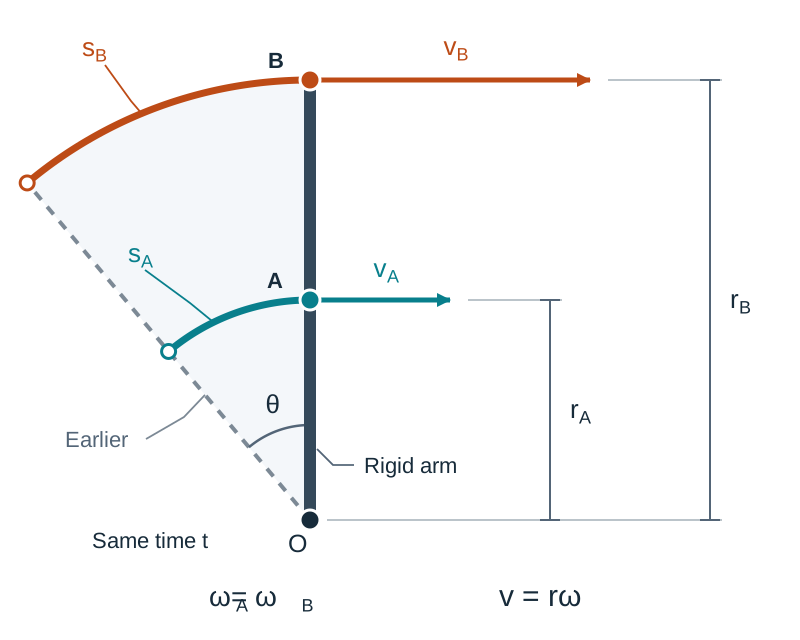
For two points on a rigid rotating arm, both share the exact same angular velocity , but the point positioned farther from the pivot (larger radius ) travels at a greater linear speed because it sweeps out a larger circumference in the same time.
Centripetal Acceleration and Centripetal Force
Because velocity changes direction continuously towards the centre of rotation, an inward centripetal acceleration is produced, directed along the radius towards the centre of the circular path. Its magnitude is given by:
By Newton's second law (), any acceleration requires an unbalanced resultant force acting in the direction of the acceleration. Centripetal force is not a distinct, independent physical force; it is simply the net inward force required to maintain circular motion, directed towards the centre of the circle:
A quick check of units confirms this relationship: mass in , radius in , and angular velocity in gives . Radians are dimensionless ratios of two lengths (arc length divided by radius), so they drop out of unit calculations.
Centripetal force is always provided by real physical interactions:
- A car rounding a horizontal bend: Friction between the tyres and the road surface provides the inward force (). If the road is icy, there is not enough friction to supply , so the car does not follow the bend: it slides off in a straight line along the tangent, not directly outwards.
- An aircraft making a banked turn: The lift force acts perpendicular to the wings. The horizontal component of this lift force acts towards the centre of the curved turn, supplying the centripetal force.
- A stone whirled on a string: Tension in the string pulls the stone inward.
- A charged particle in a magnetic field: A charged particle moving at right angles to a magnetic field follows a circle because the magnetic Lorentz force supplies the centripetal force ().
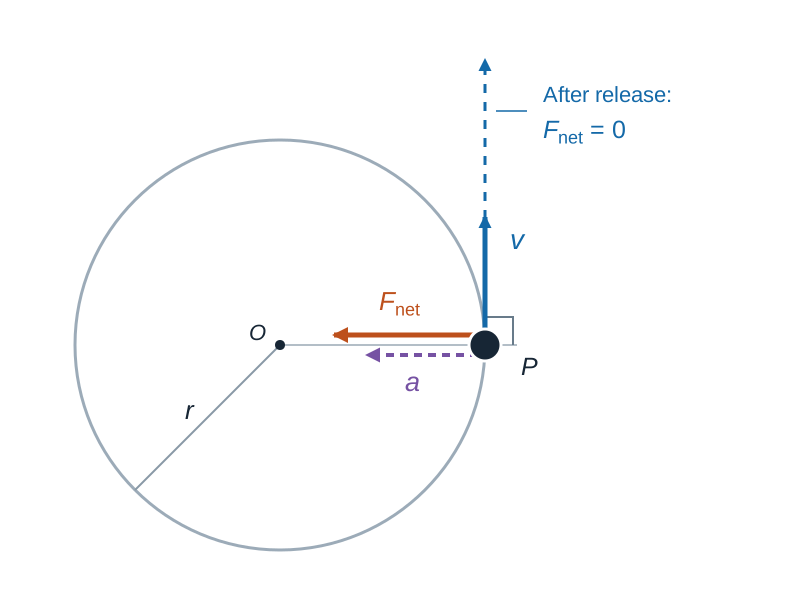
If the centripetal force suddenly ceases, such as when a string snaps, Newton's first law takes over: the object continues moving in a straight line along the tangent to the circle at the point of release.
Motion in a Vertical Circle
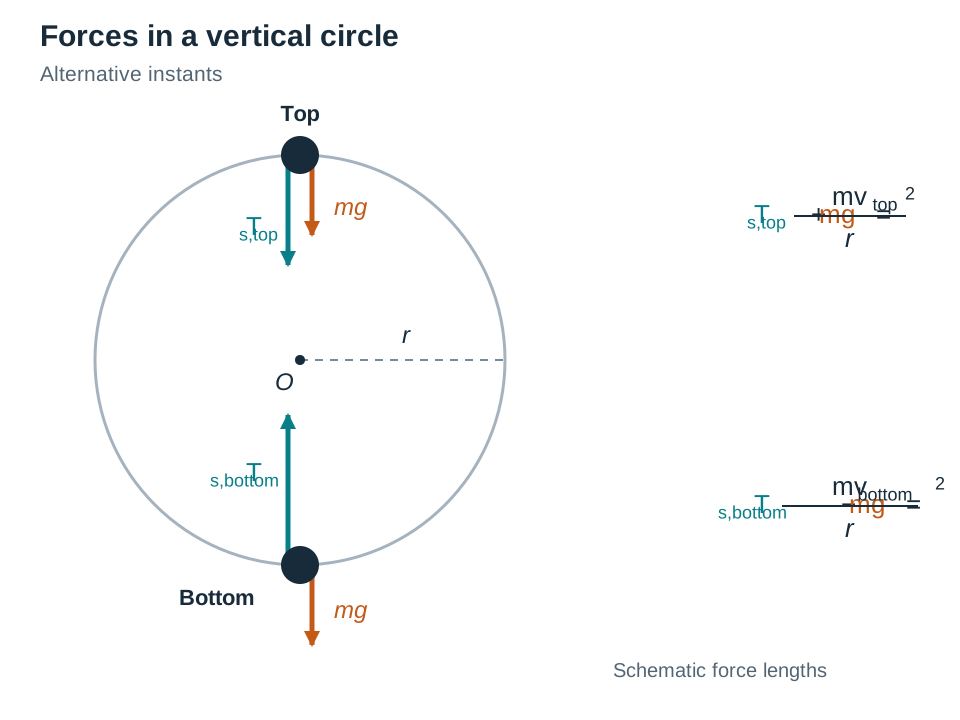
When an object of mass is whirled in a vertical circle of radius , gravity acts vertically downwards throughout the motion. To avoid confusing tension with the orbital period , let us denote the tension in the string as :
- At the top: Both the string tension and weight act vertically downwards towards the centre: , giving:
- At the bottom: Tension pulls upwards towards the centre while weight pulls downwards away from the centre: , giving:
Because gravity opposes tension at the bottom and assists it at the top, tension is greatest at the bottom of the circle. This is why a string or cable is most likely to snap at the very lowest point of the swing.