Hooke's Law and Elastic Potential Energy
Hooke's law states that the restoring force in an elastic material is directly proportional to displacement, provided the elastic limit is not exceeded:
Here, is the restoring force in newtons (N), is the spring constant in newtons per metre (), and is the change in length from the spring's natural (unloaded) length, in metres (m). It is an extension if the spring is stretched and a compression if it is squashed.
The minus sign indicates that the restoring force acts in the opposite direction to the displacement, always pulling or pushing the object back towards its natural equilibrium position. The magnitude of the external force applied to stretch or compress the spring by is .
The elastic limit is the point beyond which a material becomes permanently deformed; if stretched past this limit, it will not return to its original natural length when the force is removed.
Elastic Potential Energy ()
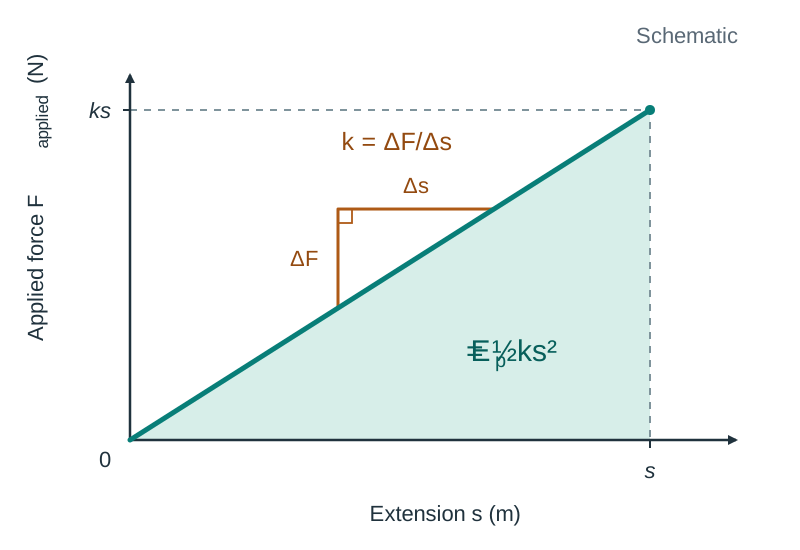
The applied force needed to stretch or compress a spring is not constant. It starts at zero and rises linearly to . The average force applied during deformation is .
The work done in stretching the spring () is stored as elastic potential energy:
On a force–extension graph ( on the -axis, on the -axis):
- The slope of the straight-line section equals the spring constant .
- The area under the straight line up to extension equals the work done, which is the stored elastic potential energy .